


Avoiding Business Insurance Claim Denial in Florida: A Strategic Guide for 2026
- siinsuranceflorida
- 5 days ago
- 14 min read
Imagine waking up to find your storefront flooded or your equipment ruined, only to have your insurance carrier tell you that you aren't covered. It's a gut-punch that no business owner should have to face, especially when you've been paying premiums for years. We've seen the frustration and the fear that comes with an unpaid claim, but we want you to know that you're not powerless. The real secret to avoiding business insurance claim denial Florida starts long before a storm hits your radar. It's about being prepared with the right records and a policy that actually says what you think it says.
We promise to show you exactly how to build a defense that stands up to even the toughest scrutiny. In this guide, we'll walk through the specific documentation protocols you need and explain the Florida laws that are actually on your side. You'll learn how to spot hidden traps in your policy and how to communicate with adjusters so they know you mean business. By the end of this article, you'll have a clear plan to turn your insurance from a source of anxiety into a reliable shield for your company's future. Let's get your business on the path to total security.
Key Takeaways
Discover how to navigate the current Florida commercial landscape by identifying the common technicalities that lead to modern claim rejections.
Learn to distinguish between "Named Perils" and "Open Perils" coverage to eliminate the "silent exclusions" that often surface after major storm events.
Implement a "Pre-Loss Baseline" and a secure "Digital Vault" to create an irrefutable evidence trail that protects your assets before a disaster strikes.
Master the proactive communication strategies essential for avoiding business insurance claim denial Florida, including how to submit legally sound "Proof of Loss" statements.
Understand the methodology of continuous policy auditing and how a strategic agency partner acts as your primary line of defense against future denials.
Table of Contents
Understanding the Landscape of Florida Business Insurance Denials
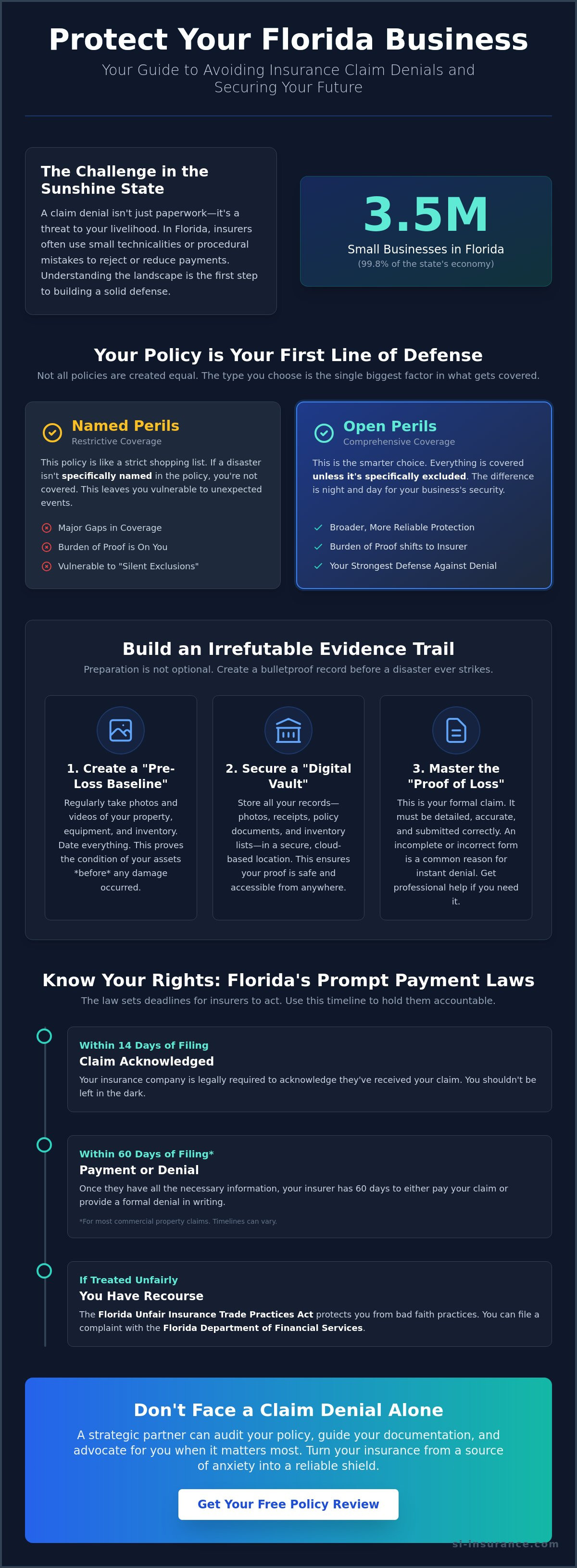
Florida is a wonderful place to build a dream, but running a business here means dealing with some pretty unique risks. With 3.5 million small businesses making up nearly 99.8% of our state's economy, there is a lot on the line every single day. When you file an insurance claim, it's more than just a business transaction; it's about getting your life and your livelihood back to normal as quickly as possible. A claim denial is basically a formal way for an insurance carrier to say they won't pay for a loss because of a specific rule in your policy or a mistake they believe was made during the process.
It's helpful to remember that a denial isn't always a flat "no" to the entire claim. Sometimes you'll run into a partial denial, where the company agrees to pay for some repairs but leaves you on the hook for the most expensive parts. This is why focusing on avoiding business insurance claim denial Florida is so important for your peace of mind. Carriers in our state are known for being incredibly thorough, often looking for small technicalities or paperwork errors to limit what they have to pay out. You don't want to be caught off guard by a "technicality" when you're already trying to manage a crisis.
To get a better feel for how these situations play out and how you can protect yourself, take a look at this helpful video:
Many rejections in the Florida market happen because of simple procedural mistakes, not because your damage isn't real. If an insurance company treats you unfairly or skips a real investigation into what happened, they might be crossing a legal line. Understanding Insurance Bad Faith is a great way to learn about your rights and when a company is failing to meet its obligations. Thankfully, Florida law is on your side in some ways, like requiring companies to acknowledge your claim within 14 days so you aren't left waiting in the dark for weeks.
Common Triggers for Denials in the Sunshine State
One of the biggest reasons claims get rejected is a simple lack of honesty or detail on the original application. If your business changes—maybe you start offering a new service or move to a bigger warehouse—and you don't tell your insurer, they might argue that your policy doesn't cover those new risks. We also see a lot of issues with the "grace period" myth. In Florida's fast-moving market, a single missed premium payment can lead to a lapse that leaves you totally unprotected right when a storm hits. Staying on top of these details is the best way to keep your safety net intact.
The Impact of Florida Statutes on Your Rights
You have more protection than you might realize thanks to the Florida Unfair Insurance Trade Practices Act, which sets the ground rules for how insurers have to treat you. There are also "Prompt Payment" laws that are a huge help; for most commercial buildings, companies have just 60 days to pay or deny a claim once they have all the info. If things get complicated, the Florida Department of Financial Services is there to act as a watchdog. If you're looking for a partner who can help you stay ahead of these rules, SI Insurance can help you align your coverage with these strict requirements so you can focus on growing your business.
Strategic Policy Engineering: Aligning Coverage with Florida Risks
Setting up your insurance defense starts way before the first clouds gather on the horizon. It’s easy to think that just having a policy means you're safe, but the actual words in that contract determine whether you get a check or a headache when you file a claim. One of the biggest secrets to avoiding business insurance claim denial Florida is choosing an "Open Perils" policy over a "Named Perils" one. Think of it this way: a Named Perils policy is like a shopping list. If a disaster isn't on the list, it isn't covered. With Open Perils, the situation is reversed. Everything is covered unless the company specifically says it’s not. It’s a much more secure way to sleep at night.
You also need to look closely at how your stuff is valued. Choosing "Actual Cash Value" might save you a little on premiums, but it only pays what your equipment is worth today, after years of wear and tear. If a $10,000 piece of machinery is destroyed, but it's five years old, you might only get a fraction of that back. "Replacement Cost" coverage is what you really want because it actually pays to get you back up and running with new equipment. If you're curious about how this all fits together, A Step-by-Step Guide to Insurance Claims is a great resource to help you visualize the process. If you aren't sure which valuation you have, it's a good idea to check your Business Owners Policy (BOP) before you actually need to use it.
Matching your coverage to your actual daily operations is just as critical. If your policy says you're a quiet retail shop but you've started doing light manufacturing or shipping in the back, that shift in your business can be an easy excuse for a denial. We call this "silent exclusions" because they don't seem like a big deal until a hurricane hits and the adjuster starts asking questions. Taking the time to align your paperwork with your real-world work is a simple step that saves a lot of pain later.
Navigating Florida-Specific Exclusions
Florida has some unique traps, and "wind-driven rain" is a big one. If rain gets pushed under your door or through a window seal without a hole being punched in your roof, some insurers will try to deny the claim. It’s a frustrating distinction, but knowing it now helps you prepare. You should also look for Ordinance or Law coverage. Since Florida updates building codes so often, you might be forced to make expensive upgrades during a repair that your basic policy won't cover. This is especially true for older buildings in places like Broward County where codes have changed significantly in recent years.
Endorsements that Strengthen Your Position
Sometimes you need a little extra help to close the gaps that a standard policy leaves open. Utility Services Time Element coverage is a lifesaver when the power goes out off-site and shuts your business down for days. We also suggest looking at Equipment Breakdown coverage. It covers things like your AC unit or specialized machines when they just give out, which a standard wind or fire policy usually ignores. And don't forget Cyber Liability. In today's world, a digital hack can be just as damaging to your business as a physical storm, and it's a risk that's often overlooked by South Florida entrepreneurs.
The Documentation Protocol: Creating an Irrefutable Evidence Trail
While the previous sections detailed the legal and structural components of a policy, the actual outcome of a claim often hinges on the quality of your evidence. Most rejections aren't based on a lack of coverage but on a lack of proof. This is why establishing a "Pre-Loss Baseline" is the single most important administrative task you can perform. It serves as the definitive record of your business assets in their undamaged state. For those focused on avoiding business insurance claim denial Florida, this baseline serves as the benchmark against which all future damage is measured, effectively neutralizing carrier arguments regarding pre-existing wear and tear.
To ensure this evidence survives a catastrophe, we advocate for the "Digital Vault" concept. This involves maintaining a cloud-based, off-site repository for all critical records, including tax returns, utility bills, and high-resolution video walkthroughs. This vault should also house third-party valuations and independent appraisals for specialized equipment. These professional assessments prevent "undervaluation" denials, where a carrier attempts to settle for a fraction of the asset's true worth. By partnering with SI Insurance, you can implement a systematic documentation strategy that turns your internal records into a formidable legal asset during the adjustment process.
The Pre-Loss Checklist
Your documentation shouldn't be a one-time event but a recurring operational protocol. We recommend an annual video walkthrough of your entire facility, ensuring you capture serial numbers and the interior of storage units. You should also maintain a centralized "Contract Registry" for all vendors and service providers. Don't overlook maintenance records; documented proof of recent HVAC servicing or roof inspections can be the difference between a paid claim and a denial based on "negligent upkeep."
Immediate Post-Loss Action Items
The first 24 hours after a loss are critical for your success. While Florida law allows a one-year window for property claims, immediate notification is essential to trigger the carrier's 14-day acknowledgment deadline. Policyholders maintain a contractual duty to mitigate further damage, such as placing tarps or boarding windows, but you must do so carefully. Never discard damaged items or repair structural breaches until the adjuster has performed an inspection. Finally, start a "Communication Log" to track every interaction with the carrier, creating a chronological narrative that is invaluable for avoiding business insurance claim denial Florida if the process becomes adversarial.
Navigating the Claims Process: Proactive Communication and Advocacy
Once you've initialized a claim, you'll be assigned a carrier adjuster who serves as the gatekeeper for your settlement. It's vital to recognize that while these individuals are often professional, their primary loyalty remains with the insurance company's bottom line. Maintaining a composed, transparent, and strictly documented relationship with them is a cornerstone of avoiding business insurance claim denial Florida. You should treat every site visit and phone call as a formal part of the evidence record, ensuring that your verbal statements are as precise as the data in your digital vault.
A central component of this phase is the "Proof of Loss" statement. This isn't a mere damage summary; it's a sworn legal document outlining your specific financial demand. Precision is non-negotiable. Any discrepancy between your initial report and this formal filing can be used by a carrier to suggest misrepresentation, which often leads to a full rejection. If you find the technicalities of these filings overwhelming, you should contact SI Insurance to ensure your advocacy is handled by experts who understand the nuances of the Florida commercial landscape and can help you present a cohesive, airtight case.
Red Flags of Bad Faith in Florida
Recognizing bad faith early can prevent a claim from stalling indefinitely. If your adjuster stops responding for weeks or ignores the statutory acknowledgment deadlines discussed earlier, take notice. Other warning signs include the carrier demanding "burdensome" or repetitive documentation you've already provided, or misrepresenting policy language to discourage you from pursuing the claim. Sometimes, an insurer might offer a settlement that's significantly lower than the undisputed damage amount without a clear, logical explanation. These tactics are often used to pressure business owners into accepting less than they're owed.
The Formal Appeal Process
If you receive a denial, your first step is to request a comprehensive, written "Explanation of Benefits" (EOB). This document must cite the specific policy language used to justify the rejection. If the reasoning feels flawed, you can file a formal complaint with the Florida Department of Financial Services (DFS). They act as a regulatory mediator, though they can't force a payment. When a dispute turns into a complex legal battle over contract interpretation, that's when you transition from agency advocacy to specialized legal representation. While public adjusters are an option, they typically charge a percentage of your final payout; a proactive agent helps you avoid that extra cost by getting the claim engineered correctly from the start.
The Role of a Strategic Partner in Claim Advocacy
A common misconception among executives is that their relationship with an insurance provider ends once the premium is paid. In reality, that is exactly where the strategic partnership begins. Most legal-focused guides will tell you how to sue after a rejection, but the more sophisticated approach involves proactive engineering to prevent the dispute entirely. An independent agency like Si Insurance Agency acts as your first line of defense because we aren't beholden to a single carrier's internal quotas. We serve as a bridge between Florida business owners and massive national carriers, using our local expertise in Broward County and throughout the state to translate regional risks into airtight policy language. This positioning is essential for avoiding business insurance claim denial Florida, as it ensures your interests are represented by professionals who understand the carrier's internal adjudication logic.
Our methodology is built on the principle of continuous policy auditing. We don't simply renew your coverage; we dissect it. As your business evolves, your risk profile changes, often in ways that standard policies aren't designed to handle. By maintaining a steady, deliberate rhythm of analysis, we identify potential "silent exclusions" before they become financial liabilities. This meticulous attention to detail is what separates a generic policy from a carefully engineered financial shield. When a loss does occur, our established relationships with carriers allow us to advocate for fair, timely settlements, often resolving issues before they escalate into formal denials.
Personalized Risk Management Strategies
Every industry faces a unique set of vulnerabilities that a "one size fits all" approach will inevitably miss. We focus on tailoring Business Insurance to your specific operational realities, whether you're managing a complex logistics chain or a high-value real estate portfolio. Proactive annual reviews allow us to capture business growth and shifts in service scope that might otherwise trigger a denial. This isn't just about purchasing a product. It's about aligning your organizational goals with a technical mitigation strategy that provides absolute security and long-term resilience.
Securing Your Business Future
The transition from "commoditized insurance" to "strategic protection" is a hallmark of elite business management. If you view your policy as a mere line item on a balance sheet, you're leaving your company's future to chance. Avoiding business insurance claim denial Florida requires a partner who acts as a protective guardian for your assets, ensuring that every protocol we've discussed, from documentation to policy engineering, is executed with precision. You can take the first step toward this level of security by requesting a comprehensive policy audit today. Contact us to experience a sophisticated, analytical approach to Florida business insurance that prioritizes your stability and provides intellectual confidence in every claim scenario.
Securing Your Organizational Resilience for the Years Ahead
We've explored how a "bulletproof" documentation system and precise policy engineering serve as your strongest defense against technical rejections. Success in the Florida market requires more than just coverage; it demands a proactive methodology that anticipates the carrier's logic before a loss ever occurs. Mastering the nuances of avoiding business insurance claim denial Florida ensures that your company remains stable even when facing the state's most complex risks. It's about shifting from a passive stance to one of calculated foresight and professional vigilance.
Since our founding in 2022, Si Insurance Agency has focused on delivering elite risk management specifically for South Florida entrepreneurs. As an independent agency with deep Broward County expertise, we represent multiple high-rated carriers to find the exact configuration your high-value business needs. You don't have to navigate these intricate financial landscapes alone. Request a Strategic Policy Audit from Si Insurance Agency today to verify that your current protection is as airtight as it needs to be. Your long-term security is well within reach when you approach your risk with foresight and technical mastery.
Frequently Asked Questions
What are the most common reasons business insurance claims are denied in Florida?
Denials often stem from a failure to disclose material facts during the application process, unapproved business operations, or lapses in premium payments. In the context of avoiding business insurance claim denial Florida, many carriers also cite a failure to mitigate damage or a breach of the "prompt notice" requirement as primary justifications for rejection. These technicalities allow insurers to argue that the policyholder didn't fulfill their contractual duties after a loss occurred.
How long does an insurance company have to deny or pay a claim in Florida?
Under current Florida statutes, insurers must acknowledge your claim within 14 days and generally have 60 days to pay or deny it once they've received notice. For commercial structures under 10,000 square feet, this 60-day window is a firm regulatory deadline designed to prevent businesses from languishing in financial uncertainty. Once a claim is approved, the insurer is typically required to issue payment within 20 days.
Can I still get paid if I didn't have a perfectly updated inventory list?
Yes, you can still secure payment through forensic accounting and secondary evidence like tax records, purchase receipts, or bank statements. While maintaining a "Digital Vault" is the gold standard for avoiding business insurance claim denial Florida, professional adjusters can reconstruct losses using historical data and industry-standard valuation models. The key is providing enough consistent documentation to make your financial demand irrefutable and legally sound.
What is the difference between a claim denial and a reservation of rights letter?
A claim denial is a formal and final refusal of coverage for a specific loss, whereas a reservation of rights letter indicates the insurer is investigating while reserving their right to deny the claim later. Receiving a reservation of rights isn't an immediate rejection, but it's a procedural warning that the carrier has identified potential coverage issues. This is the moment to engage a strategic partner to ensure your defense is airtight.
Does Florida law require insurance companies to provide a reason for denial in writing?
Florida law requires insurers to provide a specific, written explanation for any claim denial or partial rejection citing the relevant policy language. This transparency is mandated by the Florida Unfair Insurance Trade Practices Act, ensuring you have the necessary details to challenge the decision. If a carrier fails to provide this written justification, they may be in violation of state regulatory standards overseen by the Department of Financial Services.
Should I hire a lawyer immediately if my business insurance claim is denied?
You shouldn't necessarily hire a lawyer immediately, as a strategic agency partner can often resolve disputes through advocacy and meticulous policy auditing. Litigation is a time-consuming and expensive process that should be your final option. Most coverage disputes are better handled by experts who can navigate the carrier's internal adjudication logic and present a corrected evidence trail without the need for a courtroom battle.
How does "Bad Faith" law work for Florida business owners?
Florida's bad faith laws allow business owners to hold insurers accountable for failing to settle claims fairly or conducting inadequate investigations. You generally have a five-year statute of limitations to file a bad-faith lawsuit, providing a legal recourse when a carrier prioritizes its bottom line over its clear contractual duties. This remains a vital protection for entrepreneurs who have been treated unfairly by their insurance providers during the claims process.
Can an insurance company deny a claim for an "Act of God" in Florida?
An insurance company cannot deny a claim simply because an event is an "Act of God" if that specific peril is covered under your policy. Hurricanes and lightning strikes are classic examples of such events that commercial policies are designed to handle. However, they can still deny claims if the damage falls under a specific exclusion, such as rising water or wind-driven rain, which is why precise policy engineering is essential.
Comments