


Boat Insurance for Saltwater Fishing in Florida: A Strategic Guide for 2026
- siinsuranceflorida
- May 21
- 13 min read
Updated: May 28
If you assume your standard marine policy accounts for the relentless corrosive power of the Atlantic or the precise replacement value of your custom tournament tackle, you might be navigating toward a significant financial blind spot. You likely understand that Florida’s coastal waters are as unforgiving as they are rewarding. It's a sentiment shared by every serious angler who has watched a sudden summer squall or the creeping reality of saltwater oxidation threaten their investment. This guide provides the technical clarity you need to secure boat insurance for saltwater fishing Florida that actually addresses these high-stakes variables. We'll help you move beyond basic liability to a sophisticated strategy that protects your specialized electronics and offshore ambitions.
You'll discover how to manage navigational boundaries for those extended trips and ensure your vessel is fully prepared for the unique atmospheric hazards of the 2026 season. By refining your approach to risk management, you can focus on the pursuit of the catch while maintaining absolute confidence in your vessel's security. This measured, step by step progression ensures that your coverage is as meticulously engineered as the boat you command.
Key Takeaways
Learn why the aggressive nature of saltwater requires a specialized risk strategy that standard freshwater policies simply can't provide.
Secure your investment by understanding the critical role of personal effects coverage for your high-end rods, reels, and advanced marine electronics.
Master the technical aspects of navigational limits and agreed value to ensure your offshore pursuits aren't restricted by unforeseen policy boundaries.
Use a strategic checklist to audit your boat insurance for saltwater fishing Florida before the 2026 season begins, ensuring you're covered for both recreational and tournament scenarios.
Discover the advantage of partnering with an independent consultant who can analyze multiple carriers to engineer a policy tailored to your unique maritime needs.
Table of Contents
Navigating the Salt: Why Florida Fishing Demands Specialized Protection
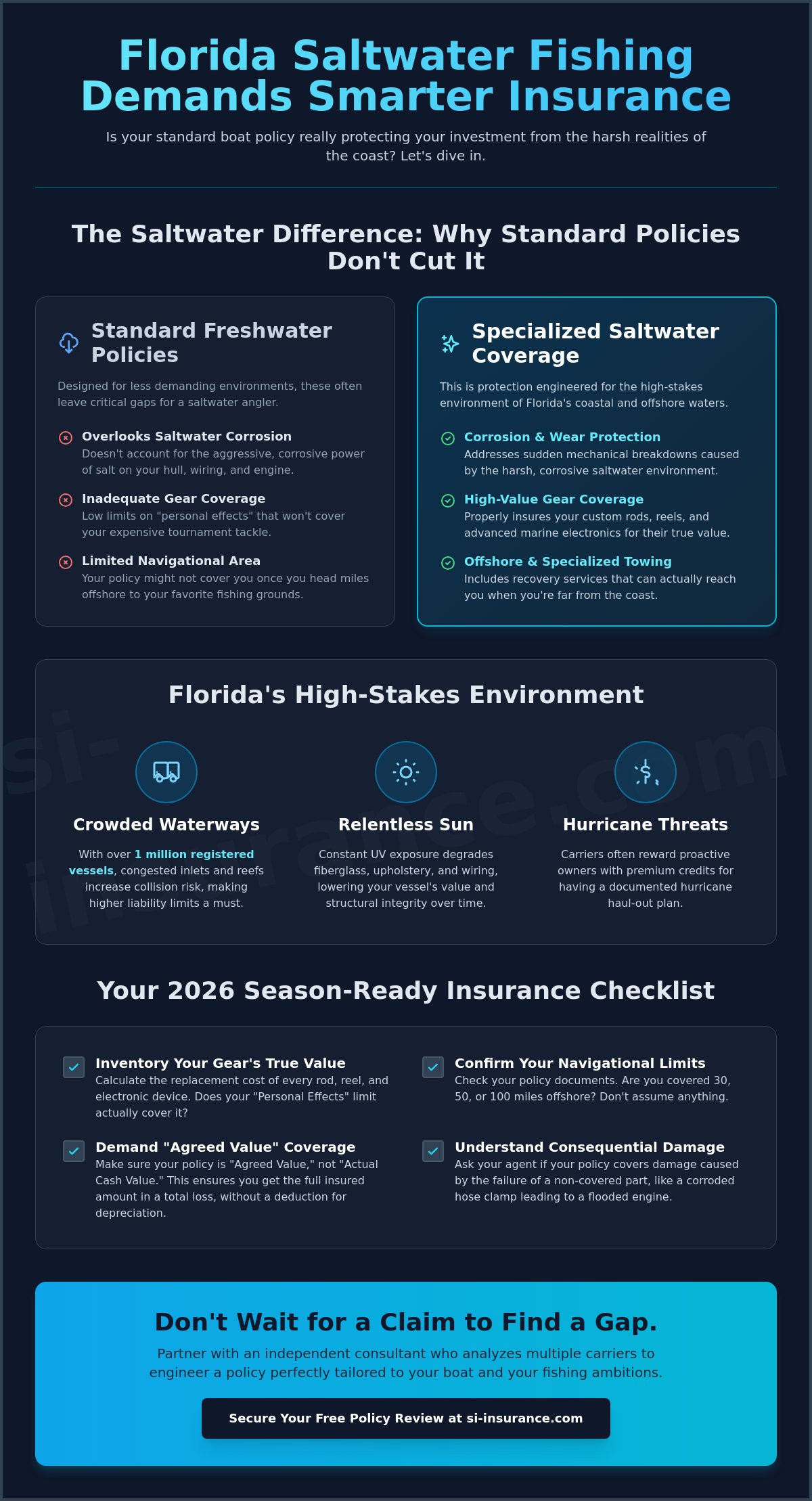
For most Florida anglers, the ocean represents more than a weekend destination; it's a significant financial and emotional investment that requires a defensive strategy as robust as the vessels themselves. Choosing boat insurance for saltwater fishing Florida isn't merely a box to check for a marina lease. It's a calculated decision to align your asset with the foundational principles of marine insurance, which recognize that saltwater environments present risks far beyond the scope of a standard inland policy. While a generic liability plan might satisfy a lender, it often fails to account for the specialized gear and structural vulnerabilities inherent to coastal fishing.
To better understand the physical toll these environments take on your vessel, watch this helpful comparison:
Florida’s waterways are some of the most densely populated in the nation, with over 1 million registered vessels as of 2026. This congestion, combined with the unpredictable nature of offshore reefs, makes standard liability limits feel remarkably thin. You aren't just protecting against a collision; you're safeguarding the years of memories and the high-value equipment that make these trips possible. A sophisticated policy acts as a silent partner, ensuring that a single mechanical failure or a crowded inlet mishap doesn't end your season prematurely. Specialized protection typically accounts for:
Aggressive hull oxidation and electrical system corrosion.
Offshore recovery and specialized towing services.
Total loss replacement for custom fishing rigs and outriggers.
The Reality of Saltwater Corrosion and Wear
Saltwater is inherently aggressive, acting as an electrolyte that accelerates electrolysis and galvanic corrosion in ways freshwater simply cannot match. It's essential to differentiate between sudden accidental damage and long-term saltwater deterioration. While many policies exclude "wear and tear," specialized saltwater coverage can be engineered to address sudden mechanical breakdowns caused by these brine environments. It's vital to understand that consequential damage occurs when a non-covered part, like a corroded seal, fails and causes catastrophic damage to a covered part, like the entire engine block.
Florida’s Unique Environmental Risks
The relentless Florida sun presents a constant threat to fiberglass integrity and upholstery, often leading to degradation that lowers the vessel's value over time. Proactive security measures, such as documented hurricane haul-out plans, are often rewarded by carriers with premium credits, reflecting a shared commitment to risk mitigation. Whether you're navigating the shallow flats of the Keys or the deep waters off the Panhandle, your local geography dictates a specific risk profile. Aligning your coverage with your specific location ensures that your boat insurance for saltwater fishing Florida is as resilient as the vessel it protects.
Beyond the Hull: Essential Coverage for Serious Anglers
While the vessel represents the core of your maritime assets, the specialized equipment housed within it often constitutes a secondary, yet equally significant, investment. For those pursuing boat insurance for saltwater fishing Florida, overlooking the nuances of personal property coverage can lead to devastating out-of-pocket expenses. Standard policies frequently cap property limits at levels that barely cover a single high-end offshore combo, let alone a full spread of tournament-grade tackle. You don't want to discover these limitations while standing at the claims desk after a theft or a catastrophic storm event.
Modern saltwater angling relies heavily on sophisticated marine electronics. Between CHIRP transducers, open-array radar, and networked multi-function displays, a single lightning strike or theft event can result in tens of thousands of dollars in losses. It's imperative that these items are specifically scheduled or that your policy's property limits are intentionally scaled to reflect current market values. Beyond the gear, environmental stewardship is a legal and ethical requirement. Florida's ecosystem is incredibly fragile. Fuel spill liability is a critical component of a professional policy, protecting you from the astronomical costs associated with accidental discharge. This is especially relevant given the scrutiny of Florida's official boating regulations, which emphasize safety and environmental protection on the water.
Insuring Your Fishing Tackle and Equipment
When selecting coverage for your rods and reels, the distinction between replacement cost and actual cash value (ACV) is paramount. ACV accounts for depreciation, which can leave you short when trying to replace a five-year-old electric reel with a new model. Opting for replacement cost ensures you can return to the water with equivalent gear. Documenting your inventory through high-resolution photos and saved receipts is a best practice that streamlines the claims process. For those with complex setups, consulting with a specialist at SI Insurance can help ensure that every outrigger, downrigger, and custom rod is accounted for in your risk profile.
Emergency Towing and On-Water Assistance
A breakdown in the Gulf Stream is fundamentally different from a stall on a calm lake. Tides and powerful currents in Florida's inlets can turn a simple mechanical failure into a life-threatening grounding within minutes. While many anglers carry memberships with BoatUS or SeaTow, it's a strategic move to ensure your primary insurance policy offers a seamless integration for on-water assistance. Unlimited saltwater packages are generally preferred over per-incident limits. The cost of a long-distance offshore tow can quickly exceed the standard $250 or $500 cap found in entry-level plans, making professional-grade assistance a necessity for peace of mind.
Navigational Limits and Agreed Value: The Technical Side of Offshore Security
When you're pushing thirty miles out into the Gulf Stream in search of pelagic species, your focus should be on the spread, not whether your policy covers your current GPS coordinates. You wouldn't fish with a broken drag; don't boat with a broken valuation. Understanding the technical architecture of your boat insurance for saltwater fishing Florida is essential for anyone venturing beyond the sight of land. While basic policies might offer a blanket sense of security, the fine print regarding where you can go and how much you'll be paid in a total loss can fundamentally change your financial recovery.
Navigational limits are more than just geographical suggestions. They're binding warranties within your insurance contract. If you're chasing tuna far offshore and a mishap occurs outside your defined boundaries, your carrier may have the legal right to deny the claim entirely. This is why aligning your coverage with your actual fishing habits is a non-negotiable step in risk management. Just as you must adhere to Florida boating laws to remain compliant on the water, you must respect these contractual limits to remain protected off it. In the 2026 market, where vessel values have seen significant shifts, ensuring your policy reflects current replacement costs is the only way to maintain a true safety net.
Understanding Your Navigational Boundaries
Most Florida policies define specific coastal waters, often capping offshore runs at 75 nautical miles from the coast. If your tournament schedule includes runs to the Bahamas or deep into the Gulf, you'll need to secure specific trip endorsements. These temporary extensions adjust your risk profile for the duration of the voyage. It's vital to remember that a breach of navigational warranty can void a claim, leaving you entirely liable for hull damage or environmental recovery costs.
Agreed Value vs. Actual Cash Value
Agreed Value remains the gold standard for protecting a serious fishing investment. In this structure, you and the insurer agree on a fixed amount at the start of the policy. If a total loss occurs, that's the check you receive, regardless of market depreciation. Conversely, an Actual Cash Value (ACV) policy applies depreciation. After a total loss, you might find that your payout is significantly lower than what's required to replace your vessel. For custom-rigged boats with specialized upgrades, a professional valuation is a wise move to ensure your figure accurately reflects your true replacement cost. You can explore these options more deeply at SI Insurance to ensure your policy matches your boat's current worth.
Preparing for the 2026 Season: A Strategic Checklist for Your Policy
As the 2026 spring run approaches, simply checking your bilge pumps and battery levels isn't enough to ensure a successful season. You need to audit your boat insurance for saltwater fishing Florida with the same precision you use to rig your lures. Expired endorsements or outdated equipment schedules can leave you exposed just when the bite gets hot. This is particularly true if your vessel falls into the category of high-performance or custom-built machinery, as detailed in our guide to Specialty Vehicle Insurance in Florida. A proactive review ensures that your coverage evolves alongside your fishing ambitions.
Before you drop your first line of the year, take a moment to verify that your policy hasn't become a static document. Florida’s maritime landscape is dynamic, and your insurance should reflect that. Whether you’ve added a new trolling motor or upgraded your radar array, these changes must be documented to remain within your "Agreed Value" framework. If you haven't spoken with an advisor recently, it's a good time to secure a professional policy review at SI Insurance to confirm your limits are still sufficient for current market replacement costs.
The Tournament Angler’s Endorsement
If you plan to enter any competitive events this year, you must understand the tournament coverage nuance. Many standard recreational policies contain exclusions for commercial use; some carriers interpret the pursuit of high-stakes prize money as a commercial venture. Beyond the prize money, the physical risks of a shotgun start with dozens of high-speed center consoles in close proximity create a unique liability profile. You need to confirm your policy specifically permits tournament participation and covers the associated entry fees and professional-level liability requirements. Don't let a technicality on your application void your protection during the most important weekend of your season.
Salvage and Wreck Removal
Florida’s reefs and mangroves are strictly protected, and the cost of removing a grounded vessel from these areas can be staggering. It's a common mistake to assume that salvage costs are deducted from your hull's total value. In a professional-grade policy, wreck removal and salvage should be in addition to your hull limit. This means if your boat is valued at $100,000 and it sinks on a protected reef, you have the full $100,000 for the boat plus a separate, often equal, amount for the environmental cleanup and recovery. Check your fine print for these specific terms:
Separate Salvage Limit: Ensure this is a stand-alone figure rather than a sub-limit of the hull value.
Environmental Indemnity: Covers fines and cleanup for fuel or oil discharge in sensitive habitats.
Wreck Removal Mandate: Covers the cost of legal requirements to move a sunken vessel that poses a navigational hazard.
The Si Insurance Advantage: Personalizing Your Saltwater Security
The complexities of marine risk management require more than an automated quote tool; they demand the oversight of a seasoned consultant who views your vessel through a lens of long-term preservation. At Si Insurance Agency, we move beyond the transactional nature of the industry to act as a protective guardian for your maritime interests. Securing boat insurance for saltwater fishing Florida involves balancing intricate variables, from hull values to offshore navigational warranties. By operating as an independent entity, we provide the distinct advantage of comparing multiple Florida-specific carriers to engineer a policy that is as specialized as your fishing strategy. This human-centric approach ensures that you aren't just another policy number, but a client whose specific needs are met with precision and empathy.
We understand that the bond between an angler and their vessel is built over years of early departures and hard-fought catches. This emotional investment deserves a partner who respects the stakes involved. Our methodology is rooted in rigorous analysis, yet our delivery remains approachable and grounded. We don't just sell policies; we build frameworks for security, a philosophy of bespoke risk management shared by MyGen Insurance Brokers, that allow you to operate at the highest levels of the sport with complete intellectual confidence. This measured approach ensures that your coverage is as robust as the boat you command.
Why a Local Florida Agent Matters
Our deep-seated understanding of the local landscape, including the specific operational requirements of Broward County marinas, allows us to anticipate risks that national providers might overlook. We maintain relationships with carriers that specialize in the Florida market, ensuring that your coverage is resilient against regional hazards like tropical systems and reef-related salvage. When a claim arises, having a local partner streamlines the communication process, replacing automated prompts with a direct line to an expert who understands the nuances of your situation. This combination of stability and foresight is the hallmark of our risk management approach, providing a level of personalized service that generic digital platforms cannot replicate.
Securing Your Boating Legacy
The ultimate objective of a professional policy is to provide the absolute security required to focus on the pursuit of the catch. When your coverage is meticulously engineered, you can navigate the Gulf Stream or the coastal flats with the confidence that your investment and your gear are fully protected. We invite you to schedule a strategic consultation for your vessel to ensure your legacy on the water remains uninterrupted. Our commitment to your security is unwavering, allowing you to enjoy the rewards of the Florida salt while we handle the technical complexities of your risk.
Securing Your Future on the Florida Salt
You’ve invested significant time and resources into mastering the coastal waters, and your defensive strategy should reflect that same level of commitment. We’ve explored how technical nuances like agreed value and navigational boundaries dictate your financial recovery after a loss. It's clear that a generic policy often fails to account for the specialized electronics and high-stakes tackle that define your fishing experience. Ensuring you have the right boat insurance for saltwater fishing Florida means moving beyond basic liability to a plan specifically engineered for the unique risks of the 2026 season.
Our team at Si Insurance Agency offers specialized expertise in Florida marine risk, providing you with access to elite carriers tailored for high-value vessels. We pride ourselves on delivering empathetic, human-led service from local Broward County experts who understand exactly what’s at stake when you’re offshore. It’s time to move toward a more sophisticated level of protection that respects your investment and your time on the water.
Request a Strategic Boat Insurance Review from Si Insurance Agency to ensure your vessel is prepared for whatever the season brings. Focus on the horizon and the pursuit of the next big catch while we maintain a steady watch over your security.
Frequently Asked Questions
Is boat insurance legally required for saltwater fishing in Florida?
Florida state law does not mandate insurance for private recreational vessels. While the state doesn't require it, you'll find that most marinas demand a minimum of $300,000 in liability coverage for slip leases; similarly, lenders require comprehensive protection for any financed boat. Maintaining a policy is a strategic necessity for managing the high-density risks found in Florida’s crowded coastal inlets.
Can I get boat insurance if I plan to fish in the Bahamas?
You can certainly secure coverage for Bahamian waters, but it requires a specific navigational limit endorsement. These extensions typically increase your annual premium by 20% to 40% because of the increased risks associated with international transit and remote recovery. It’s a technical adjustment that ensures your protection remains intact when you cross the Gulf Stream.
What happens if my boat sinks on a Florida coral reef?
Sinking on a protected reef triggers significant environmental liability and mandatory wreck removal under Florida law. A professional policy with a separate salvage limit ensures that the costs of extraction and reef mitigation don't deplete the funds meant to replace your hull. Without this specific structure, you could be personally responsible for astronomical fines and specialized recovery fees.
Does my boat insurance cover my fishing rods and expensive electronics?
Your gear is protected through personal effects coverage, though standard limits are often insufficient for professional-grade tackle. For serious anglers, it's vital that your boat insurance for saltwater fishing Florida includes scheduled property endorsements for high-end CHIRP transducers and custom outriggers. This ensures you receive the full replacement cost rather than a depreciated cash value after a theft or lightning strike.
Is hurricane damage covered by saltwater boat insurance in Florida?
Hurricane damage is covered as long as your policy includes comprehensive protection and you adhere to the specific "named storm" deductible. Most carriers now offer premium discounts ranging from 5% to 15% for owners who maintain a documented hurricane storage plan. These proactive measures, such as using a storm-rated lift or a dry-stack facility, are essential components of modern marine risk management.
How much does boat insurance for a center console cost in Florida?
The annual cost typically ranges from 1.5% to 2% of the vessel's total insured value. For a $40,000 center console, you might expect a premium between $600 and $800, while a $150,000 sportfishing rig can command between $2,500 and $3,800. These figures are influenced by your maritime experience, claims history, and the specific horsepower of your outboard engines.
Can I use my boat for occasional charter fishing under a standard policy?
Standard recreational policies strictly exclude any activity involving "carriage of passengers for hire" or commercial intent. Even if you only take a few paid charters a year, doing so without a commercial endorsement can lead to a total denial of a claim. You need a specialized policy structure that accounts for the increased liability of bringing paying guests into offshore environments.
What is the "Hurricane Haul-Out" clause in Florida boat policies?
This clause is a proactive provision where the insurer reimburses a portion of the labor costs to move your vessel to a secure location before a named storm. It’s a collaborative risk mitigation strategy that reduces the likelihood of a total loss during a hurricane. Utilizing this benefit demonstrates the kind of foresight that sophisticated carriers value in their high-level maritime clients.
Comments