


Boat Insurance in Florida: A Strategic Guide to Coverage and Costs (2026)
- siinsuranceflorida
- 10 minutes ago
- 12 min read
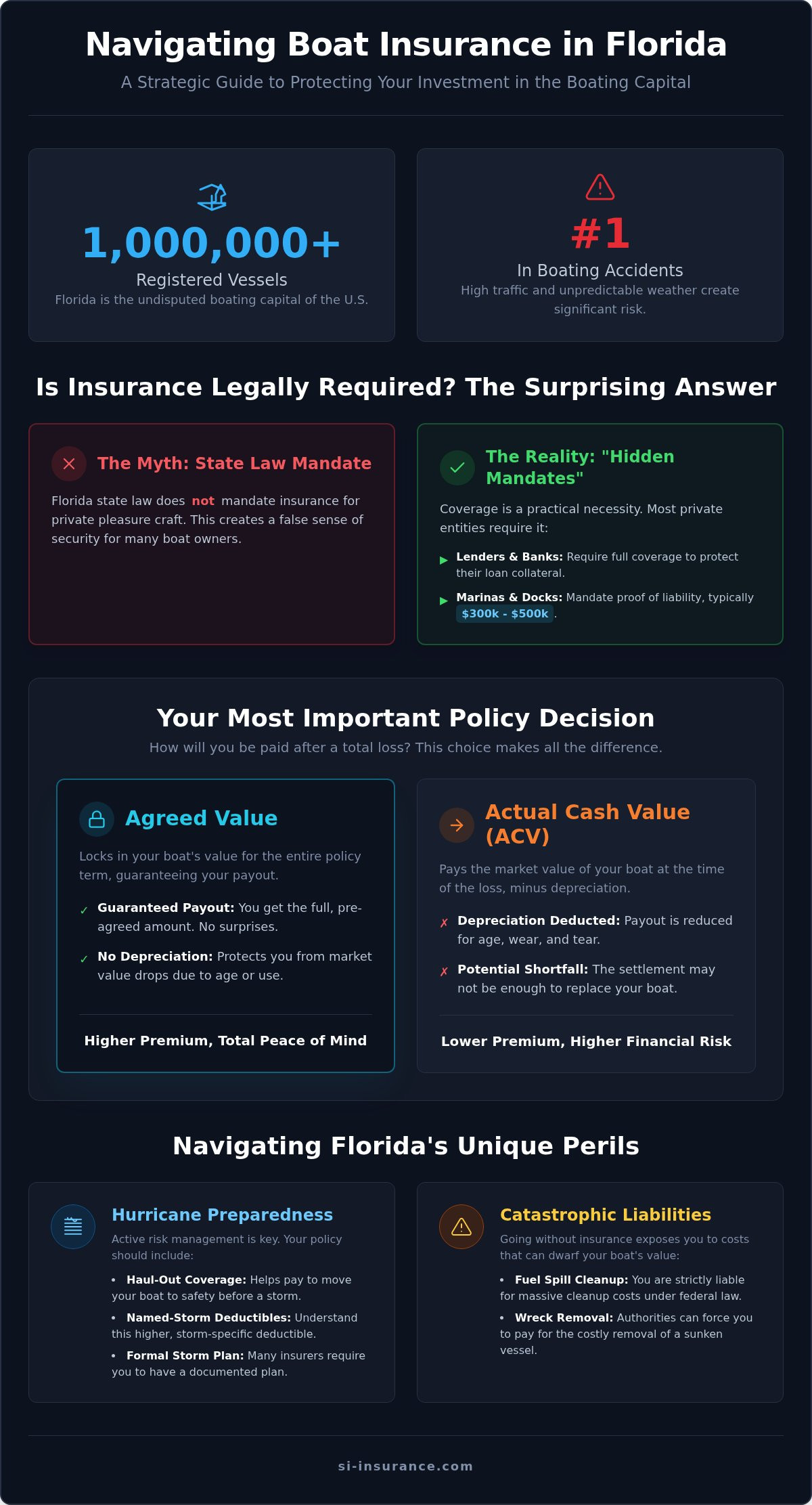
With over one million registered vessels, Florida is the undisputed boating capital of the country, yet it's also the national leader in boating accidents. You likely already know that securing reliable boat insurance florida isn't just about ticking a box; it's about protecting a high-value investment against unpredictable hurricanes and the heavy traffic of South Florida's inlets. We understand the frustration of watching premiums climb while wondering if your policy will actually deliver when a named storm makes landfall. It's a high-stakes environment where the difference between a standard policy and a strategically engineered one can mean the difference between a total loss and a full recovery.
This guide provides a professional and strategic overview of the 2026 marine insurance landscape, helping you distinguish between the technical nuances of Agreed Value and Actual Cash Value. We'll clarify the $300,000 liability limits most marinas require and show you how to structure a policy that prioritizes long-term security. You'll gain a clear understanding of named-storm deductibles and how to find a local point of contact for claims. By the end of this analysis, you'll have the intellectual confidence to choose coverage that balances sophisticated risk mitigation with the practical needs of a Florida mariner.
Table of Contents
Understanding Florida Boat Insurance Requirements and Realities
While the Florida Fish and Wildlife Conservation Commission oversees vessel registration and safety certifications, the state does not actually mandate insurance for private pleasure craft. This regulatory vacuum often leads new owners into a false sense of security. However, for anyone treating their vessel as a significant financial asset, securing a robust boat insurance florida policy is a practical necessity. The reality is that while the state remains silent, private entities and federal environmental laws create a framework of "hidden mandates" that make coverage essential for any responsible mariner.
Operating without a policy in the high-density waterways of South Florida is a high-stakes gamble. By Understanding Marine Insurance and its role in modern risk management, it becomes clear that these contracts are more than just paperwork; they're a shield against catastrophic financial exposure. Whether you're navigating a center console through a busy inlet or docking a motor yacht in Pompano Beach, the liability landscape is complex. Relying on luck in the state with the highest number of boating accidents isn't a strategy; it's a liability.
When is Boat Insurance Actually Mandatory?
If you've financed your boat, your lender will require "full coverage" to protect their collateral. Beyond the bank, your choice of dockage often dictates your coverage levels. Most marinas in South Florida, particularly throughout Broward County, require proof of liability insurance with limits typically between $300,000 and $500,000. If you plan on entering fishing tournaments or operating a professional charter, specific contractual obligations will mandate specialized liability endorsements that far exceed a basic personal policy.
The Consequences of the 'Self-Insured' Approach
Choosing to be "self-insured" means assuming total responsibility for risks that can easily eclipse the value of the boat itself. Under the Clean Water Act, boaters are strictly liable for the costs of environmental cleanup following a fuel leak or oil spill. These remediation efforts are handled by specialized teams and lead to staggering invoices from federal agencies. Wreck removal is another overlooked expense; a sunken vessel is often more costly to manage than one that's afloat, as authorities can compel you to remove a hazard to navigation at your own expense. Fuel Spillage Liability is a specialized coverage provision that indemnifies the policyholder against the significant financial penalties and remediation costs associated with the accidental discharge of oil or petroleum products into navigable waters.
At SI Insurance, we help our clients navigate these requirements by matching them with carriers that understand the specific demands of the boat insurance florida market. We don't just look for a policy that satisfies a marina's checklist; we look for one that provides absolute security for your specific lifestyle on the water. It's about ensuring that a single incident in a high-traffic inlet doesn't jeopardize your financial future.
Agreed Value vs. Actual Cash Value: A Technical Breakdown
Choosing between Agreed Value and Actual Cash Value (ACV) represents the most significant financial decision when structuring your boat insurance florida policy. This choice determines exactly how a carrier calculates your reimbursement following a catastrophic event. While an ACV policy typically offers lower annual premiums, it accounts for depreciation, meaning your payout reflects the boat's market value at the moment of the accident. Conversely, an Agreed Value policy locks in a specific dollar amount at the start of the term, ensuring that you aren't financially penalized for the natural aging of your vessel. It's a matter of deciding whether you'd rather save on monthly costs or guarantee a fixed settlement if the worst happens.
While private boaters have more flexibility, certain commercial operations must adhere to specific Florida Statutes on vessel insurance which mandate liability minimums for liveries. For the private owner, the choice between valuation methods is less about state law and more about strategic asset protection. If you've invested heavily in a late-model sportfisher or a custom center console, the gap between what you paid and the depreciated market value can grow surprisingly wide in just a few years. Locking in that value early on is often the most prudent way to safeguard your equity.
The Depreciation Factor in South Florida
Broward County's environment is notoriously harsh on marine hardware. The combination of relentless UV exposure and the high-salinity waters of the Atlantic accelerates the physical degradation of fiberglass, upholstery, and electronics. For a newer vessel, an Actual Cash Value settlement can be devastating because the market price drops faster here than in freshwater regions. Engine hours are another critical variable; a vessel with high hours will see its ACV settlement plummet, even if the hull remains in pristine condition. This is why many local owners opt for Agreed Value; it provides a predictable financial outcome that doesn't fluctuate with the volatility of the used boat market.
Total Loss Scenarios: What to Expect
In the event of a total loss, the claims process involves rigorous documentation and a professional survey to verify the incident's circumstances. With an Agreed Value policy, the payout is straightforward; you receive the amount listed on your declarations page. In an ACV scenario, the adjuster will perform a market analysis, often resulting in a figure far below what's required to purchase a comparable replacement. It's also vital to consider partial losses. Many ACV policies apply depreciation to individual parts during a repair, whereas some Agreed Value structures offer "new for old" replacement for specific components. If you're unsure which valuation aligns with your risk tolerance, it's worth consulting with an independent advisor who can run the numbers for both scenarios.
Factors Influencing Boat Insurance Costs in Florida
Calculating the cost of marine protection in the Sunshine State requires an analytical look at several distinct risk layers. When securing boat insurance florida, the primary driver is often the "Florida Premium," a geographical surcharge reflecting our state's unique exposure to tropical weather and high-density marine traffic. Since 2022, the marine market has experienced significant hardening, with premiums increasing between 15% and 25% due to substantial hurricane losses. This shift means that underwriters are applying more scrutiny than ever to the physical architecture of your vessel, including its length, hull material, and total horsepower. A high-performance center console with quad outboards presents a different actuarial profile than a displacement-hull trawler, and your premium will reflect those technical differences.
Your personal history as a mariner is just as critical as the boat's specifications. Carriers evaluate the "Operator Profile," looking for years of experience with similar vessels and a clean record on both land and water. Where you choose to travel also dictates your baseline rate. Navigational limits are a key component of your policy; a plan that includes crossing the Gulf Stream to the Bahamas carries a different weight than a policy restricted to the protected waters of the Intracoastal. By aligning your navigational habits with your coverage, you can avoid paying for offshore risks you don't intend to take.
Boating Education and Safety Discounts
Proactive risk mitigation is one of the few ways to exert downward pressure on your premiums. Completing a safety course through the Florida Fish and Wildlife Conservation Commission (FWC) is often a prerequisite for younger operators, but even seasoned captains can secure discounts by maintaining these certifications. Carriers also reward the installation of advanced on-board safety equipment. Features like permanent fire suppression systems in the engine room and GPS-based theft recovery tracking signal to the insurer that you're a calculated and responsible owner, often resulting in a more favorable rate structure.
Understanding the Hurricane Deductible
One of the most misunderstood aspects of Florida marine coverage is the distinction between your standard deductible and the "Named Storm" deductible. While your standard deductible might be a flat dollar amount for minor incidents, a hurricane often triggers a percentage-based deductible, typically ranging from 5% to 10% of the vessel's hull value. This means a $100,000 boat could face a $10,000 out-of-pocket cost before the insurance payout begins. To manage these escalating costs, some owners find that bundling their marine policy with their home insurance provides a more cohesive and cost-effective approach to total asset protection. This strategy allows for a unified risk management plan that accounts for both your primary residence and your high-value marine assets.
The Florida Factor: Hurricanes, Salvage, and Liability
While the technical valuation of your vessel serves as a critical financial anchor, the operational reality of owning a boat in the Sunshine State requires a more dynamic approach to risk management. Storms don't wait for a convenient time to strike. In this environment, boat insurance florida functions as a comprehensive response plan rather than a passive contract. Most elite carriers now require a formal, written "Hurricane Plan" as a condition of coverage, detailing exactly where the vessel will be secured and who is responsible for its transit when a watch is issued. This isn't merely a bureaucratic hurdle; it's a strategic alignment between the owner and the insurer to mitigate the catastrophic surge and wind risks that define our local waters.
To support these proactive measures, many specialized policies include a "Haul-out" provision. This clause is a sophisticated risk-sharing mechanism where the carrier agrees to reimburse a portion of the costs, often up to 50%, to professionally haul and store your vessel before a named storm arrives. It's a calculated investment for the insurer and a vital service for the owner, ensuring that financial constraints don't prevent you from moving your asset to a safer location. At SI Insurance, we prioritize carriers that offer these operational benefits, as they reflect a deep understanding of the unique pressures faced by Broward County mariners.
Salvage vs. Towing: A Critical Distinction
One of the most dangerous misconceptions in marine insurance is the conflation of towing with salvage. Towing is a simple service for a vessel that has run out of fuel or suffered a mechanical failure while remaining buoyant and stable. Salvage, however, involves a vessel in "peril," such as one that is sinking, aground, or entangled in a reef. Under maritime law, a "Pure Salvage" claim can result in an award based on a percentage of the boat's total value, which can be financially ruinous if your policy isn't properly structured. We ensure that our clients' policies cover salvage to the full insured value of the hull, protecting them from the aggressive lien structures often utilized by professional salvage companies.
Environmental and Fuel Spill Protection
Navigating high-density areas like the Hillsboro Inlet or the Pompano Beach waterways carries significant liability risks beyond simple hull damage. Florida maintains exceptionally strict environmental laws regarding the discharge of pollutants into protected marine habitats. If your vessel is damaged and begins leaking fuel, you're responsible for the mobilization of hazmat teams and the subsequent habitat restoration. Specialty Vehicle Insurance must include environmental liability for Florida boaters because the state's strict ecological protections can result in massive fines even for minor fuel discharges. To ensure your liability limits are sufficient for these complex coastal risks, you should request a strategic coverage review with our local team today.
Why a Local Florida Agency Beats the National Giants
When you're managing high-value assets in a volatile environment, a remote call center often lacks the granular knowledge required for effective advocacy. Opting for a local independent advisor for your boat insurance florida provides access to a curated network of elite marine carriers rather than a single, rigid product line. SI Insurance acts as a strategic consultant, matching your vessel’s specific architecture with a carrier that understands the intricacies of South Florida waterways. This model ensures your coverage is engineered for precision, providing an intellectual confidence that national giants simply cannot replicate.
We act as a protective guardian during the settlement process, utilizing localized expertise to navigate the logistical challenges unique to Broward County. Whether you're docking in Sunrise or Pompano Beach, our team understands the local landscape of repair facilities and surveyor networks. We also prioritize the strategic alignment of your entire risk portfolio, connecting your marine coverage with your broader Specialty Vehicle Insurance to ensure there are no gaps in your financial security.
Personalized Risk Assessment
We move beyond the generic algorithms used by retail insurers to evaluate your specific boating lifestyle. This involves customizing endorsements for high-value fishing tackle, unattached electronics, and other personal effects that standard policies often overlook. Our presence in local offices provides a human connection that's vital after a storm, offering a steady and reliable point of contact when you need results through rigorous analysis.
Getting Started with a Strategic Quote
To initiate a tailored proposal, we require specific documentation to conduct a thorough risk analysis. This includes your vessel’s Hull Identification Number (HIN), the original purchase price, and a detailed operator history. By gathering these facts, SI Insurance can deliver a proposal that's meticulously balanced and focused on long-term stability. Secure your vessel with a custom boat insurance quote today.
Protecting Your Vessel for the Seasons Ahead
Securing the right boat insurance florida requires more than just a standard policy; it demands a calculated strategy that accounts for the state’s intense environmental pressures and complex liability requirements. We’ve explored why locking in an Agreed Value settlement is often the most prudent financial move for newer vessels and why a formal hurricane preparedness plan is an operational necessity in Broward County. By prioritizing professional salvage coverage and environmental liability, you ensure that your maritime legacy remains protected against the unpredictable nature of our coastal waters. It’s about moving beyond generic coverage to achieve a level of security that allows for total confidence on the open sea. We provide clarity.
Our team provides expert guidance from local agents who understand the intricacies of South Florida’s inlets and marinas. We offer access to a network of elite marine insurance carriers, delivering sophisticated risk management that is specifically tailored to our unique environment. When you're ready to elevate your protection, we're here to help you navigate the process with precision. Request a Professional Boat Insurance Consultation to start building your custom risk management plan today. We look forward to helping you safeguard your time on the water for many years to come.
Frequently Asked Questions
Is boat insurance required by law in Florida?
Florida state law does not mandate insurance for private, non-commercial vessels. While the state remains silent on the matter, you'll find that lenders and marinas create their own requirements. If you've financed your boat or wish to secure a slip in a Broward County marina, you'll be contractually obligated to provide proof of liability and hull coverage.
How much does boat insurance cost in Florida on average?
The annual cost typically ranges between 1% and 2% of the vessel's insured value. For a boat valued at $40,000, you can expect to pay between $500 and $900 per year for a standard policy. These rates are influenced by the vessel's age, horsepower, and your specific navigational limits, such as whether you stay in the Intracoastal or head offshore.
What is the difference between towing and salvage coverage?
Towing is a service for vessels that have suffered a mechanical breakdown but remain buoyant and stable. Salvage is a much more complex and expensive undertaking that occurs when a boat is in "peril," such as when it's sinking or aground. Because salvage awards are often based on a percentage of the boat's total value, it's vital to have a policy that covers these high-stakes recovery efforts.
Does my boat insurance cover me if I boat to the Bahamas?
Your coverage for international travel depends entirely on the navigational limits defined in your policy. Many standard boat insurance florida policies restrict you to U.S. coastal waters or a specific distance from the shoreline. If you plan to cross the Gulf Stream to the Bahamas, you must secure a specific endorsement that extends your coverage area to include those islands.
What is a hurricane haul-out agreement?
A haul-out agreement is a proactive risk-sharing provision where the insurance carrier helps cover the cost of moving your boat to a safe location before a named storm. In most cases, the insurer will reimburse up to 50% of the professional labor and storage fees required to secure the vessel. This is a strategic tool that benefits both the owner and the carrier by reducing the risk of a total loss.
Does boat insurance cover my fishing gear and electronics?
Standard policies usually include a modest limit for personal effects, but this is often insufficient for high-end marine electronics or professional fishing tackle. If you've invested heavily in custom rods or advanced sonar systems, we recommend adding a specific endorsement to your policy. This ensures these items are covered for their full replacement value rather than being subject to a low sub-limit.
Why do I need a separate liability policy for my marina?
You don't typically need a separate policy, but your existing boat insurance must meet the marina's specific liability thresholds. Most South Florida marinas require a minimum of $300,000 in liability coverage to protect their facilities and other tenants' vessels from damage you might cause. We work with you to ensure your policy's declarations page satisfies these marina requirements before you sign a slip agreement.
Can I bundle my boat insurance with my Florida home or auto policy?
Bundling is an excellent strategy for simplifying your financial planning and often leads to multi-policy discounts. While marine insurance is a specialized product, many of our elite carriers allow you to group it with your home or auto coverage. This approach provides a more comprehensive view of your total risk and can streamline the communication process if a single event, like a hurricane, damages multiple assets.
Comments