


Florida Flood Insurance Requirements: A Comprehensive 2026 Strategic Guide
- siinsuranceflorida
- 4 days ago
- 13 min read
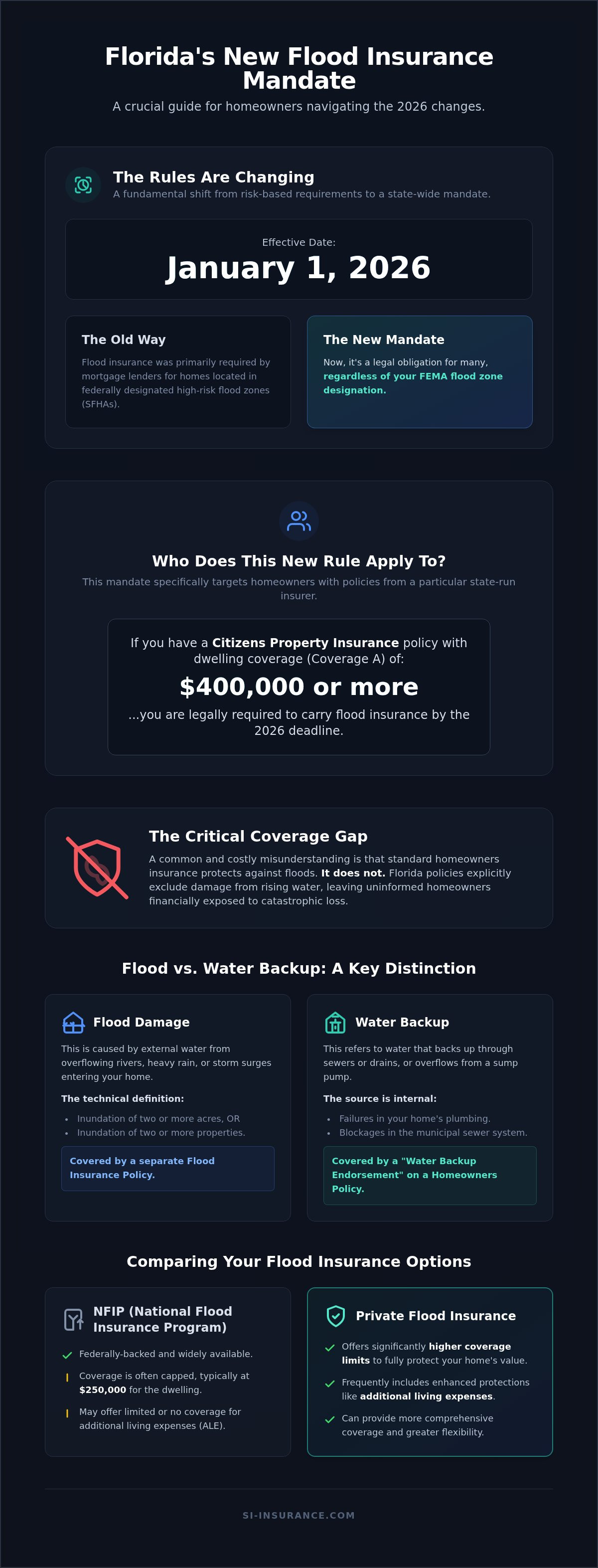
For thousands of Florida homeowners, the traditional distinction between high-risk and low-risk zones has effectively vanished as of January 1, 2026. If you hold a Citizens Property Insurance policy with dwelling coverage of $400,000 or more, you're now legally obligated to maintain specialized coverage regardless of your specific FEMA designation. This shift represents a fundamental restructuring of florida flood insurance requirements, moving away from lender-driven preferences toward a state-mandated framework. It's understandable if you feel a sense of professional concern regarding the rapid rollout of these mandates or the increasing complexity of South Florida's insurance landscape.
You've likely spent significant time deciphering updated FEMA maps or evaluating how these mandatory premiums will impact your long-term risk management strategy. We'll provide the intellectual clarity needed to interpret these legislative changes with absolute confidence. This strategic guide details exactly how to meet your legal and lender obligations while identifying the most sophisticated pathways between the National Flood Insurance Program and the expanding private market. We'll examine the 2026 phase-in tiers, evaluate the $250,000 NFIP coverage caps, and establish a methodical plan to secure your assets against the evolving risks of the Sunshine State.
Table of Contents
Understanding the Shifting Landscape of Florida Flood Insurance Requirements
Florida's residential landscape is currently experiencing a systemic transformation as the historical paradigm of voluntary risk mitigation is replaced by a framework of rigid legal mandates. The transition from a discretionary choice to a mandatory obligation reflects a broader institutional recognition of Florida's unique hydrological profile. It's a common misconception that standard homeowners insurance provides protection against rising water; however, Florida policies explicitly exclude flood damage, creating a significant exposure for the uninformed. This gap necessitates a comprehensive understanding of florida flood insurance requirements to ensure that property assets remain insulated from catastrophic loss.
The current regulatory environment is defined by a sophisticated intersection of federal mortgage laws and state-level directives, specifically those emerging from recent legislative sessions. For many property owners, these new regulations introduce a complex layer of financial planning that requires both foresight and technical precision. For the sophisticated homeowner, this means that ignorance of the law is no longer just a legal risk, but a direct threat to the preservation of equity. Acknowledging the weight these mandates place on families is the first step toward developing a resilient strategy.
To better understand this concept, watch this helpful video:
The Distinction Between Flood and Water Backup
In the context of specialized risk management, the definition of a "flood" is technically precise, requiring the inundation of two or more acres of normally dry land or two or more properties. This distinction is vital because a standard "water backup" endorsement on a homeowners policy is engineered to address failures within the plumbing or drainage systems rather than external environmental events. Because the source of the water dictates which policy responds, property owners must ensure their coverage is meticulously aligned with the specific risks of their geographic location. Failing to distinguish between these two scenarios can lead to devastating out-of-pocket expenses during a claim.
Why 2026 is a Pivotal Year for Florida Property Owners
The year 2026 serves as a pivotal threshold for Florida property owners as the state moves toward a nearly universal mandate for flood coverage within specific carrier portfolios. This shift is driven by evolved risk modeling that incorporates extreme precipitation events and localized drainage challenges alongside traditional coastal surge data. The National Flood Insurance Program (NFIP) continues to provide the foundational structure for these requirements, yet the increasing frequency of "sunny day flooding" has necessitated a more aggressive approach to mandatory protection. Engaging with a sophisticated partner like Si Insurance Agency allows for the methodical implementation of these requirements, turning a regulatory burden into a strategic advantage for long-term financial security.
Federal Mandates: Who is Legally Required to Carry Coverage by Law?
Federal oversight remains the primary catalyst for florida flood insurance requirements, specifically through the legacy of the Flood Disaster Protection Act of 1973. This legislation mandates that any property located within a Special Flood Hazard Area (SFHA) must maintain adequate coverage if the mortgage is federally backed. While conventional loans often mirror these requirements, specific government-backed instruments such as FHA, VA, and USDA loans have non-negotiable compliance standards. If your property is collateral for one of these federal programs, the lender is legally required to verify your policy annually. This institutionalized approach ensures that the systemic risk to the national mortgage market is mitigated through individual property compliance.
When a property is "mapped in" to a high-risk zone during a policy term, the transition from voluntary to mandatory coverage is often immediate. FEMA periodically updates its risk assessments, and these revisions can catch property owners unprepared. You can consult FEMA's official flood insurance page to monitor current map status and understand how federal revisions might impact your property. If a revision places your home in an SFHA, your lender will issue a formal notice requiring proof of insurance within a specified window, typically 45 days. Ignoring this notice doesn't delay the requirement; it simply triggers a more expensive and less effective administrative response from the lender.
Decoding FEMA Flood Zones: AE, VE, and X
The nomenclature of flood mapping often leads to a dangerous misinterpretation of actual risk. The "100-year flood" designation doesn't mean an event occurs once a century; it signifies a 1% annual probability of inundation. High-risk zones, primarily those starting with A or V, carry the heaviest federal mandates. Zone V and VE are particularly high-stakes coastal areas subject to wave action and storm surge. Conversely, Zone X is categorized as a moderate-to-low risk area. In Florida, however, nearly 25% of all flood claims originate from these "low risk" zones. It's a strategic error to assume that a lack of a federal mandate equates to a lack of environmental risk.
Lender Compliance and the Force-Placed Insurance Trap
Lenders utilize sophisticated tracking systems to ensure continuous compliance with florida flood insurance requirements. If a policy lapses or if the coverage limits don't meet institutional requirements, the lender will implement force-placed insurance. This isn't a service to the homeowner. Force-placed policies are significantly more expensive than private market options and typically only protect the lender's interest in the structure, neglecting your personal contents and loss-of-use protections. Maintaining a relationship with an independent advocate like Si Insurance Agency ensures your coverage remains uninterrupted and compliant, shielding you from these predatory administrative costs and ensuring your equity remains protected.
The Citizens Property Insurance Mandate: A Critical Regulatory Shift
Florida Senate Bill 2-A represents the most significant legislative intervention in the state's modern insurance history. It fundamentally alters the operational mandate of Citizens Property Insurance Corporation by transitioning it from a standard provider to a highly regulated entity with strict coverage prerequisites. By requiring all policyholders to secure separate flood coverage, the state aims to mitigate the massive financial exposure of the "insurer of last resort." This directive bypasses traditional FEMA risk designations; it applies to every Citizens-insured property, including those located in the supposedly low-risk Zone X. For many, this marks the first time that florida flood insurance requirements are dictated by their carrier rather than their geographic coordinates or mortgage type.
The rationale behind this regulatory shift is rooted in the preservation of the state's financial stability. When a major storm event occurs, the lack of flood coverage among homeowners often leads to litigation and administrative delays that hamper recovery efforts. By institutionalizing this requirement, the state ensures a more streamlined recovery process while protecting the overall solvency of the Citizens portfolio. It's a calculated move toward long-term market resilience, ensuring that the burden of flood risk is managed through appropriate insurance vehicles rather than state-funded disaster relief.
The 2026 Phase-In: Is Your Property on the List?
The rollout of this mandate follows a meticulous schedule based on the structure's replacement cost. As of January 1, 2026, the requirement extends to all Citizens personal lines residential policies where the dwelling coverage, known as Coverage A, is $400,000 or greater. It's essential to understand that replacement cost refers to the estimated expense of rebuilding the home with similar materials at current labor rates; it's not the market value of the property. Policyholders should review their most recent declarations page or consult with a specialized agent to verify their specific compliance deadline before the 2027 universal mandate takes effect.
Strategic Alternatives to Citizens Insurance
While Citizens provides a necessary safety net, the state's aggressive depopulation efforts mean that many homeowners are being transitioned into the private market. Securing a Home Insurance in Florida policy through a private carrier can offer significant advantages. Private insurers often provide more comprehensive coverage options and, in some cases, may not have the same universal flood mandate for properties in Zone X. This allows for a more tailored approach to risk management. Working with an independent agency allows you to compare these private alternatives against the total cost of a Citizens policy combined with mandatory flood premiums, ensuring your florida flood insurance requirements are met through the most cost-effective and robust financial structure available.
Evaluating Your Risk Profile: Beyond the Mandatory Zones
A fundamental error in risk assessment occurs when property owners equate the absence of a federal mandate with a lack of environmental vulnerability. While florida flood insurance requirements focus heavily on high-risk zones, the reality of Florida's flat topography means that water does not respect map boundaries. Statistics indicate that approximately 25% of all flood insurance claims originate from areas designated as low-to-moderate risk. This discrepancy is largely due to the state's rapid urban development, which replaces natural absorbent soil with impervious surfaces like asphalt and concrete, forcing rainwater into overtaxed drainage systems.
In Broward County, the risk profile is further complicated by seasonal "King Tides" and the intricate canal systems that define the region. During these high-tide events, the drainage infrastructure can actually work in reverse, pushing seawater onto streets and into residential areas far removed from the immediate coastline. For residents in cities like Sunrise or Pompano Beach, the threat is often less about a catastrophic hurricane and more about a localized, high-intensity rain event that exceeds the capacity of municipal pumps. Relying solely on historical FEMA data is a reactive strategy; a proactive approach considers the current state of local infrastructure and evolving sea levels.
The Importance of an Elevation Certificate (EC)
An Elevation Certificate is a technical document that compares a building's elevation to the estimated height of floodwaters in a specific area. While no longer strictly required for every NFIP policy under Risk Rating 2.0, an EC remains an invaluable tool for sophisticated risk management. It can provide empirical evidence that your property sits higher than the surrounding terrain, potentially qualifying you for lower premiums than the general zone designation suggests. To obtain an EC, you should contact a licensed land surveyor, though you may find an existing copy in your property's closing documents or through local municipal records.
South Florida Specific Risks: Surge vs. Surface Water
It's vital to distinguish between coastal storm surge and inland surface water flooding. Pompano Beach properties face the dual threat of Atlantic surges and tidal flooding, where the primary concern is the velocity and salinity of incoming water. In contrast, Sunrise properties are more susceptible to surface water accumulation, where intense rainfall cannot escape the inland canal systems quickly enough. Understanding these nuances allows for a more tailored insurance strategy. You can consult with our specialized agents to conduct a rigorous analysis of your specific property risks and ensure your coverage is engineered for South Florida's unique hydrological challenges.
Navigating the Florida Flood Market: Strategic Implementation with Si Insurance Agency
Fulfilling the complex florida flood insurance requirements demands a sophisticated understanding of the diverging paths between the National Flood Insurance Program (NFIP) and the burgeoning private flood market. While the NFIP provides a standardized, federally backed foundation, it often operates within rigid constraints, such as the $250,000 cap on residential building coverage and a mandatory 30-day waiting period. Conversely, the private market has evolved into a robust alternative, offering significantly higher coverage limits, additional living expenses, and replacement cost valuations for personal property. For the property owner seeking comprehensive risk transfer, the choice isn't merely about compliance; it's about engineering a financial structure that fully protects the underlying asset.
Si Insurance Agency operates as an elite risk management consultant, meticulously evaluating these market options to identify the most efficient coverage structure for your specific needs. Our independent status allows us to bypass the limitations of single-carrier agencies, providing an objective analysis of multiple providers. This methodology ensures that your strategy isn't just compliant with florida flood insurance requirements but is also optimized for cost-efficiency and depth of protection. We serve as a protective guardian for your equity, utilizing rigorous analysis to navigate the volatile insurance climate of South Florida.
The Benefits of Independent Agency Representation
The primary advantage of engaging an independent partner lies in the breadth of market access. We don't simply offer a generic policy; we conduct a rigorous comparison across a network of specialized carriers to find the precise "fit" for your property's unique elevation and construction profile. By managing your flood, home, and auto policies through our local Sunrise or Pompano Beach offices, you gain a centralized point of institutional accountability. This proximity allows for a more personalized, premium service experience, ensuring that your risk management portfolio remains cohesive and responsive to legislative changes. It's a level of foresight that single-source providers simply cannot replicate.
Securing Your Quote: What Information is Required?
To initiate a formal risk analysis, certain technical documents are required to ensure the precision of your quote. Providing a current Elevation Certificate, a detailed claims history, and high-resolution photographs of the property allows our team to present your risk to carriers in the most favorable light. It's critical to remember that NFIP policies generally carry a 30-day waiting period, which can be avoided only under specific circumstances, such as an active home purchase closing. To begin your transition toward a more secure and compliant future, we invite you to take a proactive step by contacting Si Insurance Agency for a personalized review of your current coverage and 2026 obligations.
Securing Your Assets in an Evolving Regulatory Climate
The 2026 regulatory landscape demands a transition from reactive compliance to proactive risk management. By understanding the specific thresholds of the Citizens mandate and the nuances of South Florida's hydrological profile, property owners can transform a legal obligation into a strategic asset protection plan. Relying on outdated maps or general assumptions regarding Zone X is no longer a viable strategy for those seeking long-term financial security. Instead, a methodical evaluation of both federal and private market options ensures that your coverage is engineered for precision and depth.
Meeting the current florida flood insurance requirements involves more than just checking a box; it's about securing a sophisticated partnership with a guardian who understands the local terrain. Secure your property's future with a professional flood insurance consultation from Si Insurance Agency. Our team provides expert local knowledge of Broward County flood zones and grants access to an expansive network of private and federal carriers. Through a personalized risk assessment, we'll ensure you maintain absolute security while managing the intricate financial landscape of South Florida. You don't have to face these complexities alone.
Frequently Asked Questions
Is flood insurance required by law in Florida for 2026?
While there is no universal statewide mandate for every resident, florida flood insurance requirements are strictly enforced for specific cohorts. As of 2026, all Citizens Property Insurance policyholders with dwelling coverage of $400,000 or more must carry coverage. Additionally, federal law mandates insurance for any property within a Special Flood Hazard Area (SFHA) that carries a federally backed mortgage. Compliance is a prerequisite for maintaining these financial instruments and protecting your underlying equity.
What is the new Citizens Insurance flood mandate for 2026?
The Citizens mandate, established by Senate Bill 2-A, requires a phased implementation of flood coverage for all policyholders regardless of their flood zone. Effective January 1, 2026, any personal lines residential policy with a replacement cost value of $400,000 or greater must include flood insurance. This requirement applies even to properties in the supposedly low-risk Zone X. By 2027, this mandate will extend to nearly all Citizens policyholders, effectively eliminating the option for uninsured risk.
Does my Florida homeowners insurance cover any type of water damage?
Standard Florida homeowners policies typically cover internal water damage, such as a sudden pipe burst or an accidental appliance leak. However, they explicitly exclude damage resulting from "rising water" or external flooding events. To protect against storm surge, heavy rainfall accumulation, or canal overflows, a separate flood policy is required. Understanding this distinction is vital for ensuring that your specialized risk management strategy contains no coverage gaps during a catastrophic weather event or seasonal surge.
How much does flood insurance typically cost in a low-risk Zone X in Florida?
Premiums for properties in Zone X are generally lower than those in high-risk AE or VE zones, reflecting the reduced statistical probability of inundation. Under FEMA's Risk Rating 2.0, costs are determined by specific property characteristics rather than broad geographic zones alone. Factors such as the distance to water, first-floor elevation, and the cost to rebuild influence the final rate. Consulting an independent agent allows for a comparison of NFIP and private market pricing structures to find efficiency.
Can I get flood insurance if my home has previously flooded?
Yes, you can secure coverage even if the property has a history of inundation. The National Flood Insurance Program (NFIP) does not deny coverage based on prior claims, though a history of repetitive loss may impact the premium structure. Some private insurers may have more restrictive underwriting guidelines regarding prior losses. It's often beneficial to provide a detailed mitigation plan or an Elevation Certificate to demonstrate how the property has been fortified against future occurrences and environmental threats.
What is the difference between NFIP and private flood insurance in Florida?
The National Flood Insurance Program (NFIP) is a federal initiative with standardized rates and a $250,000 cap on residential building coverage. Private flood insurance is provided by specialized carriers and often offers higher coverage limits and additional benefits like Loss of Use. While the NFIP typically imposes a 30-day waiting period, private policies may offer shorter timeframes. Choosing between them requires a calculated analysis of your property's specific value and your long-term tolerance for financial risk.
Do I need an Elevation Certificate to get a flood insurance quote?
An Elevation Certificate is no longer a strict prerequisite for obtaining a quote under the current NFIP Risk Rating 2.0 methodology. However, this technical document remains a powerful tool for sophisticated risk management. It provides precise data that may lead to more favorable pricing if it demonstrates that your property sits higher than the surrounding base flood elevation. Many private insurers still utilize this data to offer more competitive, engineered rates for high-value residential assets in South Florida.
What happens if I don't buy flood insurance but my lender requires it?
If you fail to maintain coverage required by a lender, the institution will implement "force-placed" insurance to protect its financial interest. This administrative action typically results in significantly higher premiums and provides limited protection that often excludes personal contents. To avoid these predatory costs, it's essential to stay compliant with florida flood insurance requirements. Maintaining a policy through the voluntary market ensures you retain control over your coverage limits and the associated costs of your protection strategy.
Comments