


Florida Landlord Insurance: 2026 Strategic Guide
Updated: Aug 20
In the high-stakes environment of the Sunshine State, a standard insurance policy isn't just insufficient; it's a structural vulnerability that threatens your entire real estate portfolio. You've likely felt the mounting pressure of escalating premiums while searching for reliable landlord insurance florida, coupled with the exhaustion that comes from deciphering complex hurricane deductibles that often feel like they're shifting all the risk back onto your shoulders. In such a litigious climate, the fear of an uncovered liability claim isn't just a hypothetical concern; it's a calculated threat to your financial stability.
This strategic guide will demonstrate how to construct a robust financial moat around your properties using sophisticated DP-3 policies and modern risk management strategies. By moving beyond mere compliance, you can position yourself with the intellectual confidence required to thrive in a complex market. We'll explore the technical nuances of comprehensive "open-peril" coverage, the impact of 2026 regulatory updates regarding roof age and mandatory flood disclosures, and how to align your insurance architecture with your broader business goals to ensure long-term peace of mind.
Table of Contents
Navigating the Florida Rental Insurance Landscape in 2026
Securing landlord insurance florida is no longer a matter of simply checking a box for your lender; it's a sophisticated exercise in asset protection. In 2026, the Florida market has transitioned from a period of extreme volatility into a phase of calculated stabilization. While the high-risk nature of the state remains, the entry of over 20 new insurance carriers since recent reforms has introduced a level of competition unseen in a decade. This influx of capital has expanded market capacity, allowing for more tailored coverage options. This shift means that savvy property owners must treat their insurance as a commercial-grade instrument rather than a standard personal expense. It requires a nuanced approach that considers both the physical resilience of the dwelling and the legal complexities of the current regulatory climate.
For investors who also hold assets outside of the US, you can learn more about Compare Property Insurance to explore how specialized comparison tools can optimize your search for landlord and commercial property quotes in the United Kingdom.
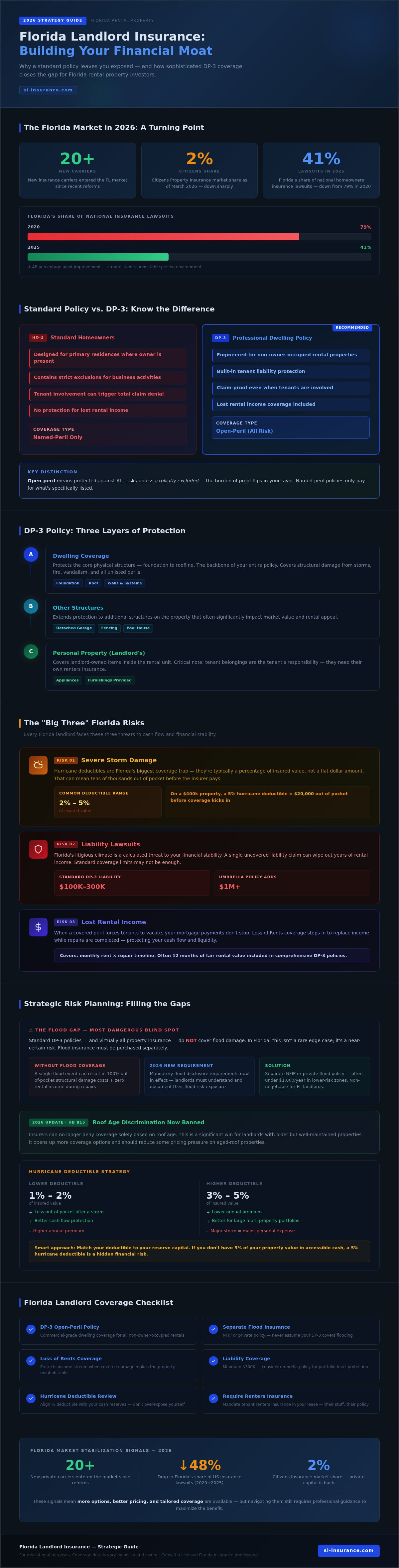
A fundamental distinction exists between a standard homeowners policy (HO-3) and a professional dwelling policy (DP-3). While an HO-3 is designed for primary residences where the owner is present to mitigate minor issues, a DP-3 is engineered for the specific risks of non-owner-occupied properties. Understanding Property Insurance Basics is essential here; the DP-3 provides "open peril" coverage, protecting the structure against all risks unless they're explicitly excluded. This level of precision is vital in a state where environmental and legal risks can fluctuate overnight. It provides the intellectual confidence required to manage a high-value portfolio without the constant fear of an uncovered loss.
The Strategic Importance of a Landlord-Specific Policy
Relying on a personal lines policy for a rental property is a dangerous gamble that often ends in financial distress. Most standard homeowners forms contain strict exclusions for business activities, which can lead to a total denial of claims if a tenant is involved. Landlord-specific policies are built to fill these critical gaps, particularly regarding tenant-related liability and the preservation of liquidity. By ensuring your coverage aligns with your business structure, you protect the long-term valuation of your real estate portfolio against unforeseen litigation or structural damage. It's about maintaining the financial health of your investment and ensuring that your assets remain liquid even in the face of a significant claim.
Legislative Shifts and Their Impact on Your 2026 Premiums
The legislative environment in Florida has undergone a significant overhaul that is finally yielding tangible results for landlords. Florida's share of national homeowners insurance lawsuits dropped to 41% in 2025, a massive improvement from the 79% seen in 2020. This reduction in litigation, combined with new regulations like HB 815, which prevents insurers from denying coverage solely based on roof age, is creating a more predictable pricing environment. The reduction in market dominance by Citizens Property Insurance, which holds only 2% of the market share as of March 2026, signals a return of private capital and a healthier, more competitive landscape.
For those working with SI Insurance, these shifts represent an opportunity to navigate a market that's finally showing signs of sanity. While the trajectory for the remainder of 2026 suggests continued stabilization, the complexity of these new laws makes local, professional guidance a necessity for any serious investor. You need a partner who understands how these legislative changes translate into premium savings and improved coverage terms.
The Anatomy of a DP-3 Policy: The Professional Standard
For the sophisticated investor, the DP-3 policy form represents the pinnacle of property protection. Unlike basic residential forms, it's designed with a commercial mindset to address the specific vulnerabilities of rental assets. The structure of landlord insurance florida is typically divided into three primary coverage sectors, each acting as a distinct layer of your financial defense. Coverage A focuses on the dwelling itself, protecting the core physical structure from the foundation to the roofline. Coverage B extends this protection to other structures on the premises, such as detached garages, perimeter fencing, or pool houses, which are often vital to a property's market value.
While Coverage C manages your personal property within the rental, like major appliances or furnishings provided to tenants, it's essential to remember that these policies are structured to exclude certain environmental catastrophes. For instance, even the most comprehensive DP-3 doesn't include protection against rising water, which is why we always recommend consulting the National Flood Insurance Program to address that specific gap. By understanding these components, you can ensure that every square inch of your investment is accounted for within your risk management framework.
Open Perils vs. Named Perils: Why DP-3 is Superior
The technical superiority of the DP-3 lies in its "open perils" designation for the dwelling. In a named perils policy, such as a DP-1 or DP-2, the burden of proof rests entirely on your shoulders; you must prove that the damage was caused by a specific event listed in the contract. Under a DP-3, the burden shifts to the insurance carrier. Every risk is covered unless the insurer can specifically point to an exclusion in the policy text. This shift in the legal landscape provides a significant tactical advantage during the claims process, especially when dealing with the complex, multi-faceted damage often seen after a major Florida storm.
Tailoring Coverage for Corporate and Trust Ownership
A common oversight among growing investors is failing to align their insurance with their legal entity structure. If your property is deeded to an LLC, trust, or partnership for asset protection purposes, your policy must reflect that ownership precisely. A standard retail policy may not allow for corporate naming, which can create a catastrophic disconnect during a liability suit. Professional DP-3 policies are engineered for this flexibility, allowing you to name your business entity as the primary insured while maintaining the integrity of your corporate veil. If you're managing a complex portfolio, partnering with a specialized agency ensures your insurance architecture matches your legal strategy.
Mitigating the 'Big Three' Florida Risks: Storms, Liability, and Lost Income
Success in the Florida rental market is often measured by the resilience of your defense against three specific pillars of risk: catastrophic weather, legal liability, and the sudden cessation of cash flow. While the physical structure is the most visible asset, the economic stability of your investment depends on how well you've engineered your landlord insurance florida to handle these pressures. The most overlooked component is often the economic loss factor. This hidden vulnerability can bankrupt an investor even if the building is eventually repaired, simply because the carrying costs outlive the cash reserves.
Fair Rental Value: Your Cash Flow Guardian
If a hurricane renders your property uninhabitable, forcing tenants to vacate for six months, your mortgage, taxes, and maintenance fees don't simply pause. Fair Rental Value coverage is specifically designed to replace that lost income during the period of restoration. At SI Insurance, we help you calculate the true impact on your ROI by ensuring your limits reflect actual 2026 market rents rather than outdated figures. This protection provides the psychological and financial breathing room needed to manage a reconstruction without draining your personal capital or sacrificing your long-term liquidity. It transforms a potential bankruptcy event into a manageable business interruption.
Liability Defense in a Litigious Environment
Florida remains a complex environment for property owners, where a single slip-and-fall incident can escalate into a multi-year legal battle. Even with the decline in statewide lawsuits mentioned earlier, the state still accounts for a significant portion of the nation's homeowners insurance litigation. Relying on a standard $300,000 liability limit is increasingly viewed as a strategic error for high-value portfolios. Sophisticated investors utilize a multi-layered approach, often integrating their landlord policy with personal umbrella insurance to extend their protection into the millions.
You shouldn't ignore the "Medical Payments to Others" provision as a proactive tool. It allows for the immediate settlement of minor injuries regardless of fault. By covering a tenant's quick trip to the urgent care or a guest's diagnostic fees, you can often resolve a situation with goodwill before it ever reaches a plaintiff's attorney. It's a small but powerful tactical move that favors resolution over litigation. When combined with a robust liability limit, it creates a formidable barrier between your personal assets and the risks inherent in the rental business. This proactive methodology is what separates a casual landlord from a professional real estate investor.
Strategic Risk Planning: Deductibles, Flood, and Excess Liability
Strategic risk planning is the deliberate process of deciding which financial burdens you'll carry personally and which you'll transfer to an insurance carrier. In a market where premiums remain a significant line item for any rental business, mastering the interplay between deductibles and supplemental policies is the hallmark of a seasoned investor. It's about more than just finding the lowest price; it's about ensuring your landlord insurance florida functions as a reliable safety net during the state's most volatile moments.
The Math of Deductibles: A Calculated Choice
Hurricane deductibles in Florida are typically percentage-based, generally ranging from 2% to 10% of the dwelling's total replacement value. While opting for a 10% deductible can provide immediate relief on your annual premium, it creates a substantial liquidity requirement during a catastrophe. For example, a property with a $500,000 dwelling limit and a 10% deductible leaves you responsible for the first $50,000 of repairs. We help our clients analyze their cash reserves to ensure they're choosing a deductible that balances short-term savings with the necessity of long-term solvency. If your business model relies on tight margins, a lower deductible is often the more prudent, defensive move.
Flood Insurance: The Essential Secondary Layer
Many landlords mistakenly believe their comprehensive DP-3 policy covers all storm-related damage, but this is a dangerous myth that can lead to catastrophic out-of-pocket losses. Standard policies almost universally exclude damage resulting from rising water or storm surge. Whether your property is located in a FEMA-designated high-risk zone or a seemingly safe inland area, a separate flood policy is a mandatory component of a "fortress" strategy. You can explore the technical nuances and carrier options in our Florida Flood Insurance guide to see how the National Flood Insurance Program compares to the emerging private market.
Professional inspections serve as your greatest leverage in the 2026 market. With recent regulatory shifts like HB 815, insurers are now prohibited from denying coverage based solely on the age of a roof if its actual condition is sound. By providing documented proof of "home hardening"—such as impact-resistant windows or secondary water barriers—you can often secure more competitive rates and better terms. This proactive approach turns your property's physical resilience into a financial asset, allowing you to negotiate from a position of strength. If you're ready to move beyond generic coverage, contact Si Insurance Agency to design a methodical risk management plan tailored specifically to your portfolio's needs.
Securing Your Legacy with Si Insurance Agency
Managing a high-value real estate portfolio in the Sunshine State requires more than just a standard insurance provider; it demands a partnership with a seasoned guardian who understands the architectural integrity of your financial defense. As an independent agency with deep local roots in Sunrise and Pompano Beach, Si Insurance Agency operates with a calm, calculated focus that matches the sophistication of our clients. We recognize that landlord insurance florida isn't a static product but a dynamic component of your broader business strategy. By moving away from transactional relationships and toward a long-term strategic partnership, we ensure your assets remain protected against the evolving legal and environmental risks of the 2026 market.
Our Methodical Approach to Risk Assessment
Our methodology is rooted in a step-by-step progression designed to instill absolute security and intellectual confidence. We begin by conducting a rigorous analysis of your entire portfolio to identify hidden vulnerabilities or costly redundancies that often go unnoticed by generalist agents. This process isn't about rushing to a quote; it's about the quiet power of technical mastery. We examine the intersection of your property's physical condition and your corporate entity structure to craft a bespoke solution that mirrors your intricate business needs. By leveraging our elite network of specialized carriers, we match your specific risk profile with the most robust coverage available, ensuring that your insurance architecture is as resilient as the properties it protects.
Next Steps: Initiating Your Strategic Review
Transitioning to a professional risk management framework begins with a comprehensive audit of your existing coverage. When you consult with our elite team, you can expect a measured and deliberate evaluation that prioritizes long-term security over short-term fixes. We don't believe in generic solutions because we know your needs are unique. To facilitate a thorough 2026 policy audit, we typically review several key data points, including your current declarations pages, recent 4-point or wind mitigation inspection reports, and documentation regarding your LLC or trust ownership structures. This level of detail allows us to provide a level of precision that safeguards your legacy against the unexpected.
If you're ready to align your insurance with your organizational goals and secure a partner who acts as a meticulous guardian for your investments, the path forward is clear. Contact Si Insurance Agency for a Professional Consultation and discover how a methodical, expert approach can transform your property protection from a simple expense into a strategic advantage.
Strengthening Your Real Estate Legacy in 2026
We've explored the intricate layers required to protect your rental assets, from the technical superiority of a DP-3 policy to the strategic math behind hurricane deductibles. In the 2026 market, securing landlord insurance florida is about more than just finding a carrier; it's about aligning your coverage with your business goals to ensure your cash flow remains uninterrupted after a major event. By eliminating the "flood gap" and establishing a multi-layered liability defense, you move from a position of vulnerability to one of intellectual confidence.
Si Insurance Agency stands as a methodical partner in this journey, offering the specialized Florida risk management and independent expertise needed to navigate this high-stakes landscape. Our professional service is designed for landlords who value foresight and precision. You don't have to manage these complex risks alone. Secure Your Investment with a Strategic Landlord Insurance Quote today. Building a resilient portfolio is a deliberate process, and we're here to ensure your financial moat remains impenetrable for years to come.
Frequently Asked Questions
Is landlord insurance legally required in the state of Florida?
Florida law doesn't mandate that property owners carry landlord insurance, but it's almost universally required by mortgage lenders to protect their collateral. Even if you own your property outright, operating without a policy is a high-risk strategy that leaves your personal assets vulnerable to the state's extreme weather and litigious environment. Maintaining a robust policy is a fundamental requirement for any professional risk management plan.
Does landlord insurance cover my tenant's personal belongings?
Your policy is designed to protect the physical structure and the liability of the property owner; it doesn't extend to the tenant's furniture, electronics, or clothing. We recommend that you require tenants to maintain their own renters insurance as a condition of the lease. This practice ensures that their personal losses are handled independently and reduces the likelihood of a legal dispute between you and your occupants.
What is the difference between a DP-1, DP-2, and DP-3 policy in Florida?
A DP-1 is a basic policy covering only specifically named perils, while a DP-3 provides the most comprehensive "open perils" protection available for rental properties. The DP-3 is the industry standard for landlord insurance florida because it covers every risk unless it's explicitly excluded in the contract. This shift in the burden of proof provides you with a significant tactical advantage during the claims process.
How does a hurricane deductible differ from a standard all-peril deductible?
A hurricane deductible applies only to damage caused by named storms and is typically calculated as a percentage of your dwelling coverage, often ranging from 2% to 10%. A standard deductible is usually a flat dollar amount for everyday incidents like fire or plumbing leaks. You must ensure that your business maintains enough liquidity to cover this percentage-based cost if a major storm impacts your property.
Can I bundle my landlord insurance with my primary residence or auto policy?
Many carriers offer multi-policy discounts, but bundling requires careful coordination if your rental properties are held in an LLC or trust. If your business and personal assets are legally separated, a standard bundle might not be the most effective way to maintain your corporate veil. We help you determine if the premium savings of a bundle outweigh the potential risks to your asset protection structure.
Does landlord insurance cover damage caused by a flood or storm surge?
Standard landlord policies almost never cover damage from rising water or storm surge, even when it's caused by a hurricane. As of January 1, 2026, Citizens Property Insurance requires all properties with a replacement cost of $400,000 or more to maintain separate flood insurance. Every Florida investor should secure a dedicated flood policy to ensure their financial moat doesn't have a catastrophic opening.
What happens to my insurance if I move my rental property into an LLC?
Moving your property into an LLC requires an immediate policy endorsement to name the entity as an additional insured or the primary policyholder. If your insurance doesn't match your legal ownership exactly, you risk a total denial of liability claims during a lawsuit. This step is a critical part of your methodical progression toward total security and ensures your legal protections remain intact.
How much liability coverage should a Florida landlord carry in 2026?
While a $300,000 limit was once the baseline, many sophisticated landlords in 2026 now carry $500,000 or more, often supplemented by a personal umbrella policy. Your liability limits should be high enough to protect the total value of your real estate portfolio from a single legal judgment. This multi-layered defense is essential in a state where legal claims can quickly escalate into high-value settlements.
Comments