


How to Choose the Right Business Insurance in Florida: A Strategic 2026 Guide
- siinsuranceflorida
- 6 days ago
- 13 min read
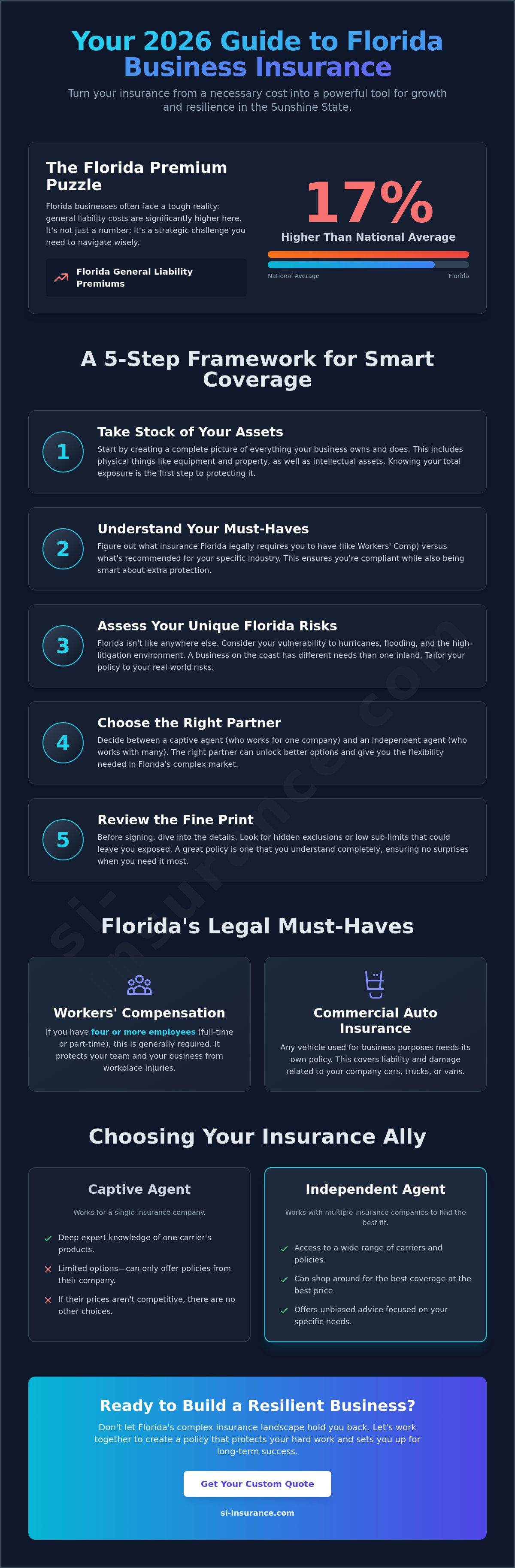
Most Florida entrepreneurs view their insurance premiums as a fixed tax on growth, but in 2026, the most successful leaders treat risk mitigation as a competitive advantage rather than a line-item expense. You've likely felt the pressure of general liability costs that sit 17% above the national average, making the question of how to choose the right business insurance in Florida more than just a clerical task. It's a high-stakes decision that requires balancing mandatory thresholds, such as the workers' compensation requirements for firms with four or more employees, against the unpredictable volatility of the coastal environment.
We recognize the underlying concern that comes with deciphering complex state-mandated clauses or the fear that a hidden exclusion in a hurricane policy could jeopardize your enterprise. This guide provides a sophisticated framework to help you master these complexities with intellectual confidence and precision. You'll gain a clear methodology for policy selection that accounts for recent legislative shifts, including the 2026 protections against arbitrary roof non-renewals. We've engineered this guide to give you the strategic foresight needed to mitigate specific industry risks while ensuring your organization remains resilient in a complex financial landscape.
Key Takeaways
Learn to transition from viewing insurance as a static expense to a dynamic asset that safeguards your enterprise against Florida's unique environmental and financial volatility.
Implement a professional five-step framework that clarifies how to choose the right business insurance in Florida by aligning policy selection with your specific industry risks.
Master the nuances of state-mandated requirements, ensuring your organization remains compliant with current 2026 Workers' Compensation and Commercial Auto liability thresholds.
Evaluate the strategic benefits of partnering with independent agents who provide the flexibility and carrier access needed to navigate a complex and often restrictive market.
Gain the foresight to identify hidden exclusions and sub-limits, ensuring your long-term security is never compromised by the fine print of a standard policy.
Table of Contents
Understanding the Florida Business Climate: Why Your Choice is Critical
Running a company in Florida in 2026 often feels like a balancing act between staying profitable and staying protected. With general liability premiums trending about 17% higher than the national average, you're likely feeling the squeeze on your budget. But figuring out how to choose the right business insurance in Florida is about more than just finding the lowest price tag; it's about making sure a single bad afternoon doesn't wipe out years of hard work. The reality is that "standard" coverage often misses the mark here because our state's risks are anything but standard.
Your specific zip code plays a massive role in your risk profile. For example, a business owner in Sunrise deals with different environmental pressures than someone operating right on the water in Pompano Beach. A warehouse inland doesn't face the same immediate storm surge threats as a storefront on the coast. Understanding these local quirks is the first step toward building a solid Business Owner's Policy (BOP) that actually fits your needs. It's about being smart and localized with your strategy so you aren't paying for things you don't need while leaving the back door wide open to risks you do face.
To better understand this concept, watch this helpful video:
Environmental Risks Unique to the Sunshine State
Florida's weather is a major factor that can't be ignored. You have to look closely at windstorm, flood, and hurricane-related business interruption. Many owners get caught in the trap of confusing "water damage" from a burst pipe with "flood damage" from rising tides. In 2026, knowing exactly where your building sits in the Broward County flood zones isn't just helpful; it's vital for your survival. If you don't have those specific layers in place, your assets are essentially on their own when the clouds turn gray. Comprehensive coverage should prioritize the reality of our tropical climate.
The Regulatory and Litigation Environment in 2026
The legal side of things in Florida is just as intense as the weather. We live in a high-litigation state, which means your liability limits need to be robust enough to handle potential lawsuits that might be less common elsewhere. Recent laws like House Bill 459 have tried to streamline property disputes, but the best defense is still a policy that's been engineered for this specific climate. Planning for long-term stability means looking at these legal realities as a standard part of your overhead. If you're looking for a partner who understands these local shifts, SI Insurance can help tailor a plan that makes sense. You can always check out more localized advice at si-insurance.com to see how these rules affect your specific industry.
A 5-Step Framework for Choosing the Right Coverage
Selecting commercial protection shouldn't be a race against a clock. While some platforms promise a seven-minute quote, a truly resilient strategy requires a methodical framework for choosing insurance that respects the specific variables of your business. The process of how to choose the right business insurance in Florida begins with a shift in perspective, moving away from transactional buying toward strategic risk engineering. By following a structured approach, you ensure that your coverage is both comprehensive and cost-effective.
Step 1: Conduct a rigorous audit of all physical and intellectual assets to determine your total exposure.
Step 2: Differentiate between state-mandated coverages and industry-specific recommendations that provide a competitive safety net.
Step 3: Evaluate your internal financial capacity to absorb minor losses through higher deductibles versus the stability of lower-retention premiums.
Step 4: Compare the efficiency of a bundled Business Owners Policy (BOP) against the surgical precision of standalone specialized policies.
Step 5: Partner with an independent agent who offers access to multiple carriers, ensuring your loyalty remains with your business goals rather than a single insurance brand.
This methodology prevents the common mistake of over-insuring low-risk areas while leaving high-value assets exposed. When you understand how to choose the right business insurance in Florida, you're not just buying a policy; you're securing the long-term viability of your enterprise against the state's specific economic and environmental pressures.
Auditing Your Exposure: What Are You Actually Protecting?
Your physical location is only one piece of the puzzle. Intellectual property, digital data, and human capital represent significant exposures that often go overlooked until a breach or lawsuit occurs. Silent risks, such as cyber threats and employment practices liability, can be just as devastating as a Category 4 storm. Your risk appetite is essentially the calculated balance between the losses your organization can comfortably self-insure and the risks that must be transferred to a policy carrier.
The BOP vs. Standalone Policy Debate
A Business Owners Policy (BOP) often serves as the most efficient vehicle for Florida small businesses, bundling general liability and property coverage into a single, cost-effective structure. However, high-risk sectors or specialized industries may find the standard limits of a BOP insufficient for their unique needs. In these cases, layering standalone policies ensures that no gaps exist between your professional liability and your physical asset protection. If you're ready to refine your strategy, exploring specialized business insurance options with a local consultant can provide the clarity you need.
Florida’s Mandatory Insurance: Navigating Legal Requirements
While we've focused on building a custom strategy for your assets, there are parts of your insurance plan that the state of Florida simply won't let you skip. It's helpful to think of these legal requirements as the floor of your protection plan. If you're figuring out how to choose the right business insurance in Florida, you have to start by meeting the standards set by the Florida Division of Workers' Compensation and the Department of Highway Safety and Motor Vehicles. Falling short here doesn't just leave you exposed to accidents; it can lead to heavy fines or even being forced to shut your doors until you're compliant.
Workers’ Comp Nuances in Florida
Workers' compensation is one of the most common points of confusion for new owners. For most businesses, the state says you need coverage once you hit four employees, whether they're full-time or part-time. However, if you're in the construction industry, the rules are much tighter. You need coverage the moment you hire your very first employee. The good news for 2026 is that the state approved a 6.9% rate decrease, which is the tenth year in a row that rates have gone down. If you're a business officer or an LLC member with at least 10% ownership, you can apply for an exemption for a $50 fee, but many owners choose to stay covered anyway. It's often worth it to have that personal safety net in case of a workplace injury that your regular health insurance might not want to touch.
Commercial Auto vs. Personal Auto for Business Use
Many people assume they can just use their personal car for business errands, but that's a dangerous gap to leave open. Florida is a no-fault state, so you're required to have at least $10,000 in Personal Injury Protection (PIP) and $10,000 in Property Damage Liability (PDL). If you own vehicles specifically for the business, those limits often need to be much higher. For example, if you're operating a heavy truck over 44,000 lbs, the state requires a limit of at least $300,000. Taxis and limos in areas like Broward County have their own requirements, usually $125,000 for bodily injury per person. You can find more details on commercial auto insurance options that keep you on the right side of the law while you're on the road.
Professional liability, or Errors and Omissions (E&O), is another one to watch. Depending on your specific industry board, you might be required to carry this to keep your license active. Skipping these mandated coverages is never worth the risk. A single audit or accident could result in administrative penalties that far outweigh the cost of a monthly premium. As you refine your approach to how to choose the right business insurance in Florida, make sure these legal basics are locked down first so you can focus on growing your business with a clear conscience.
Vetting Your Insurance Partner: Captive vs. Independent Agents
The partnership you establish with an insurance professional is as critical to your enterprise's security as the policies themselves. Selecting the right coverage is only half the battle; the entity you choose to represent your interests can be the difference between a seamless recovery and a bureaucratic nightmare. Captive agents, while often professional, are fundamentally limited to the products of a single carrier. In a market as volatile as Florida's, this narrow scope can be a significant liability. Understanding how to choose the right business insurance in Florida means recognizing that your needs will evolve, and having access to multiple carriers ensures your protection evolves with you.
Independent agents act as sophisticated consultants rather than retail salespersons. They represent you, the client, rather than the insurance company. This distinction is vital when it's time to advocate for a claim or negotiate terms in a tightening market. By maintaining relationships with dozens of carriers, an independent partner can pivot your coverage if one insurer decides to restrict its Florida footprint or significantly increase its rates. This flexibility provides a layer of stability that a single-brand agent simply cannot offer.
The Power of Choice in a Hard Market
Florida is currently experiencing what industry professionals call a hard market, where insurance capacity is limited and underwriting standards are exceptionally rigorous. In this environment, the methodology of comparing quotes from ten or more carriers simultaneously is the only way to ensure competitive pricing and comprehensive terms. A sophisticated consultant doesn't just look for the lowest premium; they analyze the carrier's solvency, their history of claims handling in the Southeast, and the specific nuances of their policy language. This analytical approach ensures that your organization isn't just buying a document, but a verified promise of protection.
Local Expertise: Beyond the Digital Quote
A partner with deep roots in the community understands how Sunrise zoning differs from Pompano Beach flood risks, providing a level of insight no algorithm can replicate. This localized perspective is a core component of our Business Insurance in Broward County: A Strategic Guide, which outlines why geography dictates your premium. Local agents can perform physical site visits to identify hazards that might be missed in a digital application, potentially lowering your risk profile in the eyes of an underwriter. They act as your primary advocate during the claims process, leveraging their personal relationships with adjusters to ensure your business receives the attention it deserves. If you're seeking a guardian for your enterprise rather than a retail salesperson, you can connect with a local expert to begin your comprehensive risk assessment today.
When vetting a potential partner, ask about their specific experience with Florida's 2026 legislative changes and their history of managing claims in Broward County. Their ability to explain complex mitigation strategies in plain language is a strong indicator of their commitment to your long-term security. A true partner doesn't just sell you a policy; they engineer a strategy that allows you to focus on growth with absolute intellectual confidence.
Finalizing Your Protection: Next Steps for Florida Entrepreneurs
Once you've navigated the frameworks and legal mandates, the final step in how to choose the right business insurance in Florida involves a meticulous examination of the fine print. Many entrepreneurs overlook the nuances of exclusions and sub-limits, assuming a "full coverage" label covers every eventuality. In reality, a policy is a legal contract with specific boundaries. You need to ensure your deductibles align with your cash flow and that sub-limits for specialized risks, like cyber breaches or windstorm damage, don't leave you underinsured when you need it most. This alignment ensures your insurance isn't just a safety net; it's a strategic component of your overall business growth plan that allows you to take calculated risks with confidence.
Mastering how to choose the right business insurance in Florida is an ongoing process of refinement rather than a one-time transaction. By integrating your risk management strategy into your quarterly or annual planning, you ensure that your protection keeps pace with your ambition. This proactive stance is what separates the state's most resilient enterprises from those that are one claim away from insolvency.
The Annual Review: Why 'Set it and Forget it' is Dangerous
A business is a living entity, and its insurance should be equally dynamic. The "set it and forget it" mentality is a significant risk factor in Florida's fast-changing economy. As your revenue climbs, your headcount expands, or your equipment inventory grows, your liability profile shifts fundamentally. Additionally, property values must be adjusted to reflect 2026 construction costs, which have seen considerable fluctuations due to supply chain and labor variables. Staying stagnant means you're likely paying for yesterday's risks while ignoring today's growth. We also recommend evaluating how recent legislative updates, such as the 2026 roof renewal protections, might impact your existing coverage limits or provide new opportunities for premium stabilization.
Securing Your Quote with SI Insurance
Moving from theory to practice requires a partner who understands the local soil. At SI Insurance, we bridge the gap between education and implementation. Our deep roots in Sunrise and Pompano Beach allow us to offer more than just a quote; we provide a strategic defense for your legacy. We've engineered our process to be thorough yet efficient, ensuring your risk management strategy scales alongside your business goals. We take the time to walk you through the nuances of your specific industry, acting as the protective guardian your enterprise deserves. If you're ready to move beyond generic solutions and secure a partner who values long-term security as much as you do, you can Contact SI Insurance for a tailored commercial consultation to secure your organization's future.
Securing Your Enterprise for the Future
Your business is a reflection of your hard work and vision, and protecting it shouldn't be left to chance or generic digital algorithms. We've explored how a methodical approach, from auditing your physical assets to understanding 2026 workers' compensation thresholds, creates a foundation for long-term stability. You now have a professional framework for how to choose the right business insurance in Florida that prioritizes strategic risk engineering over simple premium comparisons.
Since 2022, Si Insurance Agency has provided specialized knowledge in Business Owners Policies (BOP) and Commercial Auto insurance to entrepreneurs across Sunrise and Pompano Beach. As an independent agency with access to multiple Florida carriers, we act as your protective guardian, ensuring your coverage remains as dynamic as the state's economy. Transitioning from planning to implementation is the most critical step in safeguarding your legacy against the unpredictable.
Request a Strategic Business Insurance Consultation with Si Insurance to align your protection with your growth goals. We're here to help you move forward with absolute confidence.
Frequently Asked Questions
Is business insurance required by law in Florida?
Yes, certain types of coverage are legally mandated depending on your industry and workforce size. Florida law requires any non-construction business with four or more employees to carry workers' compensation insurance, while construction companies must have it if they have even one employee. Additionally, all business-owned vehicles must maintain minimum liability limits for personal injury protection and property damage to operate legally on state roads.
How much does business insurance cost in Florida in 2026?
Premiums are influenced by your specific industry and location, but Florida small businesses typically pay roughly 17% more than the national average for general liability coverage. While the state approved a 6.9% decrease in workers' compensation rates for 2026, your final costs will depend on your claims history and the safety protocols you've implemented. It's best to consult with an agent who can compare multiple carriers to find the most efficient pricing for your risk profile.
Do I need a separate flood insurance policy for my Florida business?
Yes, a standalone flood policy is almost always necessary because standard commercial property insurance excludes damage from rising external water. In our coastal environment, storm surges and heavy tropical rainfall make this a critical component of how to choose the right business insurance in Florida. Relying on a standard policy alone could leave your physical assets completely unprotected during a significant weather event.
What is a Business Owners Policy (BOP) and is it right for me?
A Business Owners Policy (BOP) is a strategic bundle that combines general liability and commercial property insurance into one cost-effective contract. It's designed for small to medium-sized enterprises that need foundational protection against common risks like fire, theft, or slip-and-fall lawsuits. While it's an excellent starting point for many, businesses with high-risk operations or specialized professional needs might require additional standalone policies to ensure no gaps exist in their defensive strategy.
How does Florida’s litigation climate affect my liability insurance choice?
Florida's aggressive legal environment means that standard liability limits are often insufficient to protect an enterprise from a catastrophic lawsuit. When you're deciding how to choose the right business insurance in Florida, it's wise to consider higher limits or an umbrella policy to provide an extra layer of financial buoyancy. This foresight ensures that a single legal dispute doesn't jeopardize the long-term stability or the legacy of your organization.
Can I use my personal car for business in Florida without commercial auto insurance?
No, using a personal vehicle for business tasks often triggers exclusions in your personal policy, leaving you without coverage during an accident. If you or your employees use vehicles for deliveries, client visits, or transporting equipment, a commercial auto policy is required to protect your assets. This ensures you meet the 2026 state liability requirements for business use, which are often higher than those for personal transportation.
What happens if I don't have Workers' Comp insurance in Florida?
Operating without mandated workers' compensation can result in devastating administrative fines and the issuance of a stop-work order by the state. Beyond these legal penalties, you'd be held personally responsible for an injured employee's medical bills and lost wages, which can reach hundreds of thousands of dollars. It's a gamble that risks the entire future of your company for a relatively small savings in premium costs.
How often should I review my Florida business insurance policy?
You should conduct a formal review of your coverage at least once a year or whenever your organization experiences a shift in revenue, headcount, or physical assets. Florida's insurance market and legislative landscape are in a constant state of flux, and 2026 has already introduced new rules regarding property renewals and dispute resolutions. Regular audits with a local independent agent ensure your protection remains perfectly aligned with your current operational reality.
Comments