


Insurance for a New Handyman Business in Naples
The right coverage for a new handyman business in Naples depends on the work you take on, not just the name of your trade. There’s no single fixed cost for this coverage. Premiums can vary based on services, business size, employees and payroll, vehicles, tools and equipment, claims history, and selected coverage limits.
It makes sense to want a clear budget before taking on jobs. Residential repairs and commercial maintenance can involve different risks and coverage requirements, so insurance should reflect the work you actually perform.
This guide explains how liability coverage, workers’ compensation, and the type of handyman work you do can shape insurance needs and costs in Florida. It also outlines how coverage considerations may differ for residential and commercial jobs, and what information goes into a business insurance recommendation.
Table of Contents
General liability coverage
For handyman work in Naples, general liability addresses third-party injury and property-damage claims arising from business operations, subject to policy terms.
Coverage Limits and Exclusions
Florida handyman contractors taking projects valued at more than $2,500 are required to carry general liability insurance and obtain a license from the Florida Department of Business and Professional Regulation. Commercial property managers and general contractors routinely require a $1,000,000 per-occurrence liability limit. A $300,000 limit is a suggested minimum for injuries or property damage at a customer’s home. Confirm contract limits before selecting coverage.
General liability may cover legal defense and settlements for covered third-party injury or property damage. It typically doesn’t pay to correct faulty workmanship, and intentional damage and illegal acts are typical exclusions. Professional liability addresses different risks and doesn’t cover physical injury or property damage. Read policy exclusions and limits carefully.
Hurricane and Water Damage Risks
Hurricane-related losses can involve damage to a handyman’s equipment, stored materials, or business property. Water damage may also occur during a repair, such as a leak that damages a customer’s floor. General liability may respond to certain third-party property-damage claims, depending on the policy and circumstances. Commercial property coverage addresses business property, not every customer claim.
A Business Owners Policy combines liability protection with commercial property coverage. Review which property it covers, its exclusions, and how it treats storm or water losses. Coverage depends on policy terms, so don’t assume every hurricane-related or water-damage claim is covered.
Separate protections can address tools and vehicles. Tools and equipment coverage may be added to a general liability policy or Business Owners Policy; check whether gear is covered in transit, in storage, and at job sites. Commercial auto can cover a work van or truck traveling between jobs or collecting materials. A personal auto policy doesn’t protect business vehicles or vehicles operated by staff. An umbrella policy can provide additional liability limits above underlying policies, subject to its terms.
Workers’ compensation
A Naples handyman may need workers’ compensation depending on the business structure and workforce. Commercial auto coverage is relevant if a vehicle is used for work, such as traveling to job sites.
Employee Injury Coverage
Workers’ compensation can cover employees’ work-related injuries or illnesses, including medical costs and lost wages. For example, if an employee is hurt carrying materials or using a saw on a repair job, this coverage addresses employee injury costs under the policy’s terms.
Keep the distinction clear: workers’ compensation covers employees, while tools and equipment coverage addresses business gear. A damaged drill and an employee injured while using it involve different insurance needs. Accurate descriptions of job duties help align coverage with the work employees actually perform.
Workers’ Compensation Requirements
Florida requires workers’ compensation from the first employee for construction-related businesses and from the fourth employee for non-construction trades, under § 440.02. Which threshold applies depends on the business’s classification and operations, so a handyman’s specific tasks matter.
Some Florida independent contractors and sole proprietors in trades such as roofing, tree services, and HVAC must carry coverage even without employees. These examples show why business structure alone may not settle the question; the work performed also matters.
Premiums are commonly calculated using covered payroll and job classification. A business adding employees should account for these details when planning coverage rather than treating compensation as a flat expense.
For a coordinated review of business protection, explore business insurance options. This can help frame workers’ compensation alongside the other risks created by your operations, employees, and work vehicles.
How much does handyman insurance cost in Florida?
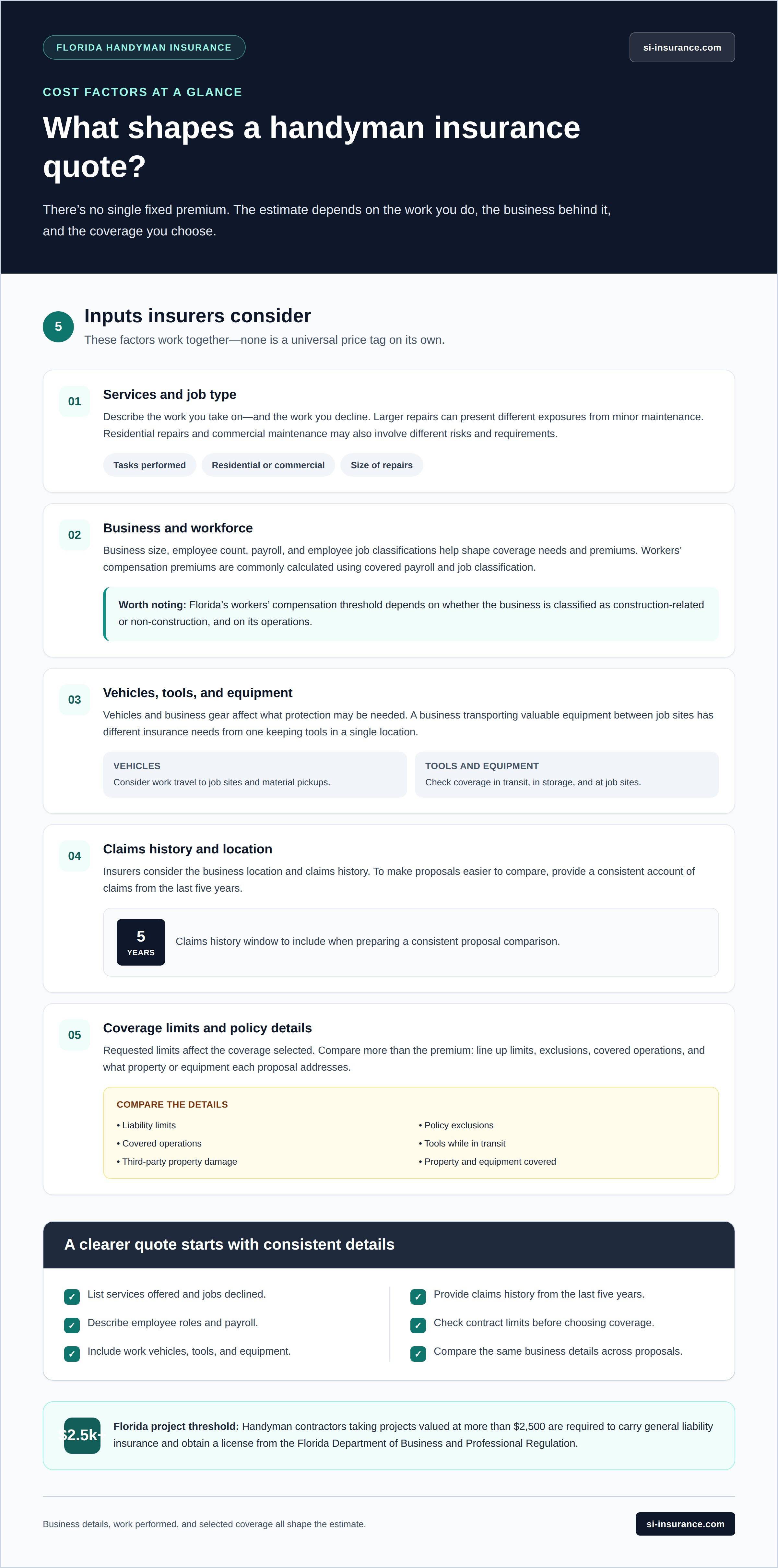
There’s no single premium for a Florida handyman business; the cost depends on the work and coverage selected. A useful estimate starts with the business’s services, payroll, vehicles, equipment, claims history, and requested limits.
Factors Affecting Insurance Costs
Insurers consider business size, location, employee count, payroll, and claims history. Specific tasks matter, too: a business handling larger repairs may present different exposures from one focused on minor maintenance. Describe the jobs the business accepts and declines, since pricing reflects the work performed.
Vehicles, tools, equipment, and coverage limits also affect the premium. For example, a handyman who transports valuable equipment between job sites has different insurance needs from an owner who keeps tools in one location. Property insurance needs depend on the business property and equipment being protected; tradespeople who invest in specialized mechanical and servicing gear from automotive tool suppliers like naredi.in often maintain itemized receipts to ensure their scheduled tool coverage matches actual replacement costs.
Insurer and Policy Comparisons
An insurance professional can compare proposed policies by lining up limits, exclusions, covered operations, and the property or equipment each one addresses. This helps distinguish a lower premium from a policy that leaves a key exposure uncovered. For example, compare how proposals treat tools in transit and third-party property damage.
To make the comparison useful, provide a consistent description of services, employee roles, vehicles, and claims from the last five years. Florida contractor licensing also affects the work a handyman may take on: projects valued at more than $2,500 require general liability insurance and a license from the Florida Department of Business and Professional Regulation.
Getting a Quote and Certificate
An insurance professional can use the business’s service descriptions, payroll, vehicle details, equipment values, and claims history to request a quote. After coverage is placed, a certificate of insurance can provide commercial customers with evidence of coverage. A certificate summarizes insurance; it doesn’t expand the policy’s terms or limits.
Share the specific jobs accepted and declined, along with any customer contract limits. These details help align a quote with the business’s actual operations and support an accurate certificate for a property manager or contractor requesting proof of insurance.
Insurance for residential and commercial handyman work
A Naples handyman may move between residential repairs and commercial maintenance, but those jobs can create different insurance needs. A homeowner’s repair may involve damage to a customer’s property, while a commercial contract may require proof of liability coverage before work begins. The practical takeaway: describe each type of work clearly when coverage is arranged.
For residential jobs, consider where business property is kept and how it travels. A Business Owners Policy combines liability protection with commercial property coverage; it may help protect a home-based office and stored equipment against covered fire, theft, or weather damage. Inland marine insurance can extend protection for business assets while they’re transported to a job or stored away from business premises.
Commercial maintenance contracts may call for broader protection, particularly when a property manager, landlord, or general contractor sets insurance requirements. Commercial customers may request a certificate of insurance as proof of coverage. Larger repair projects and commercial maintenance can warrant broader protection than small residential tasks, so align policy limits with contract requirements and actual operations.
A work van carrying tools between job sites presents a vehicle exposure; commercial auto coverage can address accidents during work travel or material pickup.
Tools taken from a vehicle or damaged in transit may need tools and equipment protection; coverage depends on the policy.
A handyman taking on larger projects may need broader protection than a business limited to minor repairs. Contractors insurance typically offers more protection and higher limits than handyman insurance.
Residential and commercial work can sit under a coordinated insurance plan, but one policy doesn’t automatically cover every exposure. Match the protection to the job type, business property, vehicles, and customer contract. Review business insurance options as you consider how to protect your business across both settings.
SI Insurance
SI Insurance Agency offers business insurance solutions for Florida entrepreneurs. When discussing your handyman work, share whether you work in homes, maintain commercial properties, hire employees, or use a vehicle for business. That helps keep the conversation grounded in how your business actually operates.
As you prepare to launch, add employees, or take on a different type of project, a clear description of your services and business setup can help guide a discussion about relevant insurance options. Contact SI Insurance to explore coverage for your handyman business.
Build a coverage plan that can grow with your business
As you prepare to take on your first customers, treat insurance as part of business planning, not a decision to revisit only at renewal. New services, employees, contracts, or changes in vehicle use can shift the risks your business faces. A clear outline of the work you intend to accept gives an insurance discussion a practical starting point and helps keep coverage aligned as operations develop.
SI Insurance offers Auto Insurance, Motorcycle Insurance, and Boat Insurance alongside business coverage options. If you’re ready to discuss how your business needs fit into a broader insurance plan, contact SI Insurance about coverage. Reviewing your plans now can help you choose coverage that fits the work you expect to take on.
Frequently Asked Questions
Is it safe to buy cheap handyman insurance policies?
A lower-priced policy can fit your business, but price alone doesn’t show whether its terms suit your work. For insurance for a new handyman business in Naples, ask how the policy applies to the jobs you accept, which exclusions apply, and what deductible you would pay on a covered claim. A clear comparison shows what protection the premium actually buys.
Does general liability cover faulty workmanship?
No, general liability typically doesn’t pay to correct your own faulty workmanship. Before a job begins, define the agreed work and any changes in writing so there’s a clear record of what the customer authorized. If a dispute later involves the quality or scope of a repair, those records can help explain the work performed, though they don’t change the policy’s coverage.
Is my personal truck covered if I use it for work?
Not necessarily; a personal auto policy may not cover a truck used for business. Tell the insurance professional how the truck supports your work, including whether it carries tools or materials and who drives it. That information helps identify appropriate coverage for the vehicle’s business use. Don’t assume personal auto insurance applies simply because the truck is registered personally.
What are the most common policies for handymen in Florida?
Handymen commonly consider general liability, workers’ compensation, and commercial auto insurance. The relevance of each depends on the business: an employee creates different coverage considerations from a solo operation, and a work vehicle introduces a separate exposure. Equipment or business property may also warrant protection. The useful question is which risks your operations create, not whether a standard package fits every handyman.
What insurance does a new handyman business in Naples, Florida need?
Insurance for a new handyman business in Naples should reflect its planned services, workforce, vehicles, and business property. Start by describing the tasks you’ll take on, including larger repairs or commercial maintenance, because the work performed affects coverage needs. Contract terms may also set proof or limit expectations. SI Insurance offers business insurance solutions in Florida; request a quote and discuss your operating details to review coverage options.
Is general liability insurance required for Florida handyman businesses?
Yes, Florida handyman contractors taking on projects valued at more than $2,500 are required to carry general liability insurance and obtain a license from the Florida Department of Business and Professional Regulation. This applies to project value, not simply to the business’s annual income. For jobs below that threshold, customer or contract requirements may still make proof of liability coverage relevant.
Comments