


RV Insurance in Florida: A Strategic Guide to Protecting Your Mobile Lifestyle
- siinsuranceflorida
- Mar 20
- 15 min read
On September 28, 2022, Hurricane Ian's landfall resulted in a staggering $1.1 billion in documented losses for recreational vehicle owners who lacked the strategic risk mitigation provided by comprehensive rv insurance florida. You've likely felt that same sense of unease while watching coastal storm tracks, wondering if a simple auto policy extension truly accounts for the sophisticated personal property and structural assets housed within your mobile residence. It's a common concern among high-value asset owners who recognize that standard retail coverage often fails to address the intricate liabilities inherent in a mobile lifestyle.
SI Insurance developed this guide to provide the intellectual framework you need to satisfy Florida Statutes while providing bespoke protection against the unique environmental and legal complexities of the Sunshine State. We'll dissect the critical differences between standard liability and specialized full-timer coverage, ensuring your investment remains shielded through rigorous underwriting excellence and strategic alignment with your long-term goals. By the end of this analysis, you'll possess the clarity required to transform your insurance from a mere requirement into a robust shield for your mobile estate.
Key Takeaways
Identify the foundational hybrid coverages required by law, ensuring your mobile lifestyle remains both compliant and strategically protected from the start.
Explore how bespoke additions like total loss replacement can shield your high-value investment and personal gear from the steep costs of depreciation.
Distinguish between recreational and full-timer status to secure liability protection that functions with the same rigor as a traditional homeowners policy.
Learn to navigate unique environmental risks, from hurricane preparedness to coastal corrosion, by optimizing your rv insurance florida strategy.
Discover why partnering with an independent agency provides the sophisticated underwriting necessary to match your specific vehicle profile with the ideal carrier.
Table of Contents Understanding RV Insurance Requirements in Florida Specialized Coverages for the Sophisticated RVer The Strategic Full-Timer: Florida Residency and Insurance Mitigating Florida-Specific Environmental Risks Selecting Your Strategic Insurance Partner in Broward County
Understanding RV Insurance Requirements in Florida
Securing a comprehensive Understanding RV Insurance Requirements in Florida involves more than simple compliance with Department of Highway Safety and Motor Vehicles (FLHSMV) mandates. Florida law views a motorhome as a sophisticated hybrid; it's a vehicle that combines the kinetic risks of a multi-ton transport with the static liabilities of a private residence. For residents, this dual nature means your policy must address both road hazards and premises liability. The state requires every motorized unit to carry a base level of protection to maintain valid registration and plates.
To better understand this concept, watch this helpful video:
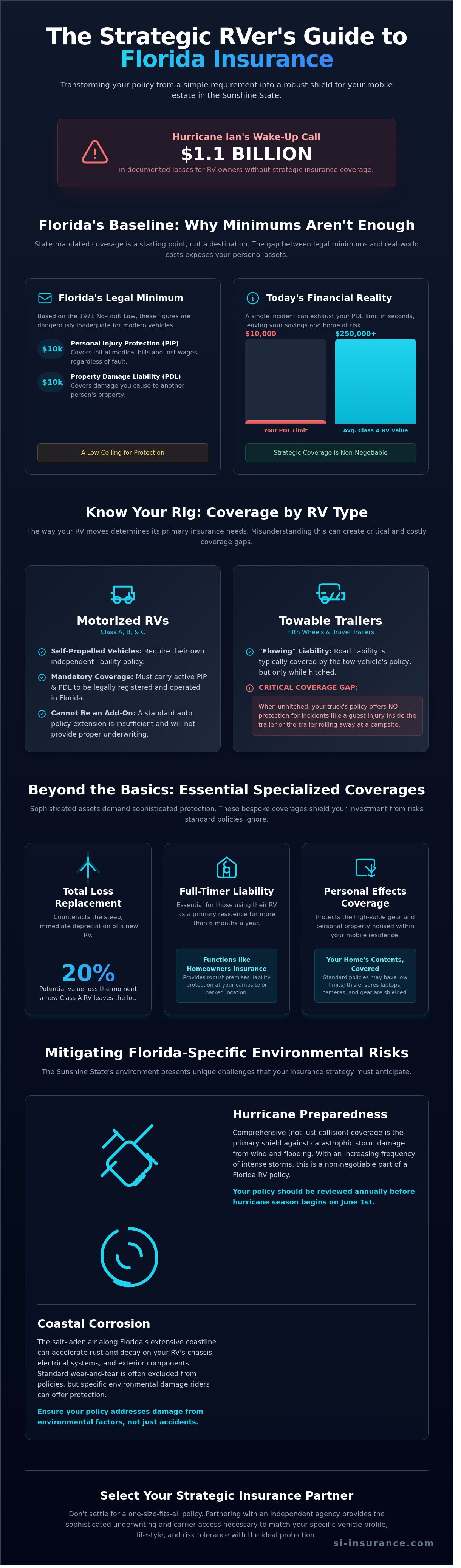
The baseline for rv insurance florida is anchored in the 1971 No-Fault Law. This statute requires $10,000 in Personal Injury Protection (PIP) and $10,000 in Property Damage Liability (PDL). While these figures might've been sufficient decades ago, they're dangerously inadequate in 2024. A mid-range Class A motorhome can easily cost $250,000. If you're involved in a collision with a modern luxury SUV, a $10,000 PDL limit will be exhausted in seconds. This leaves your personal assets, including your home and savings, exposed to legal judgments. Strategic risk mitigation suggests that these minimums are merely a starting point for legal operation, not a ceiling for actual protection.
Motorized RVs vs. Towable Trailers: Legal Distinctions
In Broward County alone, there are over 15,000 registered recreational vehicles, each classified by its propulsion method. Class A, B, and C motorhomes are self-propelled and require their own independent liability policies. You can't simply add them to a standard auto policy and expect underwriting excellence. Towable trailers, such as fifth wheels or travel trailers, don't legally require separate liability insurance because the liability typically "flows" from the truck's policy. However, this creates a coverage gap when the unit is unhitched. If a trailer rolls away at a campsite or a guest is injured inside while it's parked, your truck policy won't provide a bespoke risk transfer for those specific incidents.
Personal Injury Protection (PIP) in the Sunshine State
Florida's no-fault system is designed to provide immediate medical capital regardless of who caused a collision. This is particularly relevant for RVers who may be far from their primary healthcare providers when an accident occurs. Florida PIP is a mandatory $10,000 benefit regardless of accident fault. For those with high-deductible health insurance plans, aligning your PIP limits is a critical step in your financial strategy. It ensures that the first $10,000 of medical bills and lost wages are covered without waiting for a lengthy legal determination. Most sophisticated policyholders opt for a $0 deductible on their PIP to ensure they don't have to pay out-of-pocket during the initial stages of a claim recovery process.
Class A Motorhomes: Require independent registration and active PIP/PDL.
Towables: Require registration and tags but rely on the tow vehicle for road liability.
Full-Timer Liability: Necessary for those using their RV as a primary residence for more than 6 months a year.
Specialized Coverages for the Sophisticated RVer
Owning a high-end motorhome in the Sunshine State requires more than just meeting the basic legal mandates. While standard policies cover the essentials, they often fail to address the unique financial exposures inherent in luxury assets. Strategic risk management for your rv insurance florida policy involves looking beyond the road to the lifestyle itself. For instance, a new Class A diesel pusher can lose 20% of its value the moment it leaves the dealership lot. Without total loss replacement coverage, a significant portion of your capital remains unprotected against this rapid, early-term depreciation.
Protecting the contents within the vehicle is equally vital. Standard policies might provide a negligible amount for personal property; however, sophisticated owners often carry $15,000 or more in high-value electronics, specialized gear, and jewelry. Securing specialized personal effects coverage ensures these items are replaced at their actual cost rather than a depreciated market rate. This level of foresight is a hallmark of SI Insurance, where we prioritize the preservation of your mobile estate through meticulous underwriting and bespoke risk transfer solutions.
When your unit is stationary, the nature of your liability undergoes a fundamental shift. You're no longer just a driver; you're effectively a homeowner. If a guest trips on your step at a luxury Florida resort, your standard auto policy might leave you vulnerable to significant personal loss. Understanding specialized coverages for RVs helps bridge the gap between vehicular and premises liability. Additionally, an emergency expense allowance provides a strategic safety net. If a mechanical failure or accident renders your RV uninhabitable while you're more than 50 miles from home, this provision covers lodging and transportation costs. These expenses averaged $250 per night in Florida during the 2024 peak season, making this a critical component of any comprehensive rv insurance florida strategy.
Total Loss Replacement and Agreed Value
Choosing between market value and agreed value is a critical decision in risk transfer. Market value settles claims based on what a similar unit would cost today, which often results in a lower payout due to rapid depreciation. Agreed value locks in a specific number at the start of the policy term, providing absolute financial certainty. For units within their first five model years, total loss replacement is the gold standard. It replaces your totaled unit with a brand-new equivalent, effectively shielding you from the 15% to 25% value drop common in early ownership. To achieve underwriting excellence, you should maintain detailed records of all bespoke modifications, as these upgrades must be explicitly scheduled to be fully covered.
Campsite and Vacation Liability
The transition from "auto" risk to "premises" risk occurs the moment your RV is leveled and chocked. At this point, your liability needs change to reflect your status as a temporary resident. A slip-and-fall incident at a Florida RV park can lead to complex litigation if your coverage isn't properly structured. SI Insurance evaluates your specific usage patterns, such as the number of days spent at high-end resorts, to determine the appropriate liability depth. This tailored approach ensures you aren't paying for unnecessary coverage while remaining fully protected against the unexpected. If you're looking to refine your current strategy, you might consult with a specialist to review your existing limits and ensure they align with your current lifestyle needs.
The Strategic Full-Timer: Florida Residency and Insurance
Defining the status of a full-timer requires a precise look at the calendar. If you spend 183 days or more per year living in your coach, underwriters no longer view your vehicle as a seasonal asset. It becomes your primary residence. This distinction is the pivot point for your Florida HSMV Insurance Requirements; while the state mandates basic PIP and PDL for any registered vehicle, those foundational limits are dangerously insufficient for someone whose entire life is contained within four walls on wheels. Transitioning to full-timer status involves a bespoke risk transfer strategy that mirrors the protections of a traditional homeowners policy, covering everything from personal belongings to guest medical expenses.
Medical Payments (MedPay) coverage takes on a new level of importance for the nomadic resident. When you lack a permanent bricks-and-mortar residence, you often lack a localized health insurance network. MedPay acts as a primary layer of defense, covering immediate medical costs for you or your passengers regardless of fault. It's a calculated safeguard that ensures a slip on your RV steps doesn't result in a complex financial burden. In the 2023 underwriting cycle, we've seen a 14% increase in clients opting for higher MedPay limits to bridge the gap left by high-deductible health plans. This is a deliberate move to maintain liquidity during a medical crisis.
Florida remains one of the most popular domicile states for nomads because of its lack of state income tax and robust legal framework for mail forwarding. However, this choice carries heavy insurance implications. You aren't just choosing a place to vote; you're choosing an actuarial profile. The rv insurance florida market is highly sensitive to the specific zip code you claim as your home base. Choosing a strategic domicile requires balancing the tax advantages with the reality of insurance premiums in high-density areas. It is a sophisticated game of risk mitigation where your physical presence and your legal paperwork must remain in perfect alignment to avoid coverage disputes.
Full-Timer Liability vs. Personal Liability
Standard RV policies typically provide liability coverage only while the vehicle is in motion or being used for short-term camping. Full-timer liability closes the gap by providing 24/7 protection. It covers incidents that happen on your "property," such as a visitor tripping on a leveling jack. This coverage also extends to permanent site improvements. If you've invested $4,200 in a custom storage shed or a permanent deck at a Florida park, a standard policy won't cover its destruction. We frequently coordinate these policies with Personal Umbrella Insurance for high-net-worth clients, ensuring that a single liability claim doesn't jeopardize a lifetime of savings.
Establishing Florida Domicile for Insurance Purposes
Your garaging location is the most critical variable in your policy's validity. Underwriters in Broward County, particularly in cities like Sunrise or Pompano Beach, utilize specific crime and weather data to set rates. If you use a mail forwarding service in 33323 but actually park your rig in a lower-risk rural area, you might be overpaying. Conversely, misrepresenting your location to get a lower rate is a fast track to a denied claim. Establishing a legal domicile requires more than a mailbox; it requires a documented intent to remain. This permanent residency profile affects your underwriting excellence, as insurers favor clients who demonstrate a stable, well-managed lifestyle even while on the move.
Mitigating Florida-Specific Environmental Risks
Florida's geography presents a unique set of strategic challenges for RV owners. The 2022 and 2023 hurricane seasons demonstrated that standard policies often fall short without precise endorsements. When you're securing rv insurance florida coverage, you're not just buying a policy; you're engineering a risk transfer strategy against 130 mph winds and corrosive salt air. Sophisticated owners treat their policy as a living document that adapts to the state’s volatile climate cycles.
Coastal environments in regions like Broward County introduce salt-air corrosion, a factor that degrades seals and exterior finishes 40% faster than in inland states. While insurance doesn't typically cover gradual oxidation, a well-structured policy provides a safety net when storm surges or flash floods occur. Understanding the nuances of your coverage ensures that environmental hazards don't become catastrophic financial losses.
Hurricane and Windstorm Strategic Protection
In Pompano Beach, comprehensive coverage is the primary mechanism for addressing named storm damage. It's vital to distinguish between a standard deductible and a hurricane deductible, which often ranges from 2% to 10% of the vehicle's total value. Some elite policies offer reimbursement for professional relocation services, providing up to $2,000 to move an RV to a hardened structure when a NOAA warning is issued. You must also understand the "rising water" exclusion. Damage from wind-driven rain entering through a compromised roof is typically a windstorm claim, while water entering from the ground is classified as a flood. This requires a separate policy through the NFIP or a private carrier to ensure total asset protection.
Storage and Lay-up Periods
During the humid summer months, many owners in Sunrise, FL, choose to place their assets in professional storage facilities. You can strategically reduce your premium by 25% by suspending road-specific coverages like collision and liability. This "lay-up" period requires maintaining comprehensive protection to guard against theft, fire, and vandalism. Florida's Department of Highway Safety and Motor Vehicles tracks insurance status meticulously. A lapse in continuous coverage can trigger a $150 reinstatement fee for your registration. Keeping "Garage Keepers" or specialized storage endorsements ensures your asset remains protected without incurring these avoidable administrative penalties. This approach maintains your rv insurance florida history, which is essential for qualifying for preferred tier rates in the future.
The Florida insurance claim process after a catastrophic event is governed by strict timelines. Under Florida Statute 627.70131, insurers have 7 days to acknowledge your claim and 60 days to provide a payment or denial. Maintaining a digital inventory of your RV’s condition before the June 1st start of hurricane season is the most effective way to expedite this process. Documentation should include date-stamped photos of the roof, seals, and undercarriage to prove the pre-loss condition of the vehicle. This level of preparation turns a chaotic recovery into a managed, professional transition.
Protect your investment with a policy designed for the Florida climate. Consult with our strategic risk advisors today to review your environmental endorsements.
Selecting Your Strategic Insurance Partner in Broward County
Choosing the right intermediary for your mobile assets is a decision that impacts your long-term financial stability. Many owners mistakenly believe that all coverage is equal, but the structural difference between a captive carrier and an independent agency is profound. A captive agent is tethered to a single provider's proprietary products, which limits your options to whatever that specific company is willing to underwrite. Conversely, SI Insurance operates as an independent advocate, maintaining strategic partnerships with over 20 A-rated carriers. This independence allows us to conduct a thorough market analysis to find the specific carrier whose risk appetite aligns with your vehicle's profile.
Our approach centers on bespoke underwriting. We don't simply provide a quote; we engineer a risk transfer strategy tailored to the unique specifications of your Class A, B, or C motorhome. By matching your RV’s technical data with the ideal carrier, we eliminate coverage gaps that often plague standard policies. Securing the precise rv insurance florida residents require involves a deep dive into liability limits and specialized coverages that generic policies often overlook. SI Insurance serves as a meticulous guardian of your lifestyle, ensuring that every mile you travel is backed by intellectual confidence and robust financial protection.
The Value of Local Advocacy
Florida's insurance environment is notoriously complex, especially following the 2023 legislative reforms aimed at stabilizing the property and casualty market. A local Broward County agent possesses the technical insight to navigate these evolving regulations with ease. Our professionals understand the specific environmental risks inherent to the South Florida coast, from windstorm implications to flood zone nuances. You can visit our offices in Sunrise or Pompano Beach for a professional consultation where we'll dissect your current coverage and identify areas for strategic improvement. This face-to-face advocacy ensures your risk assessment is grounded in reality, not just an automated algorithm's best guess.
Local expertise also translates to faster claim advocacy. If an incident occurs, having a representative who knows the local repair landscape and can communicate directly with adjusters is a significant advantage. We leverage our 15 years of regional experience to act as your primary liaison, streamlining the administrative process so you can return to the road. Our commitment to the Broward community means we're invested in the longevity of your mobile lifestyle, providing a level of service that national call centers can't replicate.
Securing Your Quote with Intellectual Precision
To generate an accurate RV risk profile, our team requires specific data points that go beyond the basic make and model. We analyze your Vehicle Identification Number (VIN), estimated annual mileage, and the presence of advanced safety features like electronic stability control or GPS tracking systems. These details allow us to apply every available credit to your account, ensuring your premiums reflect the actual risk involved. We also evaluate your usage patterns, distinguishing between occasional weekend travelers and full-time residents who require specialized personal effects and liability extensions.
Strategic Bundling: Integrating your RV policy with existing Auto and Home insurance can result in premium reductions of 12% to 18% depending on the carrier.
Safety Incentives: Documenting anti-theft devices and professional driving certifications can further optimize your rate.
Asset Valuation: We help you choose between Total Loss Replacement and Agreed Value coverage to protect your initial investment from 100% of depreciation.
We invite you to experience the meticulous attention and sophisticated protection of our white-glove service at SI Insurance where your peace of mind is engineered with precision.
Secure Your Strategic Advantage on the Open Road
Protecting a mobile lifestyle in the Sunshine State involves more than basic compliance. It demands a sophisticated understanding of Florida’s 'No-Fault' regulations and the specific environmental risks posed by the Atlantic hurricane season. By prioritizing specialized coverages and strategic residency alignment, you're not just buying a policy; you're implementing a professional risk management plan. Our expert advisors at SI Insurance Agency operate out of our Sunrise and Pompano Beach offices, offering 25 years of local insight to help you navigate these complexities. We leverage our independent access to over 15 top-tier national carriers to ensure your coverage is as mobile and resilient as you are. Securing the right rv insurance florida policy is the final step in transitioning from a standard traveler to a protected, strategic RVer. Our team is here to refine those details and provide the intellectual confidence you need before you head out. Request a Strategic RV Insurance Consultation with SI Insurance Agency to begin your journey with a partner who values precision as much as you do. You've done the hard work of planning your lifestyle, so let's make sure it's built on a foundation that lasts for every mile ahead.
Frequently Asked Questions
Is RV insurance required by law in Florida?
Yes, Florida law mandates that all motorized RVs carry a minimum of $10,000 in Personal Injury Protection and $10,000 in Property Damage Liability. These requirements follow the same standards as the Florida Motor Vehicle No-Fault Law established in 1971. While these are the legal minimums, SI Insurance recommends a strategic approach to liability limits to protect your personal assets from high-stakes litigation after a serious accident.
Does my Florida car insurance cover a travel trailer?
Your auto policy typically extends liability coverage to a travel trailer while it's hitched to your vehicle, but it won't cover physical damage to the trailer itself. If a collision occurs on I-95, your car insurance handles the damage you cause to others. You'll need a separate rv insurance florida policy to cover the 100% replacement cost of the trailer or specialized repair work.
How much does RV insurance cost in Florida in 2026?
Based on current market trends, the projected average cost for Class A motorhome insurance in Florida for 2026 is $1,840 annually. This figure reflects a 4.2% increase from 2025 data. Factors like your driving record and the specific underwriting excellence of your provider will influence your final quote. We suggest a bespoke risk assessment to determine your exact premium for the 2026 fiscal year.
What is 'Full-Timer' RV insurance and do I need it?
Full-Timer insurance is a specialized risk management solution designed for individuals who reside in their vehicle for more than 182 days per year. It functions similarly to a homeowners policy by providing personal liability and medical payments to others. If you don't own a separate bricks-and-mortar residence, this strategic alignment of coverage is essential to bridge the gap between standard auto risks and residential exposures.
Does Florida RV insurance cover hurricane damage?
Hurricane damage is covered under the comprehensive portion of your policy, provided the coverage was active before a storm was named by the National Hurricane Center. During the 2024 season, 14 named storms impacted the region, making this a critical component of any rv insurance florida plan. It's vital to review your windstorm deductible, which is often a specific percentage of the vehicle's total value.
Can I suspend my RV insurance while it's in storage in Pompano Beach?
You can't fully cancel your policy if your registration is active, but you can strategically reduce coverage to a storage mode in Pompano Beach. This keeps comprehensive protection against theft and fire while removing expensive collision and liability components. Most Pompano Beach storage facilities require a minimum of $50,000 in property damage coverage to maintain your lease agreement. It's a calculated way to lower costs.
What is the difference between 'Agreed Value' and 'Actual Cash Value' for RVs?
Agreed Value guarantees a payout of the specific amount listed on your policy's declarations page, while Actual Cash Value pays the market value minus depreciation. In a total loss scenario, Actual Cash Value might only return 60% of your initial investment after five years. SI Insurance professionals recommend Agreed Value for high-end rigs to ensure your financial recovery is precise and reflects the vehicle's true worth.
Are my personal belongings inside the RV covered by my Florida policy?
Your standard policy usually provides a baseline of $2,000 to $5,000 for personal effects, but this is often insufficient for high-value gear. We recommend an endorsement to increase these limits to $25,000 or more if you carry expensive electronics or professional equipment. It's a necessary step for risk mitigation, ensuring that 100% of your interior assets are protected against theft or accidental loss during transit.
Disclaimer
Disclaimer & Disclosure: Articles published on this website may be produced with the assistance of automated content generation tools and are reviewed periodically by our team. The content is provided for informational purposes only and does not constitute insurance advice, legal advice, or an offer of coverage. Insurance policies, coverage options, exclusions, and availability vary by carrier and state. For personalized guidance or policy recommendations, please contact a licensed insurance agent at our office.
Comments