


Understanding the Florida Total Loss Threshold in 2026: A Strategic Guide for Broward County Drivers
- siinsuranceflorida
- May 4
- 12 min read
What if the most significant threat to your automotive investment isn't the accident itself, but a misunderstanding of a single percentage? Many Broward County drivers currently feel overwhelmed by the 80% rule, especially as misinformation regarding the failed March 13, 2026, PIP repeal continues to circulate. It's natural to feel a sense of unease when an adjuster begins calculating the actual cash value of your vehicle against the florida total loss threshold 2026.
We understand that losing a high-value asset in today's market is a complex financial challenge that requires a calculated, strategic response. This guide provides the intellectual confidence you need to navigate these negotiations with precision. You'll master the nuances of Florida Statute 319.30 and learn how to secure a settlement that reflects the true value of your asset. We'll examine the specific 90% threshold for late-model vehicles and provide a methodical framework for managing your claim in an environment where PIP remains the mandatory standard.
Key Takeaways
Understand the precise mathematical trigger of the 80% rule to determine when repair costs will officially categorize your vehicle as a total loss under Florida law.
Gain clarity on the florida total loss threshold 2026 landscape by recognizing that PIP remains the mandatory insurance standard despite previous legislative attempts at repeal.
Learn why local market data from Broward County is far more effective than national valuation guides when negotiating the actual cash value of your vehicle.
Master the documentation strategy required to challenge an adjuster's initial assessment and ensure your settlement reflects the true retail value of your asset.
Discover how a strategically engineered insurance policy acts as a professional safeguard during the high-stakes claims process.
Table of Contents Decoding the 80% Rule: Florida’s Total Loss Threshold in 2026 The 2026 Pivot: How PIP Elimination Impacts Total Loss Settlements Calculating Value in the Florida Market: Beyond the Blue Book Navigating the Claims Process: A Strategic Blueprint for Drivers Strategic Guardianship: Why Your Choice of Agency Matters
Decoding the 80% Rule: Florida’s Total Loss Threshold in 2026
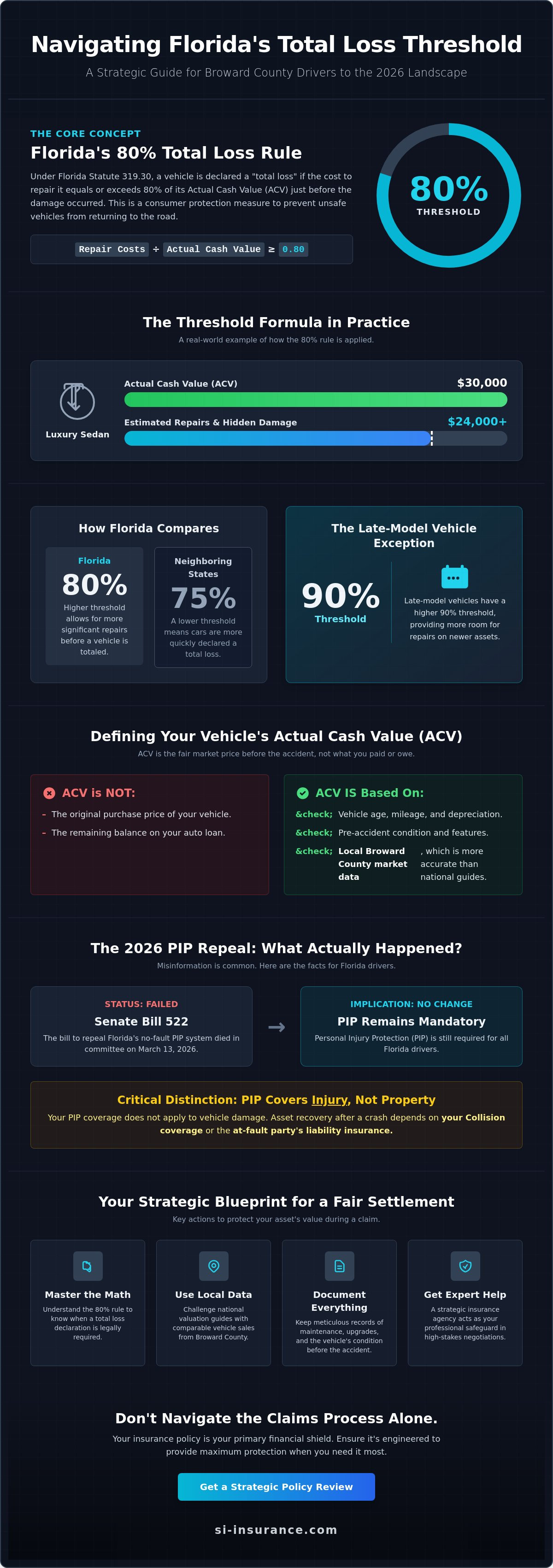
Florida Statute 319.30 establishes a clear boundary for when a damaged vehicle ceases to be a repairable asset and becomes a liability. Under the florida total loss threshold 2026, an insurance carrier is generally required to declare a total loss when the cost of repairs equals or exceeds 80% of the car's retail value. This specific percentage differentiates Florida from several neighboring Southern states that utilize a lower 75% threshold. This means Florida insurers often authorize repairs on vehicles that would be scrapped just across the state line, a distinction that requires careful monitoring by the policyholder.
Understanding the distinction between a salvageable vehicle and a constructive total loss is vital for any strategic risk management plan. By Defining a Total Loss through this mathematical lens, the state provides a predictable framework for both adjusters and policyholders. This rigor ensures that the decision isn't left to the whims of a single inspector but is instead grounded in statutory requirements that protect the financial interests of Broward County drivers.
To better understand how these thresholds impact your daily drive, watch this helpful report from CBS Miami:
Defining Actual Cash Value (ACV) in the Current Market
Many drivers mistakenly believe that the payout for a totaled car should match the original purchase price or the remaining balance on a loan. Actual Cash Value (ACV) is the fair market price of the vehicle immediately prior to the incident, adjusted for depreciation, mileage, and local economic factors within the Broward County area. In a high-demand market like Sunrise or Fort Lauderdale, these local comparables can significantly influence the final valuation. Relying on national guides often leads to a lower settlement, as they fail to account for the specific premium placed on well-maintained vehicles in the South Florida market.
The Threshold Formula in Practice
Let's look at how this calculation functions in a real-world scenario. If you own a luxury sedan with an ACV of $30,000, the florida total loss threshold 2026 is triggered once repair estimates reach $24,000. It's common for a body shop to discover hidden damage during the initial teardown process, such as structural misalignment or electrical shorts, which can quickly push a $15,000 estimate past that critical 80% mark. This threshold ultimately serves as a consumer protection mechanism. It prevents you from being forced back into a vehicle that's no longer structurally sound or safe for the road. At SI Insurance, we view these regulations as a baseline for negotiation rather than an absolute conclusion, ensuring your asset is valued with the precision it deserves.
The 2026 Pivot: How PIP Elimination Impacts Total Loss Settlements
The strategic landscape for Broward County drivers shifted significantly following the legislative sessions of early 2026. While many anticipated a historic transition to a full tort system on July 1, 2026, the reality is more nuanced after Senate Bill 522 died in committee on March 13, 2026. Despite the survival of the no-fault system, a strategic pivot is still necessary. Drivers now realize that Personal Injury Protection (PIP) offers no sanctuary for property damage, making the florida total loss threshold 2026 the primary battleground for asset recovery. This realization has forced a shift in focus toward third-party liability and the precision of collision coverage.
Understanding How PIP Repeal Impacts Settlements is essential, even if the transition remains a subject of ongoing debate. When your vehicle's repair costs approach that critical 80% mark, the speed of your settlement often depends on which lever you pull. Relying solely on the at-fault party's insurance can lead to delays and bureaucratic friction. A more calculated approach involves leveraging your own collision policy to trigger a sophisticated, high-touch claims process that prioritizes your timeline over the insurer's subrogation schedule.
Property Damage Liability (PDL) vs. Collision Coverage
In the current 2026 environment, PDL remains the mandatory minimum, yet it often falls short for high-value assets. If an at-fault driver totals your vehicle, their PDL policy is only obligated to pay up to their limit, which may be significantly lower than your car's actual cash value. Utilizing your own collision coverage provides a "white-glove" experience, allowing your insurer to pay you directly and then handle the recovery from the other party behind the scenes. It's a cleaner, more professional path to liquidity after a loss. You can explore how we engineer these bespoke risk solutions to protect your automotive investments.
The Role of Comparative Fault in Florida
Florida's legal framework for property damage relies heavily on the principle of comparative fault. This means your total loss payout is directly tied to your percentage of responsibility for the accident. If an adjuster determines you're 20% at fault, your settlement for the florida total loss threshold 2026 will be reduced by that same 20%. This requires a rigorous commitment to evidence. Documenting the scene with high-resolution imagery and securing witness statements isn't just a post-accident chore; it's a vital act of risk mitigation that protects the integrity of your final settlement check.
Calculating Value in the Florida Market: Beyond the Blue Book
Generic valuation tools often fail to capture the high-velocity market dynamics of South Florida. While a national guide might suggest a standard depreciation curve, the reality in Broward County is quite different. High demand in areas like Sunrise and Pompano Beach often keeps local retail values elevated. When your insurer begins evaluating your vehicle against the florida total loss threshold 2026, you shouldn't settle for a number generated by an algorithm in a different time zone. Instead, we advocate for a bespoke valuation approach that prioritizes local comparables and the actual replacement cost within our specific geographic corridor.
This process is grounded in Florida's Official Total Loss Guidelines, which ensure that the valuation remains transparent and legally compliant. Maintenance records also play a vital role here. A meticulously documented service history from a local dealership can add significant value to your settlement. It shifts the vehicle's condition from a subjective "good" to a verifiable "excellent," providing the intellectual foundation for a higher payout. These records aren't just paper; they're strategic assets in your recovery plan.
The Florida Sales Tax Rule
Florida law mandates that insurers include sales tax in their total loss settlements to reflect the true cost of replacing the asset. The 6% state tax, combined with any applicable local surtax, is a mandatory component of your financial recovery that must be calculated on top of the vehicle's cash value. It's a detail that adjusters sometimes overlook in the rush to close a file. You've got to ensure this amount is included to avoid leaving money on the table. A calculated review of your settlement statement will reveal if this mandatory requirement has been met.
Negotiating with Intellectual Confidence
If the initial offer feels insufficient, you've got the right to present a counter-valuation based on current listings from dealerships in the Pompano Beach area. This isn't about being confrontational; it's about ensuring strategic alignment between your policy's promise and the actual market reality. At SI Insurance, we believe that intellectual confidence is your greatest asset during a total loss dispute. If a stalemate occurs, an independent appraiser can provide an unbiased third-party perspective to resolve the valuation gap. In rare cases where an insurer remains recalcitrant, you can escalate the matter to the Florida Department of Financial Services for a formal review. This methodical approach ensures you aren't just another claim number, but a sophisticated policyholder who understands the intricacies of the florida total loss threshold 2026.
Navigating the Claims Process: A Strategic Blueprint for Drivers
The moment an accident occurs, the clock begins on a high-stakes financial negotiation. Your first priority isn't just physical safety; it's the preservation of evidence to protect your settlement under the florida total loss threshold 2026. This means securing the vehicle at a reputable facility and starting a meticulous documentation trail immediately. You've got to photograph everything, from the specific point of impact to the interior condition. When the adjuster arrives for the inspection, they're looking for more than just crumpled metal. They're evaluating the pre-accident condition to justify their valuation. Having your service records and recent upgrade receipts ready demonstrates a level of preparedness that adjusters respect.
Evaluating the "Total Loss Statement" requires a methodical eye. This document isn't a final verdict; it's an opening proposal. You should verify every line item, ensuring that the options, mileage, and trim level are accurately reflected. If the numbers don't align with the local Broward County market data we analyzed earlier, this is the moment to present your counter-evidence. Once you reach an agreement, the finalization involves a clean transfer of the title and keys. If there's an outstanding loan, the insurer will typically pay the lienholder first, leaving you with the remaining equity.
The Critical Role of Gap Insurance
Because the florida total loss threshold 2026 triggers at 80% of the vehicle's value, drivers with financed cars often face a significant financial shortfall. This "gap" exists when your loan balance exceeds the actual cash value payout. Strategic protection through gap insurance is essential for mitigating this risk. It ensures you aren't left paying for a vehicle that no longer exists. We provide deeper insights into these protections in our guide to Florida Auto Insurance, which explores how to align your coverage with modern market realities.
Owner Retention: Can You Keep Your Totaled Car?
Some owners feel a sentimental or financial pull to keep their vehicle through a process called "owner retention." This involves "buying back" the salvage from the insurer, which then deducts the salvage value from your settlement. However, this path leads to a salvage title and requires a rigorous "Rebuilt" inspection before the car is street-legal again. For modern vehicles packed with complex sensors and high-tech safety systems, this is rarely a strategic move. The cost of returning a structurally compromised car to factory standards often outweighs any perceived savings. If you're facing a complex claim, you can schedule an expert consultation to evaluate your best path forward.
Strategic Guardianship: Why Your Choice of Agency Matters
Choosing an insurance agency shouldn't feel like a simple digital transaction where you're just another policy number in a massive database. In the high-stakes environment of South Florida, the quality of your representation directly determines the quality of your financial recovery. While many drivers settle for an off-the-shelf policy, these generic products often lack the sophisticated language required to protect high-value assets. When you're navigating the complexities of the florida total loss threshold 2026, you need more than a vendor. You need a seasoned consultant who acts as a strategic guardian. A local Broward County agent understands that our traffic density and vehicle values require a more calculated approach to risk management than what's found in a standard retail policy.
Our firm positions itself as a calm and calculated partner in what is often a chaotic financial landscape. We don't rely on high-energy appeals; instead, we offer a corporate elegance that signals stability and elite expertise. By reviewing your coverage limits before an accident occurs, we ensure that your policy is engineered for maximum protection. This foresight allows you to enter any negotiation with an adjuster backed by the intellectual confidence of a perfectly structured plan. It's the difference between being reactive and being strategically prepared.
Bespoke Coverage for High-Value Assets
High-value assets require a level of precision that generic agencies simply cannot provide. We work to ensure your Specialty Vehicle Insurance is perfectly aligned with the current market realities found in the Sunrise and Pompano Beach communities. Local expertise is vital because vehicle demand in South Florida frequently defies national depreciation curves. We go beyond the standard paperwork by meticulously analyzing carrier performance data. This allows us to align our clients with insurers who have a proven track record of employing reliable adjusters who respect the florida total loss threshold 2026. This "white-glove" service ensures that your bespoke risk transfer solution performs exactly as intended when it's needed most.
Securing Your Financial Future
True intellectual security comes from the knowledge that your financial future isn't left to chance or a flawed algorithm. Waiting until after a collision to master the nuances of state statutes is a risk you don't have to take. We invite you to experience a higher level of service through a comprehensive policy audit at SI Insurance. We'll evaluate your current standing with a methodical, step-by-step progression that ensures every detail of your protection is airtight. This is the final step in your journey from confusion to strategic confidence. By partnering with a firm that prioritizes rigorous analysis and long-term protection, you ensure that your automotive investments are shielded by a seasoned guardian focused on delivering elite results.
Mastering Your Recovery in a Shifting Regulatory Landscape
Protecting your automotive investments in South Florida requires a shift from passive observation to active, strategic management. The 80% rule functions as a critical trigger, and the failed PIP repeal on March 13, 2026, ensures that the burden of property damage recovery remains a personal priority. Success in these high-stakes negotiations depends on your ability to leverage local Broward County market data rather than generic national estimates. Navigating the florida total loss threshold 2026 requires more than just a passing knowledge of the statutes; it demands a commitment to rigorous analysis and authoritative documentation.
You don't have to face the complexities of a total loss alone. Our team provides the elite expertise and authoritative claims advocacy needed to ensure your settlement reflects the true value of your asset. By choosing a partner with deep roots in the Sunrise and Pompano Beach communities, you gain a guardian who understands the unique risks of our local landscape. We invite you to Consult with a Strategic Risk Guardian at SI Insurance to audit your current policy and secure your financial future. You've got the power to turn a potential loss into a managed recovery with the right support.
Frequently Asked Questions
What is the Florida total loss threshold for 2026?
The florida total loss threshold 2026 is set at 80% of the vehicle's retail value as established in Florida Statute 319.30. For late-model vehicles, which are defined as those seven years old or newer with a retail value of at least $7,500, the threshold increases to 90% before the vehicle is declared unrebuildable. This mathematical trigger ensures that cars with excessive damage are removed from the road to maintain safety standards across Broward County.
Does Florida use the Total Loss Formula (TLF) or a percentage?
Florida utilizes a strict percentage threshold rather than the Total Loss Formula used in many other jurisdictions. An insurer must declare a total loss if repair costs reach 80% of the vehicle's actual cash value. While some states compare repair costs plus salvage value to the car's market price, Florida's 80% rule provides a clear and predictable statutory benchmark for both adjusters and policyholders.
How does the 2026 PIP elimination affect my car insurance claim?
The proposed 2026 PIP elimination did not occur because Senate Bill 522 died in committee on March 13, 2026. As a result, Florida's no-fault system remains in place, requiring all drivers to carry a minimum of $10,000 in Personal Injury Protection. Your claim for vehicle property damage will still be processed under property damage liability or collision coverage, independent of your PIP medical benefits.
Can I negotiate the Actual Cash Value of my totaled car in Florida?
You have the legal right to dispute and negotiate the initial valuation provided by your insurance adjuster. By presenting local market data and detailed maintenance records, you can challenge an offer that doesn't reflect the high retail values seen in Sunrise or Pompano Beach. If a stalemate persists, you can invoke the appraisal clause in your policy or contact the Florida Department of Financial Services for a formal review.
Does insurance pay for sales tax on a totaled car in Florida?
Florida law mandates that insurance companies include the 6% state sales tax, plus any applicable local surtaxes, in your final total loss settlement. This requirement ensures that you receive enough liquidity to actually replace the asset in the current market. You should meticulously review your settlement statement to verify that these taxes and mandatory title fees weren't omitted from the final calculation.
What happens if I owe more on my car than the insurance settlement?
If your loan balance exceeds the actual cash value of the vehicle, you're responsible for paying the difference to your lienholder. This financial shortfall is common because the florida total loss threshold 2026 triggers at 80% of the car's value, which may be less than your remaining debt. Strategic protection like gap insurance is specifically designed to cover this liability and protect your credit during a loss.
Is it possible to keep my car after it has been declared a total loss?
You can retain your vehicle through a process called owner retention, though the insurer will deduct the estimated salvage value from your payout. You'll be issued a salvage title and must pass a rigorous state inspection to obtain a "Rebuilt" status before the car is legally drivable. While possible, this is a complex path that requires careful consideration of the vehicle's structural and electronic integrity.
How long does an insurance company have to settle a total loss claim in Florida?
Florida insurers are generally required to acknowledge a claim within 14 days and must pay the undisputed portion of a settlement within 30 days after an agreement is reached. While the initial investigation and valuation can take time, the state's prompt payment laws are designed to prevent unnecessary delays. Maintaining a clear documentation trail and staying in regular contact with your adjuster can help keep this process moving efficiently.
Comments