


Universal Property and Casualty Alternatives for Florida Homeowners (2026)
Sticking with the same insurer year after year feels like the responsible choice, but in Florida, blind brand loyalty often costs you dearly. When your renewal packet arrives with steep rate hikes, tighter roof restrictions, or an unexpected non-renewal notice, researching viable Universal Property and Casualty alternatives Florida homeowners can rely on becomes an immediate priority. You aren't alone in feeling frustrated by carrier volatility, confusing solvency scores, and the anxiety of being pushed into Citizens.
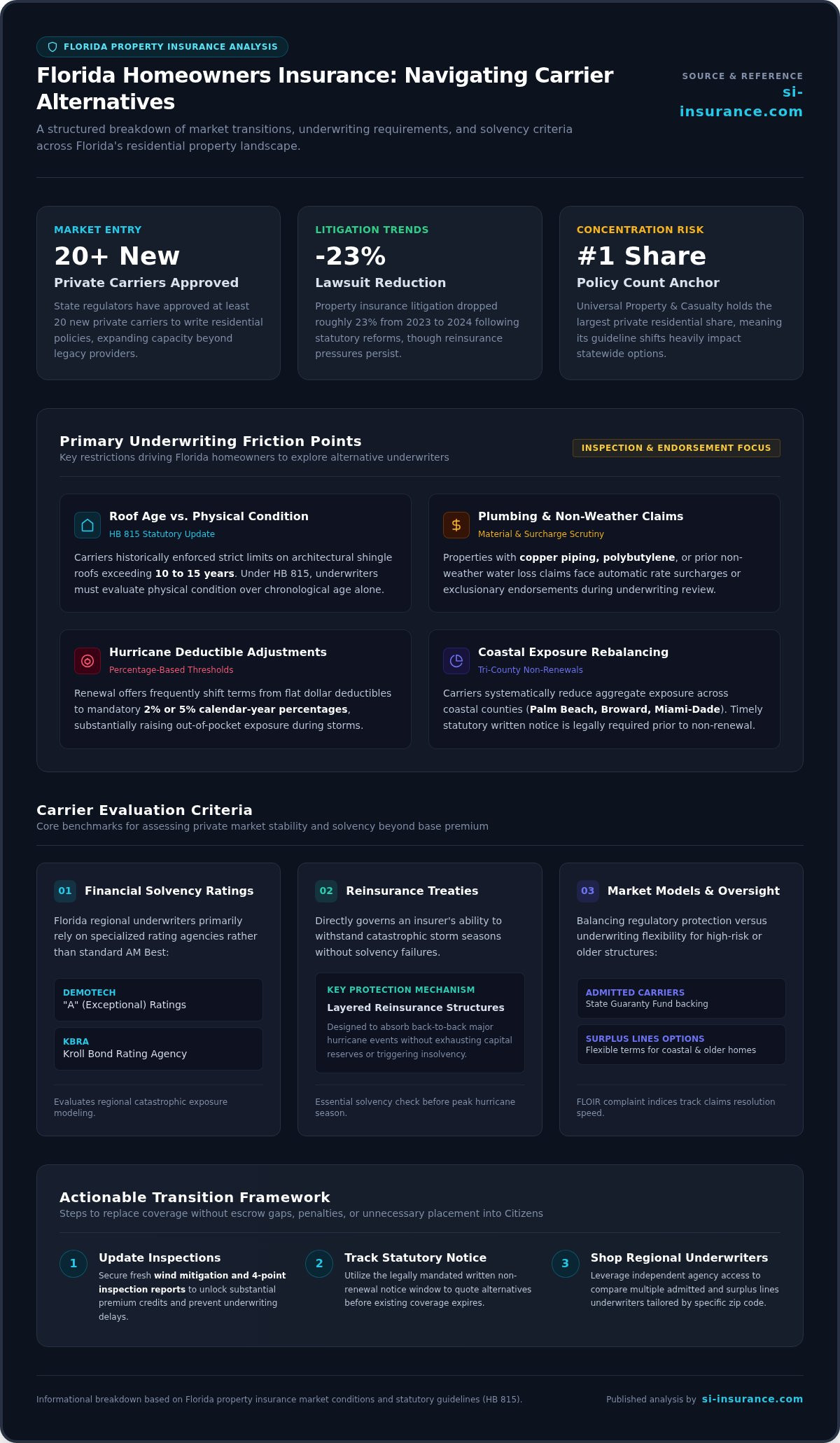
The good news is that the market is finally shifting, with at least 20 new private carriers approved to write policies across the state. You can discover reliable private market alternatives to Universal Property and Casualty to secure dependable, cost-effective Florida home coverage tailored to your property. In this guide, we evaluate financially sound carriers actively writing policies, examine key coverage trade-offs, and outline how to transition seamlessly without escrow disruptions, coverage gaps, or lender penalties.
Table of Contents
Why Florida Homeowners Seek Universal Property and Casualty Alternatives
Universal Property and Casualty Insurance Company holds the largest market share by policy count among private residential carriers in Florida. When one company anchors such a vast share of the state, its underwriting shifts ripple through hundreds of thousands of households. Even with recent modest rate reductions filed by major carriers, cumulative premium adjustments and rising reinsurance costs have pushed policyholders to evaluate their options. Exploring dependable Universal Property and Casualty alternatives Florida homeowners can access has become an essential strategy for preserving home equity while avoiding unmanageable annual expenses.
To better understand the challenges property owners face with their policies, watch this news report detailing recent carrier disputes and claim friction:
Premium Escalation and Underwriting Tightening in Florida
Underwriting guidelines across the private market have become exceptionally stringent. While Florida's legislative reforms have cut property insurance lawsuits by roughly 23% from 2023 to 2024, carriers still pass significant global reinsurance costs directly to consumers. Beyond base rates, underwriting restrictions hit homeowners hardest on structural components:
Roof age thresholds: Insurers have historically pushed strict restrictions on architectural shingle roofs exceeding 10 to 15 years, though recent statutory updates under HB 815 require underwriters to evaluate physical roof condition rather than relying solely on age.
Plumbing scrutiny: Homes with older copper piping, polybutylene, or previous non-weather water loss claims often trigger automatic rate surcharges or exclusionary endorsements.
Deductible modifications: Many renewal packages quietly adjust hurricane deductibles from flat dollar figures to mandatory 2% or 5% calendar-year percentages.
Portfolio Rebalancing and Non-Renewal Patterns
Receiving a non-renewal notice does not automatically mean your property is high-risk. Private carriers frequently engage in portfolio rebalancing to reduce aggregate exposure in coastal zones like Palm Beach, Broward, and Miami-Dade. Under Florida law, insurers must provide policyholders with timely statutory written notice prior to non-renewal, giving owners a window to shop. Rather than sliding into the state-backed Citizens Property Insurance Corporation, partnering with an independent team like Si Insurance Agency lets you review vetted Universal Property and Casualty alternatives Florida homeowners qualify for across the stabilizing private market.
Criteria for Evaluating Alternative Florida Property Insurance Carriers
Selecting a replacement insurer requires looking far deeper than the top-line annual quote. When weighing Universal Property and Casualty alternatives Florida homeowners need rigorous benchmarks to measure an underwriter's true claims-paying capability and policy integrity. Consulting a comprehensive guide to home insurance in Florida provides a solid foundation for evaluating baseline coverages before you bind a new contract. In addition, checking the Florida Office of Insurance Regulation (FLOIR) complaint indices reveals how promptly and fairly a carrier closes open claims.
Financial Solvency Ratings and Reinsurance Strength
Most national comparison sites look exclusively for AM Best grades, yet regional Florida carriers rely primarily on Demotech (such as an 'A' Exceptional rating) or the Kroll Bond Rating Agency (KBRA). These agencies specialize in regional catastrophic exposure modeling. Just as critical is the carrier's reinsurance structure. A stable insurer secures layered reinsurance treaties designed to absorb back-to-back major storm events without exhausting reserves or facing state liquidation.
Coverage Terms, Water Sub-Limits, and Endorsements
Contract language often hides policy trade-offs that can cost tens of thousands during a claim. Pay close attention to these critical policy provisions:
Water damage caps: Check whether non-weather water damage includes full Coverage A dwelling limits or caps payouts at a restrictive $10,000 sub-limit for burst pipes.
Roof valuation schedules: Distinguish between full replacement cost coverage and restrictive actual cash value (ACV) depreciation schedules that reduce payouts on older roofs.
Hurricane deductibles: Verify whether your storm deductible is a flat dollar amount or a 2% to 5% calendar-year figure tied to your dwelling value.
Filtering through these contractual nuances protects your personal balance sheet against post-storm surprises. To evaluate multiple options side by side, working with Si Insurance Agency gives you clear access to solvent regional underwriters vetted for your property's specific profile.
Comparing Alternative Carrier Models for Florida Properties
Many property owners assume their only replacement choice after a rate hike is state-backed residual insurance. In reality, the marketplace has expanded substantially. Exploring reliable Universal Property and Casualty alternatives Florida homeowners can access involves weighing three distinct operational models: regional admitted carriers, surplus lines underwriters, and the state-backed safety net.
Regional Admitted Private Carriers
Admitted carriers are fully licensed and regulated by FLOIR. Their primary advantage lies in statutory safety: policies are backed by the Florida Insurance Guaranty Association (FIGA), which steps in to pay outstanding claims up to statutory limits if a company becomes insolvent. Over the past three years, legislative changes have attracted over twenty newly approved property and casualty insurers to Florida, including reciprocal exchanges such as Orange Insurance Exchange, Orion180, and Slide. These regional carriers actively write standard HO-3 and HO-6 policies, providing competitive options for well-maintained, code-compliant homes.
Surplus Lines and Specialty Coastal Coverages
Properties with unique risks, such as older beachfront homes, historic architectural features, or properties directly on barrier islands, often fall outside standard admitted underwriting guidelines. This is where surplus lines (non-admitted) carriers step in. Surplus carriers enjoy greater regulatory flexibility to tailor policy terms and pricing to unusual structural risks. The clear trade-off is the absence of FIGA insolvency backing. If a surplus carrier fails, the state guaranty fund will not cover the losses, making reinsurance strength and balance-sheet vetting paramount.
Citizens Property Insurance vs. Private Competitors
Citizens was designed strictly as a market of last resort, not a preferred destination. While its policy count dropped to 336,000 as hundreds of thousands of policies moved to private carriers, some homeowners still turn to it. Yet placing coverage with Citizens comes with strict statutory conditions:
Depopulation rules: Under Florida law, if an admitted private carrier submits an offer within 20% of your Citizens renewal premium, you are ineligible to remain with Citizens.
Mandatory flood coverage: Citizens requires residential policyholders to secure and maintain separate flood insurance, regardless of whether the home sits in a designated high-risk flood zone.
Restricted coverage limits: Citizens policies frequently exclude desirable endorsements like water backup, personal liability increases, or high other-structure limits found in the private market.
Evaluating these distinct carrier structures with a licensed broker clarifies which Universal Property and Casualty alternatives Florida homeowners should pursue to protect their assets without unnecessary coverage trade-offs.
Actionable Steps to Switch Your Florida Homeowners Coverage
Replacing an existing policy requires a precise sequence to avoid coverage gaps or lender complications. When switching to viable Universal Property and Casualty alternatives Florida homeowners must manage inspections, carrier underwriting windows, and mortgage escrow disbursements carefully. Missing a single administrative step can lead to double billing or temporary lender-placed coverage.
Preparing Property Documentation and Inspections
Before requesting formal quotes, assemble your property's technical documentation. Underwriters rely on specific forms to price risk and apply statutory credits:
Wind mitigation inspection (Form OIR-B1-1802): This inspection verifies hurricane clips, roof deck attachment spacing, secondary water barriers, and impact-rated opening protection. Strong mitigation attributes can yield dramatic premium credits on the wind portion of your premium.
Current 4-point inspection: Mandatory for homes older than 20 to 30 years, this report reviews the electrical panel (flagging brands like Federal Pacific or Zinsco), plumbing supply lines, water heater condition, and HVAC operation.
Permit documentation: Keep municipal roof permits on hand. Even with HB 815 prioritizing roof condition over age, documented permit finalization speeds up underwriting approval.
Mortgage Servicer Coordination and Escrow Management
Most Florida property policies are paid through a mortgage escrow account. Managing this handoff smoothly prevents billing headaches and preserves lender compliance:
Secure the active binder: Once you pick a new carrier, obtain an official insurance binder showing the lender listed as the primary mortgagee with the correct clause and loan number.
Align inception and cancellation dates: Never cancel an active policy until the replacement policy is fully bound and issued. Set the prior carrier's cancellation date to match the new policy's effective date at 12:01 AM.
Transmit documentation to the escrow servicer: Send the new binder, invoice, and your previous policy's cancellation confirmation directly to your mortgage servicer's insurance department.
Collect unearned premium: If you switch mid-term, your previous underwriter will issue a prorated refund check for unused premium. Depositing this refund back into your escrow account prevents an escrow shortage during annual recalculations.
To avoid escrow errors and secure optimal terms across competing carriers, connect with Si Insurance Agency to guide your coverage transition from initial inspection to final mortgage sign-off.
Securing the Right Florida Policy Through an Independent Agent
Navigating the changing property market requires an advocate who works for you, not a single insurance carrier. When searching for viable Universal Property and Casualty alternatives Florida homeowners quickly discover that distribution channels make a major difference. Captive agents represent a single company and can only sell that carrier's proprietary policies. If that carrier raises rates, tightens roof age limits, or stops writing in your county, a captive agent cannot shop elsewhere to solve your problem.
Captive vs. Independent Broker Market Representation
Independent insurance brokers operate with open carrier access. Instead of pushing one set of guidelines, an independent agency evaluates your property across a broad network of admitted and specialty carriers. Underwriting appetites vary dramatically by zip code; an insurer with high coastal rates in Palm Beach County might offer aggressive discounts in Broward or central Florida. Independent agents pinpoint these regional pricing variations. They also provide ongoing renewal oversight, monitoring your policy year after year and switching carriers if your current underwriter changes its terms.
Comprehensive Property Protection with SI Insurance
Protecting a residential property requires looking at the total risk picture rather than buying isolated policies. Windstorm, flood, and personal liability protections must integrate cleanly so you aren't left with hazardous coverage gaps after a storm. With physical offices in Sunrise and Pompano Beach and statewide licensing, SI Insurance provides specialized advisory focused on Florida exposures, wind mitigation discounts, and multi-policy coordination.
Working with local specialists ensures you receive:
Targeted property evaluations: Detailed reviews of your wind mitigation credits, roof condition, and 4-point inspection data to capture maximum statutory discounts.
Carrier diversification: Comparative quote analyses across leading regional admitted underwriters actively expanding their Florida footprints.
Coordinated coverage portfolios: Seamless alignment across home insurance, flood insurance, auto insurance, and personal umbrella insurance to eliminate liability exposures.
Securing dependable Universal Property and Casualty alternatives Florida homeowners can count on starts with personalized, carrier-agnostic guidance designed around your home's unique footprint.
Securing Smarter Property Protection for the Years Ahead
Navigating Florida's evolving property market doesn't mean settling for automatic rate hikes or restrictive policy terms. With private capital entering the state and underwriting conditions stabilizing, evaluating viable Universal Property and Casualty alternatives Florida homeowners can trust provides a dependable path to balanced protection and long-term cost control.
Sustainable coverage comes down to proactive management. Updating your wind mitigation inspections, reviewing solvency ratings through Demotech or KBRA, and timing your mortgage escrow updates well before renewal eliminate coverage lapses and surprise out-of-pocket expenses. You don't have to navigate shifting carrier guidelines or complex contractual exclusions on your own.
With physical offices in Sunrise and Pompano Beach and statewide access to vetted private insurance carriers, our specialists deliver tailored risk assessments that optimize windstorm credits and deductible structures. Take control of your property's financial security today: connect with Si Insurance Agency to explore competitive Florida home coverage engineered around your home's unique profile.
Frequently Asked Questions
Can I switch homeowners insurance companies in Florida if I have an open claim?
You can switch insurers with an open claim, but doing so is often challenging. Most admitted carriers decline properties with unresolved claims because the existing damage complicates new underwriting liability. However, surplus lines carriers or state-backed options may bind coverage under specific exclusions. The carrier handling your active claim remains legally obligated to settle and pay for covered damages that occurred while your prior policy was active.
What happens if my current Florida property insurer non-renews my policy?
A non-renewal notice means your coverage will end on your policy expiration date, not immediately. Florida law requires insurers to provide statutory advance notice, giving you time to arrange replacement coverage. This does not indicate poor risk on your part; carriers frequently non-renew policies to reduce regional exposure. You should immediately begin shopping for viable Universal Property and Casualty alternatives Florida homeowners can access to prevent an escrow interruption or coverage gap.
Is Citizens Property Insurance always cheaper than private market alternatives?
Citizens is not automatically the lowest-cost option in Florida. While its statutory rate caps kept premiums lower in past years, private rate stabilization and new market entrants have made regional admitted carriers highly competitive. Additionally, Citizens enforces strict rules, including mandatory flood insurance purchases and a 20% depopulation threshold. If a private insurer submits an offer within 20% of Citizens' renewal rate, you cannot remain with Citizens.
How does an updated wind mitigation inspection lower alternative carrier premiums?
An updated wind mitigation inspection verifies building features that resist hurricane-force winds, allowing insurers to apply state-mandated premium discounts. Inspectors assess roof deck attachments, roof geometry, secondary water barriers, and impact-rated window protection. Qualifying features generate substantial credits directly on the wind portion of your policy. Submitting an inspection completed within the last five years ensures alternative underwriters quote the most favorable rates available for your home.
Can my mortgage company reject my new Florida homeowners insurance policy?
Your mortgage servicer can reject a new policy if it fails their underwriting guidelines or lender covenants. Most lenders require minimum dwelling coverage equal to the loan balance or full replacement value, alongside acceptable deductible limits. Additionally, Fannie Mae and Freddie Mac require carriers to hold acceptable financial stability ratings, typically through Demotech or KBRA in Florida. Ensuring your binder meets these investor standards prevents escrow disputes or forced-placed coverage.
What roof age limit do most alternative Florida insurance companies require?
Historically, Florida carriers restricted shingle roofs older than 10 to 15 years, but statutory protections under HB 815 prohibit insurers from refusing coverage based solely on roof age. Underwriters must now consider actual structural condition. Still, roofs showing visible wear, granular loss, or prior patching may face strict scrutiny or actual cash value restrictions. Having a licensed inspector verify your roof's remaining useful life helps secure standard replacement cost terms.
How do I cancel my Universal Property and Casualty policy once a replacement is bound?
Once your replacement policy is officially bound and your lender receives the binder, submit a signed cancellation request to your previous insurer or agent. Set the effective cancellation date to match the exact start date of your new policy at 12:01 AM. Universal will issue a prorated refund check for any unearned premium. Deposit that refund directly into your mortgage escrow account to maintain proper reserve balances.
Comments