


Best Insurance for First-Time Homebuyers in Florida: A Strategic 2026 Guide
Updated: Jul 19
Have you ever looked at a Florida homeowners insurance quote and felt like you needed a translator just to understand the math? It’s a common feeling for many people stepping into the market for the first time. Buying your first home is an incredible achievement, but the reality of high premiums and the fear of being underinsured during a hurricane can quickly dampen the excitement. We understand that you’re looking for more than just a policy; you’re looking for a way to safeguard your future while keeping your monthly budget in check.
Our goal is to help you navigate these hurdles so you can secure the best insurance for first-time homebuyers in Florida with total confidence. In this guide, we’ll break down the essential layers of protection you actually need and share the strategic discounts that many homeowners overlook. We'll explore everything from the critical coverage trio to the hidden value of local expertise. By the end, you’ll have a clear roadmap to protect your asset effectively, ensuring your new home remains a place of security and joy for years to come.
Table of Contents
Navigating the Florida Home Insurance Landscape as a First-Time Buyer
The Critical Coverage Trio: Homeowners, Flood, and Windstorm Insurance
Evaluating "Best": How to Compare Florida Insurance Policies Beyond the Premium
Strategic Ways to Reduce Your Florida Insurance Costs Without Sacrificing Security
Securing Your Investment: Why a Local Florida Agency is Your Best Asset
Navigating the Florida Home Insurance Landscape as a First-Time Buyer
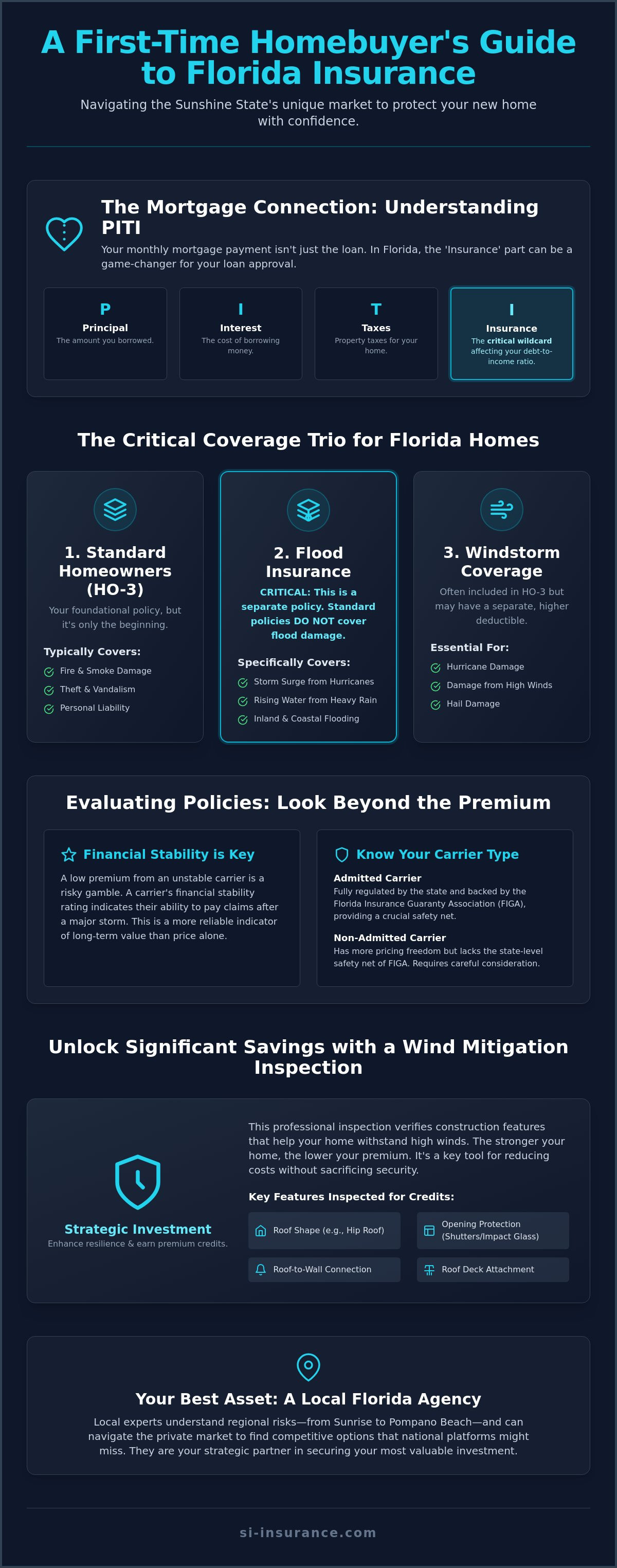
Entering the Florida property market in 2026 requires a calculated shift in perspective. While you might be primarily focused on interest rates, the local insurance climate is often the true driver of long-term affordability and investment security. The 2026 market is showing welcome signs of stabilization after years of significant volatility. Private insurers are re-entering the space, and many have filed for rate decreases with the Florida Office of Insurance Regulation. This agency plays a critical role in protecting policyholders by overseeing these filings and ensuring the market remains viable. For those seeking the best insurance for first-time homebuyers in Florida, it's essential to start with a firm grasp of the HO-3 policy. This is the standard form for single-family homes, designed to protect the structure and your personal belongings against a defined list of perils.
Many buyers are caught off guard when calculating their monthly PITI (Principal, Interest, Taxes, and Insurance) payments. While principal and interest are relatively static, insurance premiums are the wildcard in the equation. Gaining a foundational knowledge of the nuances involved in understanding homeowner's insurance is a prerequisite for any successful real estate transaction in the Sunshine State. Underestimating this cost can lead to a debt-to-income ratio that lenders find unacceptable, potentially stalling your path to ownership.
To better understand how these market factors converge, watch this helpful overview of the current landscape:
Why Florida Insurance is Different
Florida's geography creates a unique risk pool that differs from almost any other state. Tropical weather systems dictate the state's risk management strategies, forcing insurers to account for potential catastrophic losses across the entire peninsula. This risk isn't just carried by local companies; it's passed on to global reinsurance markets. When these reinsurance costs rise, those expenses are inevitably reflected in your individual monthly premium. It's also vital to distinguish between carrier types; an admitted carrier is fully regulated by the state and backed by the Florida Insurance Guaranty Association, whereas a non-admitted carrier has more pricing freedom but lacks that specific state-level safety net.
The Role of Insurance in Your Mortgage Approval
Lenders view insurance as a non-negotiable safeguard for their collateral. Your debt-to-income ratio is incredibly sensitive to premium costs, and a sudden increase in a quote can jeopardize your loan eligibility late in the escrow process. Lenders typically mandate dwelling coverage limits that reflect the total replacement cost of the structure rather than its market value. Experienced lenders like
emphasize that securing a firm insurance binder early in the process is a strategic necessity to prevent any last-minute closing delays. Ultimately, finding the best insurance for first-time homebuyers in Florida means aligning these third-party lender requirements with your own long-term financial security and peace of mind.
The Critical Coverage Trio: Homeowners, Flood, and Windstorm Insurance
Securing the best insurance for first-time homebuyers in Florida requires a shift away from the "one-and-done" mentality prevalent in less volatile markets. Protecting a high-value asset in this region necessitates a multi-layered defensive framework. This strategy typically involves three distinct pillars of protection: a standard homeowners policy, a separate flood insurance policy, and specific windstorm coverage. While the HO-3 form provides a reliable baseline for perils like fire, theft, and personal liability, it's the strategic integration of the other two layers that separates a basic policy from a truly resilient risk management plan.
Relying solely on an HO-3 policy leaves a significant gap in your financial security. In Florida, windstorm protection is often treated as a separate coverage component with its own specific deductible and triggers. When comparing top Florida insurance providers, you'll notice that the most robust solutions clearly delineate these risks rather than bundling them into a generic, potentially underinsured package.
Demystifying Flood Insurance in Florida
A common misconception among new buyers is that flood insurance is only necessary if a lender mandates it for properties in high-risk zones. However, verified data indicates that approximately 25% of all flood claims in the state originate from homes outside of these designated areas. It's critical to understand that standard homeowners policies never cover damage from rising groundwater or storm surges. You have two primary avenues for this protection: the National Flood Insurance Program (NFIP), which offers up to $250,000 in building coverage, or the private flood insurance market. Private carriers often provide higher limits and more flexible terms, making them an attractive option for those with specialized needs. Identifying your property's flood zone early in the acquisition process is a vital step in your due diligence.
Windstorm and Hurricane Deductibles
The financial mechanics of windstorm coverage differ significantly from other policy components. Most Florida policies utilize a percentage-based hurricane deductible, which is calculated based on the total insured value of the dwelling rather than a flat dollar amount. This deductible typically activates once the National Hurricane Center declares a "named storm" and remains in effect for the duration of the event. Choosing between a 2%, 5%, or 10% deductible is a strategic decision that directly impacts your annual premium and your potential out-of-pocket exposure. Balancing this risk requires a methodical analysis of your liquidity and long-term financial goals. Consulting with the experts at SI Insurance can provide the clarity needed to select a deductible structure that aligns with your specific risk tolerance.
Evaluating "Best": How to Compare Florida Insurance Policies Beyond the Premium
Selecting the best insurance for first-time homebuyers in Florida is a task that requires looking far beyond the bottom-line premium. While a low monthly cost is attractive, it often masks deficiencies in carrier solvency or restrictive coverage terms that only surface during a catastrophic claim. You should treat your insurance policy as a sophisticated financial instrument. Its value is determined by the carrier’s ability to remain liquid after a major hurricane and the precision of the contract language itself. Choosing the cheapest option can be the most expensive mistake a new homeowner makes if the policy lacks the depth required for true recovery.
One of the first metrics you should evaluate is the carrier’s financial stability rating. Organizations like Demotech and A.M. Best provide independent assessments of an insurer’s financial health. In Florida’s high-stakes environment, choosing a carrier with a "Financial Stability Rating" of A or higher is a calculated move to ensure your claims will be paid even if the entire region is impacted. Additionally, you must verify if your policy provides Replacement Cost Value (RCV) rather than Actual Cash Value (ACV). RCV ensures you receive the funds necessary to replace your roof or belongings at current market prices. ACV, on the other hand, subtracts depreciation, which often leaves homeowners with a significant financial shortfall during repairs. You also need to confirm your "Loss of Use" limits, which provide the necessary capital for temporary housing if a disaster renders your home uninhabitable.
Policy Forms You Need to Know
Understanding which form applies to your property is essential, especially in diverse markets like Broward County. An HO-3 Special Form is the standard for single-family residences, providing broad protection for the structure. If you are purchasing a unit in Sunrise or Pompano Beach, an HO-6 policy is specifically designed for condos, covering everything from the "walls-in." For those entering the market as investors, a DP-3 form provides the necessary protections for landlord-held properties. Don't overlook critical endorsements like Water Backup coverage or Law & Ordinance. Law & Ordinance is vital because it covers the increased costs of bringing a damaged older home up to current building codes during the repair process.
Carrier Reputation and Claims Handling
A carrier’s history of paying claims is just as important as their financial rating. While Citizens Property Insurance serves as the state-backed insurer of last resort, it shouldn't be your first choice if private options are available. The private market has expanded significantly in 2026, with over 15 new insurers approved to operate in the state, offering more comprehensive terms and efficient claims handling. Seek out carriers with a proven track record of local expertise. These companies understand the specific risks of Florida’s coastal and inland communities. This local knowledge ensures that your risk assessment is accurate and your protection is engineered for the long term.
Strategic Ways to Reduce Your Florida Insurance Costs Without Sacrificing Security
Achieving fiscal efficiency in your insurance planning doesn't require you to compromise on the quality of your protection. In the 2026 market, the most effective way to lower your annual expenditures is through a proactive verification of your home's physical resilience. While many focus on deductible levels, the real savings are often found in the specific architectural and protective features of the dwelling itself. Finding the best insurance for first-time homebuyers in Florida involves identifying these hidden credits and ensuring your carrier recognizes the full value of your home's mitigation efforts.
The "Wind Mitigation" inspection is arguably the most powerful tool in your financial arsenal. This report documents how well a home withstands high-wind events, focusing on roof-to-wall attachments, roof deck geometry, and the presence of a secondary water barrier. Exploring the benefits of bundling home and auto insurance in Florida is another foundational step that provides immediate multi-policy discounts. Additionally, the age and shape of your roof act as primary determinants for your base rate and overall eligibility. Beyond these structural factors, installing monitored security systems and smart home leak-detection technology can further reduce your liability premiums.
The Power of the Four-Point Inspection
If you're considering a property older than 30 years, a Four-Point inspection is an absolute requirement for insurance approval. This report focuses on the "Big Four" critical systems: HVAC, Electrical, Plumbing, and Roofing. Carriers use this data to assess the risk of a failure that could lead to a major claim. For a first-time buyer, these results are invaluable. If the inspection reveals an aging electrical panel or a roof nearing the end of its functional life, you can use these findings as a strategic lever to negotiate repairs or price concessions with the seller before closing the deal.
Structural Upgrades that Pay for Themselves
Investing in your home's exterior envelope provides both physical security and long-term financial returns. From an insurance perspective, impact-resistant windows are often viewed more favorably than manual hurricane shutters because they provide constant protection without requiring human intervention. Another critical feature is Secondary Water Resistance (SWR), which is an additional layer of protection under your shingles that prevents leaks even if the primary roof covering is lost. Architecture also plays a role. A hip roof shape, characterized by slopes on all four sides, can significantly lower your premiums compared to a gable roof because it's aerodynamically more stable during a storm. To begin engineering your custom protection plan, connect with a specialist at SI Insurance today.
Securing Your Investment: Why a Local Florida Agency is Your Best Asset
When you're staring at a mountain of closing documents for your first home, it’s easy to feel like just another number in a massive system. That’s exactly why having a local advocate makes such a world of difference. Finding the best insurance for first-time homebuyers in Florida isn't just about clicking a button on a website; it’s about having a person in your corner who actually knows the neighborhood. While big national companies might rely on generic data, we're right here on the ground. We understand that a home in Sunrise has different needs than one in Pompano Beach, and we take the time to look at your specific situation with the care it deserves.
Working with an independent team means you aren't stuck with one company's "take it or leave it" price. We act as your personal shopper, looking through dozens of different carriers to see who offers the most solid protection for your specific budget. This partnership turns a stressful transaction into a long-term plan to keep your family safe. If a storm ever hits, you won't be stuck in an automated phone tree. You'll have a local partner who is ready to walk you through the recovery process step by step, ensuring your voice is heard.
The SI Insurance Advantage
We've built our reputation on being more than just a place to buy a policy. Our team at SI Insurance is deeply connected to the Broward County community. We focus on the small details that "big box" insurers often miss, like identifying specific local building code benefits that could save you money. We don't believe in one-size-fits-all solutions. Instead, we engineer a plan that fits your life and your first home perfectly. You get the benefit of elite-level expertise delivered with a friendly, personal touch that makes the whole process feel much less overwhelming.
Next Steps for Your First Home
The best time to start your insurance journey is as soon as you have a signed contract. Waiting until the last minute can lead to unnecessary stress and might even delay your closing date. To get the most accurate quote, try to have a few key details ready. We’ll need to know the age of your roof, the total square footage, and have copies of those Wind Mitigation and Four-Point inspections we talked about earlier. These reports are your best friends when it comes to finding discounts. When you're ready to see your options, you can contact SI Insurance for a comprehensive first-time buyer consultation. We're excited to help you protect your new home and give you the peace of mind you’ve been working so hard for.
Mastering Your Florida Property Risk for the Long Term
Buying your first home is a huge milestone, and you should feel incredibly proud of getting this far. We’ve walked through the complex layers of the Florida market, from understanding the essential trio of coverage to finding those hidden credits through wind mitigation. It isn't just about finding a policy for today; it's about making sure your biggest investment is safe for the long haul. Finding the best insurance for first-time homebuyers in Florida doesn't have to be a solo mission. By looking beyond the premium and focusing on carrier stability and the right policy forms, you're setting yourself up for true financial success.
At SI Insurance, we're proud to be an independent agency that can shop over 20 different carriers to find your perfect fit. We know the unique risks of Broward County because we live and work here too. Whether you're moving into a new place in Sunrise or a condo in Pompano Beach, we're ready to provide the local support you deserve. Secure your first home with a personalized Florida insurance strategy from SI Insurance. You've done the hard work of finding your dream home; now let's make sure it's protected. Welcome to the neighborhood!
Frequently Asked Questions
Is homeowners insurance required by law in Florida?
Florida law doesn't mandate that you carry homeowners insurance, but mortgage lenders strictly require it as a non-negotiable condition of your loan. Without an active policy, you won't be able to secure financing for your purchase. If you allow your coverage to lapse after closing, your lender will likely purchase "force-placed" insurance on your behalf. This is usually much more expensive and offers significantly less protection for your personal belongings than a policy you choose yourself.
How much does flood insurance typically cost for a first-time buyer in Florida?
The cost of flood insurance depends on your property's specific elevation and whether you utilize the National Flood Insurance Program or the private market. FEMA’s Risk Rating 2.0 now determines rates based on individual property characteristics rather than broad geographic zones. Finding the best insurance for first-time homebuyers in Florida often involves comparing these private flood options, which can sometimes provide more flexible coverage limits and lower premiums than federal programs for homes in moderate-risk areas.
What is a wind mitigation inspection and do I really need one?
A wind mitigation inspection is a professional assessment of your home’s structural integrity during high-wind events, and you absolutely need one to access the state's most substantial premium discounts. The inspector evaluates features like roof-to-wall attachments, shingle strength, and the presence of a secondary water barrier. Since Florida law requires insurers to provide credits for these protective features, the small cost of the inspection often pays for itself through immediate savings on your first annual premium.
Can I bundle my auto and home insurance with Si Insurance Agency?
Yes, Si Insurance Agency offers the ability to bundle your auto and home insurance to maximize your savings and simplify your administrative tasks. Consolidating your policies through our agency allows us to leverage multi-policy discounts that can noticeably reduce your total insurance spend. This approach also provides you with a single, dedicated point of contact for all your risk management needs, ensuring that your various layers of protection are coordinated and working together effectively.
Why is my Florida homeowners insurance premium so much higher than the national average?
Florida premiums are higher than the national average primarily because of the state's unique exposure to tropical weather systems and the high cost of global reinsurance required to cover those risks. Insurers must maintain massive capital reserves to handle potential catastrophic losses across the peninsula. These environmental factors, combined with historical litigation trends, contribute to the complex pricing structures you'll encounter while searching for the best insurance for first-time homebuyers in Florida.
What happens if my insurance carrier goes insolvent in Florida?
If your insurance carrier becomes insolvent, the Florida Insurance Guaranty Association (FIGA) serves as a state-mandated safety net to process and pay outstanding claims for admitted carriers. This system ensures that policyholders aren't left financially stranded if their insurer fails. It's a vital reason why we emphasize choosing "admitted" carriers that participate in this program, as it provides an extra layer of security and peace of mind for your most valuable asset.
Does a standard policy cover mold damage from a leaking pipe?
A standard HO-3 policy usually provides limited coverage for mold remediation, but only if the growth is the direct result of a sudden and accidental water discharge. If a pipe bursts unexpectedly, many policies include a sub-limit, often around $10,000, to handle the resulting mold. However, damage caused by long-term seepage, neglected maintenance, or high indoor humidity is typically excluded. Reviewing these specific limits with your agent is essential to avoid surprises during a claim.
How does the age of my roof affect my ability to get insurance in 2026?
The age of your roof is a critical eligibility factor in the 2026 market, as many private insurers now decline to write new policies for homes with roofs older than 15 years. Even if a carrier accepts an older roof, they may restrict coverage to "Actual Cash Value," which pays less during a claim due to depreciation. For a first-time buyer, prioritizing a home with a newer roof is often the most effective way to ensure you have access to the widest range of competitive insurance options.
Comments