


How to Avoid Being Underinsured in Florida: A Strategic Guide for 2026
- siinsuranceflorida
- Jul 10
- 12 min read
Updated: Jul 19
What if the insurance policy you've diligently maintained covers the current market value of your residence but leaves you with a six-figure deficit when it's time to rebuild? In an environment where premium coastal construction costs can exceed $400 per square foot, many property owners are discovering that their financial protection is far more fragile than they realized. You're right to feel concerned about the widening gap between your existing policy limits and the actual costs of labor and materials. We've engineered a sophisticated methodology for how to avoid being underinsured in Florida, ensuring your assets are shielded by a strategy that accounts for the latest climate risks and economic shifts of 2026.
We understand that the complexity of policy language can be daunting, especially when the stakes involve your most significant investments. This guide will clarify the technical distinction between replacement cost and market value while providing a rigorous checklist to verify your coverage limits. By following this meticulous approach, you'll gain the intellectual confidence that your legacy is fully protected; this allows you to move forward with the peace of mind that no detail has been overlooked and no money is being left on the table.
Table of Contents
The Reality of Underinsurance in the 2026 Florida Market
Underinsurance is a quiet threat that often remains invisible until a major claim is filed. It occurs when your policy limits aren't high enough to cover the actual cost of a total loss. In 2026, this has become a widespread issue for Florida residents because the prices for materials and skilled labor haven't just risen; they've fundamentally shifted. This situation is often linked to the Condition of average, a rule where insurers can reduce your payout if you haven't insured your property for its full replacement value. This means even a small kitchen fire could result in a partial payout that leaves you footing a massive bill.
To better understand the complexities of coverage in our state, watch this helpful video:
Learning how to avoid being underinsured in Florida is a critical step in protecting your family's future. The financial burden of paying for reconstruction out of your own pocket is enough to derail your long-term security. It's not just about the money; it's about the stress of negotiating with contractors while your bank account drains. Many policies also include a co-insurance clause. If you don't carry coverage equal to a specific percentage of your home's value, the insurer can apply a penalty that significantly reduces your claim check, even for minor damage.
The Gap Between Market Value and Reconstruction Cost
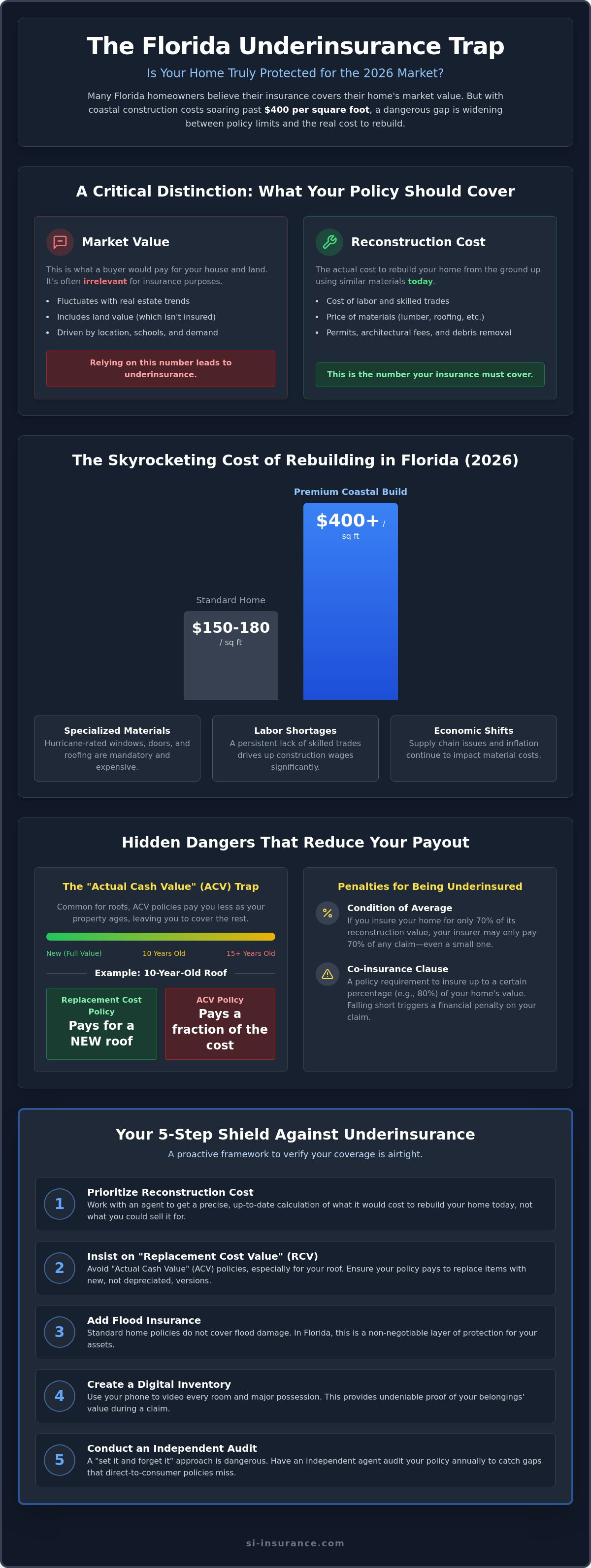
A common mistake is assuming that your home's market value is the same as its insurance value. In reality, what you could sell your home for is mostly irrelevant to your insurance limit. Market value includes the land your house sits on, which typically doesn't burn down or blow away. Rebuilding costs, however, are strictly about the price of materials and labor. With 2026 construction costs for standard homes ranging from $150 to $180 per square foot, and premium coastal builds exceeding $400, relying on old data is a gamble. The Reconstruction Gap represents the profound financial shortfall between a home's insured limit and the actual, real-world cost of rebuilding it in today's economy.
Common Triggers for Insurance Gaps
Many people find themselves searching for how to avoid being underinsured in Florida after they've already finished a major renovation. If you've updated your kitchen, added a bathroom, or installed high-end hurricane-rated windows, your Coverage A limit must be adjusted to reflect that new value. Another major risk is the "set it and forget it" approach to renewals. If you haven't audited your policy in three years, you're likely relying on 2023 pricing for a 2026 disaster. This is especially dangerous now, as a persistent labor shortage in both the Florida panhandle and southern coastal areas has driven up the cost of skilled trades. Working with a professional at Si Insurance Agency can help you identify these hidden exposures before they become a crisis.
Replacement Cost vs. Market Value: A Critical Distinction
Many homeowners mistakenly believe their insurance coverage should mirror their home's real estate value. This logic is fundamentally flawed because it conflates two entirely different financial metrics. Market value reflects what a buyer is willing to pay, influenced by land value, school districts, and local demand. Rebuilding cost, however, is strictly the price of labor and materials required to reconstruct your home from the ground up. A recent Forbes Advisor analysis highlights how market volatility can skew these perceptions, but for insurance purposes, the only number that truly matters is the cost to rebuild. Understanding this nuance is the first step in learning how to avoid being underinsured in Florida.
Opting for Actual Cash Value (ACV) on a roof is a common but dangerous strategy in our climate. Since ACV factors in depreciation, a ten-year-old roof damaged in a storm might only receive a fraction of the funds needed for a full replacement. This leaves you with a massive out-of-pocket expense at the worst possible time. To counter this, sophisticated policyholders utilize Extended Replacement Cost endorsements. This provides a safety net, often 25% to 50% above your policy limit, which is vital when post-storm demand surge drives up labor costs. An Inflation Guard endorsement acts as a secondary layer of protection, automatically adjusting your limits periodically to keep pace with economic shifts.
Understanding Dwelling Coverage (Coverage A)
Dwelling coverage, or Coverage A, is the cornerstone of your policy. It accounts for everything from your foundation to your rafters. In high-stakes areas like Broward County, rebuilding isn't just about materials; it's about compliance. The strict High Velocity Hurricane Zone (HVHZ) codes require specific impact-resistant materials that can significantly inflate costs. This is why Ordinance or Law coverage is essential for older properties. It pays for the mandatory upgrades required by current building codes that didn't exist when your home was first constructed. A brief conversation with a specialist at Si Insurance Agency can help you determine if your current limits reflect these modern requirements.
The Personal Property Trap
Your belongings often represent a larger portion of your net worth than you realize. While standard policies typically set personal property limits at 50% of your dwelling coverage, this is often insufficient for high-value households. Without a Replacement Cost endorsement for your contents, your electronics and furniture will only be valued at their used, depreciated price. For specific high-value assets that exceed standard limits, it's wise to consult our guide on Jewelry Insurance in Florida to ensure your most precious items are scheduled correctly. Mastering these distinctions is essential for anyone seeking how to avoid being underinsured in Florida.
Strategic Variables: Accounting for Florida-Specific Risks
The 2026 construction environment presents unique challenges that didn't exist just a few years ago. If you're building or repairing a home in the current market, you're looking at standard costs between $150 and $180 per square foot, while premium coastal properties often exceed $400. These figures are driven by the mandatory use of specialized materials like impact-resistant windows and reinforced roofing systems. Relying on outdated coverage limits is a significant risk; understanding these shifting variables is the only way to master how to avoid being underinsured in Florida. Beyond material costs, you must also account for your hurricane deductible. Since these are typically calculated as a percentage of your total dwelling coverage, a 2% deductible on a high-value home represents a substantial liquidity requirement that you must be prepared to fund immediately after a storm.
Another often overlooked variable is "Loss of Use" coverage. In a post-disaster scenario, the combination of permit delays and labor shortages can extend reconstruction timelines well beyond twelve months. If your policy doesn't provide sufficient funds for temporary housing that matches your current standard of living, you'll be forced to dip into personal savings. This is why a sophisticated approach to risk management looks at the entire lifecycle of a claim, from the initial deductible to the final inspection of a rebuilt structure.
The Hidden Risk of Flood Underinsurance
Standard home insurance policies across the state almost universally exclude damage from rising water. This gap is particularly dangerous in areas like Sunrise and Pompano Beach, where localized flooding can occur even during non-tropical rain events. As of January 1, 2026, Citizens policyholders with homes valued at $400,000 or more are required to carry separate flood insurance. However, the standard National Flood Insurance Program (NFIP) caps building coverage at $250,000. For many high-value assets, this creates a massive shortfall. Exploring private flood insurance is a strategic move for those seeking how to avoid being underinsured in Florida, as these policies often offer higher limits and broader protection than federal options.
Building Code Compliance and Upgrades
The Florida Building Code is one of the most stringent in the nation, and it's updated frequently to reflect new engineering data. If your home was built more than a decade ago, a partial loss could trigger a requirement to bring the entire structure up to 2026 standards. This might include expensive electrical upgrades or new foundation reinforcements. Without "Ordinance or Law" coverage, your insurer is only responsible for repairing the home as it was, not as the law now requires it to be. This specific coverage is a strategic necessity that shields you from the unexpected financial burden of mandatory modernizations.
A Step-by-Step Framework to Audit Your Coverage
It's one thing to understand the theoretical risks of the 2026 market, but it's another to have a functional plan to address them. The most effective methodology for how to avoid being underinsured in Florida begins with a professional Reconstruction Cost Estimate. You shouldn't rely on tax assessments or real estate market estimates, as these figures rarely reflect the actual cost of labor and materials. Instead, we recommend an annual valuation that accounts for the current $180 to $400 per square foot rebuilding reality we discussed earlier. This ensures your Coverage A limit isn't just a static number, but a dynamic reflection of the economic environment.
For business owners in Broward County, this audit extends to a rigorous review of your Schedule of Values. This document serves as the definitive list of your commercial assets and their respective locations. In areas like Sunrise and Pompano Beach, where localized risks can vary significantly from one block to the next, having an airtight schedule is the only way to prevent catastrophic out-of-pocket losses after a storm. Consulting with an independent agency is vital here because they can compare carrier appetites and find the specific insurers that are most comfortable with your unique risk profile.
Performing a Home Inventory Audit
Documentation is your greatest ally during a claim. We suggest walking through every room of your home with a smartphone to create a comprehensive video inventory. There are several sophisticated apps designed for this purpose that allow you to catalog serial numbers and receipts digitally. This process often reveals "high-limit" categories, such as fine art or high-end electronics, that exceed the standard sub-limits of a basic policy. Our team at Si Insurance Agency is available to help you review these inventory lists to determine which items require specialized endorsements for full protection.
Reviewing Liability and Umbrella Limits
Protecting your physical structure is only half the battle; you must also shield your net worth from Florida's litigious environment. Standard liability limits on a homeowners policy are often insufficient to protect significant assets in the event of a lawsuit. This is where Personal Umbrella Insurance becomes a strategic necessity, providing an extra layer of protection that kicks in when your primary limits are exhausted. It's also important to ensure your vehicle coverage is aligned with this broader strategy. You can find more detail on this in our Florida Auto Insurance Guide, which explains how to coordinate your various liability points into a single, cohesive defense. To begin your comprehensive risk audit today, contact our specialists for a professional policy review.
The Independent Agency Advantage: Your Safeguard Against Gaps
Speed is often the enemy of security in the insurance world. While many direct-to-consumer platforms promise an expedited quote process, they often achieve this by stripping away the granular data necessary for a truly accurate replacement cost valuation. These automated algorithms frequently rely on generic regional averages that fail to account for the specific architectural nuances or high-end finishes of your property. Relying on such a simplified model is a primary reason why homeowners struggle with how to avoid being underinsured in Florida. An independent agency, by contrast, functions as a meticulous auditor, identifying hidden exposures that a computer program is designed to overlook.
Our deep local expertise in Broward County provides a distinct layer of protection for our clients. We understand that the risk profile of a residence in Sunrise differs significantly from a coastal property in Pompano Beach, particularly regarding wind mitigation requirements and localized drainage patterns. By leveraging this geographical knowledge, we ensure that your policy isn't just a standard contract, but a custom-engineered defense. This professional foresight is essential in a 2026 market where legislative shifts and construction volatility have made the "set it and forget it" approach to insurance entirely obsolete.
Meticulous Risk Mitigation with Si Insurance
Our process at Si Insurance Agency is built on the principle of carrier comparison. Because we aren't tethered to a single provider, we have the freedom to scan the entire marketplace to find the carrier whose appetite perfectly aligns with your specific asset class. This independence allows us to bridge the gaps that often appear in direct-to-consumer policies. Beyond the initial placement, we provide a vital human touch as your advocate during the claims process. If disaster strikes, you won't be navigating a call center; you'll be working with a dedicated partner who understands your history and is committed to your full recovery. We invite you to secure a comprehensive review of your current portfolio to ensure no detail has been left to chance.
Protecting Your Florida Legacy
Viewing your homeowners policy as a strategic investment rather than a mandatory expense is the hallmark of sophisticated risk management. By prioritizing elite-level analysis over the lowest possible premium, you're choosing the intellectual confidence that comes from knowing your family's future is secure. This long-term partnership ensures that as construction costs fluctuate and new climate risks emerge, your coverage evolves in tandem. Mastering how to avoid being underinsured in Florida requires constant vigilance and professional guidance. We encourage you to review your policy limits before the next storm season begins, ensuring your legacy is shielded by the most robust protections available in 2026.
Securing Your Financial Future in a Shifting Landscape
The path to absolute security requires a shift from passive renewals to active risk mitigation. We've explored how the 2026 market demands a precise understanding of reconstruction costs and the critical need to address Florida-specific variables like building code compliance and flood exposures. Mastering how to avoid being underinsured in Florida isn't just about selecting a policy; it's about engineering a comprehensive defense for your most valuable assets. It's about ensuring that the gap between your coverage and reality doesn't become a financial burden for your family.
Since 2022, Si Insurance Agency has provided this level of sophisticated risk management. Our independent status gives you access to a wide network of top-rated carriers, ensuring your coverage is tailored to your unique needs rather than a generic model. We focus on the meticulous details that provide long-term stability and intellectual confidence. Don't wait for the next storm season to reveal a vulnerability in your protection. It's time to verify that your assets are shielded by a strategy built for the realities of today.
Request a Comprehensive Coverage Audit from Si Insurance Agency to ensure your legacy remains fully protected.
Frequently Asked Questions
What is the most common underinsurance mistake Florida homeowners make?
The most frequent error is basing policy limits on the home's real estate market value rather than its actual reconstruction cost. Market value includes land value and local demand factors, while reconstruction cost is strictly the price of labor and materials. Because 2026 building costs have shifted so significantly, homeowners who haven't adjusted their Coverage A limits often face a six-figure shortfall after a total loss.
How often should I update my home insurance reconstruction estimate?
You should conduct a professional review of your reconstruction estimate at least once every year. Given the volatility of material costs and labor availability in South Florida, an estimate that is even eighteen months old may be dangerously obsolete. Regular audits are a cornerstone of how to avoid being underinsured in Florida, as they allow you to adjust for localized economic shifts before a claim occurs.
Does my home insurance automatically increase as property values rise in Florida?
No, your policy limits do not automatically track with the rising real estate market. While some policies include an inflation guard, this feature is designed to address construction costs rather than the selling price of your home. It's your responsibility to work with an advisor to ensure your dwelling coverage reflects the current price of specialized hurricane-rated materials and skilled trades in your specific neighborhood.
What happens if my rebuilding costs exceed my policy limits after a hurricane?
If your reconstruction expenses surpass your policy limits, you are personally responsible for funding the remaining balance. This financial gap can be devastating, often requiring homeowners to dip into retirement savings or take out high-interest loans to finish repairs. Strategic endorsements, such as Extended Replacement Cost, can provide a percentage-based buffer above your primary limit to help mitigate this risk during post-storm demand surges.
Is flood insurance required even if I am not in a high-risk flood zone?
While lenders may not mandate flood insurance outside of high-risk zones, Florida's 2026 regulations require many policyholders to carry it regardless of their location. For instance, all Citizens policyholders with homes valued at $400,000 or more must have a separate flood policy as of January 1, 2026. This reflects the reality that localized flooding can occur anywhere, regardless of official flood map designations or historical patterns.
How do home renovations affect my insurance coverage requirements?
Any significant home improvement, such as a kitchen remodel or a new roof, increases the value of your structure and requires a corresponding update to your policy. Failing to report these changes can leave you partially unprotected, as your insurer's payout will be based on the home's previous, lower-value state. Documenting these upgrades immediately with your agent is an essential part of how to avoid being underinsured in Florida.
Can an independent agent help me find better coverage for a lower premium?
Independent agents possess the unique ability to compare multiple carriers to find the most competitive rates for high-quality coverage. Unlike captive agents who represent a single company, independent advisors can shop the entire marketplace for policies that offer superior protection without unnecessary costs. This objective approach ensures you aren't sacrificing essential safeguards just to achieve a slightly lower monthly premium for your property.
What is an Inflation Guard endorsement and do I need one in 2026?
An Inflation Guard is an endorsement that automatically increases your dwelling coverage limit at set intervals to keep pace with rising construction costs. In 2026, this feature is highly recommended due to the persistent upward pressure on material prices and labor rates. It acts as a passive safety net, though it should still be supplemented by a thorough annual professional review to ensure the adjustments remain accurate.
Comments