


Car Insurance for High-Risk Drivers in Florida: A Strategic Guide for 2026
- siinsuranceflorida
- Apr 20
- 13 min read
The assumption that a traffic violation or a coverage lapse should permanently exile you from the standard insurance market is a costly misconception. In Florida, where the Office of Insurance Regulation reported a significant shift in carrier stability throughout 2024, finding car insurance for high-risk drivers Florida has become an exercise in strategic risk management rather than a simple transaction. You've likely felt the pressure of a premium increase that seems disconnected from your habits, or perhaps you're facing the immediate anxiety of an SR-22 or FR-44 filing requirement. It's a stressful position to be in, especially when the threat of policy non-renewal feels like an inevitable outcome of a volatile market.
We recognize that a challenging driving history shouldn't dictate your financial future or your ability to remain mobile. This guide provides a clear, professional pathway to securing the state-mandated coverage you need to keep your license while identifying stable carriers that value long-term rehabilitation over short-term penalties. You'll discover how to manage these complex filings with precision and implement a calculated strategy to restore your standing with underwriters by the end of 2026. We'll outline the specific steps required to transform your risk profile into a position of absolute security.
Key Takeaways
Gain a sophisticated understanding of how Florida’s 2026 underwriting standards define high-risk status, allowing you to proactively manage your profile after a DUI or multiple at-fault incidents.
Navigate the complex administrative demands of SR-22 and FR-44 filings with a clear strategic roadmap that ensures your financial responsibility requirements are met with precision.
Analyze the intricate relationship between Florida’s No-Fault PIP system and premium fluctuations to better project the long-term fiscal impact of traffic violations on your coverage.
Explore advanced methodologies for securing car insurance for high-risk drivers Florida, utilizing state-approved defensive driving certifications and telematics to prove your safety commitment to carriers.
Learn why a partnership with a local independent agent is indispensable for engineering a bespoke risk transfer solution that transcends the limitations of standardized online quotes.
Table of Contents Understanding the High-Risk Driver Classification in Florida Navigating Florida’s SR-22 and FR-44 Certificate Requirements The Financial Impact of Traffic Violations on Florida Premiums Strategic Methods to Reduce High-Risk Insurance Costs in the Sunshine State Why Partnering with a Local Florida Agent is Essential for High-Risk Coverage
Understanding the High-Risk Driver Classification in Florida
In the 2026 insurance market, being labeled "high-risk" isn't a permanent mark of failure; it's a specific actuarial designation that requires a more sophisticated approach to coverage. Florida’s regulatory environment has evolved, and carriers now use highly granular data to determine which operators present a greater probability of loss. If you’re seeking car insurance for high-risk drivers Florida, you’re likely dealing with the aftermath of a major traffic violation or a series of claims that have triggered a shift in your underwriting tier. This classification is the result of a calculated assessment by insurance companies to protect their solvency while still offering a path to coverage.
To help clarify the common pitfalls people encounter during this transition, this video outlines some critical errors to avoid:
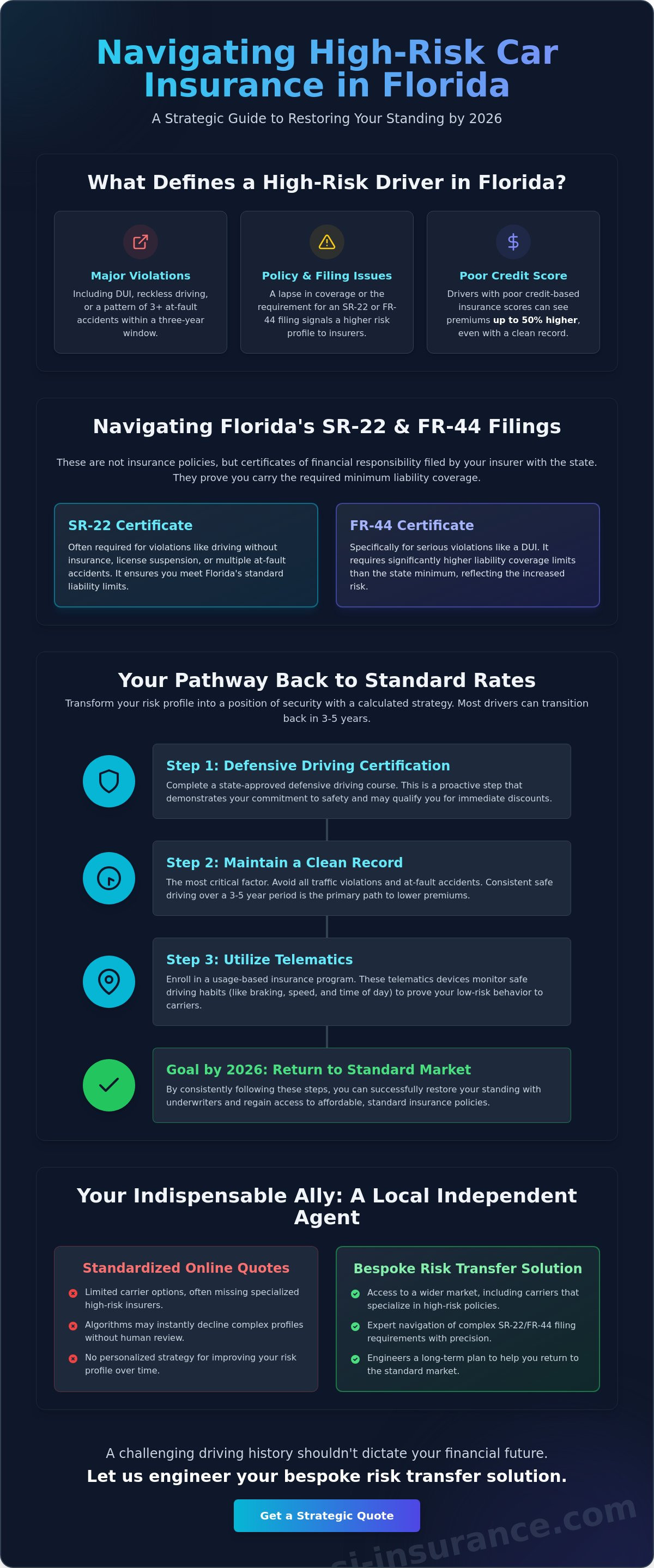
Triggers for this status typically include major infractions like DUIs, reckless driving, or a pattern of three or more at-fault accidents within a single three-year window. However, non-driving factors have become increasingly influential. In 2026, data suggests that drivers with poor credit-based insurance scores can see premiums that are 50% higher than those with excellent credit, even with a clean driving record. It's vital to distinguish between a temporary rate hike, which might follow a single speeding ticket, and a long-term high-risk designation that involves a move to non-standard carriers. At SI Insurance, we view these challenges as variables that can be managed through strategic alignment and disciplined risk mitigation.
Why Florida Insurers Categorize Certain Drivers as High-Risk
The actuarial logic behind high-risk pools is rooted in the necessity of premium loading to offset predicted losses. Florida remains a volatile market for insurers due to high litigation rates. While the 2023 tort reform (House Bill 837) aimed to reduce frivolous lawsuits, the state still experiences a disproportionate volume of legal challenges compared to the national average. This environment forces a commitment to underwriting excellence where every potential liability is scrutinized. A driver’s risk profile is influenced by foundational concepts found in Vehicle Insurance in the United States, specifically how liability limits are calculated for those with a history of frequent claims or severe violations. Carriers must balance their portfolios to ensure that one high-risk policyholder doesn't jeopardize the stability of the entire pool.
The Emotional and Financial Weight of the High-Risk Label
Receiving a non-renewal notice can feel like a personal setback, but it's a hurdle that a calculated strategy can overcome. We understand the stress these notices cause and provide a reassuring perspective on the path back to standard status. Most drivers can transition back to traditional markets after maintaining a clean record for a period of three to five years. A high-risk driver is an individual currently requiring a specialized, strategic risk transfer solution due to historical data points that suggest a higher statistical probability of future claims, a status that remains entirely manageable through disciplined risk mitigation. By focusing on long-term protection and rigorous analysis, you can restore your standing and secure your financial future.
Navigating Florida’s SR-22 and FR-44 Certificate Requirements
For many drivers identifying as high-risk, the terms SR-22 and FR-44 represent more than just administrative paperwork. These certificates are critical regulatory mechanisms that serve as a bridge between your insurance carrier and the Florida Department of Highway Safety and Motor Vehicles (FLHSMV). Think of these filings as a seal of authority. They provide the state with real-time verification that you've secured the necessary financial backing to remain on the road. Obtaining car insurance for high-risk drivers Florida often starts with understanding how these specific mandates function within the broader legal landscape.
The state uses these certificates to monitor drivers who have committed specific violations. When you're required to carry one, your insurance company must notify the state electronically that your policy is active. This isn't a one-time check. It's a continuous monitoring process. If your policy lapses for even a single day, the state is notified immediately, which often leads to an automated suspension of your driving privileges. Under Florida Statutes Chapter 322, the state maintains rigorous oversight to ensure that those with a history of high-risk behavior remain financially accountable.
The Technical Differences Between SR-22 and FR-44
While both certificates prove financial responsibility, they're not interchangeable. An SR-22 is typically required after a license suspension or for drivers with a history of multiple small infractions. It confirms you meet Florida’s basic liability requirements. However, the FR-44 is a much more stringent requirement reserved for DUI or DWI convictions. The liability limits for an FR-44 are significantly higher, specifically 100/300/50. This translates to $100,000 for bodily injury to one person, $300,000 per accident, and $50,000 for property damage.
Filing Protocol: You cannot file these forms yourself. Your insurance agency must handle the submission directly to the FLHSMV.
Duration: Both certificates generally must remain on file for 3 consecutive years.
Cost Impact: Because of the higher liability limits, an FR-44 naturally carries a higher premium than a standard policy.
Common Pitfalls in Maintaining Financial Responsibility Filings
The most dangerous mistake a driver can make is allowing a lapse in coverage. In Florida, the system is highly automated. If you miss a payment and your policy cancels, the insurance company is legally bound to notify the state. This trigger often results in an immediate license revocation. You won't get a long grace period to fix the issue. Recovering from a revocation involves extra fees and potentially restarts the 3-year filing clock from zero.
To avoid these complications, many drivers set up automated payments or work with a specialized consultant to ensure their filings stay current. It's also helpful to consult a strategic guide to Florida auto insurance to understand how these requirements influence your long-term risk management. If you're looking for a partner to help manage these complex filings, you can explore bespoke insurance solutions tailored for high-value needs.
The Financial Impact of Traffic Violations on Florida Premiums
The financial landscape for car insurance for high-risk drivers Florida is shifting rapidly as we approach 2026. It's a common misconception that Florida’s No-Fault status protects your wallet after an accident. While Personal Injury Protection (PIP) ensures your medical bills are covered regardless of liability, insurers use these claims to recalibrate your risk profile. An at-fault accident in the current market can trigger premium hikes of 32% to 48%, depending on the severity of the claim. Because Florida remains one of the most expensive states for litigation, carriers are aggressive in passing these anticipated costs onto the driver through higher base rates.
Strategic risk management requires you to look beyond the immediate cost of a ticket. A single speeding violation might seem manageable with a 12% increase, but the math changes when violations accumulate. A second minor offense within an 18 month window often leads to a compounding surcharge, where the total premium increase exceeds the sum of the individual parts. You've got to balance your coverage limits against your actual net worth. If you carry only the state-mandated minimums while owning significant assets, you're leaving yourself exposed to personal judgments that car insurance won't cover.
Rate Projections for Major Violations in 2026
By 2026, a DUI conviction in Florida is projected to result in a premium surcharge between 90% and 120%. Reckless driving isn't far behind, with estimated increases of 75%. These surcharges typically remain active on your policy for three to five years. To identify exactly how much you're being penalized, review the "Rating Factors" or "Surcharges" section on your policy's declarations page. This document breaks down the specific "points" or percentage loads applied to your base premium, allowing you to see the direct cost of past mistakes.
Credit Scores and Insurance Costs: The Florida Connection
Florida law allows insurers to utilize credit-based insurance scores to determine your premium. Statistics from the industry indicate that drivers with lower credit scores may pay up to 60% more for car insurance for high-risk drivers Florida than those with prime credit. This makes credit repair a vital part of your insurance strategy. Si Insurance Agency works with clients to analyze the total cost of risk, treating your financial health as a primary lever for reducing insurance overhead. Improving your score by 50 points can often yield more significant savings than shopping for a new carrier alone.
Strategic Methods to Reduce High-Risk Insurance Costs in the Sunshine State
Securing affordable car insurance for high-risk drivers Florida requires a shift from passive consumption to active risk mitigation. It's about engineering a profile that signals stability to underwriters who are naturally predisposed to caution. One of the most effective levers is the completion of a Florida-approved Basic Driver Improvement (BDI) course. While these are often associated with point dismissal, proactive completion can trigger premium reductions of up to 10% with certain carriers. This isn't just a compliance exercise; it's a strategic signal of intent that demonstrates a commitment to safer road habits.
Telematics programs represent another significant shift in how risk is priced. By allowing an insurer to monitor real-time data through a mobile app or plug-in device, you're replacing actuarial assumptions with hard evidence of your safety. In 2026, these "pay-how-you-drive" models are becoming the standard for rehabilitating a high-risk profile, as they prioritize current behavior over past mistakes. Similarly, adjusting your deductible is a calculated trade-off. Moving from a $500 to a $1,000 deductible can reduce monthly premiums by 15% to 30%, provided you maintain the liquidity to cover that out-of-pocket expense. Working with an independent agent is also vital. Unlike captive agents who represent one brand, independent consultants access a broad spectrum of the market to find the precise underwriting niche that fits your specific history.
Leveraging Discounts for High-Risk Drivers
Even with a complex driving history, several discount categories remain highly accessible. One of the most impactful strategies involves home insurance in Florida by bundling it with your auto policy. This creates a multi-line relationship that often results in a 10% to 15% reduction across both premiums. You should also audit your vehicle for safety features. Modern anti-theft systems or advanced driver-assistance systems (ADAS) like automatic emergency braking can provide incremental wins that accumulate into substantial annual savings.
Record Rehabilitation: A Long-Term Strategic View
Managing your reputation with the Florida DHSMV is a continuous process rather than a one-time event. You must actively track your "violation anniversary" to ensure you aren't paying for past mistakes longer than necessary. Requesting a formal copy of your Motor Vehicle Record (MVR) allows you to verify that points have been removed as scheduled and that no clerical errors are inflating your risk score. You should initiate a comprehensive market re-evaluation exactly thirty-six months after your most recent major violation, as this is when the most aggressive surcharges typically expire. This disciplined approach ensures your premium aligns with your current risk profile rather than a ghost of your driving past.
Ready to optimize your coverage through sophisticated risk management? Connect with the elite consultants at SI Insurance to begin your strategic profile rehabilitation.
Why Partnering with a Local Florida Agent is Essential for High-Risk Coverage
Online quote engines typically fail when they encounter the complexities of non-standard risk profiles. These automated systems lack the intellectual depth required to interpret a driver's unique history or the evolving regulatory environment of the Florida insurance market. By 2026, the gap between automated retail platforms and strategic risk management has widened significantly. Partnering with a local expert ensures your profile is presented with precision to carriers that value transparency over rigid data points. Si Insurance Agency provides the foresight needed to secure car insurance for high-risk drivers Florida while maintaining a focus on long-term financial stability. Our role is to act as a strategic guardian, shielding you from the volatility of a market where premiums in cities like Fort Lauderdale and Miami have seen fluctuations of 15% or more in recent cycles.
Bespoke Solutions vs. Off-the-Shelf Policies
Standard insurance products are often insufficient for drivers who require specialized filings such as an SR-22 or FR-44. We leverage our relationships with non-standard carriers that prioritize underwriting excellence and individual risk assessment rather than broad categorization. This strategic alignment allows us to find coverage where others see only obstacles. Securing car insurance for high-risk drivers Florida involves more than just a policy number; it requires a calculated approach to risk transfer. Our team acts as your advocate during disputes, ensuring every detail of your policy reflects a sophisticated understanding of your needs. Secure a personalized consultation through the Si Insurance Agency homepage to begin this process today.
A Human-Centric Approach to Risk Management
Our firm provides a white-glove service that combines professional rigor with genuine empathy. While we utilize sophisticated risk mitigation tools, we recognize that a local presence in Broward County or across Florida provides a level of security that digital-only firms cannot replicate. Having a physical office in Florida is vital when you're dealing with complex claims or urgent state filings that require immediate, expert intervention. We believe you're more than a driving record. You're a client who deserves strategic protection and a partner who treats your assets with meticulous care. This human-centric focus ensures that even in a turbulent market, your coverage remains stable, logical, and tailored to your high-value needs. You deserve a partner who offers quiet power and confidence through rigorous analysis.
Achieving Strategic Stability in the 2026 Florida Insurance Market
Navigating the evolving regulatory landscape of 2026 requires more than just standard coverage; it demands a calculated approach to risk mitigation. By prioritizing compliance with Florida DHSMV requirements and understanding the long-term impact of traffic violations, you're positioning yourself for future financial stability. Obtaining affordable car insurance for high-risk drivers Florida is entirely possible when you leverage professional underwriting excellence and strategic alignment with the right carriers.
Our team facilitates this process by navigating the complexities of SR-22 and FR-44 filings with absolute precision. We've established a wide network of non-standard Florida carriers to ensure our clients receive the bespoke risk transfer solutions they deserve. Dedicated SI Insurance Agency agents are currently serving every major city across the state, providing the elite expertise necessary to manage high-stakes insurance needs. You don't have to navigate these complex financial waters alone. We're here to help you regain control of your driving record and secure your assets. Request a bespoke high-risk auto insurance consultation from SI Insurance Agency today.
Frequently Asked Questions
What is considered a high-risk driver in Florida?
The Florida Department of Highway Safety and Motor Vehicles classifies you as high-risk if you've accumulated 12 points on your license within a 12-month period. Other triggers include convictions for serious offenses like reckless driving, racing, or driving with a suspended license. You'll also likely fall into this category if you've had a lapse in coverage exceeding 30 days or multiple at-fault accidents within a 3-year window.
How much does high-risk car insurance cost in Florida in 2026?
Industry projections for 2026 suggest that Florida drivers with major violations pay roughly 50% more than the state average premium. According to 2024 data from the Insurance Information Institute, Florida already has some of the highest rates in the country, and high-risk drivers face even steeper costs due to increased litigation risks. While prices vary, a driver with a single DUI can expect their annual premiums to double compared to a clean record.
Can I get car insurance in Florida with a DUI on my record?
You can secure car insurance for high-risk drivers Florida after a DUI, but you're legally required to obtain an FR-44 certificate. This document mandates higher liability limits of $100,000 per person and $300,000 per accident for bodily injury. Because many standard carriers won't accept DUI cases, you'll need to work with specialized non-standard insurers that focus on high-risk portfolios and strategic risk mitigation.
What is the difference between an SR-22 and an FR-44 in Florida?
An SR-22 is a certificate of financial responsibility often required after license suspensions or uninsured accidents, while the FR-44 is specifically reserved for DUI convictions. The primary distinction is the coverage amount; an SR-22 only requires the state's 10/20/10 minimums. Conversely, an FR-44 forces you to carry 100/300/50 limits, which leads to significantly higher monthly costs but provides a more robust layer of financial protection.
How long do I have to carry high-risk insurance in Florida?
Most drivers must maintain their high-risk filings for exactly 3 years from the date of the original conviction or license suspension. It's vital that you don't let the policy cancel during this 36-month window. If a lapse occurs, your insurer is legally obligated to notify the state immediately, which typically results in a license suspension and forces you to restart the three-year clock from scratch.
Will my Florida insurance rates ever go down after an at-fault accident?
Your rates will typically begin to decrease once the accident falls off your driving record, which usually takes 3 to 5 years in Florida. Insurance companies apply surcharges for at-fault incidents based on their specific underwriting guidelines, but these penalties aren't permanent. By maintaining a clean record for 36 consecutive months, you'll likely qualify for a re-evaluation of your risk profile and more competitive strategic premiums.
Does Florida have a high-risk insurance pool for drivers who can’t find coverage?
Florida provides the Florida Automobile Joint Underwriting Association (FAJUA) as a last resort for drivers who've been denied coverage by at least two standard companies. This state-mandated pool ensures that everyone has access to the mandatory minimum insurance required by law. However, FAJUA policies are notoriously expensive, so they're usually treated as a temporary measure while you search for better car insurance for high-risk drivers Florida.
How can an independent agent help me find cheaper high-risk insurance?
Independent agents provide a strategic advantage because they've got access to a broad network of 10 or 15 different non-standard carriers that don't market directly to the public. They focus on bespoke risk transfer solutions rather than off-the-shelf products found in retail markets. This specialized approach ensures that even with a complex driving history, you're receiving a calculated plan that aligns with your long-term financial security goals.
Comments