


Florida Car Insurance Laws 2026: A Strategic Guide to the No-Fault Repeal
- siinsuranceflorida
- Jul 3
- 12 min read
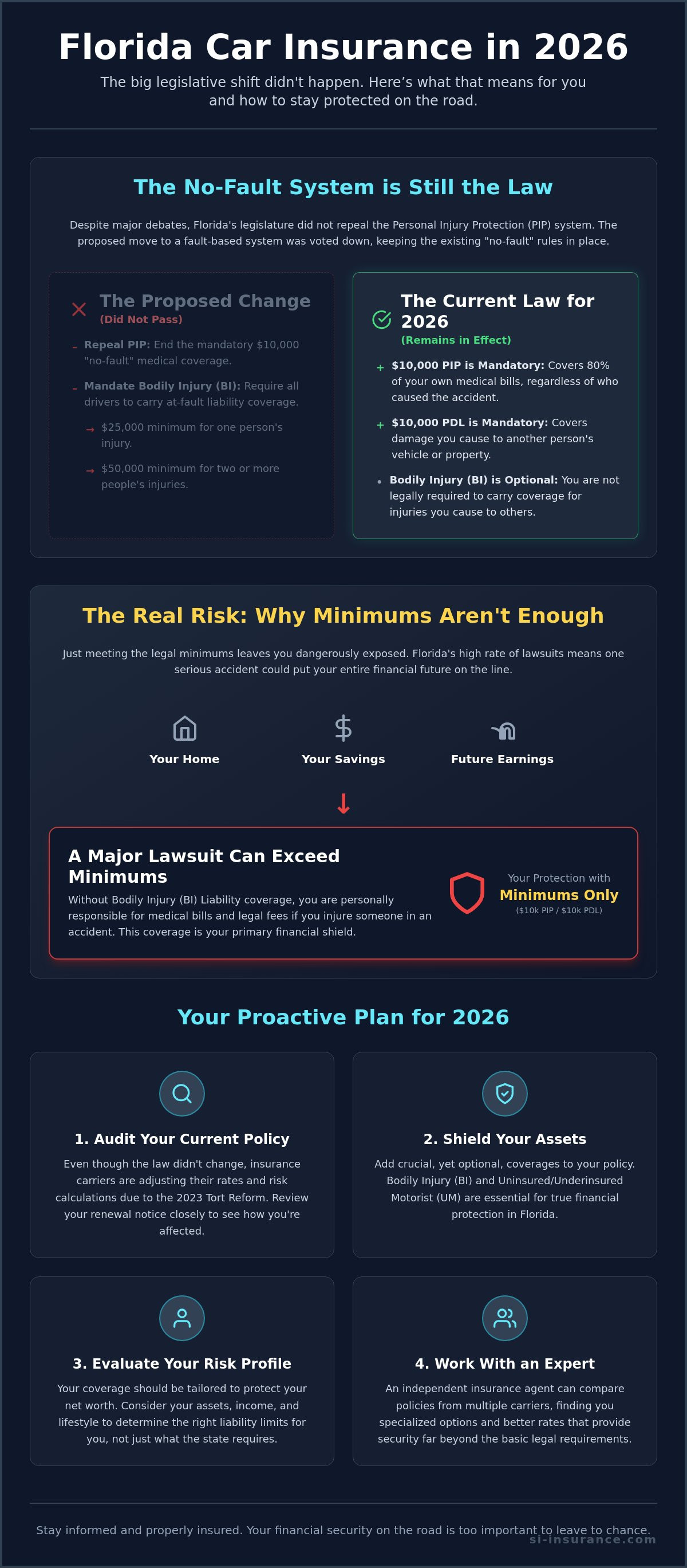
What if the massive regulatory shift you've been preparing for never actually happened, leaving your insurance strategy stuck in a high-cost holding pattern? Despite the intense debate surrounding a potential transition to a fault-based system, Florida car insurance laws 2026 remain defined by the existing no-fault requirements after the proposed repeal of Personal Injury Protection (PIP) failed to clear the legislature. This outcome means that the $10,000 PIP mandate is still the law of the land, requiring a sophisticated approach to ensure your coverage isn't just legal, but truly protective of your total net worth.
It's natural to feel a sense of unease as premiums continue to rise while the threat of litigation in our state remains a constant concern. We'll provide the expert insights you need to master these current regulations and secure your financial future with absolute certainty. This guide breaks down the mandatory coverage limits you must follow, explains why the repeal efforts stalled, and offers a clear methodology for auditing your policy to ensure your assets are shielded from the unique risks found on Florida roads.
Table of Contents
Understanding the 2026 Shift in Florida Car Insurance Requirements
The evolution of Florida car insurance laws 2026 has been defined by a rigorous debate over the state's long-standing "No-Fault" insurance framework. For decades, Florida's no-fault insurance system has functioned through Personal Injury Protection (PIP), a mechanism designed to provide immediate medical coverage regardless of who caused a collision. While this structure was originally intended to reduce the burden on the court system, it has increasingly faced scrutiny for contributing to some of the highest premiums in the nation.
The 2026 legislative cycle brought these tensions to a head, focusing on a proposed transition toward a mandatory Bodily Injury Liability (BIL) model. This shift represents a fundamental change in how financial responsibility is assigned after an accident, moving away from self-coverage toward a system where the at-fault party's insurance bears the primary weight of medical costs and damages. Legislative intent behind these reforms centered on two primary goals: curbing the rampant litigation that drives up costs and stabilizing the insurance market for the average driver.
To better understand this concept, watch this helpful video:
Although the mandatory PIP requirement remains the legal standard as of the early 2026 sessions, the target date of July 1, 2026, continues to serve as a critical milestone for policy renewals and strategic risk assessments. Understanding the mechanics of this proposed transition is essential for any motorist looking to maintain absolute security in a shifting legal landscape.
The Move from PIP to Bodily Injury Liability
The distinction between the historical PIP model and a fault-based system is profound for your personal asset protection. Under the no-fault "pay-your-own-way" model, your own insurance covers 80 percent of medical bills up to a $10,000 limit. In contrast, an at-fault liability model positions Bodily Injury Liability as your primary defense. BIL doesn't just pay for medical bills; it acts as a financial shield for your savings and property when you're held liable for another's injuries. While these reforms are debated, Property Damage Liability (PDL) remains a mandatory constant, ensuring you can cover damage to third-party vehicles or structures.
Why 2026 is a Milestone Year for Florida Motorists
This year is particularly significant because it reflects the ongoing implementation of the 2023 Tort Reform Act, which fundamentally changed how lawsuits are filed and defended in the Sunshine State. Florida is currently navigating a period of intense regulatory scrutiny as it aligns its standards with the majority of other U.S. states that already utilize fault-based systems. During the first half of the year, drivers should monitor their renewal notices closely. Even without a full repeal of PIP, many carriers are adjusting their internal risk algorithms to account for the new litigation landscape, making this the ideal time to evaluate whether your current Florida car insurance laws 2026 compliance strategy provides the level of protection you require.
The End of Mandatory PIP and the Rise of Bodily Injury Liability
The proposed restructuring of Florida car insurance laws 2026 centers on a pivot toward higher liability standards, specifically the introduction of mandatory Bodily Injury Liability (BIL). While the traditional no-fault system relied on a $10,000 Personal Injury Protection (PIP) limit to cover immediate medical costs, the reform blueprint suggests a move toward minimums of $25,000 for the injury or death of one person and $50,000 for the injury or death of two or more people in a single accident. This shift effectively reallocates financial responsibility, requiring drivers to carry coverage that protects others rather than just themselves.
Removing the $10,000 PIP requirement creates a significant void in how motorists manage their own immediate medical expenses following a collision. Without PIP's "no-fault" safety net, you may need to rely on your private health insurance or opt for Medical Payments (MedPay) coverage. MedPay serves as a voluntary alternative that functions similarly to PIP by paying for medical bills regardless of fault, but it typically lacks the lost-wage benefits that were a hallmark of the old system. This change also elevates the necessity of Uninsured Motorist (UM) coverage. In a fault-based state, your ability to recover damages often depends on the other driver's policy limits. If you're struck by an underinsured driver, UM coverage becomes your primary defense against catastrophic financial loss.
New Mandatory Minimums: A Comparative Breakdown
To grasp the scale of this transition, it helps to view the 2025 requirements alongside the projected 2026 standards. Currently, many drivers only carry $10,000 in PIP and $10,000 in Property Damage Liability (PDL). The proposed 2026 framework maintains the $10,000 PDL requirement but adds the $25,000/$50,000 BIL mandate. The "per person" logic limits the payout to any single claimant, while the "per accident" cap represents the total pool available for all injured parties. Consulting with a professional to review your liability exposure ensures these minimums don't leave your personal savings vulnerable.
Impact on Specialty and Commercial Vehicles
The BIL mandate creates a unique ripple effect for motorcycle owners, who have historically operated under different insurance requirements in Florida. A move to a universal BIL standard would likely bring motorcycles into alignment with passenger vehicles, significantly altering the cost of ownership. Similarly, businesses managing fleets must account for these changes within their risk mitigation strategies. This is particularly relevant for those securing commercial auto insurance Broward County, where high traffic density increases the statistical likelihood of multi-party claims. Even seasonal residents, or "snowbirds," must remain vigilant; if your primary policy is based in a state with lower limits, you'll need to ensure your coverage meets Florida's specific 2026 thresholds to remain compliant during your stay.
Evaluating Your Risk Profile Under the New Fault-Based System
Adhering to the basic mandates of Florida car insurance laws 2026 is merely the baseline for legal operation; it does not constitute a comprehensive defense of your financial interests. In a fault-based environment, the transition from "covering yourself" to "indemnifying others" means that your personal assets are directly exposed if a judgment exceeds your policy limits. For homeowners and business owners, the standard minimums are often dangerously insufficient. A single complex surgical procedure or a period of extended rehabilitation for an injured party can easily exhaust a $25,000 limit, leaving your savings, investments, and even future wages vulnerable to garnishment or seizure.
The risk landscape is further complicated by the distinction between "judgment-proof" drivers and those with significant holdings. If you possess tangible assets, you're a primary target for litigation in a state known for high-value settlements. This reality necessitates a shift toward sophisticated mitigation tools like personal umbrella insurance, which provides an additional layer of liability protection that triggers once your primary auto limits are exhausted. Strategic planning also requires an understanding of Florida's modified comparative negligence rules. Under current statutes, if you're found to be more than 50 percent at fault for an incident, you're barred from recovering any damages from other parties, making the precision of your liability limits your only true safety net.
Asset Protection Strategies for Florida Residents
Aligning your Bodily Injury Liability (BIL) limits with your total net worth is the most effective way to prevent catastrophic financial loss. Residents in high-traffic corridors like Sunrise and Pompano Beach face a statistically higher probability of multi-vehicle accidents, where basic coverage is quickly overwhelmed. While a $100,000/$300,000 policy is a common benchmark, high-net-worth individuals often find that $250,000/$500,000 limits offer a superior cost-benefit ratio. These higher thresholds provide the breathing room necessary for legal counsel to negotiate settlements without involving your personal property.
The Role of Uninsured Motorist Coverage
Despite the implementation of Florida car insurance laws 2026, the state continues to grapple with a high volume of uninsured or underinsured motorists. Industry data suggests that approximately 20 percent of Florida drivers operate without any insurance, a figure that remains stubbornly high despite increased mandates. In a fault-based system, your ability to recover medical costs depends entirely on the other driver's coverage. Uninsured Motorist (UM) coverage acts as a strategic hedge, allowing you to collect damages from your own carrier when the negligent party lacks the financial means to compensate you for your losses. It remains the most critical self-protection tool available for ensuring your own recovery isn't left to chance.
Navigating the Transition: A Checklist for Florida Drivers in 2026
Preparation for the evolving landscape of Florida car insurance laws 2026 shouldn't be left until the final weeks of the legislative session. A proactive strategy begins with a comprehensive policy audit at least 90 days before the July 1, 2026, milestone. This window allows you to evaluate how your current coverage aligns with the proposed shifts in liability standards. It's essential to consult with an independent agent who can provide a comparative analysis of how different carriers are responding to these reforms. Unlike captive agents, independent advisors have the flexibility to shop the entire market, ensuring your transition from a no-fault model to a potential fault-based system is both seamless and cost-effective.
As the reliance on Personal Injury Protection (PIP) diminishes in these regulatory discussions, verifying your primary health insurance becomes a top priority. You need to ensure your medical plan offers robust coverage for auto-related injuries, as the "no-fault" safety net may no longer be your primary source of recovery. Once your new policy structure is finalized, immediate coordination with the FLHSMV is required. Updating your registration and proof of insurance promptly is the only way to ensure your driving privileges remain intact and your record stays clear of administrative flags.
Avoiding Coverage Lapses and Penalties
The penalties for failing to meet the new mandatory BIL limits are rigorous. Florida authorities often utilize automated systems to detect insurance lapses, which can lead to the immediate suspension of your driver's license and registration. If your current policy is set to renew mid-term near the July 1st date, you'll need a bridge strategy that maintains compliance without double-paying for coverage. Maintaining continuous insurance is also the most effective way to preserve your "loyalty" or "continuous coverage" discounts. Even a 24-hour lapse can reset your risk rating, leading to significantly higher premiums for years to come. To avoid these pitfalls, you can schedule a comprehensive policy audit with our team today.
Local Considerations for Broward County Residents
For those navigating the high-traffic corridors of Sunrise and Pompano Beach, the 2026 transition carries additional weight. The sheer density of vehicles in South Florida increases the statistical probability of being involved in a multi-party accident where basic state minimums are quickly exhausted. This environment requires a nuanced understanding of Florida auto insurance that goes beyond simple legal compliance. Local motorists should also look for regional discount opportunities, such as mature driver courses. These programs are specifically designed to help South Florida residents lower their liability costs while sharpening the skills necessary for our unique driving conditions.
Strategic Risk Management with SI Insurance
Managing the complexities of Florida car insurance laws 2026 requires more than a standard transaction; it demands a partnership with a sophisticated risk management specialist who treats your financial security as a high-stakes priority. SI Insurance functions as an elite consultant for Florida motorists, moving beyond the generic offerings of the retail market to provide meticulously engineered protection. Our approach is rooted in the belief that insurance isn't just a monthly expense, but a critical component of your broader financial architecture. By operating as a seasoned guardian for our clients, we ensure that every policy is structured with the foresight necessary to withstand the volatile legal and regulatory climate of the Sunshine State.
Our presence in Sunrise and Pompano Beach allows us to offer personalized, premium service that addresses the specific high-density risks of Broward County. We don't believe in the one-size-fits-all methodology found in high-volume call centers. Instead, we perform a rigorous analysis of your individual risk profile, identifying potential vulnerabilities that basic policies often overlook. This commitment to intellectual confidence means you can navigate the 2026 transition with the absolute certainty that your personal assets are shielded by a calm, calculated partner dedicated to your long-term stability.
Why an Independent Agency is Critical in 2026
The primary advantage of SI Insurance lies in our independence, which allows us to monitor shifting carrier responses to legislative reforms in real time. We shop over 20 high-value carriers to find the precise alignment of coverage and cost that a single captive agent simply cannot offer. This proactive monitoring is essential as Florida car insurance laws 2026 continue to evolve, ensuring your policy remains compliant without sacrificing depth of protection. To further optimize your risk management budget, we often recommend home and auto bundling, a strategic move that provides comprehensive coverage while leveraging multi-policy efficiencies to offset rising market costs.
Secure Your 2026 Coverage Strategy Today
Waiting for a renewal notice is a reactive stance that can lead to rushed decisions and inadequate limits. A methodical review of your current liability structure with a specialized agent is the only way to ensure your net worth is protected before the July 1st milestone. We invite you to experience a more sophisticated level of service where your security is managed through rigorous analysis rather than simple automation. You can take the first step toward absolute financial peace of mind when you Request a Strategic Review with our elite consulting team today. Our commitment to your security is unwavering, providing the stability and foresight required in a complex financial landscape.
Securing Your Financial Future Amidst Regulatory Change
Adapting to the nuances of Florida car insurance laws 2026 requires more than a casual understanding of state minimums. It demands a rigorous evaluation of how a fault-based system affects your personal liability. By transitioning from the traditional no-fault safety net to a model centered on Bodily Injury Liability, you're effectively shifting your defensive strategy to focus on the preservation of your total net worth. This evolution in the legal landscape means that a proactive audit of your coverage limits is no longer optional for those with significant assets to protect.
Our team at SI Insurance acts as a protective guardian during these transitions, leveraging specialized expertise in Florida Tort Reform to ensure your security remains airtight. With local offices in Sunrise and Pompano Beach, we operate as an independent agency that shops over 20 elite carriers to find the precise risk mitigation structures your high-value lifestyle requires. You don't have to face these regulatory shifts alone. We invite you to Consult with a Strategic Risk Advisor at SI Insurance to finalize a coverage plan that instills absolute intellectual confidence. It's time to secure a legacy that's built on foresight and technical mastery.
Frequently Asked Questions
Is Florida still a no-fault state for car insurance in 2026?
Yes, Florida remains a no-fault state in 2026 because the legislative efforts to repeal Personal Injury Protection (PIP) did not pass during the most recent session. This means your own insurance is still responsible for covering your initial medical expenses and lost wages regardless of who caused the accident. While the debate over a fault-based system continues, the existing no-fault framework stays the legal standard for all registered vehicles.
What happens to my PIP coverage after July 1, 2026?
Your PIP coverage remains a mandatory component of your policy after July 1, 2026, as no legal changes were enacted to remove it. Drivers must still maintain the $10,000 minimum limit to satisfy state registration requirements. It's vital to remember that you must seek medical treatment within 14 days of an accident to remain eligible for these benefits under the current statutes.
What are the new minimum car insurance requirements in Florida for 2026?
The minimum requirements for Florida car insurance laws 2026 have not changed and currently consist of $10,000 in Personal Injury Protection and $10,000 in Property Damage Liability. Bodily Injury Liability remains optional for many drivers, though it's often required for those with a history of certain traffic violations or accidents. Relying solely on these minimums is rarely a sound strategy for protecting significant personal assets.
Will my car insurance premiums go down with the 2026 reform?
There's no evidence to suggest that premiums will decrease in 2026, especially since the proposed transition to a fault-based system was not implemented. Florida continues to see some of the highest insurance costs in the nation, with average annual full coverage rates often exceeding $3,183 according to recent data. While some major carriers may adjust rates slightly, the overall trend in the state remains focused on high litigation costs.
Do I need Bodily Injury Liability if I already have health insurance?
Yes, you absolutely need Bodily Injury Liability (BIL) because health insurance does not provide any protection for your personal assets if you're sued after an accident. Health insurance only covers your own medical bills, whereas BIL pays for the injuries you cause to others and provides for your legal defense. Without BIL, your savings, home, and future wages are at risk if a judgment is entered against you.
What are the penalties for not meeting the 2026 Florida insurance laws?
The primary penalties for failing to maintain required coverage include the immediate suspension of your driver's license and vehicle registration. You'll also face reinstatement fees that typically range from $150 to $500 depending on whether it's a first or subsequent offense. Florida uses an electronic verification system with insurance carriers, so a lapse in coverage is reported to the state almost instantly, triggering administrative action.
Can I still sue for pain and suffering under the 2026 fault-based system?
Since Florida has not transitioned to a full fault-based system, you can only sue for non-economic damages like pain and suffering if your injuries meet the permanent injury threshold. This legal standard requires proving that the accident resulted in significant loss of a bodily function, permanent scarring, or death. Without meeting this threshold, your recovery is generally limited to the economic losses covered by your own Florida car insurance laws 2026 compliant policy.
Should I increase my liability limits beyond the state minimum in 2026?
Increasing your liability limits is a critical step for any driver with tangible assets to protect in 2026. The $10,000 minimum for property damage is easily exhausted in even a minor multi-car collision involving modern vehicles. Opting for higher limits, such as $100,000 per person and $300,000 per accident for bodily injury, provides a more robust shield against the high costs of litigation and catastrophic medical claims.
Comments