


Florida Insurance Claim Process: A Strategic Step-by-Step Guide for 2026
- siinsuranceflorida
- Mar 31
- 12 min read
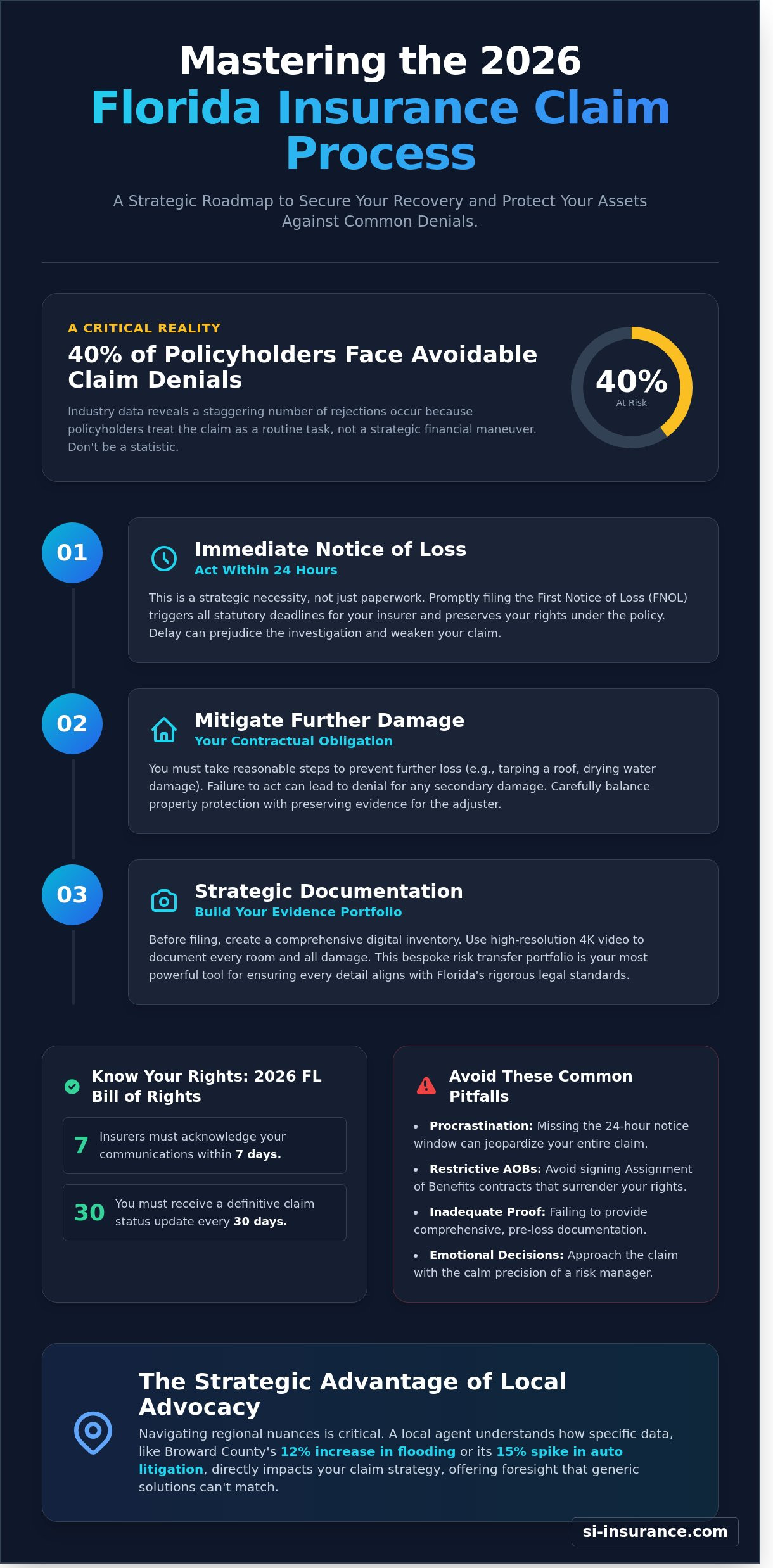
What if the standard methods you've relied on to protect your property are the exact reason your recovery efforts stall in 2026? It's a sobering reality, as industry data suggests roughly 40% of policyholders encounter avoidable denials because they treat the florida insurance claim process as a routine administrative task rather than a strategic financial maneuver. You probably feel the weight of complex hurricane deductibles and the pressure of dealing with adjusters who don't always have your best interests at heart. We recognize that this technical confusion creates a high-stakes environment where one minor error can threaten your most valuable assets.
You'll master the complexities of the Florida insurance claim process with our professional guide to securing your recovery and protecting your assets. This strategic roadmap is designed to provide absolute security and intellectual confidence by translating dense 2026 statutes into actionable, bespoke steps. We're going to examine your rights under Florida law and provide a meticulous breakdown of the timeline you must follow to secure a successful, fair settlement. It's time to move past the stress and approach your claim with the foresight and precision of a seasoned risk manager.
Key Takeaways
Gain a comprehensive understanding of the 2026 Florida Office of Insurance Regulation landscape to better anticipate how shifting regional weather patterns influence your recovery strategy.
Master the strategic architecture of the florida insurance claim process, focusing on the vital 24-hour notification window and your mandatory obligation to mitigate further loss.
Learn to navigate the complex legal interplay between Personal Injury Protection and property liability to ensure your assets remain fully protected under current Florida statutes.
Discover how to safeguard your claim against common pitfalls, such as restrictive Assignment of Benefits (AOB) contracts, that frequently lead to avoidable denials.
Uncover the strategic advantage of partnering with a local independent agent to receive the bespoke advocacy and elite risk management your property deserves.
Table of Contents Understanding the Florida Insurance Claim Landscape in 2026 The Step-by-Step Architecture of a Florida Insurance Claim Auto vs. Property Claims: Navigating Florida’s Legal Framework Avoiding Common Pitfalls and Strategic Documentation Techniques The Strategic Advantage of Local Advocacy with Si Insurance Agency
Understanding the Florida Insurance Claim Landscape in 2026
The Florida Office of Insurance Regulation (OIR) maintains a rigorous oversight framework that has evolved significantly by early 2026. This environment demands that property owners approach their coverage with a high degree of technical precision and intellectual confidence. In Broward County, the 2025 storm season recorded a 12% increase in localized flooding events, which directly influenced how the OIR evaluates solvency and claim handling procedures. You aren't just a policyholder anymore; you're a claimant entering a high-stakes financial negotiation that requires a calm, calculated approach.
Transitioning into the role of a claimant requires a psychological pivot toward professional composure. The insurance_claim_process is no longer a simple administrative task but a complex maneuver in risk management. South Florida residents face a market where capacity remains tight and every detail in a filing is scrutinized for its impact on underwriting excellence. Maintaining an emotional distance allows you to focus on the logic of your contract rather than the stress of the loss.
To gain a clearer perspective on the mechanics of this procedure, review this technical overview:
The Role of the Florida Homeowners’ Bill of Rights
The Florida Homeowners’ Bill of Rights received critical updates in 2026 to enhance transparency in the florida insurance claim process. These statutes mandate that carriers acknowledge communications within 7 days and provide a definitive claim status update every 30 days. Adopting a "Strategic Guardian" mindset is essential for effective self-advocacy. You've got to view your documentation as a bespoke risk transfer portfolio, ensuring that every piece of evidence aligns with the rigorous standards set by modern Florida law. This proactive stance ensures that your rights aren't just theoretical concepts but functional tools for asset protection.
Local Risk Factors in Sunrise and Pompano Beach
Living in Sunrise or Pompano Beach introduces specific variables that complicate the 2026 insurance market. Traffic density in Broward County reached a record high last year, leading to a 15% spike in complex auto litigation and liability claims. Simultaneously, coastal properties in Pompano Beach face distinct salt-air corrosion and surge risks that differ fundamentally from the wind-driven rain damage seen in inland Sunrise homes. Engaging a local agent at Si Insurance Agency provides the strategic alignment necessary to navigate these regional nuances. They understand how local weather patterns and zip-code-specific data influence the florida insurance claim process, offering a level of foresight that off-the-shelf solutions simply can't match.
The Step-by-Step Architecture of a Florida Insurance Claim
The florida insurance claim process requires a level of tactical precision that many policyholders underestimate. It begins with the Immediate Notice of Loss, which should ideally occur within a 24-hour window to ensure the carrier can't argue that a delay prejudiced their investigation. Notice of Loss is the formal trigger for all statutory insurance deadlines. In the current 2026 regulatory environment, filing this notice quickly is a strategic necessity to preserve your rights under the policy.
Once the notice is filed, your focus shifts to the mitigation of damages. This isn't a suggestion; it's a contractual obligation. You're required to take reasonable steps to prevent further loss, such as tarping a damaged roof or drying out a flooded basement. If you don't act, the carrier might deny portions of the claim linked to preventable secondary damage. It's a delicate balance of protecting the property without destroying evidence before the field adjuster arrives.
Step 1: Strategic Documentation and Notice
Success in 2026 depends on a comprehensive digital inventory. You should utilize high-resolution 4K video to document every room before the First Notice of Loss (FNOL) is even initiated. When you submit the FNOL, ensure you're providing a concise but thorough description of the peril. This initial communication sets the tone for the entire investigation phase. For those managing high-value assets, strategic alignment with a professional risk consultant can ensure these early steps are handled with the necessary sophistication.
Step 2: Navigating the Adjuster Inspection
You'll likely encounter either a staff adjuster, who works directly for the carrier, or an independent adjuster hired as a third-party contractor. It's vital to be present during the physical inspection to point out nuances that a time-pressed adjuster might miss. In storm-weary areas like Broward County, hidden damage such as structural micro-fissures or moisture trapped behind drywall often goes overlooked during a standard walk-through. You're there to ensure the scope of loss is exhaustive, not just superficial.
The evaluation phase often involves a "Reservation of Rights" letter. This document indicates the company is investigating the claim but hasn't yet committed to coverage. It's a standard legal safeguard for the insurer, but it requires careful review to understand which policy exclusions they're eyeing. The final resolution usually comes down to the difference between Actual Cash Value (ACV) and Replacement Cost Value (RCV). ACV payments subtract depreciation, while RCV payments provide the funds needed to actually replace what was lost at today's prices. Understanding these valuation models is the difference between a partial recovery and a full restoration of your financial position.
Auto vs. Property Claims: Navigating Florida’s Legal Framework
The florida insurance claim process demands a dual understanding of both tort-based property law and no-fault automotive statutes. For 2026, this distinction remains a critical pillar of risk management. While property claims focus on indemnification for physical assets, auto claims operate within a unique legislative bubble that prioritizes immediate medical solvency over immediate fault determination. SI Insurance views these frameworks not as obstacles, but as variables that require a calculated and bespoke approach to ensure total asset protection.
The "No-Fault" Reality of Florida Auto Claims
Florida's mandatory Personal Injury Protection (PIP) system dictates that your own insurer covers the first $10,000 of medical expenses and lost wages. It doesn't matter if an accident occurs on the busy corridors of Sunrise or the residential streets of Pompano Beach; your PIP is the primary responder. This is the "no-fault" baseline. However, the $10,000 Property Damage Liability (PDL) requirement only covers damage you cause to others. If your medical costs exceed the "serious injury" threshold defined in Florida Statute 627.737, the claim transitions into a third-party liability suit. Data from 2025 indicated that nearly 20% of Florida drivers remain uninsured. This makes Uninsured Motorist (UM) coverage a strategic necessity for those seeking absolute security within the florida insurance claim process.
Property Claims and the Hurricane Deductible
Unlike standard All-Other-Peril (AOP) deductibles, which usually involve a flat dollar amount like $1,000 or $5,000, hurricane deductibles in 2026 are typically calculated as a percentage of the structure's total insured value. For a $1.2 million estate, a 5% deductible results in a $60,000 out-of-pocket cost before the insurer contributes. These deductibles trigger only during a specific window: from the moment a hurricane watch or warning is issued by the National Hurricane Center until 72 hours after the warning terminates. SI Insurance recommends several strategies for managing these high-value retentions:
Liquidity Reserves: Maintain a dedicated fund specifically to cover the 2% to 10% deductible gap.
Strategic Alignment: Coordinate auto and property policies to avoid overlapping out-of-pocket expenses during a single storm event.
Mitigation Credits: Utilize wind-mitigation inspections to lower the underlying premium, offsetting the cost of high deductibles.
When a major storm impacts both your vehicle and your residence, managing two separate deductibles and different adjusters requires a meticulous, steady hand. This professional oversight ensures that the logic of your recovery is airtight and that no coverage gaps emerge between your distinct policy types.
Avoiding Common Pitfalls and Strategic Documentation Techniques
Success in the florida insurance claim process depends on precision and an awareness of shifting legal landscapes. One of the most significant risks involves "Assignment of Benefits" (AOB) contracts. While 2023 legislative reforms in Florida significantly restricted these agreements to curb litigation abuse, some vendors still push for control over your claim rights. Relinquishing these rights can leave you with zero leverage if the repairs are substandard or the carrier underpays, as you've essentially handed your legal standing to a third party.
Why Claims are Disputed or Denied
Carriers often cite specific technicalities to limit their liability or justify a denial. It's vital to recognize these common hurdles before they stall your recovery:
Proof of Loss Deadlines: Missing a "Proof of Loss" deadline, which typically falls within 60 days of the carrier's request, is a frequent cause for immediate claim rejection.
Pre-existing Damage: Insurers frequently argue that a portion of the damage, sometimes as much as 50%, existed prior to the recorded event.
Material Misrepresentation: If an application contains inaccurate data that would've changed the risk assessment during underwriting, the carrier may attempt to void the policy entirely.
The Power of Professional Documentation
High-stakes claims require airtight evidence that leaves no room for interpretation. You should use time-stamped metadata in every photo to prove exactly when and where the damage was recorded, ensuring the carrier can't claim the images were taken after a separate, secondary event. A detailed communication log acts as a definitive evidentiary record that eliminates the ambiguity of verbal promises by providing a dated, objective account of every interaction with the insurance carrier. This log should include names, titles, and exact timestamps of every phone call or site visit.
Challenging a low-ball estimate requires a professional, data-driven rebuttal rather than an emotional one. Instead of escalating immediately to litigation, provide a line-by-line comparison using 2025 local market rates for labor and materials. If you discover hidden issues during the repair phase, you'll need to initiate the supplemental claim process. This allows you to request additional funds for damage that wasn't visible during the initial inspection, provided you document the discovery immediately and pause work in that specific area until the adjuster reviews it.
Learn how SI Insurance manages these complex variables to protect your assets and ensure your strategic alignment with carrier requirements.
The Strategic Advantage of Local Advocacy with Si Insurance Agency
The florida insurance claim process is a sophisticated operation that requires more than just filling out forms. It demands a level of strategic foresight that only an independent advocate can provide. At Si Insurance Agency, we don't just facilitate transactions; we act as a specialized guardian for your assets. Our role involves meticulous oversight of the entire lifecycle of a claim, ensuring that every interaction with the carrier is calculated to protect your long-term interests. We understand that a claim isn't just a recovery event. It’s a pivotal moment in your financial history.
Beyond the Policy: Our Commitment to Broward County
Communication is the cornerstone of a successful recovery. We manage the dialogue between you and the insurance carrier to ensure no detail is overlooked. With the 2026 market showing a 12% shift in reinsurance capacity, having a local office in Sunrise or Pompano Beach for face-to-face support provides a tangible edge that remote call centers cannot replicate. We host strategy sessions to review your coverage alignment post-claim. This isn't a generic service. It's a bespoke risk management approach designed to address the unique pressures of the South Florida market. After a claim is settled, we conduct a rigorous audit of your policy to ensure you're positioned for stability in the coming years.
Securing Your Future with Strategic Risk Transfer
A well-managed claim is a catalyst for future financial strength. By demonstrating underwriting excellence during the recovery phase, we help you maintain a favorable risk profile that appeals to high-tier carriers. We focus on strategic risk transfer, moving beyond simple indemnity to comprehensive financial protection. This approach prevents the common pitfalls that lead to future premium spikes or non-renewals. Managing the florida insurance claim process with precision ensures that your loss history doesn't become a liability during your next renewal cycle.
Our team prioritizes technical mastery in every document and negotiation. It's time to elevate your expectations for what an agency can achieve. We invite you to experience the white-glove service of Si Insurance Agency. Contact us today for a comprehensive policy review and let us secure your strategic advantage for 2026 and beyond.
Advancing Your Strategic Position in the 2026 Florida Market
Mastering the florida insurance claim process in 2026 requires a shift from reactive filing to proactive risk management. You've learned that meticulous documentation and a firm grasp of the legislative divide between property and auto claims are the foundations of a successful recovery. In a landscape where Florida's insurance statutes have undergone 3 major overhauls since 2023, having a seasoned guardian in your corner isn't just helpful; it's essential for your financial stability. Our firm provides specialized Broward County risk mitigation from our offices in Sunrise and Pompano Beach, offering the kind of elite consulting that high-value portfolios demand. We focus on bespoke risk transfer and underwriting excellence to ensure your interests are always protected. You'll find that our 25 years of local expertise provides the intellectual confidence you need to navigate even the most complex claims. We're ready to help you secure a future defined by stability and foresight. Secure your strategic risk management partner at SI Insurance Agency. You've got the tools to succeed, and we're here to ensure you use them effectively.
Frequently Asked Questions
How long does an insurance company have to pay a claim in Florida in 2026?
In 2026, Florida insurers must pay or deny your claim within 60 days of receiving your completed proof of loss statement. This timeline is governed by Florida Statute 627.70131, which also mandates that companies acknowledge your initial communication within 7 days. If the carrier fails to meet these strategic deadlines, they're often liable for interest on the final settlement amount, ensuring your risk mitigation efforts aren't delayed by administrative friction.
Can I handle a Florida insurance claim without hiring a lawyer?
You can certainly manage the florida insurance claim process independently, though complex high-value losses often benefit from professional oversight. While approximately 65% of homeowners navigate minor claims successfully, 2024 legislative changes have altered the landscape for attorney fee recovery. It's vital to document every interaction meticulously to ensure your personal risk management strategy remains sound. If the settlement offer doesn't align with your repair estimates, seeking elite technical expertise becomes a necessary step.
What happens if my insurance claim is denied in Florida?
If your claim is denied, the insurer must provide a written explanation citing specific policy exclusions or conditions. You've the right to request a formal review or pursue alternative dispute resolution through the Florida Department of Financial Services mediation program. In 2025, data showed that 15% of initial denials were overturned through strategic appraisal or mediation processes. Don't accept a denial as final without conducting a rigorous analysis of the carrier's stated logic.
What is a "Reservation of Rights" letter in the Florida claim process?
A Reservation of Rights letter is a formal notice stating that the insurer's investigating your claim while maintaining their right to deny coverage later based on policy terms. This document doesn't mean your claim's rejected; it simply protects the carrier's legal position during the discovery phase. It's a standard part of the florida insurance claim process that signals the need for a precise and well-documented response to ensure your bespoke coverage remains intact.
How do I file a supplemental claim if I find more damage later?
You file a supplemental claim by notifying your insurer in writing as soon as you discover hidden damage, such as structural issues found during a 2026 renovation. You'll need to provide new evidence, including photos and contractor estimates, to link the damage to the original covered peril. Florida law generally requires these claims to be filed within 18 months of the initial date of loss for hurricane-related events to ensure a strategic recovery.
Is there a deadline for filing a hurricane damage claim in Florida?
You must report a hurricane or windstorm claim within 365 days of the date the storm made landfall according to current Florida statutes. For supplemental claims, the window extends to 18 months from the original date of loss. These strict deadlines make it essential to conduct a comprehensive property inspection immediately after any major weather event. Waiting too long can compromise your ability to secure the bespoke risk transfer you've paid for.
Does filing a claim automatically increase my insurance premiums in Florida?
Filing a single claim for an Act of God, like a 120-mph hurricane wind, doesn't legally allow an insurer to single you out for a premium hike. Florida carriers can adjust rates across entire zip codes based on regional loss data from the previous 12 months. Your premium might rise by 20% if the overall risk profile of your neighborhood changes after a major catastrophe, regardless of your personal claim history.
What is the difference between a public adjuster and a staff adjuster?
A staff adjuster is an employee of the insurance company whose primary goal is to protect the carrier's financial interests. In contrast, a public adjuster is an independent professional you hire to advocate specifically for your maximum recovery. Public adjusters in Florida typically charge a fee of 10% to 20% of the final settlement. They provide a bespoke level of claim management and technical underwriting excellence that staff adjusters simply don't offer to policyholders.
Comments