


Florida Minimum Auto Insurance Requirements 2026: A Strategic Guide for Drivers
- siinsuranceflorida
- Mar 16
- 15 min read
Did you know that South Florida drivers currently face premiums that are 45% higher than the national average? As we approach the regulatory shifts on January 1, 2026, understanding the Florida minimum auto insurance requirements 2026 is no longer just a legal necessity; it's a strategic move for your financial security. You've likely felt the pressure of these rising costs in Sunrise or Pompano Beach, and it's natural to feel frustrated by the complexity of recent legislative changes. It's difficult to feel secure when the rules of the road seem to be in a constant state of flux.
This guide will show you how to satisfy the mandatory coverage levels for 2026 while strategically positioning your assets to withstand the state's high litigation environment. We'll clarify the technical distinctions between Personal Injury Protection and Property Damage Liability to ensure your risk management is airtight. You'll gain a clear path toward legal compliance and the professional insight needed to secure a policy that offers genuine peace of mind.
Key Takeaways
Understand how Florida’s shifting regulatory environment and the evolution of "No-Fault" status will impact your daily commute and financial security as we head into 2026.
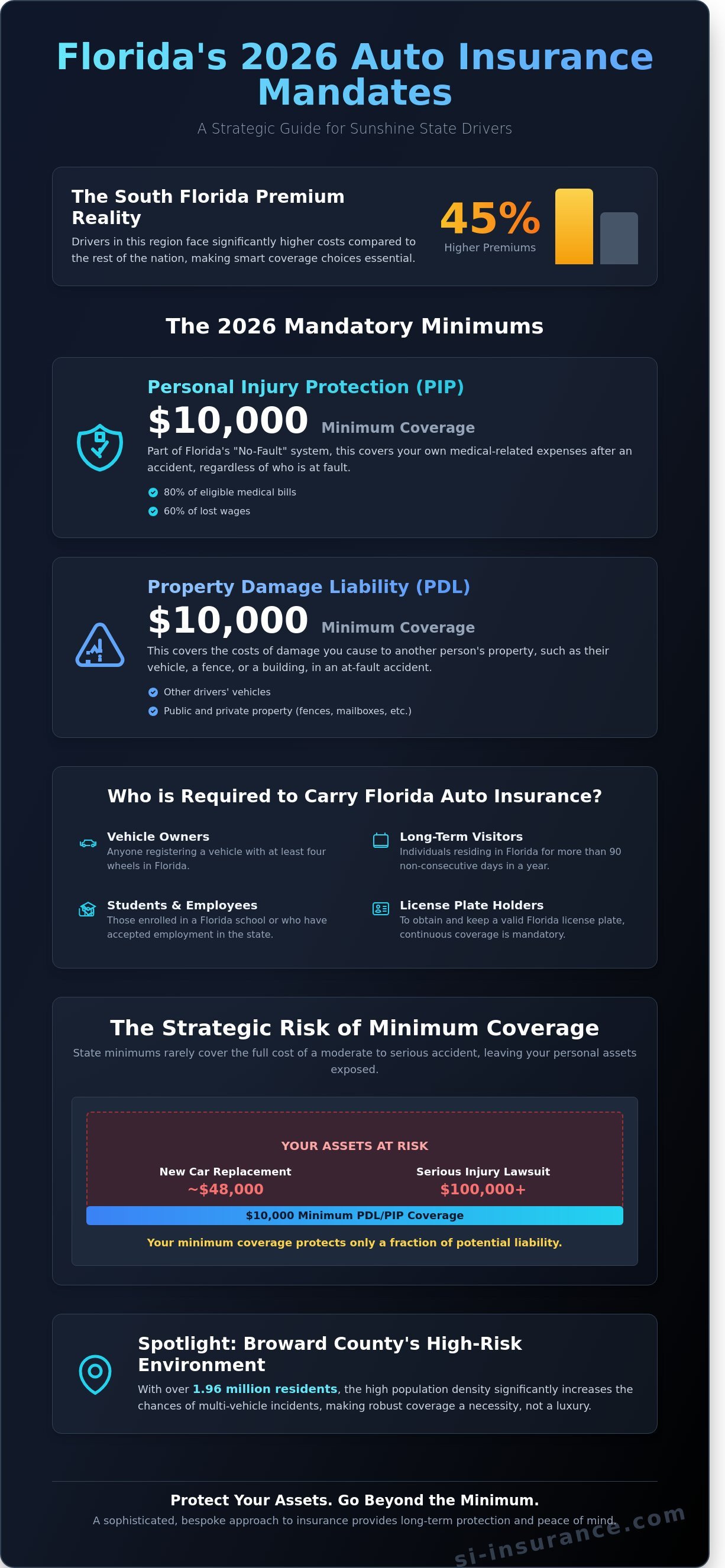
Get a clear, precise breakdown of the Florida minimum auto insurance requirements 2026 to ensure you meet the mandatory $10,000 thresholds for both PIP and PDL.
Learn why carrying only the state-mandated minimums can be a significant strategic risk when faced with the reality of modern medical expenses that often exceed basic limits.
Explore ways to tailor your coverage for the specific driving needs of Broward County, including tailored advice for residents and seasonal snowbirds in Sunrise and Pompano Beach.
Discover how a more sophisticated, bespoke approach to your insurance can provide the long-term protection and intellectual confidence required to safeguard your personal assets.
Table of Contents Navigating the 2026 Florida Auto Insurance Landscape The Mandatory Minimums: PIP and PDL Explained for 2026 Beyond the Basics: Why State Minimums May Be a Strategic Risk Tailoring Your Policy: Guidance for Broward County Residents Strategic Risk Management with SI Insurance Agency
Navigating the 2026 Florida Auto Insurance Landscape
The regulatory framework governing Florida's motor vehicle operations is undergoing a calculated transformation as we approach the 2026 fiscal year. Understanding the Florida minimum auto insurance requirements 2026 is no longer just a compliance exercise; it's a foundational component of a sophisticated risk management strategy. These mandates represent the state's latest attempt to balance affordable access to coverage with the high costs of medical care and litigation. For the discerning driver, staying ahead of these reforms is essential for maintaining long-term financial health and ensuring that personal assets remain shielded from the volatility of the modern insurance market.
A central pillar of this environment is Florida's no-fault insurance system, which dictates how claims are processed during the standard daily commute. This system is designed to prioritize immediate medical intervention, allowing injured parties to access benefits without the administrative delays associated with determining liability. It's a structure that favors efficiency and medical stabilization, yet it requires a nuanced understanding of how Personal Injury Protection (PIP) interacts with other coverage layers. Interpreting these complex state mandates requires a level of technical mastery that often exceeds the capabilities of standard retail platforms. This is where the role of an independent agency becomes vital, acting as a strategic consultant to ensure your coverage is both compliant and comprehensive.
The Impact of 2026 Legislative Reforms
Recent legislative shifts have focused heavily on refining how Personal Injury Protection is administered across the state. By 2026, new protocols for medical fee schedules and diagnostic reporting will be fully operational, aiming to reduce the hyper-litigious environment that has historically driven up premiums. The state's objective is clear: reduce the volume of lawsuits by implementing more rigorous standards for claim filing and medical necessity. For residents in communities from Sunrise to Pompano Beach, these changes are particularly relevant. In these high-traffic corridors, the updated standards will influence how quickly claims are settled and how much of your premium is dedicated to legal defense costs. It's a move toward a more predictable, albeit more regulated, insurance ecosystem.
Why Florida Remains a Unique Insurance Market
Broward County remains one of the most complex insurance environments in the country, with a population density exceeding 1.96 million residents as of recent census estimates. This high concentration of drivers naturally elevates the risk of multi-vehicle incidents, making "No-Fault" laws even more critical for managing immediate medical outcomes. These laws ensure that the first $10,000 of medical expenses are covered by your own insurer, regardless of who's at fault, which acts as a primary buffer against financial shocks. However, simply meeting the minimums is rarely enough for those with significant assets to protect. Navigating these high-stakes waters requires the foresight of a strategic guardian like SI Insurance Agency. They provide the bespoke risk transfer solutions necessary to navigate Florida's unique market, ensuring that your insurance portfolio is engineered for maximum stability and intellectual confidence. Their focus on underwriting excellence means you aren't just buying a policy; you're securing a meticulously crafted shield against the unpredictable nature of Florida's roads.
The Mandatory Minimums: PIP and PDL Explained for 2026
Every driver in the Sunshine State faces a specific set of legal obligations that dictate how they must protect themselves and others on the road. To secure a valid registration and a metal license plate in 2026, you've got to prove you're covered. These Florida minimum auto insurance requirements 2026 apply to more than just lifelong locals. If you've lived here for more than 90 days total in a calendar year, the law requires compliance. This also extends to students enrolled in any Florida school or individuals who have accepted employment in the state, regardless of their permanent address.
The legal framework is built on two pillars: Personal Injury Protection (PIP) and Property Damage Liability (PDL). You can find the full breakdown of Florida's official insurance requirements on the state's department website, which confirms that both must be maintained at a minimum of $10,000 each. Failing to maintain these levels doesn't just result in a small fine; it puts your very ability to commute at risk. The state uses an electronic reporting system that notifies officials of a lapse in real-time, often leading to immediate administrative action.
Personal Injury Protection (PIP) Deep Dive
Personal Injury Protection is essentially the "first responder" of your insurance policy. It's often called the heart of the system because it's why Florida is a "no-fault" state. It's designed to provide immediate relief for medical costs regardless of who caused the crash. However, the $10,000 limit doesn't mean you'll see a flat check for that amount. The policy follows a strict 80/60 formula: it covers exactly 80% of your necessary medical expenses and 60% of your lost wages resulting from the injury.
This specific structure means that a $10,000 bill at a trauma center would only result in an $8,000 payout from your PIP coverage. There's also a critical caveat regarding the severity of the injury. If a medical professional determines your injury isn't an "Emergency Medical Condition" (EMC), your benefit cap drops from $10,000 to just $2,500. This makes the timing of your initial medical evaluation vital. Additionally, the policy includes a $5,000 death benefit, providing a small measure of financial support for families in the most tragic circumstances.
Property Damage Liability (PDL) Essentials
Property Damage Liability looks after everyone else's assets. If you accidentally reverse into a neighbor's vehicle or a local storefront, your PDL coverage kicks in to pay for those repairs up to your $10,000 limit. It covers damage to cars, fences, buildings, and even city property like light poles or signs. It's important to realize this coverage never pays for your own car repairs. If your vehicle is totaled in an accident you caused, PDL offers zero relief for your personal loss.
Maintaining this coverage is a continuous obligation. If your policy lapses for even 24 hours, the state can suspend your driver's license, tags, and registration. To get them back, you'll likely face reinstatement fees ranging from $150 to $500 depending on how many times you've let your coverage drop. For those seeking a more strategic approach to liability protection, looking beyond these bare minimums is often the most prudent path forward. The consequences of a lapse include:
Immediate suspension of your driving privileges for up to three years or until proof of insurance is provided.
Requirement to pay a $150 reinstatement fee for a first offense.
Potential requirement to carry a more expensive SR-22 filing for future years.
While the Florida minimum auto insurance requirements 2026 provide a baseline for legal operation, they are rarely enough to protect your personal wealth in a major incident. These $10,000 limits have not changed in decades, yet the cost of vehicles and medical care has risen by over 200% in that same timeframe. Understanding these minimums is the first step in a broader risk management plan.
Beyond the Basics: Why State Minimums May Be a Strategic Risk
Many drivers operate under the assumption that meeting the Florida minimum auto insurance requirements 2026 offers a complete shield against financial loss. This belief is a fundamental misunderstanding of how liability works in a litigious environment. While the state mandates a baseline for legal operation, these figures represent a floor, not a ceiling. Relying on the bare minimum is a gamble that ignores the skyrocketing costs of vehicle technology and medical care in South Florida. It's vital to recognize that being "legal" on the road doesn't mean you're protected in the courtroom.
The $10,000 Personal Injury Protection (PIP) cap is particularly problematic as we look toward 2026. This limit has remained stagnant for decades while medical inflation has surged. A single emergency room visit at a Broward County facility today can easily surpass $15,000 for diagnostic imaging and stabilization alone. When your coverage stops at $10,000, the remaining balance becomes your personal responsibility. You can find more details on how these mandates function in this guide to Florida car insurance laws explained, which highlights the specific limitations of the no-fault system.
Property Damage Liability (PDL) presents another strategic vulnerability. The current $10,000 minimum is often insufficient for even a minor two-car accident in Pompano Beach. Consider the prevalence of high-value electric vehicles and luxury SUVs on our roads; a simple bumper replacement and sensor recalibration on a 2025 model can exceed $7,000. If you're involved in a multi-car chain reaction, that $10,000 limit is exhausted instantly, leaving you exposed to subrogation claims from other insurers who will seek to recover their payouts directly from your personal assets.
The Hidden Danger of Being Underinsured
The gap between your $10,000 policy limit and a $100,000 court judgment represents a vacuum that the legal system fills by targeting your home equity, savings accounts, and future wage garnishments. If damages exceed your coverage, plaintiffs' attorneys will look for liquid assets to satisfy the debt. We believe that strategic alignment of your policy limits with your actual net worth is the only way to ensure long-term financial stability against unpredictable road events.
The Case for Bodily Injury Liability (BIL)
Bodily Injury Liability is the most critical component of a bespoke risk transfer plan, even though it isn't strictly part of the Florida minimum auto insurance requirements 2026 for most non-commercial drivers. BIL pays for the medical expenses and pain and suffering of others when you're at fault, preventing a catastrophic lawsuit from depleting your retirement funds. For homeowners and business owners in Broward County, we typically recommend BIL limits of at least $100,000 per person and $300,000 per accident to provide a meaningful buffer. This level of coverage acts as a professional gatekeeper, often prompting insurers to settle claims within policy limits rather than allowing them to escalate into personal litigation.
Choosing your coverage isn't just about checking a box for the DMV. It's a calculated move to protect everything you've worked to build. SI Insurance focuses on these nuances because a standard policy isn't a strategy; it's just a document. True security comes from understanding where the state's requirements end and where your personal liability begins. By looking past the minimums, you're choosing to control the outcome of a crisis rather than being a victim of it.
For business owners, these considerations extend beyond insurance to the vehicles themselves. Proper maintenance is key to managing risk, and for those operating commercial vehicles, it's wise to also explore Truck Repair services to ensure fleet safety and reliability.
Tailoring Your Policy: Guidance for Broward County Residents
Broward County presents a unique set of challenges for drivers that standard, off-the-shelf policies rarely address with precision. As we approach the implementation of the Florida minimum auto insurance requirements 2026, residents in Sunrise and Pompano Beach must look beyond basic legal mandates to ensure true financial protection. A standard policy often fails to account for the high-density traffic and the specific risk profiles inherent to South Florida. We prioritize a strategic alignment between your lifestyle and your coverage limits to prevent expensive gaps in your liability protection.
Commuting in Sunrise and Pompano Beach
Driving on I-95 or the Sawgrass Expressway requires more than just the bare essentials. In 2023, Florida reported over 390,000 traffic crashes, with a heavy concentration in high-traffic corridors across Broward. You'll find that proximity to landmarks like the FLA Live Arena or the Pompano Beach Pier significantly increases local congestion, especially during event nights or peak tourist seasons. Because roughly 20 percent of Florida drivers remain uninsured, we strongly advise increasing your Uninsured Motorist (UM) coverage. It's a critical layer of protection that ensures you aren't left paying out of pocket when an underinsured driver causes an accident on your way home from work.
Managing Multi-Vehicle Households
Most families in Broward manage at least two vehicles, often with different primary drivers and varying usage patterns. Bundling these into a single strategic auto policy can reduce your total premium by 10 to 15 percent while simplifying your administrative oversight. You should ensure every driver, from the teenager just starting out to the seasoned executive, is covered under a unified framework that accounts for "stacking" options in UM coverage. Our team at Si Insurance Agency provides a comprehensive household review to identify gaps where individual policies might leave your assets exposed to litigation.
Seasonal Residency and Remote Work
Seasonal residents, frequently referred to as Snowbirds, have distinct legal obligations that differ from full-time locals. If your vehicle stays in Florida for more than 90 days total during the year, even if those days aren't consecutive, you're legally required to maintain Florida-compliant insurance. We see many part-time residents overlook this 90-day rule, which can lead to registration suspensions and unexpected fines. Conversely, if you're a remote worker in Sunrise with a low annual mileage, typically under 5,000 miles, you might qualify for specialized low-mileage tiers. These bespoke risk transfer solutions ensure you aren't overpaying for a vehicle that stays in the garage most of the week.
Local expertise isn't just a convenience. It's a strategic advantage when preparing for the Florida minimum auto insurance requirements 2026. We analyze specific underwriting nuances in zip codes like 33323 and 33060, where local environmental factors often intersect with daily driving risks. Our goal is to provide a level of foresight that standard algorithms simply can't match, positioning you for long-term stability in a shifting regulatory environment.
Securing your financial future requires a calculated approach to risk mitigation rather than a reactive one. Don't wait until the new regulations take effect to evaluate your current standing. You can schedule a strategic consultation with our specialists today to refine your Broward County coverage and ensure your policy is as sophisticated as your financial goals.
Strategic Risk Management with SI Insurance Agency
Adapting to the Florida minimum auto insurance requirements 2026 demands more than a simple policy update; it requires a calculated assessment of your total risk profile. At SI Insurance, we don't just sell policies. We engineer bespoke risk transfer strategies that protect your financial legacy from unforeseen litigation. Our team approaches underwriting excellence by analyzing the specific shifts in liability thresholds that take effect on January 1, 2026. We've spent the last 18 months preparing our clients for these legislative adjustments to ensure there are no gaps in coverage during this transition.
The SI Insurance Advantage
Choosing an independent agent means you gain a strategic advocate who isn't beholden to a single carrier. Our white-glove approach transforms complex legislative jargon into a clear, actionable protection plan. We focus on risk mitigation rather than just meeting the bare minimums. By examining your assets and potential liabilities, we align your coverage with your long-term financial goals. Our consultants act as strategic guardians, ensuring your 2026 policy reflects the sophisticated needs of a high-value lifestyle. We provide the intellectual confidence you need to drive Florida roads with absolute security.
Our local presence in Sunrise and Pompano Beach serves as a hub for regional expertise. These offices aren't just storefronts; they're centers of excellence where 15 senior risk managers analyze local traffic data and litigation trends. We understand that a driver in Pompano Beach faces different risks than one in a rural county. This granular data allows us to match you with the ideal carrier from our network of 40 elite insurance providers. We've vetted each partner for financial stability and claims-handling efficiency, ensuring they meet our rigorous standards for underwriting excellence.
Our matching process involves a meticulous analysis of several key factors to ensure your protection is airtight:
Asset Valuation: We assess your total net worth to determine appropriate liability ceilings that exceed the basic mandates.
Exposure Analysis: Our team evaluates your daily commute patterns and vehicle usage to identify hidden risks.
Carrier Solvency: We only partner with carriers maintaining an A.M. Best rating of A- or higher for long-term reliability.
Legislative Compliance: Every policy is double-checked against the 2026 statutes to prevent any regulatory friction.
Secure Your 2026 Quote Today
If you're moving to the Sunshine State, transitioning an out-of-state policy to meet the Florida minimum auto insurance requirements 2026 is a critical priority. You'll need to update your registration within 10 days of establishing residency to avoid unnecessary penalties. Our Sunrise office specializes in these complex transitions, handling the paperwork and carrier coordination on your behalf. We recommend starting this process at least 30 days before your current policy expires to ensure a seamless handoff without any coverage lapses.
Your next step involves a professional consultation with our risk management team. We'll review your current limits and demonstrate how the 2026 changes impact your personal exposure. Don't wait for the deadline to realize your coverage is insufficient. You can protect your assets with a strategic auto policy by contacting our Sunrise or Pompano Beach experts today. Our team is ready to provide the foresight and stability your financial portfolio deserves as we move into this new era of Florida insurance regulation.
Secure Your Financial Resilience for the Road Ahead
Navigating the Florida minimum auto insurance requirements 2026 is the first step toward responsible driving, but it's rarely the final word in true protection. While the $10,000 limits for PIP and PDL meet legal standards, they often leave your personal assets exposed in a serious accident. We've seen how the high traffic density in Sunrise and Pompano Beach can turn a minor incident into a major financial burden. That's why we focus on underwriting excellence to help you look past the bare minimums. As an independent agency with access to top-tier carriers, we don't just sell policies; we engineer strategic defenses tailored to your life. It's time to move beyond basic compliance and embrace a plan that offers genuine peace of mind. You've built a life you're proud of, and we're here to make sure it's properly shielded from the unexpected. Let's work together to ensure your coverage is as robust as your future plans.
You can drive with total confidence knowing your protection is as calculated as it is comprehensive.
Frequently Asked Questions
What is the absolute minimum car insurance required in Florida for 2026?
In 2026, you're legally required to carry a minimum of $10,000 in Personal Injury Protection (PIP) and $10,000 in Property Damage Liability (PDL). These Florida minimum auto insurance requirements 2026 serve as the baseline for legal operation on all public roads. While these limits provide a basic safety net, they don't cover your own vehicle repairs or medical costs that exceed the $10,000 threshold.
Is Florida still a no-fault state under the 2026 laws?
Florida remains a no-fault state in 2026, meaning your own insurance company pays for your medical treatments regardless of who caused the accident. This system is designed to speed up the payment process for minor injuries and reduce the 25 percent of civil court cases tied to small auto claims. You'll still use your PIP coverage first before you can pursue the other driver for additional damages.
What happens if I drive in Sunrise, FL without the required PIP and PDL?
If you're caught driving in Sunrise without active coverage, the DHSMV will suspend your driver's license, tags, and registration for up to three years. You'll have to pay a $150 fee to get your license back for a first offense, and that price jumps to $500 for a third strike. Police in Broward County use electronic databases to verify insurance status instantly during routine traffic stops.
Do I need a Florida insurance policy if I am only a part-time resident?
You must secure a local policy if your vehicle is in the state for more than 90 days during any 365 day period. These 90 days don't need to be consecutive, so seasonal residents who visit for three months total must meet the Florida minimum auto insurance requirements 2026. It's a strategic move to update your policy early to avoid a denied claim if an accident happens while you're here.
How much does the minimum 10/10 coverage cost in Broward County?
The average cost for minimum 10/10 coverage in Broward County currently fluctuates between $1,700 and $2,450 per year. Rates in high traffic areas like Fort Lauderdale are often 20 percent higher than in more rural counties due to the frequency of local accidents. SI Insurance suggests reviewing your specific zip code data, as prices can vary significantly even between neighboring streets.
Can I register my car in Florida with an out-of-state insurance policy?
You can't register a vehicle in Florida using insurance from another state. The policy must be issued by an agent or company licensed by the Florida Office of Insurance Regulation. You've got 10 days to register your car once you establish residency or start employment, so it's vital to transition your coverage to a Florida-specific plan immediately to stay compliant with state law.
Does the 2026 reform change how I file a claim after an accident?
The 2026 reforms haven't changed the fundamental steps, but they reinforce the strict 14 day window for seeking medical care to qualify for PIP benefits. You'll still report the crash to your own insurer first to activate your $10,000 medical coverage. If your medical bills surpass that amount or you suffer a permanent injury, you're then permitted to file a liability claim against the at-fault driver.
Why does my lender require more than the Florida state minimum coverage?
Lenders require higher limits because the state minimum only covers the damage you do to others, not the car you're still paying for. They'll mandate Comprehensive and Collision coverage to protect their 100 percent financial stake in the vehicle until the loan is settled. This strategic requirement ensures the car can be fully repaired or replaced if it's stolen, vandalized, or damaged in a wreck.
Comments