


How to File a Car Insurance Claim in Florida: A Strategic Step-by-Step Guide (2026)
- siinsuranceflorida
- Apr 23
- 13 min read
What if your eligibility for Personal Injury Protection benefits expired because you waited exactly 15 days to seek medical attention? In Florida, the 14-day medical rule acts as a strict threshold that often jeopardizes a driver's entire recovery if not managed with significant foresight. Learning how to file a car insurance claim in Florida requires a strategic understanding of the state's unique no-fault statutes to ensure your financial interests remain fully protected. It’s natural to feel a sense of uncertainty regarding potential premium hikes or how to secure the 80% medical coverage PIP typically provides during such a high-stakes period.
This guide provides the intellectual clarity and strategic roadmap you need to secure your benefits and finalize vehicle repairs with minimal out-of-pocket costs. We’ll examine the precise steps for legal compliance and risk mitigation to ensure your claim is processed with absolute precision. By following this methodical approach, you can manage the 2026 insurance landscape with the confidence of a seasoned professional, ensuring every statutory requirement is met without delay.
Key Takeaways
Identify the legal mandates of Florida Statute Section 316.065 to ensure you remain in full compliance with mandatory law enforcement notification requirements after a crash.
Secure your medical benefits by understanding the critical "14-Day Rule" and the essential steps necessary to preserve your Personal Injury Protection (PIP) coverage.
Navigate the complexities of the no-fault system with our comprehensive guide on how to file a car insurance claim in Florida, ensuring every procedural requirement is met with precision.
Master the art of strategic documentation to mitigate the risks associated with Florida’s "Modified Comparative Fault" rule and protect your right to a fair financial recovery.
Discover why local expertise in Broward County provides a superior level of risk management and policy interpretation that national insurance giants often fail to deliver.
Table of Contents Immediate Compliance: Florida Legal Requirements After a Crash Navigating the Florida No-Fault System and PIP Benefits The Step-by-Step Process for Filing Your Florida Auto Claim Strategic Documentation to Prevent Claim Denials The SI Insurance Advantage: Strategic Guardianship in Broward County
Immediate Compliance: Florida Legal Requirements After a Crash
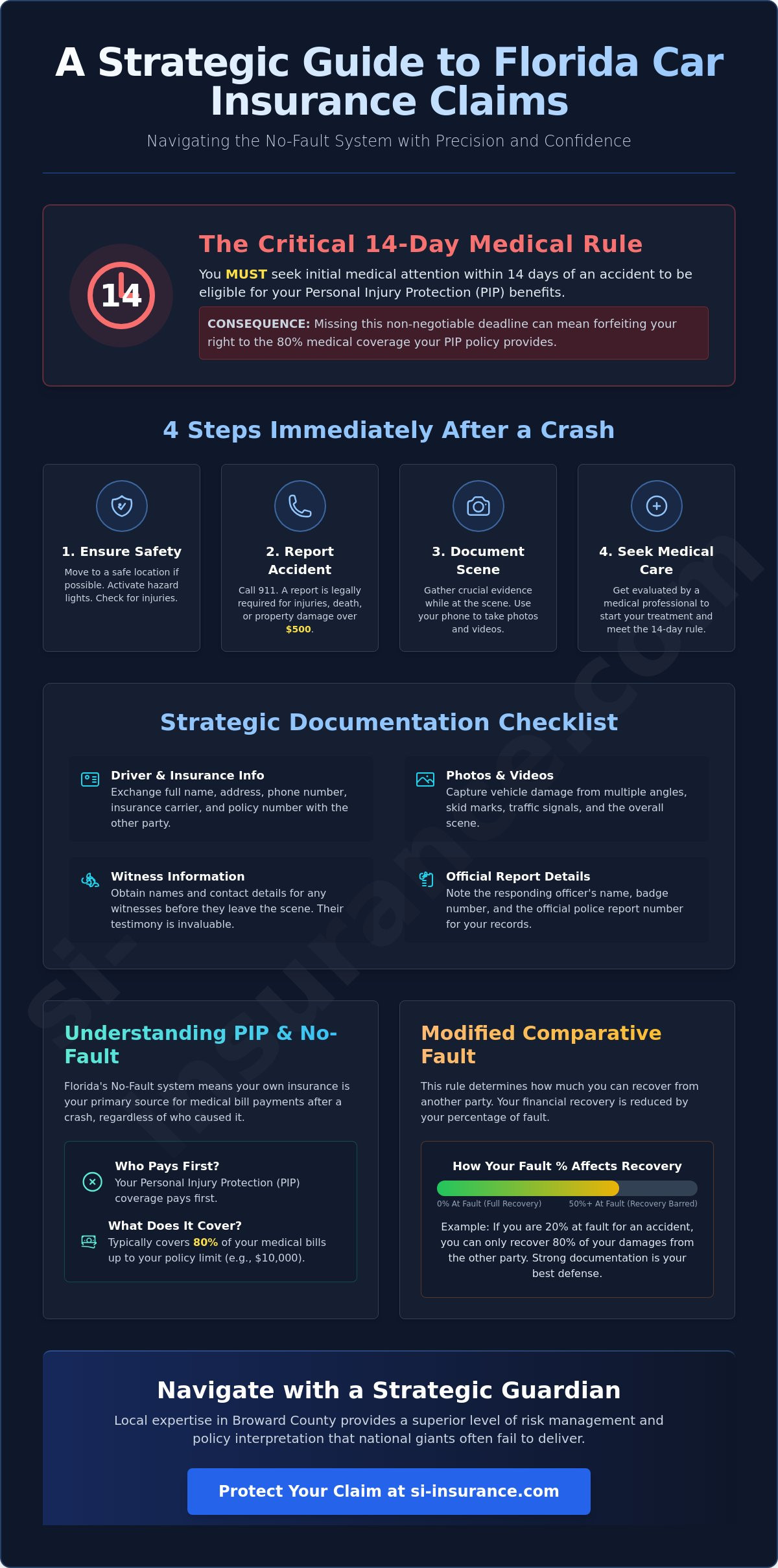
The moments following a vehicle collision are often defined by adrenaline and confusion, yet they require the highest level of strategic precision. Understanding how to file a car insurance claim in Florida begins with immediate adherence to state law. Under Florida Statute Section 316.065, drivers must notify local police, the Florida Highway Patrol, or the county sheriff if an accident results in injury, death, or property damage that appears to exceed $500. This threshold is surprisingly low; even a minor bumper misalignment on a modern luxury vehicle can easily surpass this cost in 2026. Failing to report such an incident doesn't just complicate your insurance recovery; it can lead to legal penalties that undermine your standing during the claims process.
To better understand the foundational steps of this process, watch this helpful video:
Within the Florida No-Fault System, your initial focus remains on your own Personal Injury Protection (PIP) coverage. However, securing a formal record is a non-negotiable step for long-term risk mitigation. If law enforcement doesn't attend the scene due to high call volume or jurisdictional policies, the Florida Department of Highway Safety and Motor Vehicles (FLHSMV) provides a portal for self-reporting. This digital record acts as a critical backup, ensuring your account is documented before memories fade or details are disputed by other parties involved.
When is a Police Report Legally Mandatory?
A formal report is legally required whenever a crash involves any person's injury or complaints of pain, any fatality, or a hit-and-run scenario. Officers typically utilize a long-form report for these serious incidents, which includes a detailed narrative and a digital diagram of the scene. For less severe collisions, a short-form report provides a basic summary of the event. Both documents serve as the authoritative foundation for your insurance file, providing the objective data needed for underwriting excellence during the adjustment process. Without this documentation, proving the sequence of events becomes a matter of conflicting testimonies.
Essential Information to Secure at the Scene
While the police gather their data, your role as a strategic guardian of your own interests involves meticulous documentation. You'll need to secure the other party's full name, insurance carrier, and policy number using the "Driver Exchange of Information" form. Beyond these basics, capture environmental variables that influenced the event. This includes the timing of traffic signals, the presence of skid marks, and specific weather conditions like sun glare or wet pavement. Identifying witnesses and obtaining their contact details before they depart is vital, as their unbiased testimony often proves decisive in complex liability determinations. At SI Insurance, we recognize that these early data points are the building blocks of a successful bespoke risk transfer strategy and are essential when learning how to file a car insurance claim in Florida effectively.
Navigating the Florida No-Fault System and PIP Benefits
Florida operates under a "no-fault" insurance model, which fundamentally dictates the initial stages of recovery after an incident. At the center of this framework is Personal Injury Protection, commonly referred to as PIP. This coverage is mandatory for all vehicle owners in the state. It ensures that medical providers receive payment regardless of who caused the collision. When you're determining how to file a car insurance claim in Florida, understanding that your own carrier acts as the primary payer for your medical bills is vital for maintaining financial stability. This system aims to reduce the burden on the court system by providing immediate liquidity for healthcare costs. It functions as a first-party benefit, meaning you look to your own policy first before seeking damages from anyone else.
The Critical 14-Day Medical Window
The state enforces a strict 336-hour deadline for seeking initial medical attention. If you fail to see a qualified physician within 14 days of the accident, you forfeit your right to PIP benefits entirely. This rule exists to prevent fraudulent claims; however, it often penalizes those with latent injuries like whiplash that don't manifest immediately. Under Florida Statute 627.736, a medical professional must diagnose an Emergency Medical Condition (EMC) for you to access the full $10,000 benefit. Without an EMC designation, your medical coverage is capped at a mere $2,500. Delaying treatment doesn't just hurt your health; it creates a gap in documentation that the other party's insurance will use to devalue your eventual settlement.
Understanding PIP Coverage Limits
Standard PIP policies don't cover your entire bill. Instead, they reimburse 80% of reasonable medical expenses and 60% of lost wages resulting from the injury. There's also a $5,000 death benefit included to assist families with funeral costs. For high-net-worth individuals or those with high-deductible health plans, relying solely on PIP can leave a significant financial exposure. We often recommend a strategic alignment of "MedPay" as a supplement. MedPay covers the remaining 20% that PIP ignores, ensuring that your out-of-pocket costs remain at zero. If you're concerned about how these layers interact, consulting with a professional at SI Insurance can help clarify your specific risk profile.
It's important to distinguish between your PIP and the other driver's Bodily Injury (BI) liability. PIP is your first-party coverage that pays out quickly to keep you afloat. BI is third-party coverage that you pursue from the at-fault driver if your injuries are permanent or exceed your PIP limits. Managing these two distinct paths requires a calculated approach to ensure your immediate bills are paid while preserving your right to seek a larger recovery later. Knowing how to file a car insurance claim in Florida effectively requires balancing these medical benefits with the long-term goal of total risk mitigation.
The Step-by-Step Process for Filing Your Florida Auto Claim
The moment a collision occurs, the window for strategic risk management opens. In Florida, most insurance contracts dictate that you must notify your carrier "as soon as practicable." While this phrase sounds flexible, industry standards and Florida Office of Insurance Regulation (FLOIR) guidelines suggest that reporting within 24 to 72 hours is vital for maintaining the integrity of the evidence. Delaying this initial step can lead to complications in underwriting excellence and may even jeopardize your coverage if the delay prejudices the insurer’s investigation. You'll need to understand that your filing typically splits into two distinct tracks: the property damage claim for the physical asset and the personal injury protection (PIP) claim for medical expenses.
When you interact with an insurance adjuster, your communication should be characterized by precision and composure. You'll likely be asked for a recorded statement. It's essential to stick to the objective facts of the event. Don't speculate about vehicle speeds, distances, or the intentions of other drivers. If you're unsure of a specific detail, it's better to state that you don't recall than to provide an estimate that could be used to diminish your settlement later. This calculated approach ensures that your narrative remains consistent throughout the life of the claim.
Initiating the Claim with Your Carrier
Most modern carriers provide sophisticated mobile applications that allow you to upload photos of the damage and GPS-tagged location data immediately. While these apps offer speed, speaking directly with a senior claims representative is often preferable for high-value or complex incidents to ensure bespoke handling of your file. You should provide the crash report number, typically issued by the Florida Highway Patrol or local law enforcement, as soon as you receive it. This allows the carrier to access official findings and often expedites the investigation phase. You can generally expect a formal response or the assignment of a dedicated adjuster within a 24 to 48 hour window.
Managing Vehicle Repairs and Appraisals
Florida Statute 626.9743 protects your right to choose your own repair facility. You aren't obligated to use the carrier’s preferred "direct repair" shops, though those facilities often offer streamlined administrative processes. If the cost to restore your vehicle exceeds 80 percent of its market value, the insurer will likely deem it a total loss. In such cases, the settlement is based on the Actual Cash Value (ACV). To ensure you receive a fair market valuation, you'll want to gather data on similar vehicles sold in the Florida market within the last 30 days. Knowing how to file a car insurance claim in Florida effectively means being prepared to negotiate the ACV by highlighting your vehicle’s specific upgrades or its meticulous maintenance history before the loss occurred.
Strategic Documentation to Prevent Claim Denials
Many policyholders operate under the misguided assumption that a clear-cut accident requires minimal record-keeping. This is a significant strategic error that often leads to reduced settlements. Understanding how to file a car insurance claim in Florida requires more than just submitting a digital form; it demands a meticulous, evidence-based approach to every interaction. Florida's shift to a modified comparative fault system under House Bill 837 in March 2023 means that if you're found more than 50% responsible for an incident, you're legally barred from recovering any damages from other parties. Precision in your documentation isn't just a clerical task; it's your primary defense against having your financial recovery eliminated by a carrier's liability assessment.
Maintaining a Claim Diary serves as a chronological fortress for your case. You should record the dates and times of every phone call, the full names and direct extensions of every adjuster you speak with, and detailed summaries of any verbal commitments made by the insurer. Track every out-of-pocket expense, from pharmacy receipts to transportation costs, as these figures are often the first to be disputed during final negotiations. This level of detail prevents carriers from retroactively changing their stance or questioning the timeline of your recovery process.
Documenting Evidence for Liability Disputes
Visual evidence provides an objective narrative that verbal statements cannot match. Dashcam footage and nearby surveillance from local businesses act as silent witnesses that can resolve liability disputes in seconds. When you're at the scene, photograph the final rest positions of all vehicles before they're moved to the shoulder. These positions allow reconstruction experts to calculate impact speeds and angles with scientific accuracy. You should never admit fault at the scene, even if you feel a momentary sense of responsibility. Statements made in the immediate aftermath are often recorded in police reports and used as legally binding admissions, ignoring external factors that only become visible upon professional analysis.
The Role of the Independent Medical Exam
An Independent Medical Examination (IME) is a tactical tool used by insurers to mitigate loss by seeking a medical opinion that contradicts your treating physician. While the name suggests a neutral evaluation, these exams are commissioned by carriers specifically to find grounds for terminating benefits or downplaying the severity of your injuries. To protect your interests, ensure your own physician’s findings are documented with exhaustive detail, including diagnostic imaging and functional capacity evaluations. This creates a robust medical record that is difficult for a one-time examiner to dismiss. Being prepared for this step is essential when learning how to file a car insurance claim in Florida effectively.
For a sophisticated approach to managing your personal or corporate risk, explore the bespoke solutions offered by
.
The SI Insurance Advantage: Strategic Guardianship in Broward County
Understanding how to file a car insurance claim in Florida is a vital skill for any driver, but executing that claim with precision requires a dedicated advocate. While direct-to-consumer giants often prioritize processing volume, SI Insurance functions as a strategic guardian for our clients. We don't just facilitate paperwork; we provide a sophisticated layer of protection between you and the bureaucratic complexities of the insurance industry. Our team excels at interpreting dense policy language during the high-stakes environment of a post-accident crisis, ensuring that your rights are upheld and your recovery is prioritized.
We've built our reputation on a white-glove service model that treats every incident as a unique risk management challenge. Our clients aren't just claim numbers in a database. They're partners who receive bespoke guidance designed to mitigate financial loss and restore peace of mind. By choosing a local agency, you gain access to professionals who understand the nuances of the Florida market and the specific pressures of our regional infrastructure.
Local Expertise in the Florida Insurance Landscape
Our deep roots in Broward County provide a distinct tactical advantage. We're intimately familiar with the traffic patterns of the I-95 and I-595 corridors, and we understand how local legal environments influence claim outcomes. This regional intelligence allows us to leverage our established relationships with the auto insurance companies in Florida to your benefit. We navigate these corporate structures daily, ensuring that the logic behind your claim is presented with airtight precision to the adjusters who hold the keys to your settlement.
Refining Your Coverage for Future Protection
A claim often serves as a stress test for your existing policy. Once the immediate crisis of learning how to file a car insurance claim in Florida has passed, we pivot toward refining your long-term risk profile. Many drivers discover too late that their limits were insufficient. For instance, data from the Insurance Research Council indicated in 2021 that roughly 20.4% of Florida drivers are uninsured. This makes Uninsured Motorist (UM) coverage a non-negotiable essential rather than an optional add-on.
We invite you to transition from a reactive posture to one of calculated foresight. Our advisors are ready to conduct a comprehensive audit of your current protections to ensure they align with your evolving financial needs. Contact SI Insurance Agency for a strategic review of your auto policy today to secure your future against the unpredictable nature of the road.
Secure Your Financial Future on Florida Roads
Navigating the aftermath of a collision requires more than just a basic understanding of the law; it demands a tactical approach to the state's unique no-fault system. You've seen how immediate compliance with legal reporting requirements and the meticulous documentation of every detail serve as your strongest defenses against potential claim denials. Mastering how to file a car insurance claim in Florida is the first step toward your financial restoration, but you don't have to manage these complexities by yourself.
Since 2022, SI Insurance Agency has delivered Florida-based expertise designed to protect Broward County residents from unforeseen liabilities. Our firm maintains strategic alignment with top-tier national carriers to provide personalized risk mitigation that fits your specific needs. We focus on delivering elite guardianship through rigorous analysis, ensuring your long-term protection is never left to chance. You've worked hard for what you have, and we're here to help you keep it safe.
Experience strategic protection with SI Insurance Agency today. It's the smartest move you can make for your peace of mind, and we're ready to stand by your side.
Frequently Asked Questions
Do I have to file a police report for a minor car accident in Florida?
You're legally required to file a police report in Florida if the accident results in injury, death, or property damage that appears to be at least $500. While a minor fender bender might seem negligible, Florida Statute 316.066 dictates this threshold for official documentation. SI Insurance recommends securing a report to ensure a strategic record exists for your claim. This documentation acts as a foundational asset during the risk mitigation process.
How long do I have to file a car insurance claim in Florida?
Florida law generally provides a four year statute of limitations for personal injury claims under Florida Statute 95.11, though your policy likely requires prompt notification. To maintain strategic alignment with your coverage terms, you should initiate the process immediately. Delays can complicate the underwriting excellence SI Insurance applies to your case. Knowing how to file a car insurance claim in Florida efficiently helps preserve critical evidence before it degrades.
What happens if the other driver doesn’t have insurance in Florida?
Your Personal Injury Protection (PIP) coverage provides the primary layer of medical benefit regardless of the other driver's insurance status. If your losses exceed the $10,000 PIP limit, you'll rely on Uninsured Motorist (UM) coverage or a civil suit. Data from the Insurance Research Council shows that 20.4 percent of Florida drivers were uninsured in 2022. This statistic highlights why SI Insurance emphasizes bespoke risk transfer strategies like UM.
Will my insurance rates go up if I file a claim in Florida?
Florida Statute 626.9541 prohibits insurance carriers from increasing premiums solely because you filed a claim for an accident where you weren't substantially at fault. Your rates stay stable unless the insurer determines you're more than 50 percent responsible for the incident. SI Insurance views this as a vital protection for your financial profile. We focus on strategic risk management to ensure your premium reflects your actual risk history accurately.
Can I still file a claim if I was partially at fault for the accident?
You can still recover damages if you're partially at fault, provided your responsibility doesn't exceed 50 percent under Florida's modified comparative negligence standard established in 2023. Your total compensation is reduced by your percentage of fault. If a court finds you 30 percent responsible, you'll receive 70 percent of the total award. This highlights why understanding how to file a car insurance claim in Florida with precision is essential for maximizing recovery.
What is the 14-day rule for Florida car insurance claims?
The 14 day rule requires you to seek initial medical treatment within 14 days of the accident to qualify for Personal Injury Protection benefits. Failure to meet this deadline results in a total forfeiture of your $10,000 PIP limit. SI Insurance advises all clients to undergo a professional medical evaluation immediately. This ensures your medical data is integrated into the strategic claim framework without unnecessary delays or coverage gaps.
Does Florida PIP cover property damage to my car?
Personal Injury Protection doesn't cover property damage; it's strictly reserved for medical expenses and lost wages. You must look to your Collision coverage or the at fault party's Property Damage Liability (PDL) to repair your vehicle. Florida law requires a minimum of $10,000 in PDL for all registered vehicles. SI Insurance structures your policy to ensure these distinct risk categories are addressed through comprehensive, bespoke risk transfer solutions.
How do I get a copy of my Florida traffic crash report?
You can obtain a copy of your traffic crash report through the Florida Highway Safety and Motor Vehicles (FLHSMV) online portal or at the local law enforcement agency that responded. Reports are usually available within 10 days of the incident for a statutory fee of $10 per copy. This document is a critical component of the strategic evidence gathering process. SI Insurance utilizes these reports to verify facts and support underwriting excellence during claim resolution.
Comments