


How to Find New Home Insurance After Non-Renewal in Jacksonville
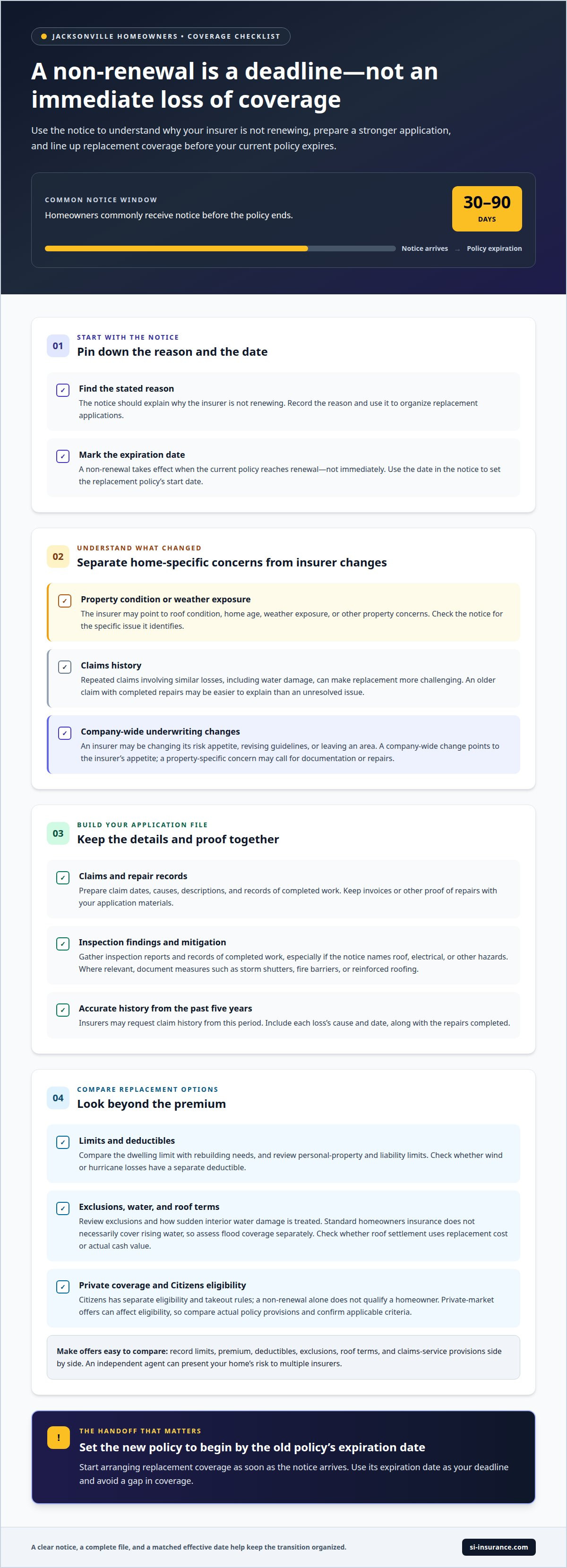
A non-renewal doesn’t end your homeowners coverage immediately; it takes effect when your current policy expires. For Jacksonville homeowners, start looking for replacement coverage as soon as the notice arrives and arrange for the new policy to begin by the expiration date. Use the date in the notice to guide your timeline and avoid a gap in coverage.
A non-renewal can feel like a judgment on your home, but it may reflect an insurer’s changing risk appetite rather than a problem that makes the property impossible to insure. This guide explains what the notice means, how to identify the reason, and how to prepare applications for private insurers. You’ll also learn how an independent agent can help explore options across insurers, making finding new home insurance after non-renewal in Jacksonville a more structured process.
Table of Contents
Reasons insurers do not renew policies
In Florida, a homeowners policy may be non-renewed because of weather exposure, property condition, claims history, or underwriting changes. Notice periods vary by state and insurance company; homeowners commonly receive 30 to 90 days before the policy ends. Citizens eligibility and takeout rules are separate: a non-renewal alone does not qualify a homeowner, who must meet Citizens’ current eligibility criteria.
Read the notice for the specific reason. A non-renewal takes effect at renewal, unlike cancellation during the policy term. The notice should identify the insurer’s reason and the expiration date. Record both, then use the stated reason to organize your replacement applications and avoid delays.
Separate property concerns from company changes. An insurer may cite roof condition, home age, prior claims, or its changing risk appetite in Jacksonville. It may also be leaving an area or revising underwriting guidelines. A company-wide change points to its appetite, while a property-specific concern may require documentation or repairs.
Review claims history accurately. Repeated claims involving similar losses, including water damage, can make replacement more challenging. Gather claim dates, descriptions, and repair records before applying. An older claim with completed repairs can be easier to explain than an unresolved issue, so keep invoices or other proof together.
Address documented hazards promptly. If the notice identifies roof, electrical, or other property concerns, collect inspection findings and records of completed work. Storm shutters, fire barriers, or reinforced roofing can demonstrate risk mitigation when relevant. Don’t assume a repair changes the insurer’s decision; use the notice to guide replacement planning.
Set the new effective date before the old policy expires. Start arranging replacement coverage as soon as the notice arrives, and align the new policy’s start date with the old policy’s expiration. Florida cancellation rules are distinct: after the first 60 days of an active policy, an insurer can cancel only for limited reasons, such as nonpayment or fraud, according to the Florida Legislature.
Consider Citizens only after reviewing eligibility. Citizens is a Florida coverage option with its own eligibility and takeout rules; homeowners must meet applicable criteria, and private-market offers can affect eligibility. Have the property details and non-renewal notice ready when assessing this route alongside private coverage.
What Does a Home Insurance Non-Renewal Mean?
Compare replacement policies by the protection and obligations they provide, not by premium alone. Florida homeowners can consider private-market coverage and, if eligible, Citizens Property Insurance Corporation. Citizens’ policy terms and eligibility rules affect whether it is an option, so compare its actual provisions with private offers.
Set the dwelling limit around rebuilding needs. Compare each policy’s dwelling limit with the cost to rebuild the home, not its market value. A Jacksonville property’s location, construction, and materials affect that calculation. Review personal-property and liability limits too, so the proposed coverage reflects more than the structure.
Compare premiums alongside deductibles. A lower premium may come with a higher deductible or narrower protection. Check whether wind or hurricane losses use a separate deductible, and note how much you would pay before coverage applies. Compare the same coverage limits across carriers for a meaningful premium comparison.
Read exclusions and water terms carefully. Standard homeowners insurance doesn’t necessarily cover rising water, so assess flood coverage separately. Compare how policies treat sudden interior water damage and other exclusions. A Jacksonville home near water may need a different combination of protections than a home with no identified flood exposure.
Review roof settlement language. Roof age can affect underwriting and settlement terms. Compare whether a policy describes roof payment using replacement cost or actual cash value, and note any conditions tied to inspection or maintenance. Keep the wording in front of you, rather than relying on a summary of coverage.
Match the policy type to the property. Standard coverage may suit a home accepted by private carriers; specialty coverage can address a more unusual risk profile. Temporary coverage may bridge a short transition, but confirm its term, exclusions, and continuation provisions before relying on it. An HO-8 policy uses actual cash value and named perils, not full replacement cost.
Use one comparison sheet for every offer. Record limits, premium, deductibles, exclusions, roof terms, and claims-service provisions side by side. An independent agent can compare a homeowner’s risk across insurers. Inspection findings, roof repair records, and mitigation such as storm shutters can inform underwriting and strengthen an application.
Shopping for replacement coverage through an independent agent
Contact an independent insurance agent soon after receiving the non-renewal notice. An independent agent can present your home’s risk to multiple insurers, helping identify carriers willing to consider its property details and claims history.
Assess Prior ClaimsPrepare an accurate record of claims from the past five years, including each loss’s cause and date and the repairs completed. Insurers may request this history when evaluating an application, and repeated claims involving similar losses can affect available options. Keep repair records with your application materials; completed work can help explain an older claim and distinguish it from an unresolved property issue.
Maintain Continuous CoverageSet the replacement policy to begin no later than the date your current policy expires, then send the new insurance details to your mortgage lender. A coverage lapse can lead the lender to obtain force-placed insurance, which usually costs more and provides less protection. A gap can also make it harder to find future coverage.
Give the agent a complete application file.Provide your current declarations page, the non-renewal notice, recent inspection reports, and proof of relevant repairs. Include accurate property details and explain the insurer’s stated reason for non-renewal. Complete information helps the agent present the risk consistently to insurers and reduces delays caused by missing or conflicting details.
Compare replacement offers before deciding.Ask the independent agent to compare available quotes with your current policy’s limits, deductibles, exclusions, and effective date. A non-renewal does not by itself determine the new premium; the reason for the decision and the property’s risk profile can affect offers. Keep your mortgage lender informed as you arrange the selected policy.
Finding a private insurer after non-renewal
Private insurers assess each property’s condition, claims, and underwriting profile individually. In Jacksonville, which insurers are willing to offer quotes depends on those details, so prepare a clear application rather than relying on a fixed carrier list.
Use the first 48 hours to organize your application. Gather your non-renewal notice, current declarations page, inspection reports, and proof of completed repairs. Make sure the reason stated in writing matches the documents you provide. A complete, consistent file helps insurers understand the property without avoidable follow-up.
Describe the property accurately. Prepare details about the roof, electrical systems, occupancy, and any improvements. Insurers consider roof age and, in some cases, applicants’ finances when evaluating coverage. Include records of roof replacement or repairs so underwriters can assess documented work rather than relying only on age.
Request quotes across the private market. An independent agent can present your risk to multiple insurers and identify carriers willing to consider it. Ask for each quote’s limits, deductibles, exclusions, roof settlement terms, and effective date. Compare equivalent coverage, not just premiums, and note whether wind and flood protection meet your needs.
Consider specialty-market options when standard coverage is difficult. Surplus lines insurers have greater flexibility for unusual or higher-risk properties because they aren’t bound by the same rate and form regulations as standard insurers. Review the policy wording closely, including covered causes of loss, exclusions, and claims provisions, before selecting an offer.
Coordinate the start date with your lender. Choose an effective date no later than the current policy’s expiration, then send the new insurance information to your mortgage lender. A lapse can prompt the lender to obtain force-placed coverage, which usually costs more and protects the lender’s interests. Explore private home insurance options as you organize replacement coverage.
SI Insurance: Auto Insurance
SI Insurance Agency offers Home Insurance for Jacksonville homeowners arranging replacement coverage after a non-renewal. Once you understand the notice, gather your property details, and compare policy terms, SI Insurance Agency can help you discuss your home coverage needs. Base your decision on the home’s risk profile and the protections outlined in each policy, including limits, deductibles, and exclusions. SI Insurance Agency also offers Auto Insurance, Motorcycle Insurance, and Boat Insurance for customers reviewing other coverage needs. To discuss Home Insurance for your property, contact SI Insurance Agency.
Make your next renewal easier to manage
Use this transition to establish a clearer record for future insurance decisions. Keep the new policy documents, inspection reports, repair receipts, and communications with your mortgage lender together, so the home’s condition and coverage history are easier to explain at renewal. If you complete further improvements, add their documentation to the same file.
Finding new home insurance after non-renewal in Jacksonville is not only about securing a replacement policy; it is also an opportunity to keep your property information current and organized. Well-maintained records can support future conversations with insurers and help you assess whether your coverage still reflects your home’s needs.
For help discussing home coverage, contact SI Insurance. SI Insurance also offers Auto Insurance, Motorcycle Insurance, and Boat Insurance. Take the next step with a clear view of your home’s risks and the protection you want in place.
Frequently Asked Questions
What is the difference between cancellation and non-renewal?
Cancellation ends an active policy before its scheduled expiration; non-renewal ends coverage at the renewal date. The distinction affects your timeline because cancellation may require you to arrange replacement coverage sooner. After the first 60 days of an active homeowners policy, an insurer can cancel it only for limited reasons, such as nonpayment or fraud, according to the Florida Legislature. Review the notice for the applicable end date.
What will a new policy cost after a non-renewal?
The premium depends on the home’s location, condition, coverage limits, deductibles, claims history, and reason for non-renewal. A notice doesn’t automatically mean the replacement policy will cost more. Compare quotes with equivalent limits and deductibles, then consider how exclusions and roof settlement terms affect protection. Costs vary by case, so request a quote and compare actual offers rather than assume a standard increase.
Can an independent agent really help more than calling one company myself?
An independent agent can present your property’s risk to multiple insurers, while contacting one company gives you only that company’s assessment. Different carriers may weigh the same property details differently, including roof condition and documented repairs. That broader comparison can make the search for replacement coverage in Jacksonville more structured. Review each offer’s coverage terms and effective date, not just whether a carrier is willing to quote.
Can claims from years ago still affect my ability to get insured?
Yes. Older claims can remain relevant when an insurer requests claims history during underwriting. Their effect depends on factors such as the type and frequency of losses and whether repairs were completed. Keep records showing what happened and how the damage was addressed. A dated repair invoice or inspection report can clarify the home’s current condition and help distinguish resolved damage from an outstanding concern in a new application.
Could an HO-8 Policy Be the Answer?
An HO-8 policy may be worth comparing if a home’s age or characteristics make standard coverage difficult to secure. It covers actual cash value rather than the home’s full replacement cost and is a named-peril policy. That means its settlement basis and covered causes of loss differ from broader replacement-cost coverage. Read the policy wording carefully to determine whether those limits suit the home and your financial needs.
What should Jacksonville homeowners do immediately after receiving a non-renewal notice?
Ask the current insurer whether repairs, improvements, or an alternative policy could address its stated reason. Then organize the notice, property records, and repair documents for replacement applications. For Jacksonville homeowners, a clear account of the insurer’s concern and the property’s current condition can make the next application more straightforward. Keep your lender informed as you arrange coverage, and retain copies of correspondence and policy documents.
Comments