


PIP Coverage Florida Requirements: A Strategic Guide for 2026
- siinsuranceflorida
- Apr 24
- 13 min read
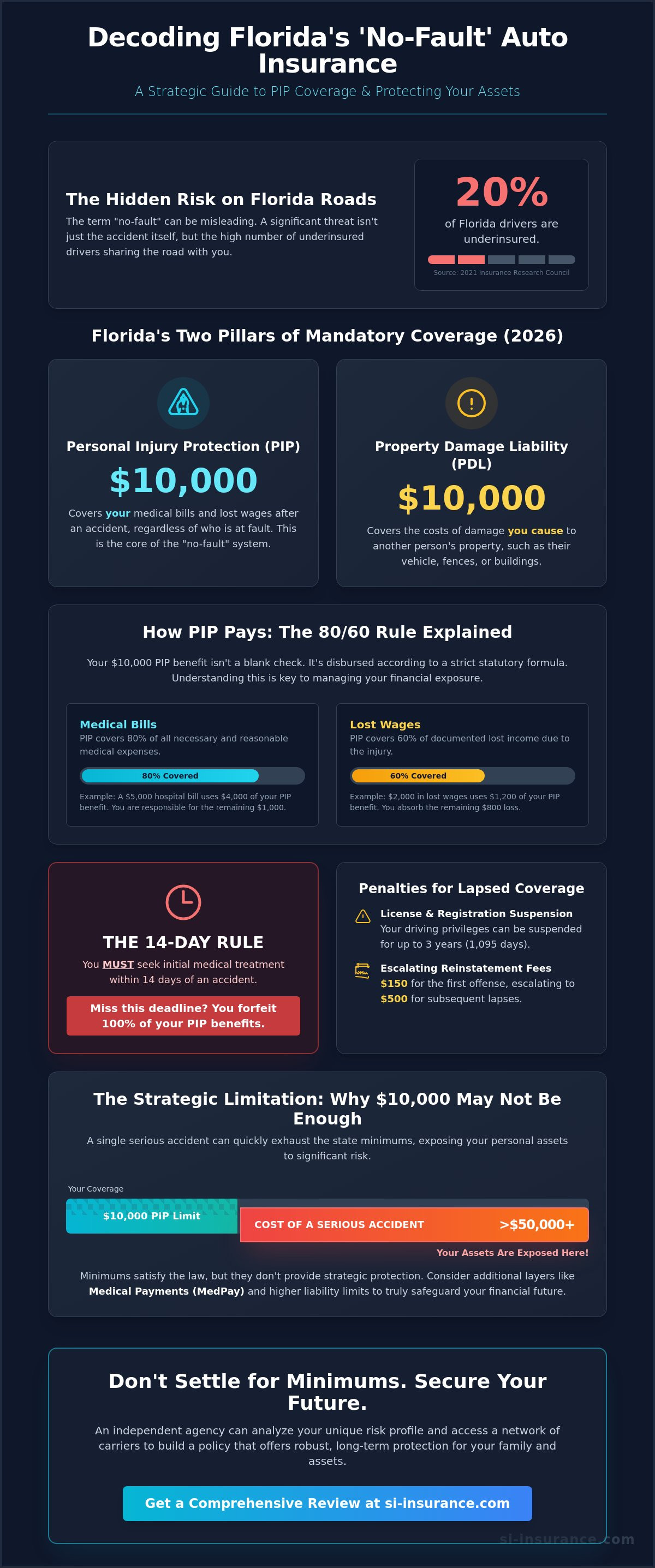
The "no-fault" designation in Florida's legal framework is often the most expensive misnomer a policyholder can encounter. While the term suggests simplicity, it actually conceals a complex web of liability that can leave even the most diligent drivers exposed. Most drivers find the current PIP coverage Florida requirements confusing, and we recognize that this frustration stems from a genuine desire to protect your family and assets. It's difficult to feel secure when nearly 20% of motorists on our roads are underinsured according to 2021 Insurance Research Council reports.
This guide offers a rigorous analysis of these mandates to ensure you satisfy all FLHSMV standards while strategically shielding your private capital. You'll gain a clear perspective on the 2026 regulatory environment and the specific nuances of the mandatory $10,000 benefit threshold. We'll break down the statutory language into actionable insights, providing the intellectual confidence you need to manage your risk portfolio with precision and foresight.
Key Takeaways
Gain a clear understanding of Florida’s no-fault framework to ensure your medical claims are processed with the speed and precision required for financial stability.
Navigate the complexities of PIP coverage Florida requirements by mastering the "80/60 rule" and its essential companion, Property Damage Liability.
Identify the critical statutory timelines, specifically the 14-day rule, to prevent a total forfeiture of your benefits following a motor vehicle incident.
Evaluate the strategic limitations of the $10,000 minimum limit and determine if additional layers like Medical Payments (MedPay) are necessary for your risk profile.
Learn how to leverage the expertise of an independent agency to access a curated network of carriers for more sophisticated, long-term protection.
Table of Contents Understanding Florida’s No-Fault Insurance Framework Florida PIP Coverage Requirements and Benefit Limits in 2026 The Critical 14-Day Rule: A Statutory Timeline for Your Benefits Strategic Limitations: Why the ,000 Minimum May Not Be Enough Securing Your Strategic Protection with Si Insurance Agency
Understanding Florida’s No-Fault Insurance Framework
Florida Statute 627.736 serves as the legislative foundation for the state's no-fault insurance system. This framework requires every owner of a motor vehicle with four or more wheels to maintain specific levels of financial responsibility to ensure public safety. At its core, the system prioritizes immediate medical solvency over the lengthy and often contentious process of determining legal blame. This isn't just a regulatory hurdle; it's a calculated mechanism designed to ensure that injured parties receive care without waiting for a court's verdict. By mandating this coverage, the state creates a buffer against the financial shocks that follow a collision.
To gain a clearer perspective on how these regulations function in real-world scenarios, watch this detailed overview:
A frequent point of confusion involves the "no-fault" label itself. It doesn't mean that drivers are immune from liability for causing an accident. Instead, it refers to payment priority. Under Personal Injury Protection (PIP), your own insurance provider is the first to pay for your medical expenses and lost wages, regardless of who is at fault. This structure allows for a more efficient strategic alignment of resources, ensuring that medical providers are compensated quickly while reducing the burden on the state's legal infrastructure.
What is PIP and Why is it Mandatory?
PIP functions as a first-party benefit that follows the driver and their household. In every city across the state, from Miami to Pensacola, the law demands a minimum of $10,000 in coverage for vehicle registration. This requirement applies to any vehicle with at least four wheels that is registered in Florida. The benefit is designed to provide immediate liquidity, covering 80 percent of medical bills and 60 percent of lost wages. It provides a vital safety net for passengers and pedestrians who may not have their own policies.
The Philosophy of the No-Fault System
The strategic rationale behind this system is the mitigation of litigation. Florida is one of only 12 states currently utilizing this model as of 2024. By requiring your own insurer to pay the initial $10,000, the state effectively filters minor injury claims out of the court system. This prevents the judiciary from becoming overwhelmed by small-scale disputes. Meeting the PIP coverage Florida requirements isn't just about legal compliance; it's about participating in a system that values rapid medical intervention over prolonged legal battles. This approach ensures that the focus remains on recovery and long-term protection rather than procedural delays.
Florida PIP Coverage Requirements and Benefit Limits in 2026
In 2026, the regulatory framework for drivers remains anchored by the mandate for specific financial safeguards. To legally operate a vehicle, the state dictates a minimum of $10,000 in Personal Injury Protection alongside $10,000 in Property Damage Liability (PDL). This PDL component is the essential companion to PIP, as it addresses the costs of damage your vehicle causes to the property of others. Failing to maintain these PIP coverage Florida requirements carries heavy administrative weight. The state can suspend your driver license and registration for up to 1,095 days. Reinstatement fees aren't cheap; they start at $150 for a first occurrence and escalate to $500 for subsequent lapses. At Si Insurance Agency, we focus on maintaining continuous coverage to ensure our clients avoid these disruptive penalties through proactive risk management.
Mandatory Minimums for Florida Drivers
The $10,000 limit serves as the ceiling for most claims, but the actual disbursement follows a rigid mathematical formula. This structure is designed to provide immediate liquidity for medical needs without the delay of determining fault. It's a system built for speed, though it requires a sophisticated understanding of the 80/60 rule to manage personal financial exposure effectively. If you're involved in an incident, you must seek medical attention within 14 days to preserve your eligibility for the full benefit amount.
The 80/60 Rule: What PIP Actually Pays
The mechanics of benefit distribution are governed by Florida Statute 627.736, which outlines the 80/60 reimbursement protocol. This means the policy pays 80% of all reasonable medical expenses. For example, if a diagnostic imaging session costs $1,500, the PIP benefit covers $1,200. The remaining 20% remains the responsibility of the individual unless covered by secondary health insurance. For lost wages, the policy compensates 60% of gross income lost due to a disability from the accident. If a professional loses $3,000 in monthly income, the policy provides $1,800. Every standard Florida policy also includes a $5,000 death benefit, providing a final layer of bespoke risk transfer for the policyholder’s estate.
The reach of this protection is broader than many realize. It covers:
The primary policyholder while driving or as a passenger.
Relatives who live in the same household, even if they're in someone else's car.
Certain passengers who don't own their own vehicle and lack their own PIP coverage.
Pedestrians and bicyclists hit by the insured vehicle.
This comprehensive scope ensures that household risks are strategically aligned under a single policy. For those seeking a deeper analysis of how these limits interact with their broader financial goals, consulting with a specialist at Si Insurance Agency can provide the necessary clarity and long term security.
The Critical 14-Day Rule: A Statutory Timeline for Your Benefits
Florida law is unforgiving when it comes to the timeline for medical intervention after a motor vehicle accident. You have exactly 14 days from the moment of impact to seek initial medical care. If you miss this window by even a single day, you forfeit your right to access PIP benefits entirely. This isn't a flexible guideline; it's a statutory barrier that insurance carriers use to deny claims before they even begin. For any executive or high-net-worth individual, failing to document injuries within this period represents a significant failure in personal risk mitigation.
Seeking Treatment Within the Statutory Window
To satisfy the 14-day requirement, you must receive an initial assessment from a qualified medical professional. This includes a medical doctor (MD), an osteopathic physician (DO), a chiropractic physician (DC), or a hospital facility. It's quite common for drivers to delay treatment because adrenaline often masks the true extent of soft tissue damage or neurological impact. You might feel fine on day three, but by day 15, a latent cervical injury could become debilitating. At that point, the law doesn't care how much you've paid in premiums; your coverage is effectively void.
Strategic protection starts with immediate action. Even if you believe your injuries are negligible, a professional evaluation creates the necessary paper trail to preserve your financial interests. This proactive approach is a cornerstone of understanding your Florida car insurance policy and ensuring your coverage remains an active asset rather than a dormant contract. We view this 14-day window as the most critical phase of post-accident recovery management.
EMC vs. Non-Emergency Limits
Meeting the 14-day deadline is only the first step in securing your benefits. The actual amount of money available to you depends heavily on the medical diagnosis you receive. Under current PIP coverage Florida requirements, there's a tiered payout system that dictates how much of your $10,000 limit you can actually use:
Emergency Medical Condition (EMC): If a physician determines you have an EMC, you gain access to the full $10,000 benefit.
Non-Emergency Injuries: If your injuries don't meet the EMC threshold, your benefits are capped at a mere $2,500.
An EMC is defined as a condition requiring immediate medical attention to prevent serious jeopardy to your health or the serious impairment of a bodily function. A formal EMC diagnosis must be issued by a physician to unlock the remaining $7,500 of your coverage. Since Florida's official insurance requirements mandate that every driver carry this coverage, it's vital to ensure you aren't left with a $7,500 shortfall simply because of a documentation technicality. In the complex landscape of 2026, a precise medical record isn't just about health; it's a calculated move to ensure your PIP coverage Florida requirements are fully met and your financial exposure is minimized.
Strategic Limitations: Why the $10,000 Minimum May Not Be Enough
Florida's mandatory $10,000 limit for Personal Injury Protection has remained unchanged for decades, even as the price of healthcare has climbed year after year. For drivers navigating the congested intersections of Broward County or the busy corridors of Sunrise, relying on this baseline is a significant gamble. The reality is that the PIP coverage Florida requirements were established in a different economic era. They don't reflect the current costs of emergency trauma care or long-term rehabilitation services.
We see a consistent trend where the financial burden of an accident quickly outpaces the available insurance. If you're involved in a serious collision, that $10,000 isn't a windfall; it's a small buffer that can vanish within hours of entering a hospital. We don't view these minimums as a safety net, but rather as a regulatory floor that offers little protection for your personal assets.
The Gap Between PIP and Modern Medical Costs
A single emergency room visit in South Florida can easily exceed $15,000 once you factor in diagnostic imaging, physician fees, and facility charges. Because PIP only covers 80% of your medical expenses, a $10,000 policy actually provides a maximum of $8,000 in medical benefits. This leaves you responsible for the remaining 20% plus any costs that exceed the cap. You can find more detail on how these limits interact with other policy types in our Ultimate Guide to Auto Insurance in Florida.
Ambulance Fees: Often range from $800 to $2,500 depending on the level of care required.
Diagnostic Imaging: A single MRI can cost upwards of $3,000 in a hospital setting.
Surgical Intervention: Even minor outpatient procedures frequently start at $10,000.
Strategic Alignment: MedPay and Health Insurance
To mitigate these risks, we often recommend Medical Payments coverage, known as MedPay. This isn't a redundant expense; it's a strategic tool designed to pay the 20% gap that PIP ignores. MedPay can also cover your deductible, ensuring that you aren't paying thousands out of pocket before your benefits even begin. In the standard order of operations, PIP pays first, and then MedPay or your private health insurance settles the remaining balances.
Our consultants at Si Insurance Agency focus on engineering bespoke policies that align these different layers of protection. We look at your existing health insurance deductibles and out-of-pocket maximums to determine exactly how much MedPay is necessary to shield you from financial loss. This level of precision is vital in high-traffic areas like Sunrise, where the probability of a multi-vehicle incident is statistically higher. We don't believe in off-the-shelf solutions when your financial stability is on the line.
to strategically audit your
PIP coverage Florida requirements
and eliminate dangerous gaps in your protection.
Securing Your Strategic Protection with Si Insurance Agency
As Florida enters 2026, the landscape of risk management requires more than just a standard policy. It demands a partnership with a firm that understands the nuances of underwriting excellence. Si Insurance Agency positions itself as the premier choice for residents who value a sophisticated approach to their personal security. We don't just sell policies. We engineer risk mitigation strategies that align with your specific financial profile. This level of foresight is what separates a basic plan from a truly resilient defense.
Choosing an independent agency gives you a distinct advantage. Instead of being locked into a single carrier's rigid framework, you gain access to a curated network of elite providers. This allows us to perform a comparative analysis that ensures your PIP coverage Florida requirements are met with the highest degree of strategic value. We focus on the precision of the fit, not just the speed of the transaction. It's a calculated process designed to provide intellectual confidence in your coverage choices.
Navigating Complex Florida Statutes
Our team acts as a strategic guardian for every client we represent. We ensure your coverage is logical and airtight, protecting you from the legal vulnerabilities that often arise from poorly structured policies. While we maintain a physical presence across all cities in the state, our deep roots in Broward County allow us to provide localized insights that national call centers simply can't match. You can get a quote for affordable auto insurance in Sunrise, FL to see how our regional expertise translates into better underwriting outcomes. We understand the specific traffic patterns and litigation trends that impact local premiums.
The Si Insurance Advantage
We pride ourselves on a white-glove service model that prioritizes elite expertise in personal lines. This isn't a high-volume retail operation. It's a bespoke consultancy where we match your needs with carriers that offer the best long-term protection. Navigating the specific PIP coverage Florida requirements in 2026 demands a steady hand and a calculated approach. To secure your standing, we recommend these strategic steps:
Conduct a comprehensive review of your current PIP and PDL limits to ensure they reflect 2026 cost-of-living adjustments.
Evaluate your deductible levels against your liquid cash reserves to optimize your risk transfer.
Consolidate your personal lines to leverage multi-policy efficiencies without sacrificing coverage depth.
Our commitment to steady, deliberate service means you'll always understand the logic behind your policy structure. Contact Si Insurance Agency today for a professional review of your portfolio. We'll ensure your transition into the 2026 regulatory environment is seamless, secure, and strategically sound. Your protection is our primary objective, handled with the meticulous attention it deserves.
Securing Your Financial Resilience for 2026
Navigating the shifting landscape of Florida's insurance statutes requires more than just checking a box for basic compliance. As we move into 2026, it's clear that the standard $10,000 limit often fails to address the actual costs of modern emergency care. Missing the strict 14-day window for medical treatment can also permanently jeopardize your access to benefits. Relying on outdated or generic policies creates a vulnerability that strategic risk management can easily solve. Understanding the nuances of PIP coverage Florida requirements is vital; however, having a dedicated partner to interpret those rules is what provides true peace of mind.
At Si Insurance Agency, we don't offer off-the-shelf solutions. Our team acts as a strategic guardian, utilizing a consultant-led approach to identify gaps in your current coverage. By leveraging our relationships with top-tier Florida carriers and our deep knowledge of South Florida statutes, we ensure your policy is a precise instrument of protection. It's about more than just a policy; it's about intellectual confidence in your financial future. Request a bespoke auto insurance consultation with Si Insurance Agency to begin your journey toward a more secure and calculated risk profile. You deserve a plan that's as meticulous and forward-thinking as you are.
Frequently Asked Questions
Is PIP insurance mandatory in Florida for 2026?
Yes, PIP insurance remains a mandatory legal requirement for all Florida drivers throughout 2026. Florida’s no-fault laws mandate this coverage to ensure immediate medical funding regardless of who caused the collision. If you're operating a vehicle with four or more wheels, you're legally obligated to carry this policy to maintain your registration. Failing to comply can result in the immediate suspension of your driving privileges and vehicle tags.
What happens if I don’t seek medical treatment within 14 days of an accident?
You'll forfeit your eligibility for PIP benefits if you don't seek professional medical treatment within the strict 14-day window established by Florida law. This 14-day rule is a non-negotiable statutory deadline. Failing to visit an emergency room or a licensed physician within 336 hours of the incident means your insurer can legally deny your claim, leaving you responsible for all resulting medical costs and long-term rehabilitation expenses.
Does Florida PIP coverage pay for damage to my car?
No, Florida PIP coverage doesn't provide any financial reimbursement for physical damage to your vehicle. This specific policy component is designed exclusively for medical expenses, disability benefits, and death benefits. To address vehicle repairs, you'll need to utilize your collision coverage or file a claim against the at-fault driver’s property damage liability policy, which is also a mandatory requirement under state law for 2026.
Can I sue the other driver if I have PIP insurance?
You can pursue a lawsuit against the other driver only if your injuries meet the permanent injury threshold defined in Florida Statute 627.737. This includes significant and permanent loss of a bodily function, permanent scarring, or death. While PIP is your primary source of recovery, it doesn't prevent legal action for pain and suffering when medical expenses surpass the standard limits or result in life-altering physical impairment.
How much PIP coverage am I legally required to carry in Florida?
You're legally required to maintain a minimum of $10,000 in pip coverage Florida requirements as of the 2026 fiscal year. This limit applies per person, per accident. It typically covers 80% of necessary medical bills and 60% of lost wages, provided the treatment is linked to a documented injury. Carrying less than this amount puts your driver’s license at risk and leaves you personally liable for initial medical costs.
Does my PIP coverage apply if I am a passenger in someone else’s car?
Yes, your own PIP policy typically serves as the primary coverage even when you're a passenger in someone else’s vehicle. If you own a car in Florida, your insurance follows you rather than the vehicle. In cases where a passenger doesn't own a vehicle or live with a relative who does, the PIP policy of the vehicle owner will then provide the necessary medical benefits up to the standard limits.
What is the difference between an Emergency Medical Condition (EMC) and a standard injury for PIP?
An Emergency Medical Condition (EMC) designation allows you to access your full $10,000 benefit, while a non-emergency injury limits your payout to just $2,500. A qualified physician must determine that your symptoms are acute and pose a serious jeopardy to your health to trigger the higher limit. Without this specific EMC certification, 75% of your potential medical funding remains inaccessible under standard pip coverage Florida requirements.
How does PIP work if I am hit by an uninsured driver in Broward County?
PIP functions as your immediate financial safeguard regardless of the other driver’s insurance status in Broward County. Since Florida is a no-fault state, your own insurer pays your initial medical claims even if the at-fault party is uninsured. This system ensures that 80% of your emergency costs are covered quickly, though you'd need Uninsured Motorist coverage to recover additional damages like pain and suffering from the collision.
Comments