


Renters Insurance for UF Students in Gainesville: Compare Quotes
The lowest premium may not provide the coverage your lease or belongings need. Florida has no general statewide renters-insurance requirement for residential tenants, but a Gainesville landlord may require coverage in the lease. Renters insurance for UF students in Gainesville can protect eligible belongings and may include personal liability and additional-living-expense coverage, subject to the policy terms.
It’s understandable to wonder whether you need a separate policy, especially if a parent has homeowners insurance or your landlord insures the building. Neither policy automatically protects your belongings, personal liability, or extra living costs after a covered loss.
This guide explains what can affect a quote, what personal-property coverage may protect, and how replacement-cost coverage differs from actual-cash-value coverage. You’ll also learn which lease requirements to consider and how an insurance agent can compare quote options based on the rental address, coverage limits, deductible, household, claims history, pets, and optional coverage.
Table of Contents
Is renters insurance required in Gainesville FL?
Florida doesn’t have a statewide renters-insurance requirement for residential tenants, but your Gainesville lease may require coverage. Keep in mind that liability-only insurance is different from a policy that also protects your belongings and helps with additional living expenses.
Lease Liability Requirements
Your lease may require personal liability coverage and set a limit, start date, proof process, or instructions for listing an additional interest. Required limits may be $100,000 or $300,000, depending on the lease. Liability coverage may respond to covered claims for injury or property damage for which you’re legally responsible. Before moving into a campus apartment, check the lease’s coverage limit and proof requirements.
Campus Housing Requirements
Campus housing terms can differ from those in a private Gainesville lease. Check your housing agreement to see whether it requires renters insurance and what coverage or proof you need.
Your lease may specify the liability limit, policy start date, proof-of-insurance process, and instructions for listing an additional interest. Liability-only insurance may meet a liability requirement, but it doesn’t necessarily protect your belongings or cover extra living costs.
A renters insurance policy can combine personal-property, personal-liability, and additional-living-expense coverage. Personal liability may apply if a guest is injured or you’re responsible for damage to someone else’s property. Medical-payments coverage may address certain eligible guest expenses regardless of fault, subject to the policy form and limit. If covered damage makes your rental uninhabitable, additional-living-expense coverage may help with eligible increased costs, such as temporary lodging or meals.
A landlord’s policy generally protects the building, not a tenant’s belongings, liability, or additional living expenses. A resident liability program may also differ from a renters policy issued in your name. Compare your lease requirements with the policy’s limits and protections instead of treating liability-only insurance as equivalent to renters insurance.
Personal property coverage
Personal-property protection depends on the policy, where you live, and what you own. A UF student’s belongings in a dorm may be covered differently from those in an off-campus rental.
Personal Property Coverage Scope
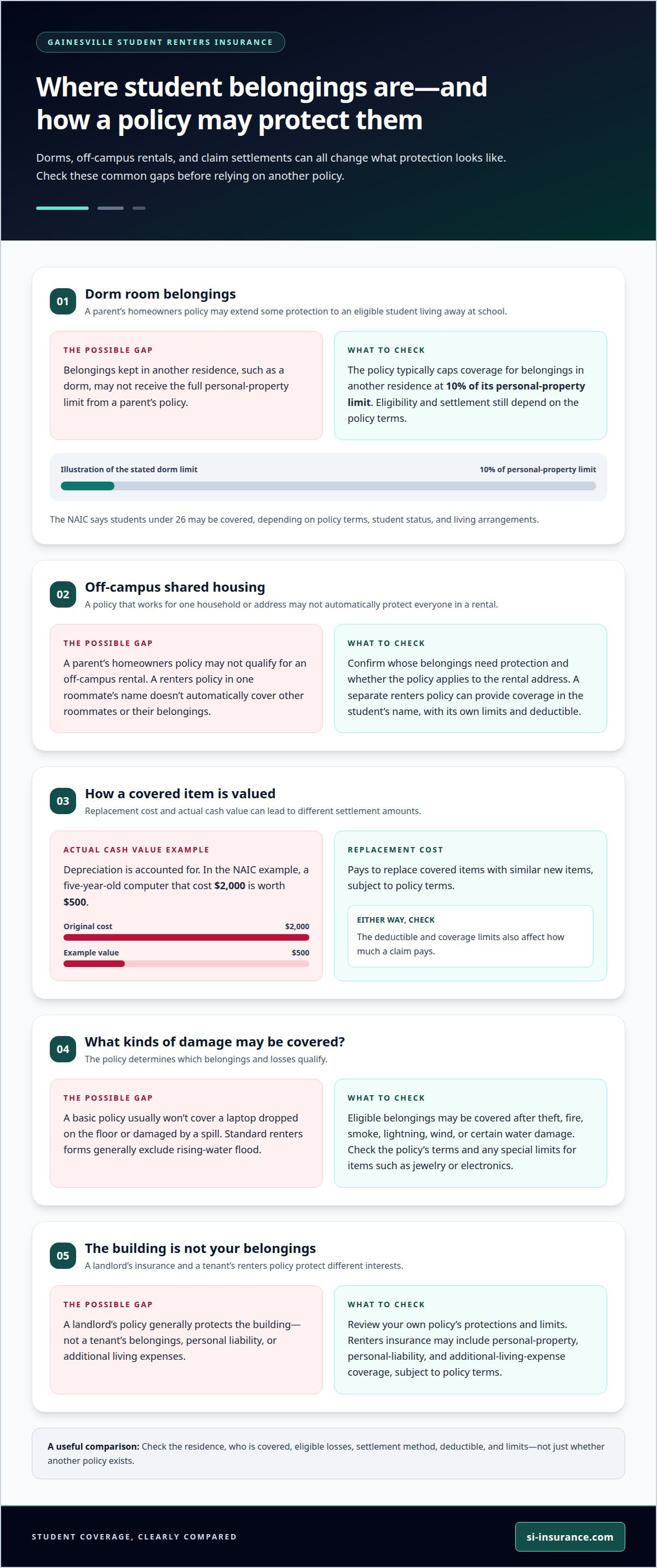
Renters insurance may cover eligible belongings after losses such as theft, fire, smoke, lightning, wind, or certain water damage. The policy determines what qualifies. A basic policy usually won’t cover a laptop dropped on the floor or damaged by a spill. Replacement-cost coverage pays to replace covered items with similar new items, subject to policy terms.
Actual-cash-value settlements account for depreciation. In the NAIC’s example, a five-year-old computer that cost $2,000 is worth $500. The deductible and coverage limits also affect how much a claim pays.
Parents’ Policies Versus Student Coverage
A parent’s homeowners policy may extend some protection to an eligible student living away at school. The NAIC says students under 26 may be covered, depending on the policy terms, student status, and living arrangements. A separate renters policy can provide coverage in the student’s name, with its own limits and deductible.
Dorm Coverage Under Parents’ Policies
For belongings kept in another residence, such as a dorm room, a homeowners policy typically caps coverage at 10% of its personal-property limit. The policy’s terms still determine eligibility and settlement.
Students moving to campus can use this limit to assess whether a parent’s policy may suit their belongings. Electronics, clothing, books, and other possessions all contribute to the amount at risk.
Off-Campus Coverage Considerations
A parent’s homeowners policy may provide limited coverage for a student, but an off-campus rental may not qualify. A renters policy in one roommate’s name doesn’t automatically cover other roommates or their belongings. Check whose property needs protection and whether the policy applies to the rental address.
Standard renters forms generally exclude rising-water flood. Some policies also set special limits for jewelry or electronics, so students with valuable items should consider how those limits affect protection. Students comparing a separate policy can review renters coverage options for their housing needs.
What Changes the Renters Insurance Price?
For students in Gainesville off-campus apartments, a quote depends on more than university enrollment. The rental address, coverage limits, deductible, household details, claims history, pets, optional coverage, and insurer can all affect the price. Moving from a dorm to an apartment changes the residence information used for a quote.
Your apartment’s location and the protection you need help shape your policy. Think about your belongings, budget, and any lease requirements when choosing coverage limits and a deductible. The deductible is the amount you pay toward a covered claim before policy benefits apply.
A landlord’s building insurance doesn’t automatically cover your personal property or liability. Your lease may require a particular liability limit or proof of insurance, so check its terms when choosing a policy. The landlord’s insurance remains separate from coverage for your belongings.
In shared student housing, a policy issued to one roommate doesn’t automatically cover everyone or their possessions. Claims history, pets, and optional coverage can also affect a quote, depending on your household’s circumstances.
Living on campus doesn’t mean an insurer skips credit-related review, and student status alone doesn’t determine how a quote is calculated. Compare policy terms and coverage rather than assuming campus residence creates a pricing exemption.
For Florida students, compare quotes using the same address, belongings, limits, and deductible. Check whether each policy offers replacement-cost or actual-cash-value coverage, since settlement terms differ. Comparing equivalent options makes price differences easier to understand.
How an insurance agent compares Gainesville renters insurance quotes
For a useful comparison, give each agent the same Gainesville address, household details, claims history, pets, and coverage requests. Consistent quote inputs make it easier to see whether differences come from policy terms rather than assumptions about your apartment.
Compare equivalent limits and deductibles, including the liability limit required by your lease and the amount of personal-property coverage. A lower premium may come with a higher deductible or narrower protection, so check what each quote includes.
Look at how personal-property coverage applies to eligible belongings stolen from your residence and whether settlement terms provide replacement cost. Also compare liability protection for situations where you’re legally responsible for injury or property damage.
Review additional living expenses separately. If covered damage makes your apartment uninhabitable, a policy may help with eligible increased costs, such as temporary lodging or meals. Compare the limits and conditions rather than assuming this coverage is the same in every quote.
A parent’s homeowners policy may cover an eligible student, depending on its terms and the living arrangement. An agent can compare that option with a renters policy in the student’s name. Roommates should also check whose belongings and policy are covered; one person’s policy doesn’t automatically cover everyone.
Living on campus alone doesn’t establish that an insurer won’t use credit scoring. Insurers use their own rating approaches, and details such as the address, coverage choices, deductible, and claims history can affect quotes. Ask which inputs and policy provisions explain any meaningful differences.
Before weighing premiums, make sure the limits, deductibles, and protections are equivalent. Start a renters quote comparison based on your Gainesville housing and coverage needs.
SI Insurance: Renter Insurance
UF students renting a Gainesville dorm or off-campus apartment can ask SI Insurance about renter insurance. Before speaking with an agent, check your lease and compare coverage needs. An agent can then walk you through quote options and explain how they relate to your situation.
When comparing policies, look at the rental address, personal-property limits, deductible, and liability requirements. Ask how replacement-cost coverage and additional living expenses work, too, so you know what each policy covers. If a parent’s homeowners policy may apply, compare that option with a policy in your name.
SI Insurance Agency also offers Auto Insurance, Motorcycle Insurance, and Boat Insurance. If your main concern is protecting belongings in a rental, renter insurance is the place to start.
Contact SI Insurance to talk about renter insurance for your Gainesville housing situation.
Set your coverage plan before your next move
Moving from a dorm to a Gainesville apartment can change your insurance needs. Treat each change of residence as a prompt to reassess who needs protection, which belongings matter most, and how the policy fits your lease. Preparing ahead can help you choose coverage that suits your new place.
For renters insurance for college students at UF in Gainesville, start with a conversation about your actual living arrangement. Bring questions such as how a policy may fit with a parent’s coverage or what happens when roommates share an apartment. A clear discussion can help you make an informed choice without relying on assumptions about student housing.
SI Insurance can discuss renter insurance in relation to your Gainesville housing needs. Contact SI Insurance about renters coverage when you’re ready to explore your options. Review your coverage before signing a lease or moving in, so you know what to expect in your new home.
Frequently Asked Questions
Does my parents' homeowners insurance cover me at college?
It may, depending on the policy, your student status, and where you live. The NAIC says students under 26 may be covered, subject to policy terms. Belongings in a dorm may have a separate limit, typically 10% of the policy’s personal-property limit, before the deductible. An off-campus rental may not qualify, so your living arrangement matters.
How Much Coverage Does a Student Need?
Choose coverage based on the belongings you want protected and your lease requirements. Add up the value of items like a laptop, bicycle, clothing, and books, and check for special limits on valuables. A lease may require liability limits such as $100,000 or $300,000. The deductible also affects what you pay toward a covered claim.
Should I Add Liability Coverage?
Liability coverage can help if you’re legally responsible for an injury or property damage. For example, a guest could be injured in your apartment, or an accident could damage someone else’s property. Medical-payments coverage is different: it may cover certain eligible guest medical expenses regardless of fault, subject to policy terms and limits. Check both against your lease requirements.
What does renters insurance cover in Florida?
Depending on the policy, eligible belongings may be covered after theft, fire, smoke, lightning, wind, or certain water damage. Coverage has limits and exclusions. For example, a basic policy usually doesn’t cover a laptop dropped or damaged by a spill. Belongings stolen from a car may be covered subject to the deductible, while damage to the car itself falls under auto insurance.
What if a hurricane makes my apartment unlivable?
If covered hurricane wind damage makes your apartment uninhabitable, loss-of-use coverage may help with eligible extra living costs, such as temporary lodging or additional meals. Wind-related personal-property claims may involve a separate hurricane deductible. Rising-water flood damage is generally excluded from standard renters forms, so wind and flood losses may be treated differently under the policy terms.
Does UF renters insurance cover students living in off-campus apartments in Gainesville?
A renters policy can protect eligible belongings in an off-campus apartment, subject to its terms. UF enrollment alone doesn’t establish coverage. A parent’s homeowners policy may offer limited student protection, but an off-campus rental may not qualify. Your lease may also set liability limits and proof-of-coverage requirements.
Comments