


RV Insurance in South Florida: A Strategic Guide to Protecting Your Mobile Lifestyle in 2026
- siinsuranceflorida
- Jun 30
- 12 min read
Could you imagine paying 35% more for your peace of mind just because of your zip code? In South Florida, that's the reality for many travelers. We know that the intersection of rising premiums and the annual threat of hurricane season can turn your mobile dream into a source of constant anxiety. It's often difficult to tell where your auto policy ends and your home-style protection should begin. This guide offers a strategic roadmap for securing RV insurance South Florida residents can rely on during the most volatile weather cycles.
We'll break down the mandatory $10,000 personal injury protection requirements and help you distinguish between basic liability and the comprehensive safeguards needed for high-value assets. You'll learn how to structure your policy to account for storage risks and the specific needs of full-time residents in 2026. By looking at specialized hurricane riders and the nuances of full-timer coverage, we'll help you build a defense that is as resilient as the lifestyle you've chosen to lead.
Table of Contents
Understanding RV Insurance Requirements in South Florida
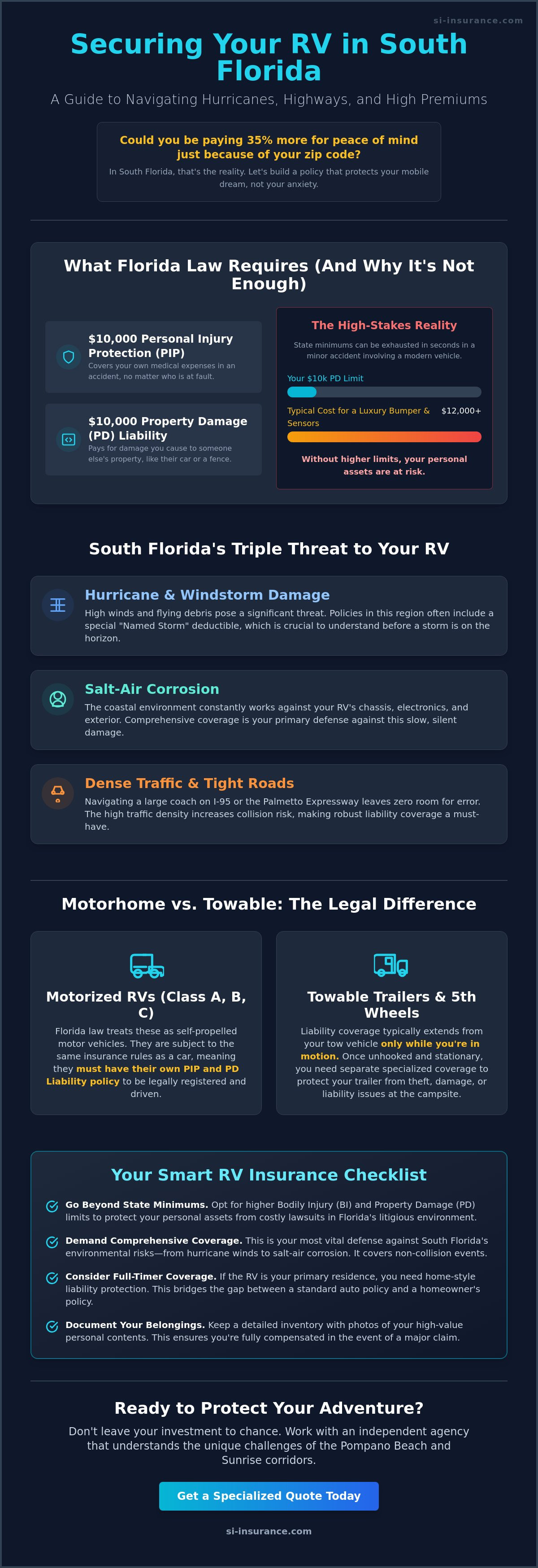
Florida law establishes a distinct legal separation between motorized coaches and towable trailers. For those operating Class A, B, or C motorhomes, the state views these assets as self-propelled motor vehicles, which subjects them to the same foundational principles of vehicle insurance that govern standard automobiles. If you're pulling a travel trailer or a fifth wheel, the liability typically extends from your primary tow vehicle while you're in motion. However, once the unit is unhooked at a site in Pompano Beach or Sunrise, the legal landscape shifts significantly; the need for specialized RV insurance South Florida becomes much more apparent to protect the stationary asset.
The high traffic density of the South Florida corridor presents a unique challenge for RV owners. When you're maneuvering a forty-foot coach through the tight interchanges of I-95 or the Palmetto Expressway, the margin for error is razor-thin. A minor miscalculation doesn't just result in a fender bender; it involves a massive vehicle with significant kinetic energy. This reality makes understanding the baseline legal requirements the first step in a broader risk management strategy.
To better understand the various types of coverage available for your motorhome, watch this helpful video:
Mandatory Coverages: PIP and PD Liability
Florida operates under a no-fault insurance system, which means your own policy provides the primary medical coverage through Personal Injury Protection (PIP) regardless of who's actually to blame for a collision. Every motorized RV registered in the state must carry a minimum of $10,000 in PIP and $10,000 in Property Damage (PD) liability. Property Damage liability is specifically designed to pay for the damage you cause to another person's vehicle or property, up to the current $10,000 state minimum. While these policies generally remain valid when you travel across state lines, the relatively low limits can leave you exposed in jurisdictions with different legal standards that don't recognize Florida's no-fault protocols.
Why State Minimums Are Rarely Enough
Relying solely on state minimums is a precarious strategy in Broward County's high-stakes and often litigious environment. The cost of a single luxury vehicle bumper or a modern sensor-heavy sedan can easily eclipse a $10,000 property damage limit in seconds. While Bodily Injury (BI) liability isn't a mandatory requirement for Florida registration, it's a critical component of a sophisticated insurance portfolio for any high-net-worth traveler. Without BI coverage, your personal assets and your equity in the RV itself are vulnerable if you're found at fault in an accident involving significant injuries. In a region where legal claims are frequent and medical costs are rising, opting for higher liability limits is the only way to ensure absolute security for your mobile lifestyle and long-term financial health.
Mitigating South Florida’s Unique Environmental Risks
South Florida represents a unique paradigm in risk management, where the tropical climate serves as a persistent threat to your mobile investment. While we previously outlined the official Florida RV insurance requirements, those regulations focus primarily on legal compliance and third-party liability rather than asset preservation. For travelers navigating the High-Velocity Hurricane Zones of Broward and Miami-Dade, comprehensive coverage acts as the essential mechanism for mitigating non-collision losses. This layer of protection is engineered to address the specific volatility of our environment, including the impact of wind-borne debris and sudden atmospheric shifts that can compromise a high-profile vehicle in seconds.
Hurricane and Windstorm Considerations
In the context of RV insurance South Florida providers often implement a specialized "Named Storm" deductible, which triggers once a tropical system is officially identified by the National Hurricane Center. Unlike a standard flat deductible, this is frequently calculated as a percentage of the vehicle's total insured value; this requires a more sophisticated level of financial foresight from the owner. Your choice of storage location also plays a pivotal role in premium calculation. Units housed in hurricane-rated, enclosed facilities typically command more favorable rates than those left in open-air lots. Comprehensive coverage remains the primary defense against falling objects, such as uprooted palms or displaced commercial signage, which are common hazards during high-wind events in the Pompano Beach corridor.
Coastal Corrosion and Environmental Degradation
Environmental degradation presents a more subtle but equally taxing challenge for the coastal traveler. It's vital to recognize that most standard policies classify salt-air corrosion and humidity-induced mold as "wear and tear," which falls under the owner's maintenance responsibility rather than an insurable loss. The intense UV index characteristic of our region can rapidly compromise roof sealants and awnings, leading to secondary water intrusion that may be excluded if it's deemed a result of neglected upkeep. However, specialized riders can occasionally be secured to protect high-end exterior finishes or custom paint work against specific environmental hazards. If you're concerned about how these exclusions might impact your long-term security, it's prudent to consult with a specialist who understands the granular details of coastal risk management.
Flood Insurance and Rising Water
Rising water is a constant concern in low-lying municipalities like Hollywood and Fort Lauderdale. While many comprehensive policies do include coverage for sudden flooding, the distinction between a "vehicle" and a "structure" can become blurred for those who remain stationary for long periods. If your RV is semi-permanently situated in a designated flood zone, you must verify that your policy doesn't contain specific exclusions for "stationary flooding" that might differ from a standard automotive flood claim. Ensuring your policy accounts for the unique drainage challenges of South Florida's limestone shelf is a critical step in maintaining absolute security for your mobile lifestyle.
Specialized Coverage for Full-Timers vs. Recreational Users
In the specialized world of RV insurance South Florida underwriters draw a firm line between those using their vehicle for weekend excursions and those who've transitioned to a mobile primary residence. For insurance purposes, if you occupy your unit for more than six months of the year, you're generally classified as a "full-timer." This distinction is paramount because it fundamentally changes the nature of your liability exposure. While a recreational policy focuses primarily on road risks, a full-timer policy incorporates elements of residential protection, ensuring that your financial interests are shielded whether you're parked in a luxury resort or navigating a coastal highway.
One of the most critical strategic decisions involves selecting between Total Loss Replacement and Actual Cash Value (ACV). In the current 2026 market, where luxury motorhome values can fluctuate significantly due to supply chain shifts, an ACV settlement might not provide enough capital to replace your asset after a catastrophic event. Total Loss Replacement is often the superior choice for newer units; it provides a comparable current-model replacement rather than a depreciated cash payout that might leave you with a significant financial shortfall.
Full-Timer Personal Liability
When your RV serves as your home, the risk of a guest being injured on your "property" becomes a reality that standard auto policies aren't designed to handle. Full-timer personal liability coverage acts as a bridge, offering the same type of protection you'd expect from a traditional homeowners policy. It covers medical payments for visitors who might slip or fall in or around your parked unit. Full-timer coverage is essential for those using their RV as a primary residence because it provides the comprehensive liability protection typically found in a standard homeowners policy.
The 'Snowbird' Strategy: Storage and Seasonal Use
For the seasonal traveler who leaves their vehicle in Pompano Beach or Sunrise during the humid summer months, a strategic suspension of coverage can lead to significant premium savings. You can often pause collision and road-liability coverages while the unit is in secure storage. However, maintaining comprehensive coverage is non-negotiable. This ensures you're still protected against theft, fire, and the ever-present threat of tropical systems. When leaving your rig for the summer, following professional advice on preparing your RV for a hurricane is a vital part of your risk mitigation plan.
For those managing high-value assets or custom coaches, a standard policy might still leave gaps in your protection. You may find that a more nuanced approach, similar to Specialty Vehicle Insurance in Florida, is necessary to account for the unique valuation and storage requirements of elite mobile living. This level of foresight ensures that your lifestyle remains uninterrupted, regardless of the season or the location of your residence.
A Strategic Checklist for Protecting Your RV Investment
Protecting a mobile asset in the unique climate of South Florida requires more than just paying a premium; it demands a proactive approach to documentation and risk assessment. When you're managing RV insurance South Florida claims adjusters will prioritize concrete evidence of the vehicle's condition prior to an incident. We recommend a comprehensive annual audit of your policy to account for both the natural depreciation of the chassis and any high-value upgrades you've installed, such as lithium battery banks or custom solar arrays. This ensures your coverage limits remain aligned with the actual replacement cost of your specific configuration.
Hurricane Preparedness and Insurance Documentation
As we approach the most volatile months of the year, creating a digital inventory of your RV’s contents is a non-negotiable step for the serious traveler. Use your smartphone to record a slow walkthrough of the interior, opening cabinets and documenting electronics, specialized kitchen equipment, and outdoor gear. This visual record is invaluable if you need to utilize your policy’s "Emergency Expense" allowance, which provides for temporary lodging and travel costs if your RV becomes uninhabitable during a storm. If a disaster is declared in Broward County, your first step should be to secure the vehicle and then immediately contact your agent to initiate the claims process before local resources become overwhelmed.
Evaluating Towing and Roadside Assistance
One of the most common pitfalls for new owners is assuming that a standard auto roadside assistance plan is sufficient for a Class A motorhome. Standard plans often lack the heavy-duty equipment required to tow a vehicle weighing twenty thousand pounds or more; a mistake that can cost you thousands in out-of-pocket expenses on the Florida Turnpike. Specialized RV roadside assistance is engineered to handle the unique dimensions and weight of your rig, ensuring that you aren't left stranded because a tow truck is too small for the job. It's helpful to understand how these services differ from traditional car coverage by reviewing our Florida Auto Insurance: A Strategic Guide, which highlights the limitations of standard consumer plans.
A truly resilient insurance strategy is never static. It evolves as you add equipment and as the market value of your coach shifts. If you haven't reviewed your current limits against the 2026 replacement costs, it's time to take action. You can request a strategic coverage analysis to ensure your mobile lifestyle remains protected against both the predictable and the unforeseen risks of the South Florida coast.
Why an Independent Agency is Best for South Florida RVers
Algorithmic pricing from national carriers often fails to capture the intricate realities of the local environment. When you're seeking RV insurance South Florida residents frequently discover that a generic online quote doesn't account for the specific flood patterns of Sunrise or the unique wind-velocity risks in Pompano Beach. An independent agency serves as a bridge between high-level risk analysis and the personal needs of the traveler. We don't just process transactions; we engineer a comprehensive protection framework that prioritizes your long-term security over a quick sale. This personalized approach is the only way to ensure that your policy is as resilient as the asset it's designed to protect.
The complexity of Florida's insurance market requires a partner who can navigate the frequent shifts in state legislation and carrier appetites. While a direct-to-consumer brand is limited to its own proprietary products, an independent consultant has the liberty to scan the entire horizon. This means we can identify specialized underwriters who may offer more favorable terms for custom Class A coaches or unique full-timer setups that traditional companies might view as too high-risk for their standard portfolios.
The Power of Choice: Multiple Carriers, One Agent
Working with an independent agent gives you access to a curated selection of specialized RV underwriters that don't sell directly to the general public. These carriers often provide more nuanced coverage options, allowing us to customize riders for high-value items like custom jewelry, professional-grade electronics, and expensive solar power systems. At Si Insurance Agency, we leverage these relationships to compare multiple rates simultaneously, ensuring that your coverage isn't just comprehensive, but also competitively priced. It’s about finding the exact intersection of premium value and elite-level protection for your specific mobile lifestyle.
Expert Advocacy in the Broward County Community
The true value of a local partner becomes most apparent when you need to navigate the claims process after a significant weather event. We understand the logistical challenges of Broward County and act as your direct advocate, ensuring that your claim receives the professional attention it deserves. Instead of dealing with an anonymous call center, you have a seasoned consultant who knows your history and understands the high-stakes nature of your investment. This level of sophisticated service is essential for owners who view their RV not just as a vehicle, but as a significant pillar of their financial and personal life.
Your journey deserves a protection strategy that is as meticulously planned as your route. If you're ready to move beyond generic coverage and secure a policy tailored to the specific demands of the Florida coast, we're here to help. Contact us today for a strategic consultation, and let's ensure your mobile lifestyle remains secure for every mile ahead.
Securing Your Future on the Open Road
Protecting a mobile lifestyle in our region demands a transition from standard automotive thinking to a more sophisticated risk management mindset. We've established that the distinction between motorized coaches and towable trailers is just the beginning; the real challenge lies in mitigating the persistent threats of hurricane season and coastal corrosion. Securing the right RV insurance South Florida travelers need involves more than just a transaction. It's about building a defense that accounts for everything from high-velocity wind zones to the nuances of full-time residential liability. By moving beyond generic, one-size-fits-all policies, you're choosing to safeguard your equity and your freedom.
Our team at Si Insurance Agency is ready to act as your dedicated guardian in this complex market. We provide expert local knowledge of Broward County risk factors and offer access to a wide network of specialized RV carriers that understand your specific needs. From sophisticated claims advocacy to personalized service, we ensure your coverage is as meticulously engineered as your rig. Take the next step toward absolute security and Request a Strategic RV Insurance Consultation with Si Insurance Agency. Your journey is unique, and we're committed to keeping it that way.
Frequently Asked Questions
Is RV insurance required by law in Florida?
Florida law mandates that all motorized RVs carry a minimum of $10,000 in Personal Injury Protection (PIP) and $10,000 in Property Damage Liability (PDL). These requirements apply to Class A, B, and C motorhomes registered in the state. If you're towing a travel trailer, the law doesn't require separate liability insurance; however, your lender will almost certainly mandate comprehensive and collision coverage as a condition of your financing agreement.
Does my Florida auto insurance cover my travel trailer?
Your standard auto policy generally extends liability protection to your trailer only while it's physically attached to and being towed by your vehicle. It won't cover physical damage to the trailer itself or liability issues that occur while it's unhooked at a campsite. Securing a dedicated policy for RV insurance South Florida ensures your asset is protected against theft, weather events, and injuries that happen on your temporary property.
How much does RV insurance cost in South Florida?
Premiums in this region are approximately 35% higher than the national average due to the elevated risk of hurricane damage and higher local repair costs. Owners of Class A motorhomes can expect annual costs ranging from $1,000 to over $4,000 for luxury models. In contrast, occasional users of towable trailers typically pay between $200 and $600 annually, depending on the unit's value and chosen deductibles.
What is 'Full-Timer' RV insurance and do I need it?
Full-timer coverage is a specialized product designed for those who use their RV as a primary residence for more than six months of the year. It functions similarly to a homeowners policy by providing personal liability and medical payments for guests injured near your parked unit. You'll need this if you've transitioned to a mobile lifestyle, as standard recreational policies often exclude claims if the vehicle is used as a permanent home.
Does RV insurance cover hurricane damage in Broward County?
Hurricane damage is typically covered under the comprehensive portion of your policy, which addresses non-collision events like wind, flood, and falling debris. You should pay close attention to your "Named Storm" deductible, which is often calculated as a percentage of your RV's total value. This specific structure ensures that your high-value asset remains protected during the most volatile months of the Florida weather cycle.
Can I suspend my RV insurance while it's in storage?
You can often suspend road-specific coverages, such as collision and liability, while your vehicle is in a secure storage facility during the off-season. This storage option can reduce your premium while maintaining comprehensive protection against theft, fire, and storms. It's a strategic way to manage costs without leaving your investment vulnerable to South Florida's unpredictable environmental threats or theft while you're away.
What is Total Loss Replacement coverage for an RV?
Total Loss Replacement ensures that if your RV is destroyed, the insurer provides a brand-new, comparable model rather than just the depreciated cash value. This is a critical safeguard for newer units, as RVs tend to depreciate rapidly in their first few years. Without this rider, an Actual Cash Value settlement might not provide enough capital to purchase a replacement vehicle of the same quality or class.
How does a high-value RV policy differ from a standard one?
High-value policies offer more sophisticated protection, including significantly higher liability limits and specialized riders for custom equipment or expensive personal contents. These plans are engineered for owners of luxury coaches who require absolute security for built-in electronics, solar arrays, and high-end interior finishes. They bridge the gap between basic automotive coverage and the comprehensive asset protection required for an elite mobile lifestyle.
Comments