


Social Engineering Fraud Coverage in Florida BOPs, Cyber, and Crime Policies
A Business Owners Policy is usually not the policy to rely on for social engineering fraud. If you’re asking, “Is social engineering fraud covered by my BOP in Florida?” the practical answer is that BOP cyber endorsements almost never cover this type of loss. Coverage is more likely under a crime or cyber policy, often through specific wording or an endorsement.
That distinction matters when a convincing email or other false instruction prompts an employee to transfer money. A crime policy may treat the loss differently from a cyber policy, and neither automatically covers every scenario. The policy wording, how the fraud began, and whether required verification steps were followed can all affect the outcome.
This article explains where social engineering coverage may sit across BOP, cyber, and crime policies, what conditions may apply, and why overlapping coverage does not necessarily mean multiple policies will pay. Use it to understand your business’s protection and identify potential gaps.
Table of Contents
Social engineering coverage under cyber, crime, and BOP policies
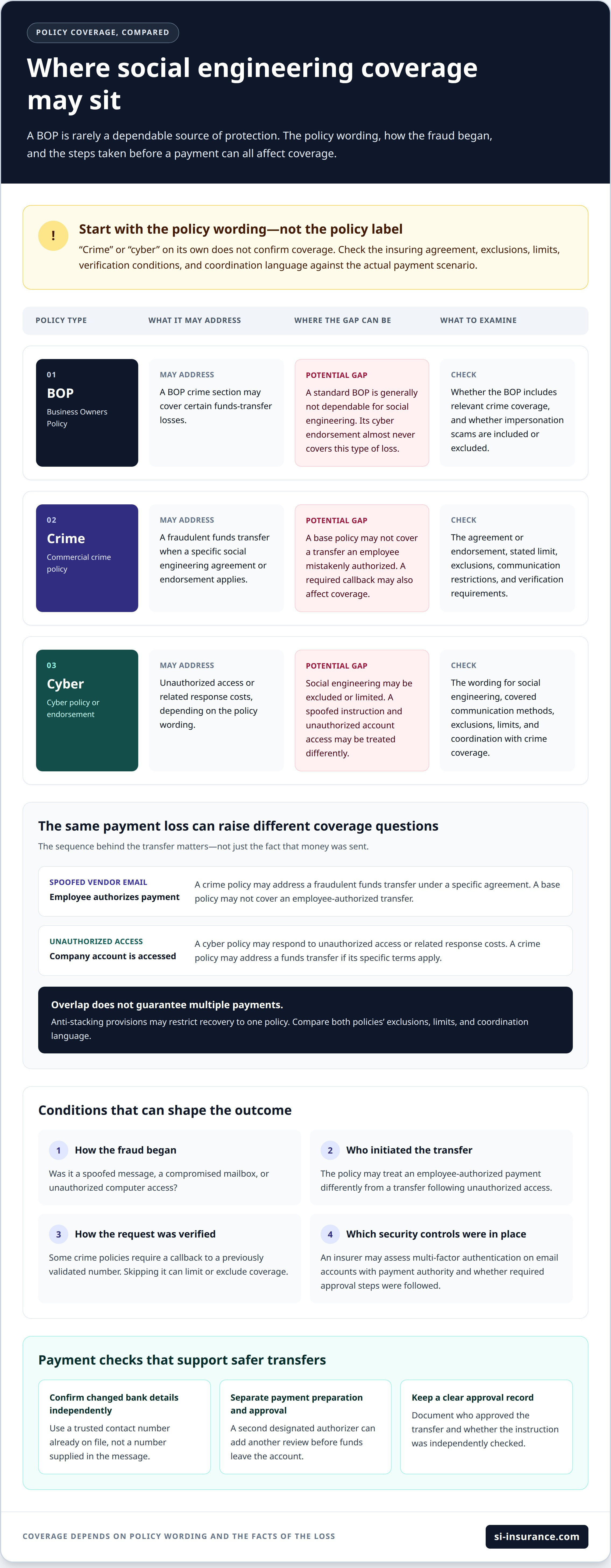
A BOP is rarely a dependable source of social engineering protection. Coverage more often depends on specific crime or cyber policy wording. For example, a spoofed vendor email may trigger different provisions from unauthorized access to a company account.
Commercial Crime Policy Protection
Commercial crime coverage protects against specified financial losses, but a base policy may not cover a transfer an employee mistakenly authorized. This matters when a fraudster impersonates a vendor and sends replacement payment instructions. A dedicated social engineering insuring agreement or endorsement may address that scenario, subject to its stated limit and requirements. The policy wording, not the “crime” label alone, determines whether the loss fits.
Crime and Cyber Coverage Coordination
Crime and cyber coverage can address different parts of one incident, so read the policies together. A cyber policy may respond to unauthorized access or related response costs, while a crime policy may address a fraudulent funds transfer under a specific agreement. Both may appear relevant when an employee acts on a spoofed email, but anti-stacking provisions may restrict recovery to one policy. Compare the insuring agreements, exclusions, limits, and coordination language with the actual scenario.
BOP Crime Coverage and Exclusions
No blanket Florida requirement makes social engineering protection automatic under a BOP. A BOP crime section may cover certain funds-transfer losses, but impersonation scams are not necessarily included in its base terms. A standard crime policy may exclude a loss when an employee mistakenly authorizes payment; a specific endorsement can change that result. Cyber policies may also exclude or limit social engineering, and some crime forms restrict coverage if an employee skips a required callback to a previously validated number. The exact policy wording, including any communication-method restrictions, is key. A vendor’s fraudulent bank-change request, for instance, may be treated differently from a transfer initiated after unauthorized computer access.
Social engineering fraud and business email compromise
Business email compromise occurs when a criminal manipulates business communications to divert money or sensitive information. A common example is a vendor email that looks legitimate but replaces established payment instructions with the criminal’s bank details. The employee may send the payment believing the request came from a trusted business contact.
These attacks can involve a compromised mailbox, a lookalike email address, or a convincing message from an apparent executive. In a vendor-payment scam, the fraudster may monitor an existing email thread before sending altered instructions. That context can make the request feel routine, even though the account details have changed.
Business email compromise complaints in the United States totaled 21,442 in 2024, according to the FBI Internet Crime Complaint Center. The figure reflects reported complaints, not every attempted or successful incident. For an individual business, exposure depends on its payment activity, the information available to a criminal, and how employees handle changed instructions.
The loss may start with one transfer and grow if the fraud goes unnoticed. For example, a criminal impersonating a supplier could redirect a scheduled invoice payment, then repeat the same pattern in later requests. A compromised employee mailbox can also expose conversations that help the fraudster imitate normal approval language.
Business email compromise can complicate a claim because an employee may authorize the payment after being deceived. The sequence matters: whether an account was accessed without permission, what communication prompted the transfer, and how the funds moved can affect which policy provision may apply. Crime and cyber policies may address different parts of that sequence.
To reduce exposure, verify changed vendor banking details independently using contact information already on file. A separate phone call, rather than an email reply, can help confirm whether the request is genuine. Requiring a second designated approver for significant transfers adds another review before funds leave the account.
Coverage conditions and required security controls
In Florida, policy wording determines which deceptive instructions qualify and how a claim is assessed. Insurers may examine how the fraud began, how funds moved, who acted, and whether required verification steps were followed.
A coverage requirement may include multi-factor authentication on email accounts with payment authority. For example, an insurer may assess whether the employee’s account had that control when a fraudulent payment request arrived. The policy may also limit coverage to instructions received through specified communication methods, making the channel part of the claim analysis.
Out-of-band verification means confirming a transfer request through a separate, trusted channel. If a vendor emails new banking instructions, staff can call a previously validated number already on file rather than replying to the email or using a number included in it. Some crime policies require this callback; skipping it can limit or exclude coverage for the resulting loss.
Internal payment controls help show that a request followed the organization’s approval process. A business can require two designated authorizers for wire or ACH transactions and separate payment preparation from approval. These steps create a record of who approved the transfer and whether the instruction was independently checked. When one employee handles every stage, fewer internal safeguards are in place.
For wire-fraud risk, controls should address both changed instructions and routine payments. Businesses can independently validate vendor or payee banking changes, use dual authorization, and apply multi-factor authentication to email, remote access, and administrative access. SPF, DKIM, and DMARC domain authentication can also help prevent email spoofing. These measures reduce exposure but do not replace policy requirements.
When a claim follows, the original message, verification method, approval record, and transfer details help show what happened. A spoofed vendor request may be assessed differently from an employee’s account accessed without authorization. Because cyber and crime forms can define these events differently, coverage depends on the applicable agreement and its conditions.
Social engineering fraud coverage
The decisive issue is whether a policy specifically insures the loss mechanism, not simply whether computers were involved in a phishing attack. A criminal might impersonate a client, supplier, or executive and persuade an employee to send an authorized payment. That can cause direct financial loss without unauthorized access to the business’s systems.
Some cyber policies exclude social engineering or provide a separate sublimit. A larger overall cyber limit does not establish that coverage applies to a deceptive payment.
Crime coverage can address another part of the attack. A specific social engineering or fraudulent instruction agreement may cover an employee’s transfer in response to a fraudulent request, subject to defined conditions and a stated limit. The policy may distinguish a vendor’s false bank-change email from a transfer caused by unauthorized computer access. The event’s details can shape which insuring agreement applies.
Consider limits against the largest payments the business could lose, including money handled for a client. For example, a company that routinely sends substantial supplier payments could face a material gap if its social engineering sublimit is lower than a typical transfer. An anti-stacking provision may also restrict recovery when both crime and cyber policies appear relevant.
For a practical review, compare the covered communication methods, definition of a fraudulent instruction, required verification, applicable exclusions, and sublimits across each policy. Then match those terms against realistic attack scenarios, such as a spoofed executive request or a compromised email thread. This identifies whether the protection addresses the business’s actual exposure, rather than relying on a broad policy label. To discuss broader business coverage, review your business insurance options.
SI Insurance
SI Insurance Agency serves customers across Florida, with insurance options for individuals and businesses. If you’re reviewing how your BOP, cyber, and crime coverage fit together, the agency can help you understand how they work alongside your other policies. Its offerings include auto, motorcycle, boat, and home insurance.
As you assess your coverage, keep in mind that policy wording is central to any social engineering claim. Use the principles in this article to guide your review and the questions you ask.
Contact SI Insurance to learn more about available coverage.
Make your next review more deliberate
If you’re asking whether social engineering fraud is covered by your BOP in Florida, use that question to guide a focused review of your business’s payment exposure. Consider which payment instructions could be changed, who can authorize transfers, and how your procedures would hold up if someone impersonated a familiar contact. Revisit these questions when payment workflows or internal responsibilities change.
A clear record of approval steps and verification practices can make a future claim review more orderly. Align those procedures with the policy wording rather than relying on a general policy label. This helps keep coverage discussions grounded in how the business operates.
To review how your BOP addresses social engineering fraud, speak with SI Insurance about coverage. Discuss your payment approval steps and verification practices.
Frequently Asked Questions
CRIME OR CYBER POLICY?
Either policy may respond, depending on how the loss occurred and the wording. A fraudulent payment instruction may fit a crime policy’s specific social engineering agreement, while a cyber policy may address unauthorized access or related incident costs. For example, a compromised mailbox followed by a deceptive transfer can involve both policy types. Review their exclusions and coordination terms together.
Does a Florida business owners policy cover social engineering fraud?
A Florida BOP generally should not be treated as automatic protection for a deceptive payment. Social engineering losses are almost never covered by BOP cyber endorsements, and coverage depends on any applicable policy wording. If a business relies on its BOP alone, a spoofed invoice or false executive request could fall outside its protection. The key is whether the policy specifically addresses the loss.
What endorsements add social engineering or fraudulent instruction coverage to a BOP?
Look for a specific social engineering fraud or fraudulent instruction insuring agreement or endorsement. The title alone is not enough: the wording may define who must appear to send the request, which communication methods qualify, and whether a transfer must follow a callback procedure. For example, an endorsement limited to vendor instructions may not address an impersonated executive’s request. Read the covered scenario and conditions together.
What limits, sublimits, and deductibles apply to social engineering coverage?
The amount available depends on the specific agreement and any separate sublimit; the overall cyber limit may not apply to this loss. Deductibles also depend on the contract. Compare the applicable limit and deductible with the largest transfer the business could lose.
Comments