


What to Do After a Car Accident in Florida: A Strategic Guide to Safety and Claims (2026)
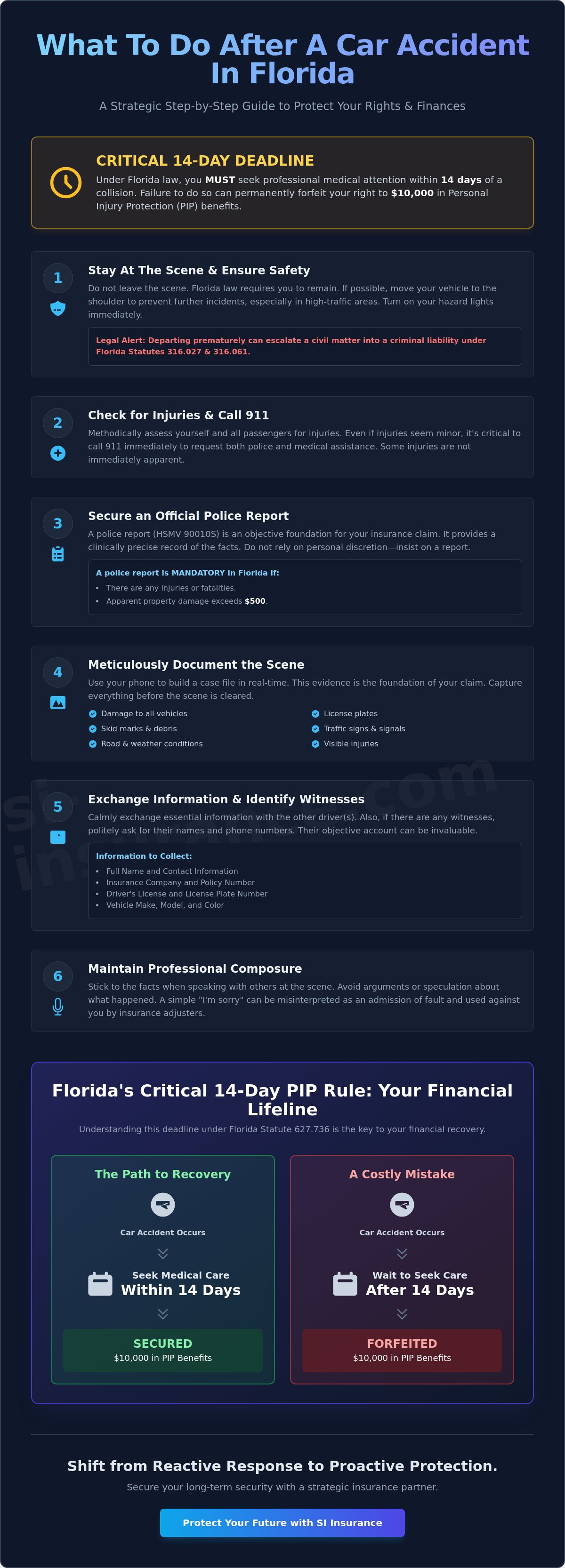
Did you know that failing to seek professional medical attention within 14 days of a collision can permanently forfeit your right to $10,000 in mandatory insurance benefits under Florida Statute 627.736? In the high-stakes environment of Florida's legal system, knowing exactly what to do after a car accident in Florida often represents the thin line between a successfully secured recovery and a claim that is administratively collapsed. It's exhausting to balance the immediate shock of an accident with the rigid demands of state statutes and insurance adjusters. You're right to feel concerned about how these decisions will impact your premiums and your long-term financial health.
This guide provides a strategic alignment between your immediate recovery needs and the state's complex statutory reporting requirements. We'll walk through the specific police reporting thresholds and the critical 14-day medical window to ensure your financial protection remains undisturbed by clerical errors. By following these deliberate and calculated steps, you'll secure your future and handle your recovery with the intellectual confidence of a seasoned risk consultant.
Key Takeaways
Establish immediate legal compliance and safety protocols to protect your standing and preserve the scene's integrity for future risk assessment.
Learn how to capture meticulous visual evidence and documentation that serves as the foundation for a sophisticated strategic defense of your interests.
Navigate the complexities of the no-fault system by understanding the essential 14-day medical window required to maintain your PIP benefit eligibility.
Secure your financial future by discovering exactly what to do after a car accident in Florida when managing communications with third-party adjusters.
Shift from reactive response to proactive protection with bespoke risk mitigation strategies designed to safeguard your long-term security.
Table of Contents Immediate Post-Accident Protocol: Safety and Legal Compliance in Florida Documentation and Evidence: Building a Strategic Defense Deciphering Florida's No-Fault System and PIP Benefits Navigating the Insurance Claim: Avoiding Administrative Pitfalls Restoring Security: Long-Term Risk Mitigation with Si Insurance
Immediate Post-Accident Protocol: Safety and Legal Compliance in Florida
The seconds following a collision require a calculated transition from shock to strategic risk management. Under Florida law, specifically Statutes 316.027 and 316.061, the imperative of remaining at the scene can't be overstated; departing prematurely can escalate a civil matter into a criminal liability. You'll need to position your vehicle to mitigate secondary risks, moving to the shoulder if the car is operable to ensure the safety of other motorists on high-velocity thoroughfares. This initial phase of what to do after a car accident in Florida dictates the trajectory of your eventual insurance recovery and legal standing. Partnering with a strategic guardian like SI Insurance ensures that your risk mitigation strategy begins the moment your vehicle comes to a rest.
To better understand this concept, watch this helpful video:
While the immediate focus remains on physical safety, your long-term interests depend on how you manage the scene's integrity. Florida operates under a unique regulatory framework where Florida's No-Fault System governs the initial distribution of benefits. However, a sophisticated approach doesn't rely solely on basic coverage. You must evaluate the $500 property damage threshold established by Florida Statute 316.066; if damage appears to exceed this specific figure, a formal police report becomes a mandatory legal requirement rather than a matter of personal discretion. During these interactions, maintain a composed, professional distance from other parties. Avoid unintended admissions of fault; even a simple "I'm sorry" can be leveraged by adverse underwriters to undermine your claim's strategic alignment.
When to Contact Law Enforcement
Distinguishing between a minor fender bender and a significant event is vital for your records. If there's any injury or damage exceeding the $500 limit, you should request a formal crash report, known as HSMV 90010S. This document serves as an objective foundation for your claim. While local police might handle smaller incidents, the Florida Highway Patrol often manages accidents on major interstates like I-95. Having this official account ensures that the facts are preserved with clinical precision, supporting your pursuit of underwriting excellence during the recovery phase.
Securing the Scene in Broward County
In high-density areas like Sunrise or Pompano Beach, the risk of secondary collisions is statistically higher due to heavy traffic volume. You should utilize hazard lights and flares immediately to alert oncoming drivers. Assessing injuries requires a methodical approach, checking yourself and passengers before emergency services arrive. Maintaining a professional composure during these moments facilitates a more accurate official account. By acting as a calm, calculated partner in the process, you ensure that the details recorded by authorities reflect a clear narrative of what to do after a car accident in Florida to protect your future interests.
Documentation and Evidence: Building a Strategic Defense
The immediate aftermath of a collision is often chaotic, yet it serves as the most critical window for securing your financial and legal standing. When considering what to do after a car accident in Florida, the transition from physical safety to meticulous data collection must be seamless. SI Insurance views this phase as the foundation of a robust risk mitigation strategy. Every detail captured on-site acts as a primary source for future underwriting excellence and claim resolution.
According to the official Florida Driver Handbook, drivers are legally obligated to exchange specific information, but strategic defense goes beyond mere compliance. You're effectively building a case file in real-time. This proactive approach ensures that the narrative of the event is defined by empirical evidence rather than subjective memory.
A Comprehensive Photographic Checklist
Visual evidence provides an objective narrative that memory cannot replicate. Start by capturing wide-angle shots of the entire intersection; this establishes the spatial relationship between vehicles and fixed objects like traffic lights or stop signs. Move closer to document specific damage points, paying close attention to paint transfers that can prove the angle of impact. You'll need clear images of all license plates and VIN numbers, typically found on the driver-side dashboard. In South Florida, where 50 percent of summer afternoons involve sudden heavy rainfall, documenting current road saturation or standing water is vital for contextualizing traction issues.
Information Exchange Best Practices
Accuracy is the priority during the exchange of credentials. You should record the full name, physical address, and insurance policy numbers for every driver involved. Don't overlook the passengers; document their names and specific seating positions, as this information is essential for calculating potential liability and medical exposures. Understanding what to do after a car accident in Florida requires a disciplined focus on data integrity. You should never sign any documents at the scene other than those provided by law enforcement officers.
Beyond the vehicles, look for environmental factors that may have influenced the event. Obstructed signage or malfunctioning signals can shift the burden of liability toward municipal entities. If witnesses are present, record their statements immediately. Human memory begins to degrade within 24 hours of a stressful event, so capturing their initial impressions provides a significant advantage. This level of detail ensures that your bespoke risk transfer solutions remain effective and fully supported by verified facts.
Deciphering Florida's No-Fault System and PIP Benefits
Florida’s insurance landscape operates under a mandate of immediate financial resolution, prioritizing your physical recovery through Personal Injury Protection (PIP). This no-fault structure requires your own insurance carrier to act as the primary payer for medical costs, regardless of who caused the collision. Understanding What to Do After a Car Accident involves recognizing that your policy serves as your first line of defense in a complex legal environment. The system aims to minimize litigation by providing rapid access to $10,000 in benefits, covering 80% of necessary medical expenses and 60% of lost wages. This statutory framework limits your ability to seek non-economic damages from the other driver unless your injuries surpass a specific threshold of permanency, significant scarring, or loss of bodily function. The strategic allocation of these funds requires a precise understanding of how statutory requirements interface with individual policy limits.
The 14-Day Medical Rule
Florida Statute 627.736 establishes a strict 14-day window for medical intervention that you cannot afford to ignore. If you don't seek professional evaluation within 336 hours of the incident, your insurer possesses the legal right to deny your PIP benefits entirely. Even if you believe your symptoms are minor, a clinical assessment is essential for risk mitigation. You must explicitly inform your healthcare provider that the visit relates to a motor vehicle accident to ensure proper documentation. A critical distinction exists between standard injuries and an Emergency Medical Condition (EMC). If a physician doesn't diagnose you with an EMC, your available PIP coverage is restricted to a $2,500 cap. Securing a comprehensive diagnostic evaluation is a vital component of what to do after a car accident in Florida to preserve access to your full $10,000 limit.
Understanding Property Damage Liability (PDL)
While medical coverage follows no-fault protocols, property damage is handled through an at-fault liability lens. Florida law mandates a minimum of $10,000 in Property Damage Liability (PDL) to cover repairs or replacement costs for the other party’s assets. This separation between personal injury and physical property is a core concept in Florida auto insurance: a strategic guide to coverage in 2026. When you are determining what to do after a car accident in Florida, remember that your PIP covers your body, but your PDL covers their car. If the total damage exceeds the $10,000 minimum, which is increasingly common as vehicle technology costs rise, you may face personal financial exposure. Strategic alignment of your coverage limits with your total asset value is the only way to ensure absolute security against such claims. Professional risk management requires looking beyond the state minimums to protect your long-term financial stability through bespoke risk transfer solutions.
Navigating the Insurance Claim: Avoiding Administrative Pitfalls
The administrative phase of a claim requires the same level of precision as the initial emergency response. When considering what to do after a car accident in Florida, your primary objective should be the protection of your long-term financial interests through meticulous record-keeping. Every receipt, medical diagnosis, and communication with an adjuster forms part of a larger strategic narrative. If you fail to log these details, you're essentially leaving your recovery to chance. You should notify your insurance provider within 24 hours to ensure alignment with policy requirements; even if you weren't at fault, this initial notification is a prerequisite for activating your own coverage benefits.
Maintaining silence on social platforms is equally critical. In the current legal environment, digital footprints are heavily scrutinized by defense teams. A simple post about a weekend outing or a casual photo can be weaponized by adjusters to suggest your injuries aren't as severe as documented. By staying off these platforms during an active investigation, you mitigate the risk of a misinterpretation that could derail your claim. You'll also need to manage communication with third-party adjusters with a high degree of caution. These professionals are trained to minimize corporate liability, so keeping your interactions brief and professional is essential for your risk mitigation strategy.
Filing Your Claim with Precision
Your initial report should be a concise, objective summary of the event. You'll want to avoid using speculative language regarding fault or the specific speeds involved. Florida law is particularly strict regarding timelines. The 14-day rule for Personal Injury Protection (PIP) benefits is a non-negotiable deadline that requires you to seek medical treatment within two weeks to maintain coverage eligibility. At Si Insurance Agency, we act as a strategic guardian for our clients, ensuring the filing process is handled with the intellectual rigor necessary to withstand intense scrutiny from third-party adjusters.
Common Post-Accident Mistakes to Avoid
One of the most dangerous errors is accepting an immediate cash settlement from another driver at the scene. This informal agreement offers zero legal protection and often ignores the reality that approximately 35% of soft-tissue injuries don't manifest until 48 to 72 hours after the initial impact. You should also resist the urge to provide recorded statements to opposing insurance firms without professional guidance. These conversations are often structured to lead you into admissions that reduce the value of your settlement. Wait until you've consulted with your professional advisors to ensure your words are as precise as your documentation.
Secure your financial future with a partner who understands the complexities of Florida risk management. Contact Si Insurance Agency today for a sophisticated approach to your insurance needs.
Restoring Security: Long-Term Risk Mitigation with Si Insurance
Once the initial shock of a collision fades, your focus should shift toward long-term financial resilience. Knowing what to do after a car accident in Florida is a vital first step, but the real work begins when you evaluate how well your current policy protected your lifestyle. Many drivers find that their existing coverage limits are no longer sufficient to meet the rising costs of medical care and litigation. We take a disciplined approach to reviewing your portfolio; we ensure that your protection isn't just a standard template but a bespoke shield designed for your specific assets. It's about moving from a reactive state to a position of controlled security.
Evaluating Your Coverage Post-Accident
Florida’s insurance environment is notoriously complex. Data from the Insurance Research Council indicates that nearly 20% of drivers in the state operate without any insurance coverage. This high frequency of uninsured motorists makes your Uninsured/Underinsured Motorist (UM) coverage the most critical element of your risk transfer strategy. We look closely at whether your UM limits are stacked or non-stacked to maximize your recovery options after an incident. Additionally, with vehicle technology becoming more advanced, repair costs have surged by over 10% in recent cycles. This makes high-limit Collision and Comprehensive coverage essential for protecting your capital. You can begin this process by consulting with SI Insurance: Your Local Agent in Broward County to ensure your policy is built on a foundation of precision.
Bespoke Limits: We adjust your liability thresholds to match your current net worth and risk exposure.
Asset Protection: We verify that your policy shields you from personal litigation and predatory claims.
Inflation Adjustment: Our reviews account for the rising costs of local medical services and specialized labor.
The Value of a Strategic Guardian
Our firm functions as more than a mere provider; we act as a strategic guardian for your financial future. Si Insurance Agency focuses on the deliberate alignment of your auto, home, and umbrella policies. This holistic view prevents the coverage gaps that frequently occur when policies are managed in isolation, especially in high-density areas like Fort Lauderdale or Hollywood. Our consultants offer a measured, professional perspective that helps you navigate renewals with absolute clarity. We prioritize underwriting excellence and long-term stability over the quick, generic fixes found in retail markets. This white-glove service is designed to restore your peace of mind through rigorous analysis and elite expertise. If you want to ensure your family's security is managed with the highest level of sophistication, Contact Si Insurance Agency for a strategic review of your Florida auto policy today.
Elevating Your Post-Accident Strategy
Navigating the aftermath of a collision requires more than just immediate action; it demands a calculated approach to long-term financial security. We've explored the necessity of meticulous documentation and the intricate nature of Florida's No-Fault system. These elements are vital for a successful claim. Understanding exactly what to do after a car accident in Florida ensures you don't fall victim to administrative pitfalls that could jeopardize your PIP benefits. Since 2022, our professional risk mitigation experts have functioned as strategic guardians for residents across Broward County and the entire state. We specialize in deciphering complex statutes to provide bespoke risk transfer solutions that protect your high-value assets. It's about having an elite partner who understands the high-stakes nature of risk management and underwriting excellence. Our team is dedicated to providing the foresight needed to manage these complex financial landscapes with precision. Secure your strategic insurance review with Si Insurance Agency today. You can move forward with absolute confidence knowing your protection is engineered for long-term stability.
Frequently Asked Questions
Do I have to report a minor accident to the police in Florida?
Yes, you must report an accident to law enforcement if it results in any injury, death, or at least $500 in apparent property damage. Even if the incident seems minor, Florida Statute 316.066 requires this formal documentation to ensure a strategic record exists for future claims. Failing to report a qualifying event can lead to a non-criminal traffic infraction. It's always safer to call the police to the scene to establish an objective baseline of the facts.
What happens if I don't see a doctor within 14 days of my Florida car accident?
You lose your right to Personal Injury Protection (PIP) benefits if you don't seek medical treatment within 14 days of the incident. Florida Statute 627.736 mandates this strict window for initial care to qualify for the $10,000 in medical coverage. If you miss this deadline, your insurer will likely deny your claim entirely. Seeking immediate evaluation is a critical step in what to do after a car accident in Florida to protect your physical and financial health.
Does Florida's 'No-Fault' law mean I can't sue the other driver?
Florida's no-fault law doesn't prevent you from suing, but you must meet a specific injury threshold to pursue the other driver for pain and suffering. According to Florida Statute 627.737, this includes permanent loss of a bodily function, significant scarring, or permanent injury. If your medical expenses exceed your $10,000 PIP limit or your injuries are severe, you can file a liability claim against the at-fault party to recover full damages and lost wages.
How much property damage is required to file a formal crash report in Florida?
A formal crash report is mandatory when property damage appears to be $500 or more. While this figure was established years ago, it remains the legal trigger for officer-filed reports under state law. If the damage is below this amount and there are no injuries, you can self-report the crash using the Florida Department of Highway Safety and Motor Vehicles website. Most modern fender benders easily exceed this $500 mark due to high labor and parts costs.
Will my insurance rates go up if I file a PIP claim in Florida?
Your insurance provider cannot legally raise your premiums solely because you filed a PIP claim, provided you weren't substantially at fault. Florida Statute 626.9541 protects policyholders from rate increases for accidents where they're less than 50 percent responsible. This legal safeguard ensures you can access your mandated $10,000 in medical coverage without fear of immediate financial penalties. It's a key component of the state's strategic approach to protecting drivers after a collision.
What should I do if the other driver doesn't have insurance in Broward County?
If an uninsured driver hits you in Broward County, your own PIP coverage acts as the primary source for medical payments. Florida has one of the highest uninsured motorist rates in the country, with roughly 20 percent of drivers lacking coverage in 2023. If your costs exceed $10,000, you'll need to rely on your Uninsured Motorist (UM) policy. Without UM coverage, recovering funds for vehicle repairs or pain and suffering becomes significantly more complex and difficult.
Can I use my own health insurance instead of PIP after an accident?
You can't use health insurance as your primary coverage because Florida law dictates that PIP is primary for auto-related injuries. Your PIP policy must pay the first $10,000 of covered medical expenses before your private health insurance begins to contribute. Once your PIP limit is exhausted, your health insurance provider can step in to cover remaining costs. Knowing this order of operations is vital when deciding what to do after a car accident in Florida.
How do I obtain a copy of my Florida crash report online?
You can obtain a copy of your crash report online through the Florida Department of Highway Safety and Motor Vehicles Crash Portal. Reports are generally available for download 3 to 10 days after the incident for a fee of $10, plus a $2 processing charge. You'll need the crash report number or the date and location of the accident to complete the request. This digital record serves as a foundational element for any strategic insurance claim or lawsuit.
Comments