


Boat Insurance in Fort Lauderdale: Costs and Coverage
Boat insurance coverage in Fort Lauderdale has no single standard rate. The cost depends on the vessel and the protection selected. Florida law doesn’t require boat insurance, although marinas and lenders may make it a condition of using a slip or financing a boat. Factors such as the boat’s size, value, use, storage location, and operator experience can affect the premium.
It’s reasonable to want a clear picture of both the premium and what a policy would protect before making a decision. The right way to assess the cost is to consider how the boat is used and where potential losses could arise, then compare that with the policy’s limits, deductibles, and exclusions.
This article explains the main types of boat coverage, Florida’s insurance requirements, and the factors that influence premiums in Fort Lauderdale. It also outlines how to think about storm-related terms, personal watercraft, and common coverage gaps, so you can approach the decision with a more practical understanding of what protection may fit your needs.
Table of Contents
What Does Florida Boat Insurance Cover?
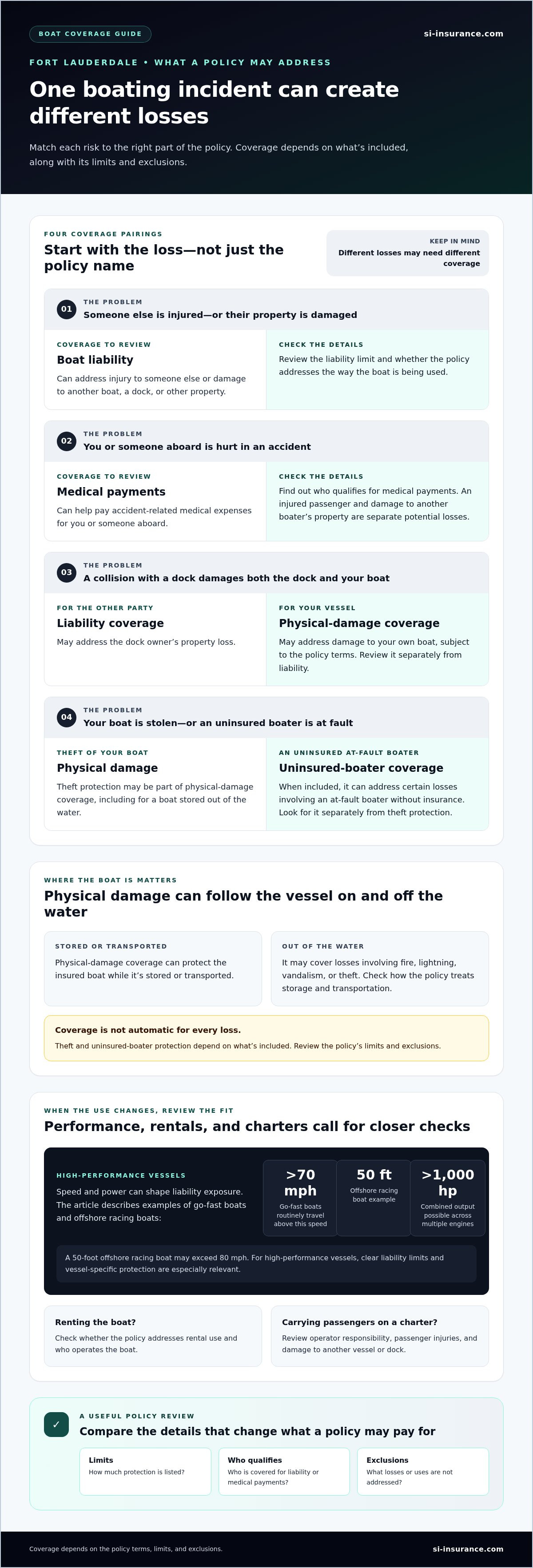
Boat policies may combine liability, medical payments, and physical-damage protection. Liability can address injury or property damage to others, while medical payments can help with accident-related expenses for people aboard. Theft and uninsured-boater losses depend on the protection included.
When comparing boat insurance coverage in Fort Lauderdale, match each coverage to how you use, store, and transport your vessel. Limits and exclusions matter as much as the coverage categories.
Liability and Medical Expense Coverage
Personal liability can help protect you or a family member if an accident injures someone else. Boat liability can also respond when a collision damages another boat, a dock, or other property. Medical payments coverage can help pay medical expenses if you or someone aboard is involved in an accident. Review the liability limit and who qualifies for medical payments.
A fishing trip, for example, could involve both an injured passenger and damage to another boater’s property. These are separate potential losses, so consider how liability and medical payments address each one.
Physical Damage and Collision Liability
Physical-damage coverage can protect the insured boat while it’s stored or transported. Out of the water, it may cover losses involving fire, lightning, vandalism, or theft. Collision liability generally concerns losses involving others, while damage to your own vessel may be addressed separately under the policy. Review these as distinct parts of the policy.
A collision with a dock, for instance, could damage both the dock and your boat. Liability coverage addresses the other party’s loss, while physical-damage coverage may apply to your vessel, subject to the policy terms.
Theft and Uninsured Boater Coverage
Theft protection may be part of physical-damage coverage, including when a boat is stored out of the water. Check how the policy treats storage and transportation, and note any limits or exclusions. Uninsured-boater coverage, when included, can address certain losses involving an at-fault boater without insurance.
These protections address different risks: theft involves the loss of your property, while uninsured-boater coverage concerns an accident involving another operator. Look for each coverage separately in the policy rather than assuming one applies to both.
Speed can also shape liability exposure. Go-fast boats routinely travel above 70 mph, and a 50-foot offshore racing boat may exceed 80 mph. High-performance vessels may use multiple engines producing more than 1,000 horsepower combined. Those capabilities make clear liability limits and vessel-specific protection especially relevant.
Rental and charter use calls for closer review of who operates the boat and how it’s used. Personal-use and charter arrangements can involve different exposures. Before renting or carrying passengers on a charter, check whether the policy addresses that use, operator responsibility, passenger injuries, and damage to another vessel or dock.
Florida boat insurance requirements
Florida doesn’t require boat insurance by law, but a marina or lender may require a policy under its own agreement. You could meet the state’s insurance rules and still be unable to use a marina slip or complete financing without the required coverage. Read the agreement before making plans to buy a boat or rent a berth.
Registration is separate from insurance. Florida requires registration for all motorized vessels operating on public waterways. If you’re preparing a motorized boat for use on those waters, account for registration whether or not you carry insurance. A policy doesn’t take the place of registration, and registration doesn’t cover financial losses from an accident.
Boating safety equipment is a separate requirement. The Florida Fish & Wildlife Conservation Commission enforces the state’s boating safety equipment requirements. Insurance and safety compliance serve different purposes: one concerns financial protection, the other required equipment. For example, a registered motorized vessel on a public waterway still needs to meet applicable equipment requirements.
Marina and lender conditions depend on their agreements. A marina may set conditions for using a slip, while a lender may include insurance requirements in its financing terms. Read the document for the exact requirements, including any specified coverage, then compare them with the policy you’re considering.
Boat insurance premiums vary with the vessel and coverage, so a general statewide figure may not reflect your situation. Type, size, value, condition, use, storage, operator experience, and claims history can all affect the assessment. A smaller vessel kept in storage, for instance, differs from a larger boat used regularly. Compare policies using the same vessel details and coverage choices.
When preparing to use a boat, keep these checks separate:
Determine whether the motorized vessel needs registration for its planned public-waterway use.
Read marina or loan documents for any insurance condition.
Consider applicable safety equipment requirements separately from insurance.
Use accurate boat details when comparing policy options.
For example, if you keep a motorized boat at a marina and operate it on public waterways, review the marina agreement, registration needs, and safety-equipment requirements separately. Checking each requirement on its own makes it easier to see what applies, without treating insurance as a substitute for registration or safety compliance.
How Much Does Boat Insurance Cost in Fort Lauderdale?
Boat insurance cost depends on the vessel, its use and storage, operator experience, and claims history. Consider liability limits alongside physical-damage protection, and compare each deductible, including any separate hurricane deductible.
Seasonal and Hurricane Risks
Atlantic hurricane season runs from June 1 through November 30 annually. For a Fort Lauderdale boat owner, that season makes storm preparation and policy terms practical parts of coverage planning. Review where the vessel is stored, whether it must be secured or moved, and which damage the policy addresses.
Some insurers require Florida boat owners to move vessels out of high-risk zones before a storm. Read the policy’s storm-related requirements before hurricane season to understand what steps may apply to your boat.
Hurricane Coverage and Deductibles
Some Fort Lauderdale policies include named-storm coverage with a separate deductible. It may differ from the deductible for other covered damage, so compare them individually. Also review requirements for securing or relocating the vessel, as a storm clause may set conditions for protecting the boat.
For example, a boat kept in a high-risk zone may have to be relocated before a storm. The policy wording determines what action is required and how the storm deductible applies to a covered loss.
Coverage Limits and Storm Damage
Choose limits with the vessel’s value and potential liability exposure in mind. A deductible is the portion of a covered loss you pay under the policy, so assess it alongside the limit. For hurricane damage, check whether a separate named-storm deductible applies.
Storms can damage a boat while it’s stored or secured. Review how the policy addresses the vessel’s location, storm-related requirements, and any limits that could affect a claim. Emergency towing or service may also matter if a storm leaves the boat unable to travel.
Premiums reflect several vessel-specific factors, not simply the season. Boat type, size, value, age, condition, use, storage location, operator experience, and prior claims can all influence the calculation. A regularly used boat kept in one location may present a different risk profile from one used occasionally or stored elsewhere.
The price depends on the specific boat and is provided after a quote request. Factors include vessel type, size, value, condition, use, storage, operator experience, and claims history. This frames the cost around the boat and its exposure rather than a generalized figure.
Before hurricane season, take three practical steps: read the storm clauses, identify each applicable deductible, and note any requirements to secure or relocate the boat. Review emergency towing terms, too. These details clarify how the policy is intended to respond if a storm affects the vessel.
Boat, jet ski, and personal watercraft coverage
Coverage needs depend on the watercraft, its equipment, how it’s used, and where it travels. For a useful quote, describe those details accurately, including marina storage and any charter activity.
Boat and Personal Watercraft Coverage
Boat and personal watercraft policies may address physical damage and liability, with protection shaped by the vessel and selected limits. Standard policies often include navigation electronics such as GPS and radar, while high-end systems may need additional limits. Emergency service reimbursement may help cover towing, labor, or supplies, and optional coverage may address expensive fishing gear or other personal items.
For a jet ski, describe its use and storage rather than assuming boat policy terms apply in the same way. The size, type, and value of each watercraft help identify relevant coverage needs. If you own both a boat and a personal watercraft, consider each separately, including its equipment and where it’s kept.
Before requesting a personalized quote, gather the vessel’s type, size, value, age, condition, intended use, storage location, operator experience, and claims history. These details shape how the risk is evaluated. Then compare liability and property-damage limits, emergency towing terms, and how the policy treats electronics or fishing equipment. Boating-safety or multi-policy discounts may also be available under some options.
Personal and Charter Yacht Use
Use matters. A yacht used for personal outings has a different pattern of use from one operated as a charter. Describe who operates the vessel, whether passengers are carried for charter purposes, and where the boat travels. These details help align the quote with actual activity rather than treating every yacht as personal-use.
Boats over 27 feet are typically classified as yachts. A personal yacht kept at a marina and used for family trips may have different coverage considerations from a charter yacht carrying paying passengers. Review how the policy addresses the intended use, liability exposure, and equipment, including any high-end navigation systems.
Pay close attention to navigation limits. A boat traveling beyond its policy’s limits, such as on a trip to the Bahamas, may need additional coverage. Share planned destinations when arranging coverage, and review the permitted navigation area before departure. A policy suited to local use may not cover a voyage outside its stated limits.
For a tailored comparison, organize details for each boat, jet ski, or yacht, then assess limits against its value and use. Include emergency towing, fishing equipment, navigation electronics, and charter activity in your review. This gives you a clearer basis for matching coverage to the watercraft and how it’s used.
Boat insurance in Fort Lauderdale
Fort Lauderdale’s boating environment makes the policy details as important as the coverage category. The city has more than 300 miles of navigable inland waterways and more than 50,000 registered yachts. For local boaters, a tailored review should connect the vessel’s value, use, and navigation area with the policy’s limits, exclusions, and claim valuation method.
Many Fort Lauderdale boat owners choose agreed-value coverage. It sets the insured value in advance and pays that amount for a total loss, without depreciation, up to the policy maximum. Actual-cash-value coverage instead reflects the watercraft’s current market value, considering its age, condition, and prior damage. Compare these approaches against the boat’s condition and the financial impact of a total loss.
Read limits and exclusions closely. Boat policies generally exclude gradual wear and tear, routine maintenance issues, marine growth or long-term exposure, and mechanical or electrical failure unrelated to a covered event. A sudden covered incident and a gradual maintenance problem can lead to different claim outcomes. Review the wording for each type of loss rather than assuming every repair falls under physical-damage coverage.
Some boats and smaller watercraft may be covered under a homeowner’s policy, but that doesn’t make it equivalent to a dedicated boat policy. Compare how each treats the vessel, liability, and intended use. A boat kept at a marina, for example, may have different needs from a smaller craft used occasionally. Liability-only coverage is more limited than broader boat insurance.
Survey requirements can also affect the application process. For a vessel above the applicable value threshold, a survey may be part of underwriting. Keep vessel details and condition information organized so the policy assessment accurately reflects the boat.
Review the policy yearly, especially after a change in value, condition, equipment, storage, or use. A boat traveling beyond its navigation limits, such as on a trip to the Bahamas, may need additional coverage. Also distinguish emergency towing and service reimbursement from damage protection: towing, labor, and supplies address different needs.
For a practical review, list the vessel’s agreed or market value, navigation plans, storage location, and expected use. Then compare the policy maximum, deductible, exclusions, and claims valuation method. This helps Fort Lauderdale boaters identify where coverage matches their plans and where policy terms may leave a gap.
SI Insurance: Auto Insurance
SI Insurance Agency offers Boat Insurance for Fort Lauderdale boaters reviewing protection for their vessel, intended use, and navigation area. It’s a natural next step when you’re ready to compare policy terms with the risks discussed here, including liability, physical damage, storm conditions, and exclusions.
If your household also needs protection for vehicles, motorcycles, or a home, SI Insurance Agency offers Auto Insurance, Motorcycle Insurance, and Home Insurance. Considering these needs together can help you organize your decisions while keeping each policy focused on its own risks.
For help exploring boat insurance options, contact SI Insurance.
Make Your Next Coverage Review Count
Before renewing, set aside your current policy and note any changes to your boat or how you use it. This gives you a clear starting point for discussing boat insurance coverage in Fort Lauderdale and deciding whether the policy still fits your plans.
SI Insurance offers Boat Insurance, Auto Insurance, and Motorcycle Insurance. If you’re ready to talk through your boat coverage, contact SI Insurance.
Bring your questions and current policy to the conversation, then take the next step with a clearer idea of what you want your coverage to do.
Frequently Asked Questions
What Isn’t Covered?
Coverage depends on the policy wording and circumstances of a loss, so don’t assume every repair or incident qualifies. If damage occurs, record when and where it happened, photograph the affected areas, and keep receipts for related expenses. These details can help distinguish a sudden incident from a condition that developed over time. Read the exclusions alongside the claim instructions before deciding how to proceed.
What’s Included in a Boat Insurance Policy?
A policy’s declarations page is a useful starting point. Check that it identifies the correct vessel and shows the selected limits and deductibles. Then read any endorsements, which can change or add terms to the base policy. If you add equipment or change how you use the boat, compare those details with the documents rather than relying on an old summary.
What does boat insurance typically cover in Fort Lauderdale?
Policies may address damage to the insured boat and losses involving other people, but the response depends on the selected terms. Start a local review with how you actually use the vessel: where you launch, where you keep it, and whether its use has changed. If you switch from private outings to carrying charter passengers, make sure the policy reflects that activity.
How much does boat insurance cost in Fort Lauderdale, Florida?
Premiums vary with the vessel and policy, so comparing a single number can be misleading. For a meaningful comparison, use the same boat details and similar coverage limits, deductibles, and valuation terms. A lower premium, for example, may come with a different deductible or total-loss valuation. Review those differences together before deciding which option fits your priorities.
Which factors affect boat insurance rates in Fort Lauderdale?
Insurers assess details about the vessel, its operation, and the protection requested. Before asking for a quote, gather accurate information about the boat’s condition, use, storage, and operating history. Note any changes since the last review, such as a new owner or a different use pattern. Clear, consistent information helps the assessment reflect the boat’s actual circumstances.
Is boat insurance legally required in Florida or by marinas and lenders?
Florida law doesn’t require boat insurance, although a marina or lender may set insurance conditions in its agreement. Treat these as separate questions: state requirements concern operation, while a contract can set conditions for a slip or financing. Review marina or loan documents before signing, and compare any stated coverage terms with the policy you intend to carry.
Does boat insurance cover hurricanes, named storms, and storm surge in South Florida?
Storm protection depends on the policy’s definitions, exclusions, and conditions. Read how the contract addresses storm surge rather than assuming it’s treated the same as wind or other storm damage. Check the applicable deductible and any preparation requirements together. If you keep a boat in South Florida, reviewing these clauses before storm season can clarify what the policy requires and how a claim may be assessed.
What navigation limits, lay-up periods, or hurricane preparation rules apply to Fort Lauderdale boat policies?
These terms vary by policy. Before a trip, compare the planned route with the policy’s navigation area; for seasonal storage, note any lay-up dates or limits on use. Record storm-preparation steps in the contract, such as securing or moving the boat. Aligning your itinerary and storage plans with the policy helps avoid assumptions about permitted use.
Comments