


Restaurant Insurance in West Palm Beach: How Much It Costs
A new restaurant in West Palm Beach may need workers’ compensation, general liability, and property coverage, with liquor liability if it serves alcohol. Florida businesses with four or more employees must carry workers’ compensation insurance, and commercial leases commonly set general liability limits. To understand what insurance a new restaurant needs in West Palm Beach, start with legal and lease requirements, then assess the restaurant’s property, operations, and risks.
Insurance costs are difficult to estimate until the restaurant’s coverage needs are clear. Premiums depend on factors such as location, sales, capacity, employee count, and operational risks. This article explains how those factors shape restaurant insurance costs in Florida, what key policies may cover, and how landlord requirements and alcohol service can affect a West Palm Beach restaurant’s insurance plan.
Table of Contents
Is workers’ compensation required in Florida?
Florida restaurants with four or more employees must carry workers’ compensation insurance. The employee threshold, payroll, and job duties all shape the coverage decision.
For a concise overview of restaurant insurance and its cost factors, watch this video:
Florida Workers’ Compensation Requirements
Florida restaurants must carry workers’ compensation when they have four or more employees. Sole proprietors and partners don’t count as employees toward this threshold. However, they may choose to include themselves by filing form DWC-251. Before opening, count the people working for the business and distinguish employees from owners. That assessment helps determine whether the legal threshold applies to the restaurant’s staffing structure.
Coverage for Restaurant Employees
Workers’ compensation can provide benefits such as replacement income and medical care to employees injured or made ill by a work-related incident. Examples include a kitchen worker suffering a burn or a server being injured during a shift. This coverage addresses benefits related to work injuries or illnesses, not ordinary personal medical costs. Employers should consider their staff’s duties and payroll when arranging coverage.
Workers’ Compensation Costs and Payroll Rates
These figures are different reference points, not one universal rate. Payroll volume and employee classifications affect the calculation. Keep payroll records current as staffing and wages change, since payroll is the basis used to express these rates.
Classification and Payroll Review
Full-service restaurants typically use NCCI workers’ compensation classification code 9082. Classification is relevant because the work performed informs how payroll is assigned for premium calculations. Review job duties alongside payroll, rather than treating every restaurant role as identical. A kitchen position and a front-of-house role may involve different work exposures. Accurate descriptions help align the restaurant’s payroll and classification details when coverage is arranged.
Workers’ Compensation and Employer Liability
Florida’s workers’ compensation system generally provides employee benefits without requiring proof of employer negligence. In return, employees typically can’t sue their employer. This differs from liability coverage for other kinds of claims. For restaurant owners, the practical takeaway is to treat employee injury protection and broader business liability as separate coverage needs. Meeting the workers’ compensation requirement does not replace the need to consider other restaurant risks.
What is a Business Owner’s Policy?
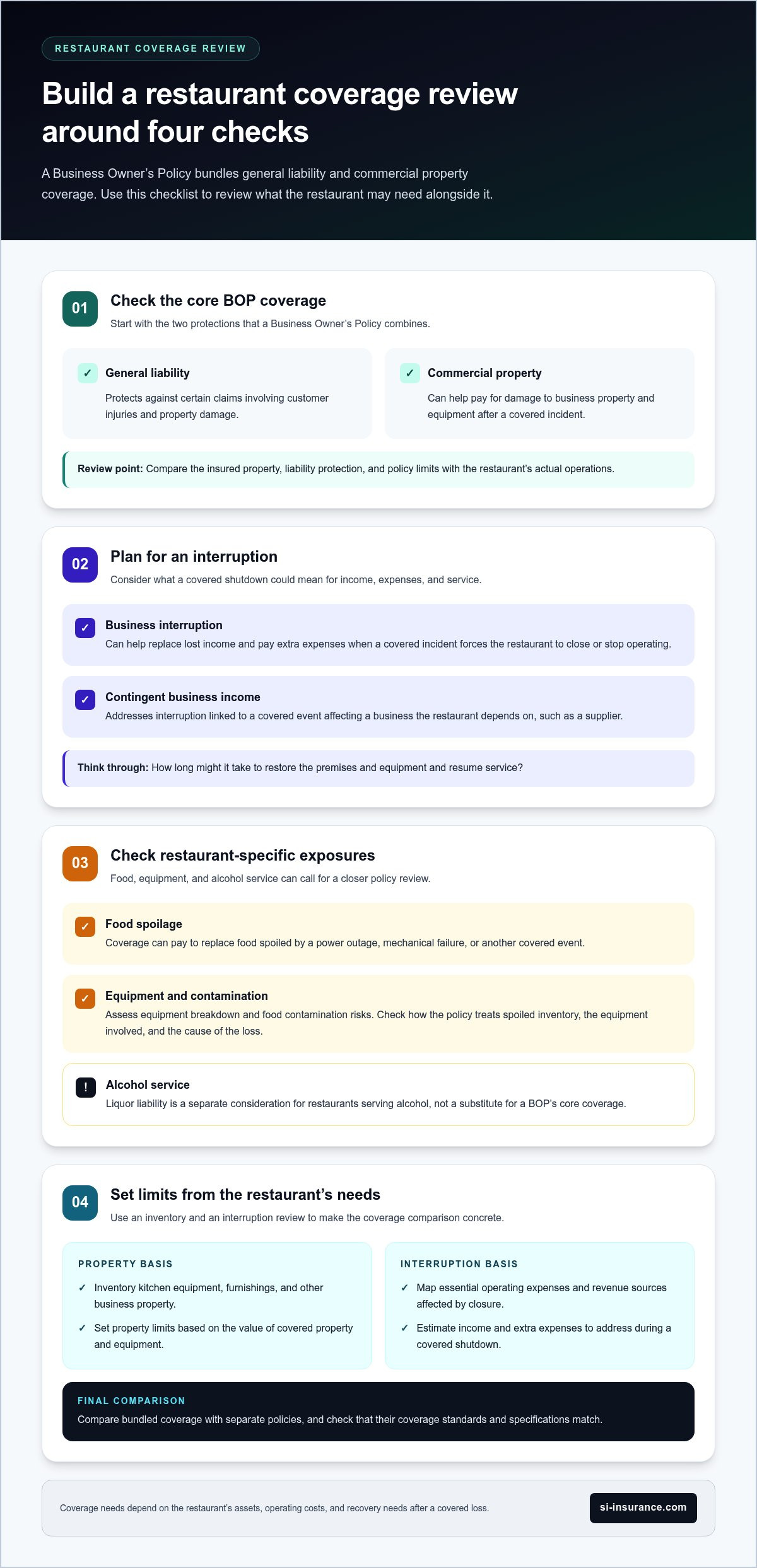
A Business Owner’s Policy (BOP) bundles general liability with commercial property coverage. The appropriate property and interruption limits depend on the restaurant’s assets, operating costs, and recovery needs after a covered loss.
Food spoilage coverage can pay to replace food spoiled by a power outage, mechanical failure, or another covered event. Review how this protection works alongside property and equipment coverage.
Restaurant Business Owner’s Policy Coverage
For a restaurant, a BOP combines protection against certain liability claims with commercial property coverage. Property insurance can help pay for damage to business property and equipment after a covered incident. Compare the insured property, liability protection, and policy limits with the restaurant’s actual operations. Liquor liability is a separate consideration for restaurants serving alcohol, not a substitute for a BOP’s core coverage.
Business Interruption and Income Coverage
Business interruption insurance can help replace lost income and pay extra expenses when a covered incident forces a restaurant to close or stop operating. Consider how long it could take to restore the premises and equipment and resume service. Contingent business income addresses interruption linked to a covered event affecting a business the restaurant depends on, such as a supplier. Account for these dependencies when reviewing interruption needs.
Food Spoilage and Related Coverage
Food spoilage coverage can pay the replacement cost of food spoiled by a power outage, mechanical failure, or another covered event. For example, a refrigerator failure could affect ingredients prepared for upcoming service. Restaurants can also assess equipment breakdown and food contamination risks as part of their coverage review. Check how the policy wording treats spoiled inventory, the equipment involved, and the cause of the loss.
Commercial Property and Interruption Needs
How much commercial property and business interruption insurance does a restaurant need? Set property limits based on the value of covered business property and equipment. Then estimate the income and extra expenses the business would need to address during a covered shutdown. The restaurant’s assets and operating costs provide a practical basis for those amounts.
Build the review from an inventory of kitchen equipment, furnishings, and other business property. Then map essential operating expenses and the revenue sources affected by closure. Compare bundled coverage with separate policies to ensure their coverage standards and specifications match. A clear inventory and interruption analysis can help owners assess whether a BOP fits their restaurant’s needs. For broader business protection options, explore business insurance information.
General liability coverage and landlord requirements
General liability protects against certain claims involving customer injuries and property damage. For a West Palm Beach restaurant, lease terms and customer-facing risks help determine the limits to consider.
Restaurant General Liability Coverage
General liability can cover claims involving bodily injury, personal injury such as libel or slander, advertising injury, and property damage. Restaurant examples include a customer slipping on a wet floor, alleging food-related illness, or being served a beverage that is too hot. Review how the policy addresses these risks and what limits apply. Liquor liability is a separate consideration for alcohol-related claims.
Customer injury and damage to a visitor’s property are different exposures, so consider both when assessing protection. Restaurants also depend on their premises functioning properly, from dining areas to service spaces. Walk through where customers enter, wait, dine, and pay. This can help identify situations in which an accident could lead to an injury or property damage claim.
Landlord Requirements
Most commercial leases in Florida require restaurants to carry general liability limits of at least $1 million per occurrence and $2 million aggregate. In high-value areas, landlords may require $2 million per occurrence and $4 million aggregate. The lease is the starting point: compare its exact limits and wording with the proposed policy before signing or renewing.
Florida restaurant landlords may require the landlord to be named as an additional insured and request annual certificates of insurance. Keep these requirements with the lease documents and coordinate the certificate details with the coverage arrangement. This helps align the restaurant’s insurance records with the landlord’s stated requirements, not just the requested limits.
General Liability Premiums
Restaurant general liability premiums depend on factors such as location, sales, capacity, employee count, and risk exposure. The clientele and how customers use the premises can also affect the assessment. A busy dining room with frequent customer traffic, for example, presents different risks from a small operation with limited seating. Quotes should reflect the actual business, not a generic restaurant profile.
To prepare for quotes, gather details about the restaurant’s location, operations, sales, capacity, and staffing. Compare proposed limits and coverage, not just the premium. Commercial auto insurance addresses vehicle-related risks and is distinct from general liability. If the restaurant uses vehicles, account for that separate exposure rather than assuming general liability will cover it.
Food Contamination Coverage
Food contamination insurance can address losses associated with contaminated food, while general liability may respond to customer claims involving food-related illness. These protections serve different purposes: one concerns the restaurant’s loss, while the other concerns claims alleging harm to a customer. Review each policy’s covered events and how its wording treats spoiled food, contamination, and resulting claims.
Suppose a restaurant discovers that ingredients have contaminated a prepared dish. The business may face both inventory concerns and a customer allegation, which raise different coverage questions. Include food handling and storage processes in the review, and compare food contamination protection with general liability. Clear distinctions help owners understand which policy addresses each potential loss.
Common restaurant insurance policies in Florida
A Florida restaurant’s coverage plan should reflect its services, property, and operating risks. Licenses and permits also affect opening preparations, particularly for food service, alcohol, and customer access to the premises.
Property insurance can help protect restaurant equipment and business property against covered incidents such as fire, theft, vandalism, burst pipes, or equipment breakdown. It may not cover natural disasters such as hurricanes or floods. Restaurants with property in a high-risk flood zone need a standalone flood insurance policy for flood coverage. Review the property policy’s covered events separately from flood protection, and keep in mind that damage restoration specialists like firexperts.net can help mitigate losses when fire or water emergencies occur.
Business interruption coverage can help replace lost income and pay extra expenses when a covered incident forces operations to stop. Foodborne illness and liquor liability may also be relevant to a restaurant or bar, depending on its risks. If the business uses vehicles, consider commercial auto coverage for vehicles used in restaurant operations. Each policy addresses a different risk, so match coverage to actual activities.
Florida restaurants that prepare and serve food need a Food Service License issued by the Florida Department of Business and Professional Regulation (DBPR). Each restaurant location needs a separate Food Service License. Employees who prepare or serve food must obtain a Food Handler’s license within 30 days of being hired. Florida law caps the Food Handler’s license cost at $15 per person.
Restaurants that sell or serve alcohol need an alcoholic beverage license from the Florida Division of Alcoholic Beverages and Tobacco, as well as liquor liability insurance for alcohol-related claims. This liability coverage can protect the restaurant if an intoxicated customer injures themselves or another person. The license and insurance serve different purposes: one authorizes alcohol sales or service, while the other addresses certain related claims.
Other operating approvals may apply to a West Palm Beach restaurant. Florida restaurants generally need a local business license, also known as a local business tax receipt. A certificate of occupancy may also be required from the local building or zoning department to confirm that the premises meet building codes and are approved for restaurant use. Restaurants selling taxable goods in Florida must register with the Florida Department of Revenue to collect and remit sales tax.
Before opening, list each location, service, and operating feature, then match it to the relevant policy or approval. For example, off-site catering must follow food service licensing rules and may require additional approvals, depending on where food is prepared and served. This helps restaurant owners distinguish insurance needs from licensing obligations and commercial property risks.
Liquor liability
Serving alcohol changes a restaurant’s liability profile because an intoxicated customer can injure themselves or another person. Review liquor liability alongside employee, vehicle, and data-related risks to understand how each fits into the coverage plan.
Liquor Liability and Alcohol Service
Liquor liability insurance can protect a restaurant when an intoxicated customer injures themselves or someone else. Consider how alcohol is served, including dining-room service, bar operations, and private events. These details help describe the restaurant’s exposure when arranging coverage. Because a customer injury may involve medical expenses or property damage, review the policy’s scope and limits against the restaurant’s alcohol service.
That range is a market estimate, not a price for a particular restaurant. Location, operations, coverage needs, and risk exposure shape the assessment. A restaurant serving alcohol only with meals has a different service pattern from a bar-focused operation, so quotes should reflect actual activities.
Employment Practices Liability
Restaurant owners can also consider employment practices liability coverage for employment-related allegations. A dispute involving an employee’s treatment at work, for example, raises a different concern from a customer’s alcohol-related injury. Consider the restaurant’s staffing structure, workplace procedures, and how employee concerns are handled. This helps distinguish employment risks from workers’ compensation, which addresses work-related injury or illness.
Documenting workplace policies and employee processes gives owners a clearer basis for discussing employment risks. A growing team, shift changes, and supervisory responsibilities can affect how the restaurant manages workplace interactions. Keep this assessment separate from liquor liability, since each addresses a distinct category of potential claims.
Cyber Liability and Customer Information
Restaurants that keep customer or payment information in digital systems should include cyber liability in their risk review. Identify where information is stored, which systems handle transactions, and who has access. These steps help clarify the restaurant’s digital exposure. Cyber incidents differ from intoxicated-customer claims, so don’t assume a policy addressing one category automatically covers the other.
For example, a restaurant using digital reservations and electronic payment systems should map those processes before assessing coverage needs. Note which vendors and platforms support daily operations, then consider how an interruption or information incident could affect service. This inventory gives owners a practical starting point for discussing cyber-related risks.
Separate Policies for Separate Incidents
A single incident can raise distinct coverage questions. If an intoxicated customer leaves and causes a vehicle accident, liquor liability and auto insurance involve different risks. Commercial auto coverage is relevant when vehicles are used for business, while liquor liability addresses alcohol-related claims. Identify who drives, which vehicles serve the restaurant, and how alcohol service is managed.
For a coordinated review of restaurant and related business exposures, explore business insurance options.
SI Insurance: Auto Insurance
SI Insurance can help you consider Auto Insurance for personal vehicles alongside your restaurant’s separate business coverage needs. If you or an employee drives a personal vehicle for restaurant work, don’t assume a personal policy covers that business use. Vehicles used for business may need a different insurance approach, so separate personal driving from restaurant operations when reviewing coverage.
Auto Insurance may also matter to owners balancing restaurant responsibilities with household needs. SI Insurance also offers Motorcycle Insurance, Boat Insurance, and Home Insurance, supporting personal coverage needs without confusing them with restaurant liability or property protection.
For help with personal Auto Insurance, visit SI Insurance online.
Set Your Coverage Plan Before Opening
Deciding what insurance a new restaurant needs in West Palm Beach starts with turning the business plan into a practical risk review. Consider how the premises will be used, how the team will work, and which services will be offered. This gives you a clearer basis for matching coverage to the restaurant’s actual activities instead of relying on a generic package.
SI Insurance offers Business Insurance and a Business Owner’s Policy for business protection. If you’re ready to discuss how those options may fit your restaurant’s plans, contact SI Insurance about restaurant coverage. A measured review now can help you move toward opening with a coverage plan connected to the way you intend to operate.
Frequently Asked Questions
How much does restaurant insurance cost in Florida?
Restaurant insurance costs vary with the policies, limits, and business-specific risks selected. For owners deciding what insurance a new restaurant needs in West Palm Beach, useful quote details include projected sales, payroll, property values, seating capacity, and planned services. Keep these figures consistent across quote requests so you can compare coverage on a like-for-like basis, rather than focusing on premium alone.
How much does it cost?
There isn’t one fixed total for every restaurant. The premium reflects the selected coverage and operating profile. Before requesting a quote, prepare an inventory of business property, estimated payroll, expected sales, and a clear description of operations. Note whether the restaurant plans delivery, catering, or alcohol service. These details help ensure the quote reflects the intended business rather than incomplete assumptions.
What are the most common policies for restaurants in Florida?
Common restaurant coverage includes workers’ compensation, general liability, commercial property, and business interruption insurance. Depending on the business, owners may also consider liquor liability, commercial auto, or flood coverage. To prioritize, list the restaurant’s assets, activities, and contractual requirements, then identify which policy addresses each risk. This can reveal gaps or overlapping coverage before the restaurant opens.
What insurance is legally required for a new restaurant in Florida?
Florida’s insurance requirements depend on restaurant staffing and vehicle use, and alcohol service carries its own insurance obligation. Keep insurance decisions separate from operating approvals, such as food-service licensing and a local business tax receipt. Maintain separate lists for insurance, licenses, and lease requirements so completing the permit process isn’t mistaken for an insurance review.
Does a Florida restaurant need workers’ compensation insurance, and what are the employee thresholds?
Yes. Florida restaurants with four or more employees must carry workers’ compensation; sole proprietors and partners aren’t counted toward that employee threshold. Owners who want to include themselves may file form DWC-251. For planning, record each person’s employment status and keep payroll information aligned with the restaurant’s staffing records, especially as hiring changes during opening and daily operations.
What Florida liquor liability insurance is required for a restaurant serving alcohol?
A Florida restaurant serving alcohol needs liquor liability insurance for alcohol-related claims. The state also requires an alcoholic beverage license, which is separate from insurance. Document whether alcohol will be served at the bar, with meals, or at catered events, then use that description when arranging coverage. This helps ensure the insurance review reflects how the restaurant serves customers.
What types of general liability insurance should a new restaurant in West Palm Beach carry?
General liability coverage should reflect the restaurant’s customer-facing activities and lease terms. Owners planning what insurance a new restaurant needs in West Palm Beach can start by matching lease requirements to the proposed policy, including limits and any additional-insured wording. Then consider whether separate liquor liability or property protection is needed, since these address risks beyond general liability.
What commercial auto insurance is needed for restaurant delivery vehicles in Florida?
Restaurant-owned delivery vehicles should be considered for commercial auto coverage, and Florida sets minimum requirements for commercial auto insurance. If staff use personal vehicles for deliveries, hired and non-owned auto liability may address certain business-related liability claims, but it doesn’t cover damage to the employee’s vehicle. Identify which vehicles are used for deliveries and who drives them when assessing the restaurant’s auto risks.
Comments