


Commercial Auto Insurance in Broward County: A Strategic Risk Management Guide (2026)
Driving a business vehicle in Broward County today feels a lot more like a high-stakes obstacle course than a simple commute. You likely know that sinking feeling of watching traffic on I-95 or Sunrise Boulevard and wondering if your current coverage really has your back if something goes sideways. It’s stressful to think that a single fender bender could put everything you’ve worked so hard for at risk, especially when it’s hard to tell exactly where your personal policy ends and your business liability begins. We understand those worries, and we're here to help you clear up that confusion with a protective strategy that truly fits your local operation.
In this guide, we'll help you navigate the complexities of commercial auto insurance Broward County with a focus on real-world protection. You'll learn how to properly structure your coverage to handle our unique South Florida traffic while staying fully compliant with the latest 2026 mandates. We’re going to walk through the essential policy components and the specific risks you face on our roads, giving you the confidence to know your business is safe and secure for the long haul.
Table of Contents
Defining the Boundary: Personal vs. Commercial Auto Insurance in Florida
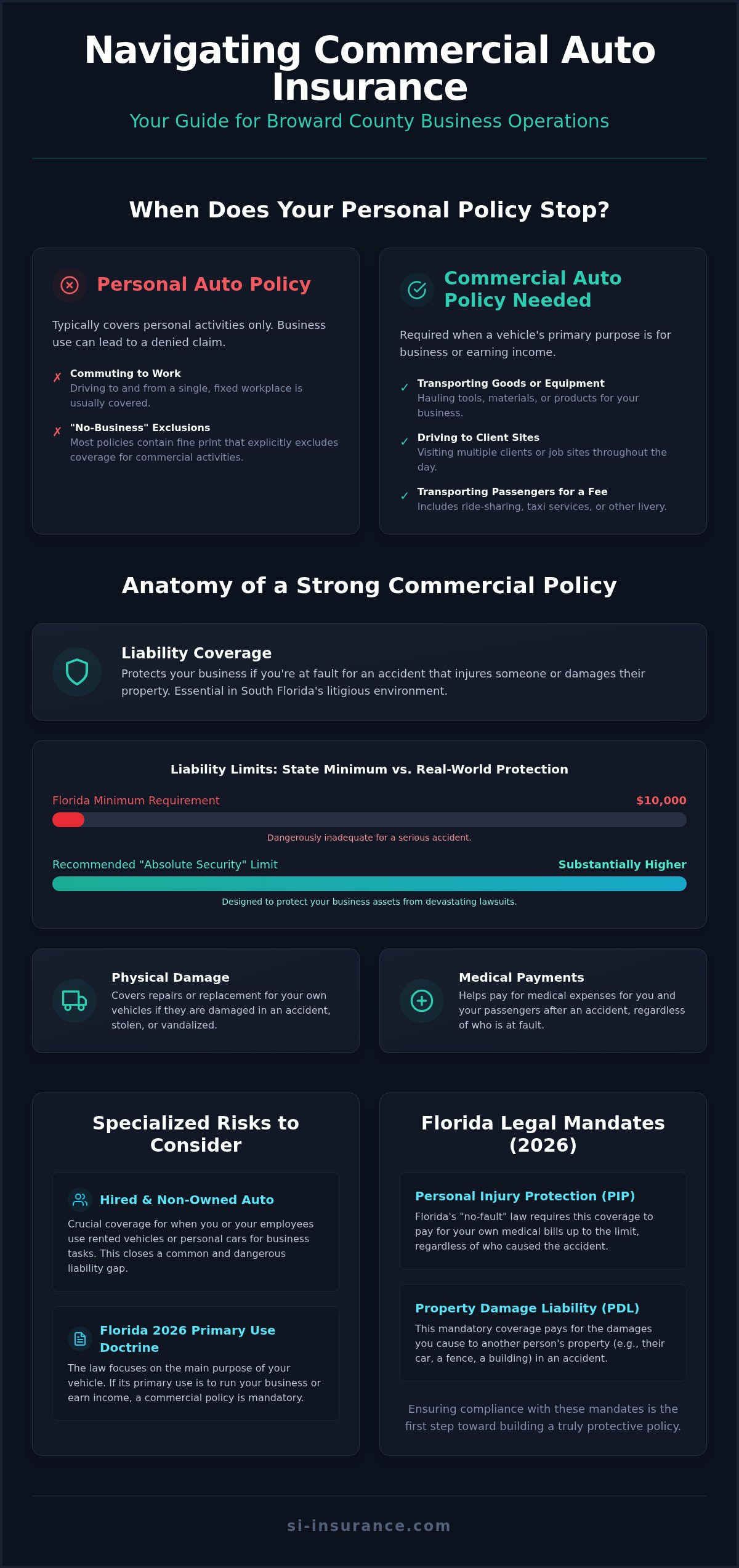
Let's talk about that line between your personal life and your business life. It's often blurrier than we'd like, especially when your vehicle is involved. Commercial auto insurance isn't just a fancy legal term; it's really just a way to make sure your business has a safety net when your car or truck is being used as a tool for work. When you're looking into Personal vs. Commercial Auto Insurance, you're trying to figure out which policy kicks in when you're on the clock. In Broward County, getting your commercial auto insurance Broward County right means knowing exactly when that switch happens so you aren't left holding the bill.
Think about the difference between driving to the office and driving for the office. Commuting is just getting from point A to point B to start your day. But "dispatching", like when you're heading out to meet a client in Pompano Beach or hauling equipment to a job site in Sunrise, is a whole different story. If you're in an accident while you're technically working and you only have a personal policy, your insurance company might just walk away. That gap in coverage is where things get scary, because it leaves your business bank account and your personal savings wide open to a lawsuit in our very litigious local environment.
To better understand how these concepts apply to local business operations, watch this helpful video:
The "Grey Area" of Mixed-Use Vehicles
A lot of entrepreneurs in our area use the same SUV to drop the kids at school and then head straight to a sales meeting. It's convenient, but it creates a bit of a puzzle for insurance. You need to know when your car has officially crossed into "business" territory. It isn't about the logo on the door; it's about what you're doing in that moment. To keep things simple: In 2026, Florida's primary use doctrine looks at whether your vehicle's main purpose is to help you run your business or earn a paycheck.
Why Personal Policies Fail Business Owners
Most personal policies have "no-business" rules hidden in the fine print. These aren't just suggestions; they're hard limits. If you're using your car to deliver goods or transport paying passengers, your personal policy is essentially off the table. This is why many owners end up in an "uninsured business" trap. They think they're covered, but the moment a claim is filed, they realize they're on their own. Working with a team like SI Insurance helps you spot these traps before they snap shut, making sure you have a real plan instead of just a hope.
The Anatomy of a Sophisticated Commercial Auto Policy
Building a policy that actually works for you is a bit like putting together a puzzle where every piece needs to fit just right. While Forbes explains commercial auto policies as a mix of liability and asset protection, the reality on our streets is that you need a setup that's specifically tuned for South Florida. Getting your commercial auto insurance Broward County right means looking at three main areas: protecting others, protecting your vehicles, and protecting your people. It's not just about legal compliance; it's about making sure your business can survive a bad day on the road.
Liability is usually the first thing people think about because it's what protects you if you're responsible for someone else’s injuries or property damage. Then you have physical damage coverage, which handles repairs for your own vehicles, and medical payments for those inside the car. Every one of these layers needs to be balanced so you aren't overpaying for things you don't need, but you aren't left wide open where it matters most. It's about being prepared for the unpredictable nature of local traffic.
Liability Limits for High-Value Operations
Florida's $10,000 minimum is basically a drop in the bucket if a major accident happens. When we talk about finding your "Absolute Security" limit, we're looking at what it would take to protect your business if a serious crash occurred on the Sawgrass Expressway. For many local companies, a standard policy isn't enough, which is why we often look at Umbrella Insurance. It’s like having an extra safety net that stays in the background until your main policy limits are reached, providing that extra peace of mind when the stakes are high.
Physical Damage and Business Continuity
If your van or truck is stuck in the shop, your business is likely losing money every hour it's off the road. This is where collision and comprehensive coverage come in to protect your balance sheet. You’ll need to decide between Actual Cash Value, which pays what the vehicle is worth today, or a Stated Amount, which is usually better if you’ve added expensive tools or customizations. Choosing the right deductible is also a bit of a balancing act; a higher one lowers your monthly bill, but you need to be sure you have the cash ready to get back on the road quickly.
Every part of your policy should serve a specific purpose for your business. If you're feeling a bit unsure about whether your commercial auto insurance Broward County limits are actually doing their job, the folks at SI Insurance are always happy to help you take a look and see where you stand.
Evaluating Specialized Risks: From Hired Auto to Fleet Management
Risk isn't a monolith. A light-duty courier van navigating Sunrise Boulevard encounters vastly different physical and legal hazards than a heavy-duty freight truck operating near Port Everglades. To build a resilient policy, you must first categorize your exposure by vehicle weight and operational function. Heavy-duty vehicles, for instance, trigger higher liability mandates in Florida due to their potential for catastrophic damage. Securing the right commercial auto insurance Broward County means looking beyond the vehicles you own to the risks you unintentionally inherit through daily operations.
One of the most overlooked vulnerabilities is vicarious liability. This occurs when an employee uses their personal vehicle for a business errand, such as a bank run or a client meeting. If an accident happens during that trip, your business is often the primary target for litigation. Because personal policies almost always exclude business-related incidents, the organization is left to defend itself against sophisticated legal challenges. Managing this grey area requires a calculated approach that bridges the gap between personal ownership and corporate responsibility.
Hired and Non-Owned Auto (HNOA) Strategy
Hired and Non-Owned Auto (HNOA) coverage acts as a protective guardian for businesses that don't maintain a physical fleet. Consider a scenario where an office manager is involved in a collision while picking up office supplies in their own car. Without HNOA, the business balance sheet is directly exposed to the resulting claims. This coverage is a fundamental pillar of Business Insurance in Broward County, providing the necessary indemnity when hired or employee-owned vehicles are used for company purposes. It ensures that your risk management strategy is airtight, even when you aren't the one behind the wheel.
Fleet Mitigation for Broward Operations
For organizations operating five or more vehicles, Florida law typically allows for a "Fleet" designation. This transition is a strategic opportunity to centralize risk management and access volume-based premium structures. However, a larger fleet requires more rigorous oversight. Implementing telematics and strict safety protocols isn't just about safety; it's a premium reduction strategy that demonstrates to carriers that your risk is well-engineered. You'll also need a methodical process for evaluating driver eligibility. High-risk driver profiles can significantly inflate costs, so maintaining a clean corporate driving record is essential for long-term financial stability. By focusing on these technical details, you can transform your fleet from a liability into a well-protected asset.
Navigating Florida’s Legal Mandates and No-Fault Laws
Florida's regulatory environment for business vehicles is notoriously complex. In 2026, the state remains a no-fault jurisdiction, which fundamentally shifts how initial medical claims are handled after an accident. For those securing commercial auto insurance Broward County, understanding these mandates isn't just about avoiding tickets; it's about insulating your company from administrative shutdowns and legal exposure. While the $10,000 minimum for Property Damage Liability (PDL) is the legal floor, it's rarely enough to cover a modern collision in South Florida's high-value traffic.
Subrogation, the process where your insurer pursues the at-fault party to recover costs, becomes particularly intricate under no-fault rules. Because Florida has one of the highest rates of uninsured motorists in the country, roughly 20%, your policy must be robust enough to handle the initial financial shock regardless of who caused the crash. This litigious environment means that compliance is your first line of defense, but strategic limit-setting is what actually protects your equity.
PIP and the Commercial Driver
Under the no-fault system, Personal Injury Protection (PIP) covers the first layer of medical expenses for drivers and occupants. For business owners, the interaction between PIP and Workers’ Compensation can be a source of confusion. Generally, Workers’ Comp is the primary payer for injuries sustained while an employee is on the clock, but PIP remains a mandatory statutory requirement for vehicle registration. In 2026, Broward businesses must maintain a minimum of $10,000 in Personal Injury Protection (PIP) to comply with Florida’s no-fault statutes.
State-Specific Filing Requirements
Operating heavier commercial units requires a higher level of regulatory transparency. If your vehicles exceed a Gross Vehicle Weight of 26,000 pounds, you're subject to specific Florida Department of Highway Safety and Motor Vehicles (FLHSMV) filings and increased liability limits. For example, vehicles between 26,000 and 34,999 pounds require a $50,000 combined single limit, while those over 44,000 pounds must carry at least $300,000 per occurrence. Lapses in coverage are reported electronically to the state, often resulting in immediate suspension of tags and registrations.
Maintaining continuous coverage is essential for both legal compliance and your reputation as a reliable operator. If you're concerned about your fleet's current compliance status, you can contact SI Insurance for a methodical review of your state filings and liability structures.
The Si Insurance Approach: Engineering Your Commercial Shield
In a financial landscape as volatile as South Florida's, you don't need a salesperson; you need a calculated partner. At Si Insurance Agency, we position ourselves as a protective guardian for local entrepreneurs, moving beyond the transactional nature of retail insurance. Our methodology isn't about finding the fastest quote, but about engineering a specialized risk transfer mechanism that aligns with your specific organizational goals. When you're seeking commercial auto insurance Broward County, you deserve a consultant who views your fleet through the lens of long-term security and intellectual precision.
We've found that the most resilient businesses are those that treat insurance as a strategic asset rather than a sunk cost. By acting as an elite consultant, we provide the foresight necessary to anticipate regional shifts in litigation and regulation. This composed, analytical approach ensures that your coverage isn't just a piece of paper, but a robust shield designed to withstand the unique pressures of the Broward commercial corridors.
The Independent Advantage
Our status as an independent agency is the cornerstone of our strategic value. Unlike captive agents who are tethered to a single provider's limitations, we have access to a sophisticated network of elite carriers. This independence allows us to conduct a methodical analysis of the market, matching your unique risk profile with the carrier whose strengths best protect your bottom line. It's about finding the precise intersection of comprehensive protection and competitive structure. For a broader look at how we manage these complexities across the state, you can explore our Florida Auto Insurance: A Strategic Guide.
Next Steps in Risk Mitigation
Transitioning to a more sophisticated risk management structure begins with a rigorous audit of your current exposure. We don't believe in generic solutions, so our process requires a detailed review of your operational data. To initiate a precise commercial analysis, we typically gather the following documentation:
Current policy declaration pages and three to five years of loss runs.
A comprehensive driver list, including MVRs and safety training certifications.
Detailed vehicle schedules, including Gross Vehicle Weight (GVW) and specialized equipment values.
Documentation of existing safety protocols or telematics integration.
Once your initial shield is engineered, we establish a deliberate cadence for annual reviews. This ensures your coverage evolves alongside your business and the shifting legal landscape of 2026. If you're ready to move away from generic retail models and toward a more calculated partnership, engage with Si Insurance for a methodical commercial auto analysis. We're here to provide the absolute security and intellectual confidence your business demands.
Securing Your Operational Future in South Florida
Transitioning from basic compliance to a sophisticated risk management strategy is what separates vulnerable businesses from resilient ones. By now, it's clear that navigating the complexities of commercial auto insurance Broward County requires more than just meeting state minimums. It demands a deep understanding of how no-fault laws, vicarious liability, and specific fleet requirements intersect with your company’s unique goals. Moving forward with a methodical plan ensures that your assets remain protected against the high-stakes litigation environment that defines our region in 2026.
As an independent agency, Si Insurance Agency provides the flexibility and localized expertise necessary to engineer a shield that fits your specific needs. We don't believe in generic retail packages; instead, we focus on a rigorous, analysis-driven approach to matching you with elite carrier networks. Taking the time to audit your current limits and filings today is the most effective way to prevent catastrophic financial loss tomorrow. We're ready to help you navigate these financial corridors with absolute confidence. Request a Strategic Commercial Auto Analysis from Si Insurance to begin fortifying your business today.
Frequently Asked Questions
What is the minimum commercial auto insurance requirement in Broward County for 2026?
In 2026, the baseline requirement for any vehicle registered in Florida, including those in Broward County, is $10,000 in Personal Injury Protection (PIP) and $10,000 in Property Damage Liability (PDL). However, commercial motor vehicles weighing 26,000 pounds or more must carry significantly higher limits, ranging from $50,000 to $300,000 per occurrence. These state mandates are merely a starting point and rarely provide sufficient protection against the high-value claims common in South Florida.
Does my personal auto insurance cover me if I use my car for business in Florida?
Most personal auto policies in Florida specifically exclude coverage for business-related activities. If you use your vehicle to transport goods for a fee or to visit multiple job sites, a claim involving an accident during these tasks will likely be denied. This leaves your personal assets fully exposed to litigation. Transitioning to a dedicated commercial auto insurance Broward County policy is the only way to ensure that your business and personal wealth remain protected.
What is Hired and Non-Owned Auto (HNOA) insurance and do I need it?
Hired and Non-Owned Auto insurance provides liability protection for vehicles your business uses but doesn't own, such as employee vehicles or rental cars. If an employee is involved in a crash while running a business errand, your company could be held vicariously liable for damages. You absolutely need this coverage if your team members ever use their personal cars for work tasks, as it acts as a secondary shield after their personal limits are exhausted.
How does Florida’s "No-Fault" status affect my commercial auto policy?
Florida’s no-fault status means that your own insurance pays for the first $10,000 of medical expenses through PIP, regardless of who caused the accident. In a commercial context, this can complicate subrogation efforts, especially with the high volume of uninsured motorists in Broward County. While PIP handles immediate medical needs, a sophisticated policy must also include robust bodily injury liability to manage the potential for lawsuits that exceed these initial no-fault thresholds.
Can I list my employees as drivers on my commercial vehicle policy?
You should list all employees who regularly operate company vehicles on your policy to ensure they're fully covered. Carriers evaluate the motor vehicle records (MVRs) of every listed driver to determine your overall risk profile and premium costs. It's vital to maintain an updated driver list, as failing to disclose a regular operator could lead to a claim denial or policy cancellation if an accident occurs while they are behind the wheel.
What factors influence the cost of commercial auto insurance in South Florida?
Several local factors influence premiums in South Florida, including high traffic density and the region’s reputation for frequent litigation. Your specific costs are determined by your fleet’s size, the weight and function of your vehicles, and the driving history of your employees. Carriers also look at your claims history and the specific safety protocols you've implemented, such as telematics, to gauge how well you manage risk in this high-stakes environment.
Is a Business Owners Policy (BOP) sufficient, or do I need a separate auto policy?
A standard Business Owners Policy (BOP) typically protects your physical location and general liability but doesn't cover vehicles owned by the business. While some BOPs can be endorsed with Hired and Non-Owned Auto coverage, any vehicle titled in the company’s name requires a standalone commercial auto policy. Relying solely on a BOP leaves a massive gap in your risk management structure, especially if your operations involve daily transit or delivery services.
What happens if my commercial vehicle is involved in an accident in a different state?
Most commercial auto policies provide coverage throughout the United States and Canada, ensuring your protection doesn't end at the Florida border. However, if your vehicles are involved in interstate commerce, you may be subject to federal Department of Transportation (DOT) requirements and higher liability limits. It's essential to verify that your policy includes the necessary filings, such as an MCS-90 endorsement, to remain in compliance when crossing state lines for business operations.
Comments