


Common Home Insurance Mistakes in Florida: A Strategic Guide to Avoiding Costly Coverage Gaps in 2026
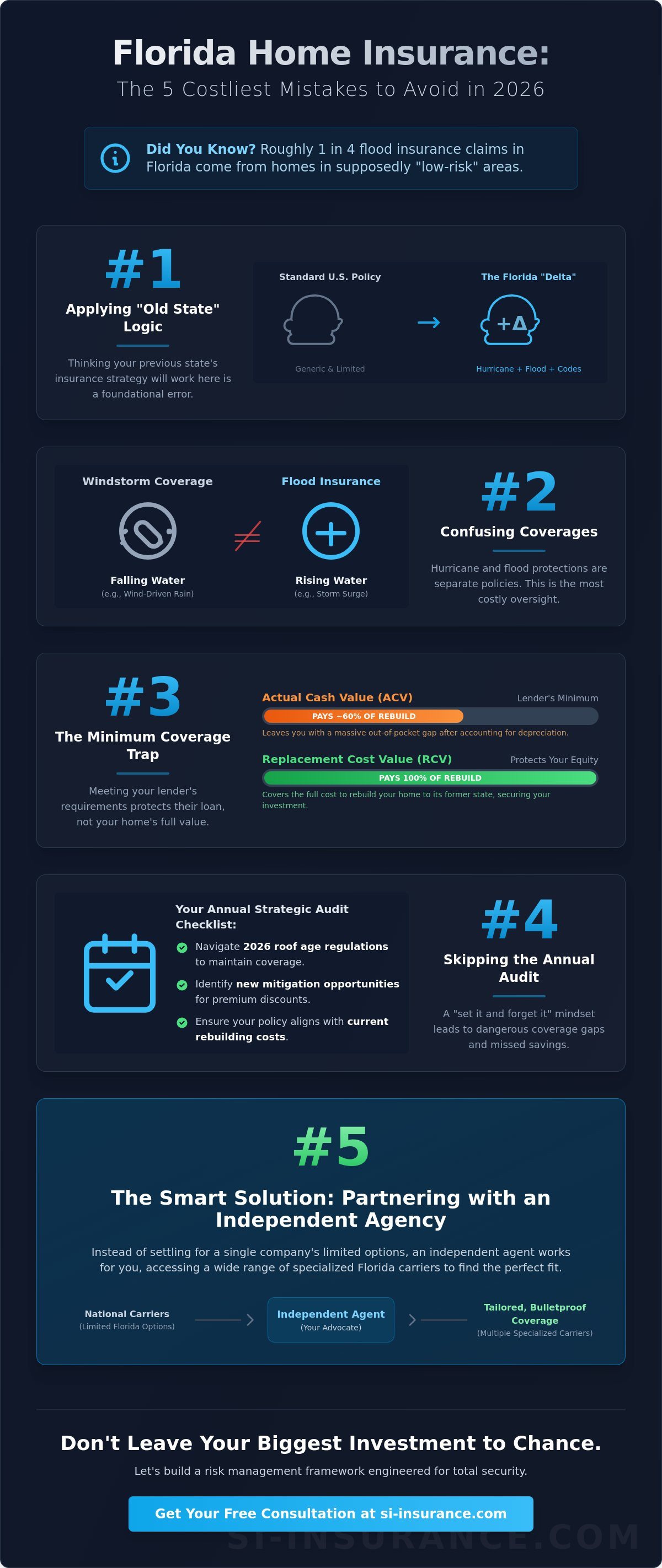
Did you know that approximately 25% of all flood insurance claims in Florida originate from areas traditionally categorized as low risk? This single data point highlights why relying solely on standard flood zone maps is one of the most common home insurance mistakes in Florida that can lead to catastrophic financial exposure. You've likely felt the mounting pressure of rising premiums and the inherent frustration of deciphering opaque policy language that often obscures more than it reveals. It's perfectly reasonable to seek a more sophisticated approach when the insurance logic of the past no longer aligns with the complex realities of the 2026 market.
This strategic guide provides the technical precision you need to transform your coverage from a static monthly expense into a bulletproof risk management framework. We'll show you how to secure your property investment and achieve absolute peace of mind by identifying the subtle strategic errors that leave even the most diligent homeowners vulnerable. We'll examine the latest legislative shifts, including the 2026 roof age regulations and the critical distinctions between windstorm and flood protections, to ensure your insurance strategy is engineered for total security and that your claims are paid with professional precision.
Key Takeaways
Identify why applying "Old State" logic is one of the most common home insurance mistakes in Florida. The unique "Florida Insurance Delta" requires a localized approach to risk management.
Master the technical distinction between rising and falling water. This ensures your policy covers both storm surge and wind-driven rain before a hurricane makes landfall.
Discover why meeting your lender's minimum requirements doesn't always protect your home's equity. You'll learn how to transition from Actual Cash Value to Replacement Cost coverage.
Navigate 2026 roof age regulations with a strategic annual audit. This process helps you identify mitigation opportunities that can significantly lower your premiums.
Understand why partnering with an independent agency is a superior strategy. It gives you access to a curated selection of multiple carriers tailored to your high-value needs.
Table of Contents
The Peril of "Old State" Logic: Why Florida Home Insurance Demands a Local Perspective
Confusing Hurricane Coverage with Flood Protection: The Most Costly Technical Oversight
The "Minimum Coverage" Trap: Why Meeting Lender Requirements Often Leaves You Vulnerable
Neglecting the Annual Policy Audit: Strategic Steps to Mitigate Risk and Reduce Premiums
Beyond the Policy: Partnering with SI Insurance for Sophisticated Risk Management
The Peril of "Old State" Logic: Why Florida Home Insurance Demands a Local Perspective
Many homeowners relocating to the Sunshine State arrive with assumptions forged in more predictable environments like the Midwest or the Northeast. They often believe that a standard policy structure is universal, yet this is one of the most common home insurance mistakes in Florida. We call this the "Florida Insurance Delta," a significant gap between national coverage standards and the specific mandates required to survive the local climate and regulatory environment. Relying on your previous state’s framework isn't just a minor oversight; it's a foundational error that can leave your most valuable asset exposed. While understanding home insurance policies is a helpful starting point for any property owner, the local nuances here are far more complex than a general overview suggests.
To better understand how these regional complexities impact your coverage and why the market has become so specialized, watch this helpful video:
As we move through May 2026, the market is finally showing signs of stabilization after years of extreme volatility. With 17 new insurance carriers entering the space and average premiums dropping between 10% and 40% from their historical peaks, the availability of private insurance is expanding. However, this shift requires a sophisticated understanding of local building codes, particularly in high-velocity zones like Broward County. Structural requirements here are among the most stringent in the world, and failing to align your policy with these specific codes can result in significant out of pocket expenses during a rebuild. Avoiding these common home insurance mistakes in Florida requires a shift from a "set and forget" mindset to one of active, strategic management.
The Regulatory Landscape of the Sunshine State
The Florida Office of Insurance Regulation (OIR) maintains a rigorous oversight role that dictates how policies are written and claims are processed. Recent legislative reforms, such as Senate Bill 2-A, have fundamentally altered the landscape by establishing a one-year deadline for filing initial hurricane claims. These changes aim to reduce litigation and stabilize premiums, but they also place a higher burden of proof on the homeowner. State-backed options like Citizens Property Insurance are now strictly intended as a last resort. In fact, policy counts have dropped to approximately 391,768 as of early 2026 as the state successfully transitions homeowners back to the private market. Understanding these regulatory shifts is essential for maintaining a bulletproof insurance strategy.
Why National Carriers Often Struggle in Florida
You’ve likely noticed that many household-name national brands have reduced their footprint or withdrawn from the state entirely. National carriers often struggle to manage the concentrated risk of a Florida hurricane season, leading to the rise of specialized Florida-domestic insurers. This is why partnering with an independent agency, like SI Insurance, is a strategic necessity. An independent agent acts as an elite consultant, providing access to regional markets that national brands simply can't reach. It’s about building a partnership focused on long-term security through meticulous analysis of your specific risk profile rather than settling for a generic, one size fits all policy.
Confusing Hurricane Coverage with Flood Protection: The Most Costly Technical Oversight
One of the most devastating realizations a homeowner can face occurs in the aftermath of a storm when they discover that "water damage" isn't a monolithic term in the eyes of an insurance adjuster. In the high stakes environment of Florida risk management, the distinction between "rising water" and "falling water" determines whether a claim is paid or denied. If wind rips a shingle from your roof and rain pours into your attic, your standard homeowners policy generally responds because the water fell from the sky. However, if a storm surge or overflowing canal sends water into your living room, that's considered rising water. Without a specific flood policy, you're facing a total loss on those repairs. This technical confusion remains one of the most common home insurance mistakes in Florida, often leaving residents with massive out of pocket expenses they mistakenly believed were covered.
There's a dangerous misconception that living in "Flood Zone X" or a low risk area removes the need for protection. Data from the National Flood Insurance Program (NFIP) suggests that approximately 25% of all flood claims originate from these very areas. While your lender might not mandate coverage for a property outside a high risk zone, the lack of a mandate doesn't equate to a lack of risk. Securing a separate policy is a strategic necessity for anyone serious about asset protection. If you're concerned about your specific vulnerabilities, reviewing your current flood exposure with an expert can reveal gaps that a standard policy simply ignores.
The Mechanics of the Hurricane Deductible
Standard policies usually feature a flat dollar deductible for everyday claims, known as the All Other Peril (AOP) deductible. Hurricane coverage operates differently, utilizing a percentage based system calculated from your home's total insured value. For instance, if your home is insured for $500,000 and you have a 2% hurricane deductible, you're responsible for the first $10,000 of damage before the insurer contributes a single dollar. This is a significant financial hurdle that catches many off guard. To dive deeper into the technicalities of these costs, you should examine our guide on Hurricane Deductibles in Florida: How They Work.
Flood Insurance: Beyond the Mortgage Requirement
Timing is everything when it comes to flood protection. Most policies, especially those through the NFIP, require a 30 day waiting period before they become effective. If you wait until a tropical depression is churning in the Atlantic, it's already too late to secure coverage for that event. It's also vital to recognize the limits of federal programs. The NFIP caps dwelling coverage at $250,000, which is often insufficient for high value Florida properties. For comprehensive security, we often recommend looking into the private market for excess flood insurance to protect the full equity of your home.
The "Minimum Coverage" Trap: Why Meeting Lender Requirements Often Leaves You Vulnerable
When you secure a mortgage in the Sunshine State, your lender will mandate a specific level of insurance to protect their collateral. A frequent pitfall for many homeowners is the assumption that these lender requirements equate to comprehensive protection for their personal wealth. This is one of the most common home insurance mistakes in Florida because it fails to account for the inherent conflict of interest between you and the bank. The lender's primary objective is to ensure the loan balance is covered if the structure is destroyed, yet they have little incentive to protect the equity you've spent years building or the high-value personal assets within your home. Relying on these bare-minimum standards can leave you with a massive financial deficit after a major loss.
Valuation Methods: ACV vs. RCV
The technical distinction between Actual Cash Value (ACV) and Replacement Cost Value (RCV) is perhaps the most significant SERP gap in current insurance discussions. If your policy is written with ACV for your roof, the insurer will subtract years of depreciation from your claim payout. For a fifteen-year-old roof damaged in a storm, you might only receive a fraction of what a new roof actually costs in the 2026 market. We strongly advocate for RCV to ensure your policy provides the liquidity needed for a total recovery. Replacement Cost Value is the contractual obligation to restore property without deducting for age or wear. Without this specific designation, you're essentially self-insuring the gap between a depreciated check and the real-world cost of labor and materials.
The Critical Role of Ordinance or Law Coverage
Florida’s building codes are among the most rigorous in the nation, particularly in High Velocity Hurricane Zones (HVHZ) like Broward County. If your home was built several decades ago, it likely doesn't meet the stringent 2026 requirements for impact-resistant windows or specific roof-to-wall connections. When a home suffers more than 50% damage, local ordinances often mandate that the entire structure be brought up to current code during the rebuild. Standard policies only cover the cost to repair the home as it originally existed. Ordinance or Law coverage is vital because it pays for these mandatory, and often expensive, upgrades. Without it, you'll be forced to pay the difference between "old code" and "new code" out of your own pocket.
In our increasingly litigious environment, we also recommend that high-net-worth individuals consider a Personal Umbrella Liability policy. While your homeowners policy includes basic liability, it can be quickly exhausted by a single significant legal judgment. For those seeking a more sophisticated risk management strategy, an umbrella policy provides an essential layer of protection that guards your global assets from unforeseen legal exposure. True security comes from looking beyond the lender's checklist and engineering a policy that reflects the actual value of your lifestyle and property.
Neglecting the Annual Policy Audit: Strategic Steps to Mitigate Risk and Reduce Premiums
Many homeowners treat their coverage as a static utility, paying renewals without scrutinizing the underlying terms. This "set and forget" approach is a primary driver of financial loss and remains one of the most common home insurance mistakes in Florida. Risk is dynamic; it evolves as your property ages and as the state legislature updates building codes. Treating your policy as a fixed document means you're likely missing out on significant premium credits or, worse, carrying coverage that no longer reflects the true replacement value of your home in the 2026 market. A strategic annual audit ensures your risk management plan aligns with current underwriting standards, which have become increasingly rigorous regarding property condition and documentation.
As of July 1, 2026, House Bill 815 provides a layer of protection by prohibiting insurers from refusing to renew a policy solely because a roof is less than 15 years old. However, once a roof crosses that 15-year threshold, insurers gain significant leverage to demand a full replacement or apply substantial premium surcharges based on visible deterioration. If you haven't reviewed your policy recently, you might be unaware of how your roof's aging profile is impacting your eligibility for the private market. Moving your policy away from state-backed options requires a proactive approach to maintenance and a deep understanding of how mitigation can offset rising costs. To ensure your property is positioned for the best possible rates, you should contact SI Insurance to schedule a comprehensive review of your current standing.
The Wind Mitigation Inspection Roadmap
The wind mitigation inspection is the single most effective tool for lowering your insurance costs in the Sunshine State. Florida law mandates that insurance companies provide credits for specific hurricane-resistant features that reduce the likelihood of a total loss. Inspectors look for several technical benchmarks, including the method of roof-to-wall attachments, such as clips or wraps, and the specific nail spacing on the roof deck. They also verify the presence of a secondary water barrier, which acts as a final line of defense if your shingles are stripped away. These credits are applied directly to the wind portion of your premium, often resulting in savings that far outweigh the cost of the inspection itself.
Inventory Management and Scheduled Personal Property
A standard homeowners policy contains internal sub-limits that often surprise people during a claim. These limits typically cap coverage for high-value items like jewelry, fine art, or high-end electronics at a few thousand dollars, regardless of the item's actual appraisal. To achieve full protection, you must "schedule" these assets individually. Scheduling provides full-value protection and often removes the standard deductible for those specific items. This is a critical step for anyone with significant personal collections. For a deeper look at protecting your most prized possessions, read our sibling article on Jewelry Insurance in Florida: A Strategic Guide.
Beyond the Policy: Partnering with SI Insurance for Sophisticated Risk Management
Finding the right policy is only part of the equation; the real value lies in the ongoing management of your risk profile. As we've discussed, the landscape is full of technical traps, and falling into these common home insurance mistakes in Florida can leave you financially exposed at the worst possible time. This is where SI Insurance steps in as your elite consultant. Unlike a captive agent who only represents one brand, we operate as an independent agency. This gives us the freedom to scan a wide array of Florida-specialized carriers to find the exact fit for your high-value assets.
Our presence in the Broward community, with offices in Sunrise and Pompano Beach, shows our commitment to the families we protect. We aren't just reading from a script; we understand how the local environment affects your premiums and your claims. By pairing traditional industry stability with modern engineering, we provide a level of foresight that generic retail agencies simply can't offer. We focus on building a partnership that prioritizes long-term security over simple transactions.
The SI Insurance Methodology
We use a rigorous process to align your specific risk profile with the right carrier. This isn't just about finding the lowest number; it's about ensuring your claims are paid with professional precision. During the stress of a claim, we act as a calm and calculated partner, guiding you through every administrative hurdle. Our goal is to give you absolute intellectual confidence in your coverage by applying a meticulous approach to every detail of your policy.
Securing Your Future Today
Don't wait for the next storm cycle to find the gaps in your protection. We invite you to experience a more sophisticated level of risk management by initiating a dialogue with our team. You can start this process right now through our online quote tool or contact page. Protect your Florida investment with a strategic review from SI Insurance and gain the peace of mind that comes from true foresight.
Engineering Your Long-Term Security in the 2026 Florida Market
You've now seen how the 2026 market offers a unique opportunity for stabilization, provided you move past the "set and forget" mentality of previous years. By addressing the technical distinctions between rising and falling water and looking beyond bare lender requirements, you're already positioning yourself ahead of the curve. Avoiding common home insurance mistakes in Florida is about more than just a lower premium; it's about ensuring your claims are handled with the professional precision your lifestyle deserves. It's time to stop reacting to the market and start engineering your own protection.
At Si Insurance Agency, we serve as elite consultants with independent access to dozens of Florida-specialized carriers. Our team brings deep expertise in Broward County building codes and mitigation strategies to ensure your home remains an asset rather than a liability. We invite you to experience a more personalized, sophisticated approach to high-value asset protection. Request a Strategic Policy Review from Si Insurance Agency to begin your transition toward absolute security. You've worked hard to build your life in the Sunshine State, and we're here to help you protect it with confidence.
Frequently Asked Questions
Is flood insurance required in Florida even if I am not in a high-risk zone?
Lenders don't usually require flood insurance for properties in low-risk areas like Zone X, but it remains a critical addition to your risk management strategy. Standard homeowners policies explicitly exclude damage from rising water, regardless of your location. Given that approximately 25% of all flood claims originate from these low-risk areas, skipping this coverage is one of the more common home insurance mistakes in Florida. Securing a separate policy ensures your equity is protected from unpredictable storm surges.
What is the difference between a hurricane deductible and a standard deductible?
A standard deductible, often called an All Other Perils (AOP) deductible, is a fixed dollar amount you pay for everyday claims like theft or fire. In contrast, a hurricane deductible is calculated as a percentage of your home's total insured value, typically ranging from 2% to 10%. If your dwelling is insured for $500,000, a 2% deductible means you're responsible for the first $10,000 of hurricane damage before your insurer provides any reimbursement for the loss.
How does the age of my roof affect my home insurance premium in Florida?
The age and condition of your roof are primary factors in determining your premium and overall eligibility for private market coverage. As of July 1, 2026, state law prohibits insurers from non-renewing policies solely for roofs under 15 years old that pass a professional inspection. However, once a roof exceeds this age, you'll likely face significant premium spikes or be forced to replace the structure to maintain your policy. Newer roofs often qualify for substantial discounts through specialized mitigation credits.
Does my homeowners insurance cover my home-based business in Broward County?
Standard homeowners policies provide extremely limited coverage for business-related assets, typically capping protection at $2,500 for equipment stored on the premises. More importantly, your personal liability coverage generally excludes any incidents arising from professional activities or client visits. To fully protect a home-based business in Broward County, you should consider a Business Owners Policy (BOP) or a specific endorsement. This ensures your professional equipment and legal liabilities are managed with the same precision as your personal property.
What is wind mitigation, and how much can it actually save me?
Wind mitigation is a specialized inspection that verifies your home's ability to withstand high-velocity winds through features like reinforced roof-to-wall attachments and secondary water barriers. Florida law mandates that insurers apply credits to the wind portion of your premium for these structural enhancements. While exact savings vary based on your specific location and the carrier, these credits can often reduce your annual costs by several hundred dollars, making the inspection a high-return investment for any Florida homeowner.
Can I change my insurance policy in the middle of hurricane season?
You can technically change your insurance policy at any time, but you should avoid waiting until a tropical system is actively threatening the state. Once a tropical storm or hurricane watch is issued for any part of Florida, insurers typically implement a "binding moratorium," which prevents the issuance of new policies or the adjustment of existing coverage limits. It's best to conduct your policy audits and make necessary changes during the calmer months to ensure uninterrupted protection for your assets.
What happens if my home is underinsured during a total loss event?
If your home is underinsured during a total loss, you are personally responsible for the financial gap between your policy limit and the actual cost to rebuild. This situation often arises when homeowners fail to adjust their dwelling coverage to match rising construction costs. Falling into this trap is among the common home insurance mistakes in Florida that can result in the loss of your home's equity. Maintaining an accurate replacement cost valuation is essential for a full financial recovery.
Why did my Florida home insurance premium increase so much in 2026?
While the 2026 market is showing signs of stabilization, premiums remain influenced by high reinsurance costs and the increased price of labor and building materials. Even as 17 new carriers have entered the market to provide more competition, individual premiums may still rise if your property hasn't been updated with modern wind mitigation features. Stricter underwriting standards and the state's aggressive depopulation of Citizens Property Insurance also play a significant role in the shifting costs you see on your renewal notice.
Comments