


Explaining flood insurance timing and preparedness to your Naples family
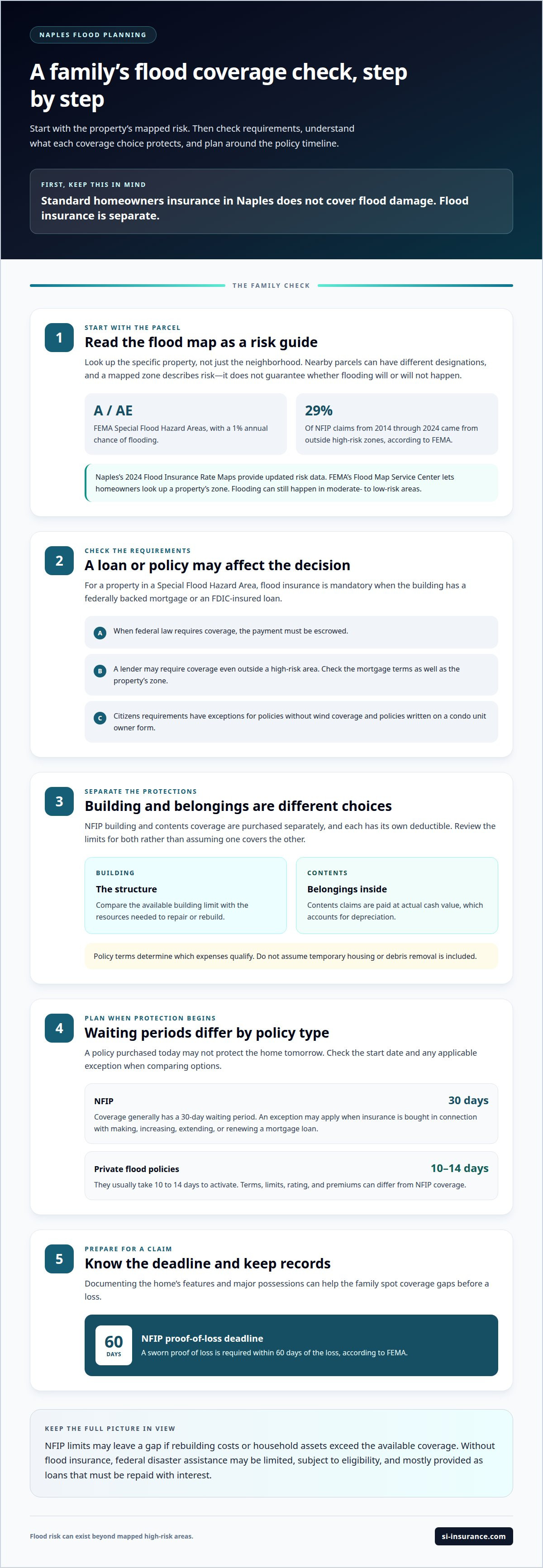
A flood policy can be purchased today and still not protect a Naples home tomorrow. If you’re discussing flood insurance with your family in Naples, start with this timing rule: according to the Federal Emergency Management Agency, coverage generally has a 30-day waiting period, although an exception may apply when insurance is purchased in connection with making, increasing, extending, or renewing a mortgage loan.
It’s understandable to assume a home’s location or standard homeowners policy tells the whole story, but flood risk and coverage needs can be more specific. Explaining the need for flood insurance to your family in Naples means clarifying what NFIP building and contents coverage includes, how local flood zones may affect your household, and when a lender or policy may require coverage. It also means discussing practical ways to prepare, so your family can consider the home’s exposure, when coverage begins, and what the policy is designed to protect.
Table of Contents
How much does the NFIP cover?
NFIP coverage separates protection for a building from protection for its contents. Building and contents coverage are purchased separately, and each has its own deductible.
Covered losses generally involve direct physical flood damage to insured property, subject to the policy’s terms and limits. Contents claims are paid at actual cash value, which accounts for depreciation. According to the Federal Emergency Management Agency, a Naples flood insurance policy has a 30-day waiting period before coverage begins. An exception may apply when coverage is bought in connection with making, increasing, extending, or renewing a mortgage loan. Private flood policies usually take 10 to 14 days to activate, and their terms, limits, rating, and premiums can differ from NFIP coverage.
To obtain a quote, Naples homeowners can compare NFIP and private flood options, then select building and contents limits suited to their property and belongings. NFIP limits may leave a gap when rebuilding costs or household assets exceed the available coverage. After a flood, according to the Federal Emergency Management Agency, NFIP claims require a sworn proof of loss within 60 days of the loss.
Without flood insurance, federal disaster assistance may be limited, subject to eligibility requirements, and mostly provided as loans that must be repaid with interest. A disaster declaration does not make that assistance equivalent to an insurance claim. Families should consider the potential out-of-pocket burden when assessing their coverage needs.
How do flood zones work in Naples?
Naples flood maps classify property risk, helping homeowners understand exposure and possible lender requirements. A zone describes mapped risk, not a guarantee that flooding will or will not occur.
Risk Beyond High-Risk Zones
Flood risk outside a high-risk zone means a property can still flood despite a lower-risk map designation. The Federal Emergency Management Agency classifies Zones A and AE as Special Flood Hazard Areas, with a one percent annual chance of flooding.
FEMA’s Flood Map Service Center lets homeowners look up a property’s flood zone. Naples’s 2024 Flood Insurance Rate Maps provide updated risk data that can affect premiums and eligibility. Review the specific parcel, not only a neighborhood map, since nearby properties can have different designations.
Risk also exists beyond mapped high-risk areas. FEMA estimates that 29 percent of NFIP claims from 2014 through 2024 came from outside those zones. In Florida, moderate- to low-risk areas have less than a one percent chance of flooding each year, but flooding remains possible. A lower-risk label therefore doesn’t mean a household can ignore flood planning.
Florida Flood Events and Storm Surge
Florida flood events include rainfall flooding and coastal storm surge, which can affect properties differently. During Hurricane Milton in October 2024, Naples recorded storm surge levels of 5.08 feet.
That distinction shows why homeowners should consider more than a flood hazard area designation when assessing exposure. A map can help frame a flood insurance decision, while the property’s location and potential water sources can inform the family’s preparedness plan. Reviewing the map alongside the home’s specific characteristics helps clarify what a zone indicates and what it cannot predict about an individual flood event.
When Florida mortgages and Citizens policies require flood coverage
Federal mortgage rules and some Citizens policies can make flood insurance a condition of coverage. The requirement depends on the property’s mapped risk and the specific policy or loan.
Requirements for Mortgages and Citizens Policies
For a property in a Special Flood Hazard Area, flood insurance is mandatory when its building has a federally backed mortgage or an FDIC-insured loan. The Flood Disaster Protection Act of 1973 is cited by the U.S. Congress as a basis for mandatory coverage in certain high-risk areas.
When federal law requires insurance, the payment must be escrowed. A lender may also require flood coverage for a home outside a high-risk area, even when federal law does not. For Naples homeowners, both the mortgage terms and the property’s flood-zone designation matter.
Citizens flood-insurance requirements have exceptions: they do not apply to policies without wind coverage or policies written on a condo unit owner form. This helps explain why neighbors with different policy types may face different requirements.
Buildings, Contents, and Additional Coverage
Flood insurance can protect a building’s structure, its contents, or both, but these are separate coverage choices. NFIP building coverage applies to the structure, while contents coverage applies to belongings inside it.
That distinction matters after a flood: damage to a home’s walls and damage to its furniture are different losses. Review the policy’s covered property, limits, and deductibles for each category. Do not assume temporary housing or debris removal is included; policy terms determine which expenses qualify.
Replacement-cost planning means comparing the amount available for the structure with the resources needed to repair or rebuild it. Contents limits should also reflect household belongings. Documenting the home’s features and major possessions can help owners spot potential gaps before a loss, rather than treating a lender’s minimum coverage requirement as a complete recovery plan.
Flood insurance and family preparedness
Start the family conversation with one clear distinction: standard homeowners insurance in Naples does not cover flood damage. A separate flood insurance policy addresses that exposure. The National Flood Insurance Program (NFIP) provides one route to coverage for eligible properties in participating communities. A home’s flood zone describes mapped risk, but flooding can also happen elsewhere.
If I were explaining the need for flood insurance to my family in Naples, I’d make the discussion specific to our household. I’d explain whether the property is in a high-risk hazard area, whether a lender requires coverage, and why belongings need separate consideration from the building. Renters should understand that a landlord’s or property manager’s flood policy does not cover their personal property. Families can also agree on who will share updates and where everyone will meet after an evacuation.
I’d also discuss the financial consequences. Federal disaster assistance after flooding is limited, depends on eligibility, and is mostly provided as loans that must be repaid with interest. In Naples, a property owner who received a federal grant for earlier flood losses must have flood insurance to qualify for future aid. This helps explain why insurance planning matters even when a mortgage does not require coverage.
Keep the insurance policy, household contact details, and key property records together where family members can access them.
Agree on an evacuation communication plan, including how relatives will reconnect if phone service is disrupted.
Identify essential medications, documents, and belongings to take if local officials issue evacuation instructions.
Then invite questions instead of trying to settle every concern at once. Ask each family member what they think the policy covers, clarify gaps using the actual documents, and revisit the plan when the home, household, or coverage changes. A shared understanding turns flood preparedness into a practical household plan.
SI Insurance: Flood Insurance
SI Insurance offers flood insurance for Naples households considering how to protect a home and its contents from flood losses. It can be a practical next step when a flood zone, mortgage condition, or household risk review raises questions about coverage. The decision should account for both the property and your family’s financial exposure.
A useful discussion starts with your household’s circumstances: whether you own or rent, what the lender requires, and which parts of the property and belongings you want to protect. NFIP and private flood policies can differ in limits, terms, and waiting periods. Understanding those distinctions helps families weigh options against their priorities.
Consider reviewing coverage before a home purchase, mortgage change, renewal, or shift in household needs. For example, a family that has added valuable belongings may want to revisit contents protection, while a homeowner assessing a mapped hazard area may need to understand how the property’s location affects the decision. Plan ahead because coverage may not begin immediately after purchase.
If you’re discussing flood insurance with your family in Naples, SI Insurance can help you weigh the considerations and work through the coverage decision. Bring any questions that remain after reviewing your flood zone, policy limits, and lender requirements. A focused conversation can clarify what matters for your circumstances before you choose coverage.
For a no-pressure conversation about flood coverage, contact SI Insurance.
Frequently Asked Questions
Are there exceptions to the 30-day waiting period between the date of purchase and the effective date?
Yes. An exception may apply when flood insurance is purchased in connection with making, increasing, extending, or renewing a mortgage loan. A newly designated Special Flood Hazard Area property may also qualify if coverage is purchased within 13 months after a map revision. For a property affected by flooding on burned federal land, a one-day waiting period may apply if the policy is purchased within 60 days of the fire-containment date.
What are the financial risks associated with flooding?
Flooding can leave a household responsible for substantial repair and replacement costs because standard homeowners insurance does not cover flood damage. Federal disaster assistance is subject to eligibility requirements and is mostly provided as loans that must be repaid with interest, rather than as a substitute for insurance.
What is the difference between flood zones X, AE, and VE?
Zone X generally indicates lower mapped flood risk, while Zones AE and VE identify higher-risk conditions with distinct hazards. The Federal Emergency Management Agency classifies Zones A and AE as Special Flood Hazard Areas with a one percent annual chance of flooding; Zone AE also has a base flood elevation. Zone VE is a coastal high-hazard area exposed to wave action, with higher flood insurance requirements and premiums.
What is the flood risk in Naples, Florida, by neighborhood and flood zone?
Risk varies by parcel, so a neighborhood label alone can’t establish a home’s exposure. Naples’s 2024 Flood Insurance Rate Maps provide updated property risk data, and central or coastal locations may have different conditions from inland areas. Use the Federal Emergency Management Agency’s Flood Map Service Center to locate a property’s zone, then consider its elevation and nearby water exposure when interpreting the designation.
How do FEMA flood maps and flood zones affect Naples homeowners?
FEMA flood maps assign zones that can influence a property’s insurance eligibility, premiums, and mortgage requirements. A map designation describes mapped risk, not whether an individual home will flood. For a purchase or renewal, use the parcel’s current designation and compare it with the property’s elevation information and policy details. A lender may require coverage based on the mapped zone and loan arrangement.
Is flood insurance required for a mortgage in Naples, Florida?
Flood insurance is required when a building in a Special Flood Hazard Area has a federally backed mortgage or an FDIC-insured loan. A lender can also require coverage outside a high-risk zone, even when federal law does not. Citizens policy requirements are separate: the flood-insurance requirement does not apply to policies without wind coverage or policies written on a condo unit owner form.
Comments