


Florida Home Insurance Mistakes: 2026 Strategic Guide
Updated: Sep 19
What if the policy you've held for years is actually a liability disguised as protection, leaving your greatest asset vulnerable to the very risks you intended to mitigate? For many, the "set-it-and-forget-it" approach leads to common home insurance mistakes in Florida that only surface once a claim is filed and subsequently denied. You likely feel the mounting pressure of high premiums and the persistent confusion surrounding how hurricane deductibles differ from standard flood coverage. It's a complex landscape where a single oversight regarding your roof's condition or your property's replacement cost can result in devastating financial exposure.
This strategic guide provides the clarity you need to manage these intricacies with absolute confidence. You'll discover how to avoid the pitfalls of underinsurance while positioning your assets for maximum protection in a stabilizing 2026 market. We'll explore the impact of recent legislative reforms, such as House Bill 815, and analyze how you can utilize new rate decreases from private carriers to lower your costs. By the end of this analysis, you'll possess a meticulous understanding of how to align your coverage limits with actual risk, transforming your insurance from a burdensome expense into a sophisticated shield for your home.
Table of Contents
The Evolving Landscape of Florida Property Insurance in 2026
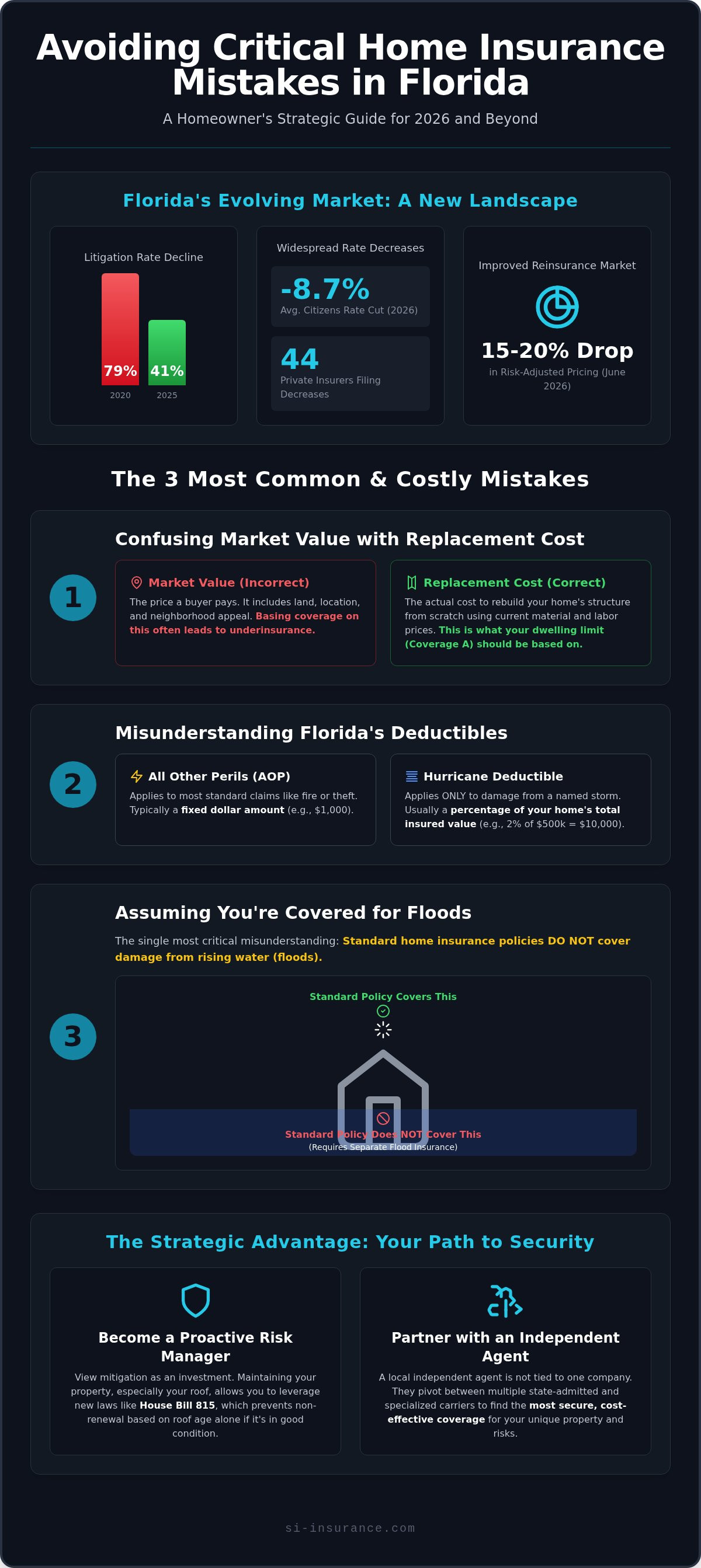
Florida's property insurance market has traditionally been a source of significant anxiety for homeowners, but by September 2026, we're seeing a distinct shift from the volatility of previous years toward a more structured, stabilized environment. This stabilization isn't a signal to relax; instead, it's a call to move away from being a passive policyholder. One of the most common home insurance mistakes in Florida is assuming that a policy renewal automatically guarantees adequate protection without a strategic review of current market conditions. With litigation rates falling from 79% of the national total in 2020 to just 41% in 2025, the market is opening up, yet the complexity of choosing the right carrier has only increased.
You've likely noticed that the conversation around premiums is changing. Regulators recently approved an average statewide rate decrease of 8.7% for Citizens Property Insurance for 2026 renewals, marking the first cut since 2015. Additionally, 44 private insurers have filed for rate decreases as of August 2026. While these numbers are encouraging, they shouldn't distract you from the reality that Florida remains a high-stakes environment. Success here requires you to transition into a proactive risk manager who understands how legislative shifts directly impact your personal bottom line.
Why Florida Insurance is Inherently Different
Florida doesn't follow the same rules as the rest of the country. Our premiums are heavily dictated by the Florida Hurricane Catastrophe Fund and the global reinsurance market, which saw risk-adjusted pricing drop by roughly 15% to 20% in June 2026. In regions like Broward County, High-Velocity Hurricane Zones (HVHZ) impose strict building codes that directly impact your eligibility and costs. While standard home insurance policies provide a foundational framework, they often fail to account for the specific geographic pressures and specialized legal environment of the Sunshine State. National templates simply don't have the nuance required to protect a coastal asset effectively.
The Shift Toward Proactive Risk Mitigation
You should view risk mitigation as a long-term capital investment rather than a recurring cost. The 2026 regulatory environment is finally favoring the prepared homeowner through initiatives like House Bill 815. Effective July 1, 2026, this law prohibits insurers from refusing to renew a policy based solely on the age of a roof, provided the roof is in good condition. This shift rewards those who maintain their properties rather than penalizing them for the passage of time.
Understanding the structure of your provider is also vital. In our market, admitted carriers are those strictly regulated by the state and backed by the Florida Insurance Guaranty Association, whereas non-admitted carriers provide specialized coverage for unique risks without that specific state backing. As an independent provider, Si Insurance Agency monitors these carrier shifts to ensure your coverage remains resilient. By focusing on these technical details now, you'll avoid the gaps that leave so many others vulnerable during a crisis.
Confusing Market Value with Replacement Cost
One of the most common home insurance mistakes in Florida is the fundamental misunderstanding of how a property should be valued for protection. Many homeowners look at their recent real estate appraisal or a Zillow estimate and assume that figure should dictate their coverage limits. This is a dangerous conflation. Market value represents the price a buyer is willing to pay for your land, your neighborhood's reputation, and your local school district. In contrast, your insurance policy's Coverage A, or dwelling limit, must focus exclusively on the cost to rebuild your physical structure from the ground up.
In the 2026 economic environment, the gap between market value and reconstruction cost has widened significantly. While real estate prices might fluctuate based on interest rates, the cost of specialized labor and raw materials in Florida continues to face upward pressure. If you're basing your coverage on a purchase price from several years ago, you're likely underinsured against the current reality of the construction market. Regularly updating your dwelling limit is a non-negotiable task for anyone seeking true financial security.
The Rebuilding Cost Calculation
Reconstructing a home in Florida involves unique regulatory and logistical hurdles. The Florida Building Code, particularly for properties in High-Velocity Hurricane Zones, requires specific impact-resistant materials and structural reinforcements that standard national templates often ignore. Many homeowners overlook "Law and Ordinance" coverage, which is a critical error. This provision pays for the additional costs required to bring an older home up to 2026 building codes during a repair. Without it, you could be personally responsible for thousands of dollars in mandated upgrades that your basic policy won't touch. To ensure your limits are accurate, it's wise to seek an independent professional evaluation rather than relying on generic online calculators.
The Dangers of the Coinsurance Clause
Falling short on your valuation doesn't just limit your payout in a total loss; it can trigger a "coinsurance penalty" on partial claims. Most policies require you to carry insurance for at least 80% of the home's actual replacement value. If you carry less than that, the insurer is entitled to reduce your claim payout proportionally. For instance, if your home would cost $500,000 to rebuild but you only insured it for $250,000, you've only met 50% of the requirement. If a storm causes $100,000 in damage, the carrier might only pay $50,000, leaving you to fund the rest. You can find more detail on these technical requirements in our guide to home insurance florida, which breaks down the math of modern risk management.
The Critical Misunderstanding of Florida Deductibles
Florida's insurance structure is unique because a single deductible rarely covers every scenario. One of the most common home insurance mistakes in Florida is assuming your out-of-pocket cost is a fixed, flat dollar amount across all claims. In reality, your policy likely splits financial responsibilities between All Other Perils (AOP) and a specific Hurricane deductible. While the AOP deductible usually applies to everyday events like fire, pipe bursts, or theft, the Hurricane deductible is a different financial instrument entirely, calculated using a method that often catches homeowners off guard during a crisis.
The primary point of confusion lies in the math. Unlike an auto insurance deductible that might be a simple $500, Florida hurricane deductibles are typically percentage-based. This percentage is calculated from your total dwelling limit (Coverage A), not the amount of the claim itself. If your home is insured for $500,000 and you have a 2% hurricane deductible, you're responsible for the first $10,000 of damage. If a storm causes $15,000 in damage, your insurer only pays $5,000. This structural nuance means that for smaller losses, you might find yourself self-insuring the entire repair despite having a "full" policy.
Hurricane vs. Windstorm vs. All Other Perils
The "trigger" for a hurricane deductible is strictly defined by Florida law. It only applies to damage caused by a storm that the National Hurricane Center has officially declared a hurricane; the clock starts when a watch or warning is issued and ends 72 hours after the warning is lifted. If a tropical storm or a severe thunderstorm damages your roof, you'll likely only pay your standard AOP deductible, which is often a flat $1,000 or $2,500. However, in certain coastal Broward County zones, windstorm coverage may be carved out as a separate requirement with its own specific triggers, necessitating a meticulous review of your policy's declarations page.
Strategic Deductible Selection
Choosing a higher deductible is a common way to lower your monthly premium, but it's a strategy that requires careful liquidity planning. A deductible is essentially a risk-sharing mechanism between you and the carrier; you're agreeing to self-insure the initial portion of a loss in exchange for a lower cost of entry. If you opt for a 5% or 10% deductible to save money today, you must ensure that those funds are readily available in a dedicated reserve account for catastrophe day.
For high-value homes, we often suggest "Hurricane Deductible Buy-Down" policies. These allow you to secure a lower percentage, such as a flat $1,000 or 1%, even if your primary carrier requires a 2% minimum. By consulting with an independent provider like Si Insurance Agency, you can evaluate whether the premium savings of a high deductible outweigh the potential financial shock of a massive out-of-pocket requirement after a storm.
Neglecting the "Invisible" Peril: Flood and Water Seepage
Perhaps the most pervasive and financially catastrophic of all common home insurance mistakes in Florida is the assumption that a standard policy provides protection against rising water. It's a nuance that many only discover when they're standing in an inch of water after a summer deluge. In the insurance industry, we distinguish strictly between "water damage" and "flood damage." It isn't a minor semantic difference; it's the difference between a fully funded restoration and a total out-of-pocket loss.
A standard policy typically covers water that falls from the sky through a hole in your roof or bursts from a pipe inside your walls, but it stops the moment water touches the ground outside. If that water enters your home from the ground up, it's classified as a flood. Without a separate policy, you're essentially self-insuring against one of the most frequent risks in the Sunshine State. This gap in coverage remains the primary reason many homeowners find themselves underinsured after a major storm event.
The Gap Between Home and Flood Policies
The "rising water" rule is the primary tool adjusters use to determine coverage eligibility. If the water enters your home from the ground, whether from a clogged storm drain or a nearby canal, your standard policy won't pay a cent for the repairs. As we move through 2026, the National Flood Insurance Program (NFIP) remains a staple, but a growing private market now offers more flexible limits and broader definitions of protection. These private options can often be tailored to include debris removal and loss of use, which the NFIP traditionally limits. This is particularly important for high-value items; you should review our guide on jewelry insurance florida to understand how your most precious assets are handled during a total loss event.
Endorsements That Save Your Interior
Beyond the rising tide, you must consider what happens when your internal systems fail. Skipping these specific endorsements is another of the common home insurance mistakes in Florida that we see during the rainy season. "Water Backup and Sump Pump Overflow" is an optional endorsement that every Florida home needs. This covers the damage caused when a sewer line or drain backs up into your home, a frequent occurrence in low-lying terrain during heavy rains. Since Florida homes rarely have basements, your entire living space is at risk when these systems fail. We recommend maintaining a comprehensive digital inventory of your property to streamline any future claims. A digital inventory isn't just a suggestion; it's a strategic necessity. By recording a video walkthrough and storing receipts in the cloud, you provide the undeniable proof adjusters need to settle a claim quickly. To ensure your home is protected from every angle, you can request a comprehensive flood risk assessment from our team today.
Partnering with a Local Independent Agent for Long-Term Security
The direct-to-consumer insurance model often appeals to those seeking a quick, transactional experience, but this approach is frequently where common home insurance mistakes in Florida begin. An algorithm or a remote call center representative cannot account for the street-level nuances of a Sunrise neighborhood or the specific wind-exposure risks of a property in Pompano Beach. In our volatile market, a generic policy is a liability. You need a partner who understands that your home isn't just a set of data points, but a complex asset requiring a tailored risk management strategy. Relying on a single-carrier agent limits your flexibility; when that carrier raises rates or exits the state, you're often left scrambling for coverage without an advocate.
Choosing an independent provider ensures that your interests always come first. At Si Insurance Agency, we act as meticulous consultants who scan the entire marketplace to find the most resilient coverage for your specific needs. We maintain relationships with a diversified portfolio of admitted and surplus carriers, allowing us to pivot your protection as market conditions shift. This level of foresight is what separates a standard policyholder from a sophisticated risk manager. By centralizing your protection, including your florida auto insurance and specialty vehicle needs, you create a cohesive shield that eliminates gaps and simplifies your financial life.
The Independent Agency Advantage
The primary benefit of an independent agency is the ability to provide objective, multi-carrier comparisons. We don't work for the insurance companies; we work for you. This distinction is vital when navigating the 2026 landscape, where carrier appetites for Florida risk change almost monthly. Because we're local to Broward County, we understand the building trends and local mitigation requirements that national companies often overlook. This proximity allows us to offer reassuring, expert guidance that builds intellectual confidence in your coverage choices.
Your 2026 Insurance Audit Checklist
To avoid the "coverage drift" that leaves many homeowners underinsured, we recommend a deliberate annual review of your entire insurance portfolio. Use this checklist as your strategic starting point:
Verify your roof's status: Confirm the age and material of your roof against the new 2026 carrier guidelines to ensure you're benefiting from recent legislative protections.
Update mitigation credits: Review your most recent windstorm mitigation inspection; if you've made upgrades to your windows or doors, a new inspection could significantly lower your costs.
Analyze valuation limits: Ensure your Coverage A limits reflect 2026 reconstruction costs rather than outdated real estate appraisals.
Market comparison: Consult with an independent expert to compare your current renewal against new private market alternatives that have entered Florida this year.
Don't leave your most valuable asset to chance in a complex market. Contact Si Insurance Agency for a comprehensive policy review today and secure the professional advocacy you deserve.
Securing Your Financial Future in a Stabilized Florida Market
The transition from a passive policyholder to a proactive risk manager is the most effective way to protect your property and your peace of mind. You now understand that avoiding common home insurance mistakes in Florida doesn't just involve paying a premium; it's a technical discipline that requires a firm grasp of replacement costs, deductible math, and the specific exclusions found in standard policies. By correctly valuing your structure and securing separate flood protection, you're ensuring that your recovery after a storm is fully funded rather than a personal financial burden.
As an independent provider with offices in Sunrise and Pompano Beach, we offer more than just a quote. We provide the sophisticated risk management and multi-carrier access necessary to navigate this high-stakes landscape with absolute confidence. Our expertise allows us to engineer personalized solutions that align with your long-term security goals, ensuring your coverage remains resilient as the market evolves. Secure Your Florida Home with a Strategic Policy Review from Si Insurance Agency. With the right partner by your side, you can face the future with the certainty that your greatest investment is meticulously protected.
Frequently Asked Questions
Is flood insurance mandatory in Florida if I am not in a high-risk zone?
While not federally mandated for properties outside Special Flood Hazard Areas, flood insurance is increasingly required by private lenders and state-backed entities like Citizens Property Insurance. Even if your zone is considered low risk, Florida's flat topography means nearly any area can flood during heavy rain. Avoiding this coverage is one of the most common home insurance mistakes in Florida since standard policies exclude rising water.
What is the "roof age rule" for Florida homeowners insurance in 2026?
Under House Bill 815, which became effective July 1, 2026, Florida insurers are prohibited from refusing to issue or renew a policy based solely on the age of a roof. If the roof has at least five years of useful life remaining, as determined by a professional inspection, the carrier must consider its actual condition rather than its chronological age. This legislation provides significant relief for owners of well-maintained older properties.
How does a hurricane deductible differ from a standard deductible?
A hurricane deductible is a specific financial responsibility triggered only by damage from a named hurricane, whereas your standard All Other Perils deductible applies to everyday claims like fire or theft. Most hurricane deductibles in Florida are calculated as a percentage of your total dwelling limit, such as 2% or 5%, rather than a flat dollar amount. This structural difference often results in significantly higher out-of-pocket costs after a major storm event.
Will my Florida home insurance cover my jewelry and high-value collectibles?
Standard homeowners policies provide very limited coverage for high-value items, often capping payouts for jewelry or collectibles at $2,500 total. To protect significant assets, you should add a scheduled personal property endorsement or a separate jewelry insurance policy. This ensures your valuables are covered for their full appraised value without the constraints of your standard policy's sub-limits or high hurricane deductibles.
What is windstorm mitigation, and how does it lower my premium?
Windstorm mitigation involves specific construction features that enhance a home's ability to withstand high-velocity winds, such as impact-resistant windows, roof-to-wall attachments, and water-shedding barriers. Florida law requires insurers to provide premium credits for these features. By providing a certified mitigation inspection report to your agent, you can often secure substantial discounts on the wind portion of your premium, reflecting your property's reduced risk profile.
Can I bundle home and auto insurance in Florida to save money?
Yes, bundling your home and auto insurance remains a highly effective strategy for reducing your overall insurance expenditure. Many carriers offer multi-policy discounts that can lower premiums on both your residence and your vehicles. Working with an independent provider like Si Insurance Agency allows you to explore these bundling opportunities across multiple carriers, ensuring you receive the most competitive combined rate available in the current 2026 Florida market.
What happens if my insurance carrier leaves the Florida market?
Most Florida policies include a specific, limited sub-limit for mold remediation, typically ranging from $10,000 to $50,000. This coverage generally only applies if the mold is a direct result of a covered peril, such as a sudden pipe burst. Damage caused by long-term humidity or poor ventilation is typically excluded. Understanding these limits helps you avoid the common home insurance mistakes in Florida that lead to denied water damage claims.
Comments