


Florida Landlord Insurance: 2026 Strategic Guide
Updated: Sep 19
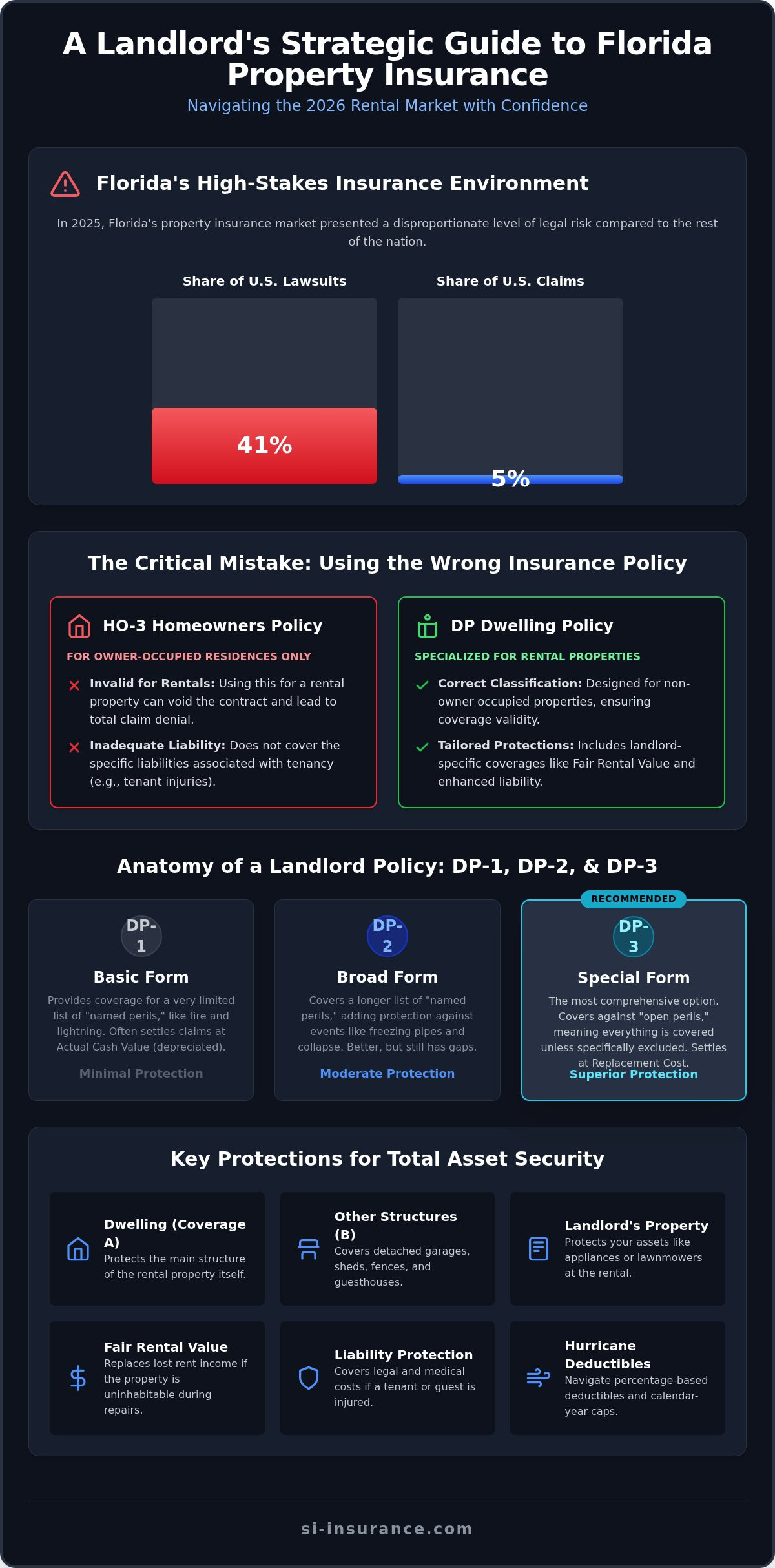
Did you know that in 2025, Florida was the epicenter for nearly 41% of all property insurance lawsuits in the United States, despite accounting for only 5% of total claims? For sophisticated property owners, these figures represent more than just a statistical anomaly; they reflect a high-stakes environment where a single oversight can jeopardize years of capital appreciation. You're likely feeling the pressure of rising premiums and the technical complexity of distinguishing between standard homeowners coverage and the specialized requirements for landlord insurance florida. It's a landscape that demands intellectual confidence and a meticulously calculated approach to asset preservation.
This strategic guide provides the specialized expertise necessary to navigate the complexities of the 2026 rental market, ensuring your investment remains resilient against both natural disasters and civil legal challenges. We'll examine the structural advantages of DP-3 policies, the critical importance of hurricane risk mitigation, and the latest legislative reforms impacting your liability profile. By aligning your coverage with these professional standards, you can secure total asset protection and maintain the continuity of your rental income, even when faced with the most challenging environmental or legal variables. The objective of this analysis is to transition your insurance from a mere expense into a robust risk-management strategy.
Table of Contents
Beyond Homeowners: Why Your Florida Rental Needs Specialized Landlord Insurance
Navigating Policy Structures: Comparing DP-1, DP-2, and DP-3 Coverage
Safeguarding Your Revenue: The Role of Fair Rental Value and Liability Protection
Managing Florida-Specific Risks: Hurricane Deductibles and Property Mitigation
Securing Your Investment: Why a Local Independent Agency Offers Superior Protection
Beyond Homeowners: Why Your Florida Rental Needs Specialized Landlord Insurance
The transition from a primary residence to a revenue-generating asset necessitates a fundamental recalibration of your risk-management strategy. Many investors mistakenly assume that a standard homeowners policy, typically an HO-3 form, provides sufficient protection for a property occupied by tenants. This assumption is a significant oversight that can lead to total claim denial during a catastrophic event. Because insurance carriers calculate premiums based on the specific risks associated with owner-occupancy, securing specialized landlord insurance florida is a requisite step for maintaining the integrity of your investment portfolio.
The acquisition of landlord insurance florida acts as a sophisticated barrier between your personal financial stability and the inherent liabilities of the rental market. Standard policies are designed for the predictable patterns of a single family living in their own home. They don't account for the increased wear, higher liability exposure, or the potential for lost revenue that occurs when a property is managed as a business. To facilitate a deeper understanding of these structural distinctions, we suggest reviewing this technical overview:
The Risks of Improper Classification
Insurance contracts are built upon occupancy clauses that define exactly who is permitted to reside in the dwelling. When you move a tenant into a property covered by a traditional homeowners policy, you've fundamentally altered the underwriting parameters of that contract. Carriers view non-owner occupied properties as higher risk because tenants generally don't maintain the same level of daily vigilance as an owner. If a fire or water leak occurs and the carrier discovers the property was being rented without their knowledge, they'll likely rescind the policy and deny the claim entirely. A Dwelling Fire policy is the industry standard for non-owner occupied properties, providing the specific legal and financial framework required for rental activities.
Coverage Components: What a Landlord Policy Actually Protects
A comprehensive policy engineered for the Florida market provides a multi-layered defense for your capital. It's designed to address the specific physical and operational needs of a rental unit. As an independent partner, Si Insurance Agency provides the specialized oversight needed to ensure these components are correctly valued. Key protections include:
Dwelling Coverage (Coverage A): This protects the primary residential structure against covered perils, such as fire, wind, or lightning, based on its replacement cost.
Other Structures (Coverage B): This extends protection to detached elements on the premises, including fences, sheds, detached garages, or guest houses.
Personal Property: While it doesn't cover tenant belongings, it protects your assets used to service the rental, such as lawnmowers, appliances, or lobby furniture in multi-unit buildings.
Navigating Policy Structures: Comparing DP-1, DP-2, and DP-3 Coverage
The architecture of a landlord insurance florida policy is defined by the Dwelling Property (DP) hierarchy, a standardized system that dictates the scope of coverage and the methodology of loss settlement. For the sophisticated investor, understanding these distinctions is critical because they determine the net recovery after a catastrophic event. The choice between a named peril and an open peril policy isn't merely a matter of premium cost; it's a strategic decision regarding the level of risk retention you're willing to accept. When evaluating Florida-Specific Risks, the structure of your policy form becomes the primary determinant of your financial resilience.
DP-1: The Basic Choice for Older Investments
DP-1 policies operate on a strictly named peril basis, meaning the contract only provides indemnity for specific events explicitly listed in the policy, such as fire, lightning, or internal explosions. These policies typically settle claims on an Actual Cash Value (ACV) basis, which deducts depreciation from the final payout. While this structure offers the most limited protection, it's often the only viable solution for properties with older systems or roofs exceeding 15 years in age. In certain high-exposure Florida zip codes where underwriting criteria are exceptionally stringent, the DP-1 form serves as a necessary, albeit basic, safety net for distressed or aging assets.
DP-3: The Gold Standard for Comprehensive Protection
As the preferred choice for modern Florida rentals, the DP-3 form utilizes an open peril approach for the dwelling structure. This means the policy covers all causes of loss unless they're specifically excluded in the contract language. This shift in the burden of proof provides a superior level of security for the property owner. More importantly, DP-3 policies generally provide Replacement Cost Value (RCV) settlements. This ensures you can restore the property to its original condition without the financial burden of depreciation, which is essential for maintaining the long-term yield of your investment. For investors utilizing leverage through private money brokers like JGL Capital LLC, the RCV settlement of a DP-3 policy is often a non-negotiable requirement for protecting the lender's interest.
Selecting the correct policy form requires a meticulous analysis of your property's specific profile and your overall risk tolerance. Consulting with an expert at Si Insurance Agency can help you determine which structure aligns with your long-term security goals while ensuring you remain compliant with all lender requirements.
Safeguarding Your Revenue: The Role of Fair Rental Value and Liability Protection
Beyond the physical structure, the financial viability of a rental investment depends on the stability of its cash flow. When a covered peril renders a property uninhabitable, the cessation of rental income can be as damaging as the physical destruction itself. This is why landlord insurance florida includes specialized provisions to bridge the gap between disaster and restoration. It transforms a potential insolvency event into a manageable operational pause. By prioritizing income protection, you're not just insuring a building; you're securing the underlying yield of your capital.
Fair Rental Value: Protecting Your Cash Flow
Fair Rental Value (FRV) provides reimbursement for the lost gross rental income during the timeframe required to repair or rebuild the dwelling after a covered loss. There's a critical distinction here that many investors overlook. While a homeowners policy offers 'Loss of Use' to cover the owner's additional living expenses, FRV focuses exclusively on the investor's revenue stream. For landlords carrying mortgages or short term investment property loans on their rental properties, this coverage is essential to ensure that debt obligations are satisfied even when the property is vacant for repairs. Fair Rental Value ensures your ROI remains intact after a disaster by providing a continuous source of capital during the restoration period.
Florida's legal climate remains notoriously complex, making high-limit liability protection a non-negotiable component of a sophisticated risk-management strategy. A comprehensive policy provides for professional legal defense costs, which are often covered in addition to the policy's liability limits. This ensures that the expenses of a legal dispute don't erode your primary coverage. Common liability scenarios in the Florida market include:
Premises Liability: Slip-and-fall incidents on pool decks or uneven walkways.
Structural Failures: Injuries resulting from aging balconies or stairwells.
Tenant Disputes: Allegations of wrongful entry or privacy violations.
Proactive risk management also utilizes 'Medical Payments to Others' coverage. This provision allows for the immediate settlement of minor medical expenses regardless of fault, often acting as a strategic tool to prevent larger, more contentious liability lawsuits. For owners of high-value assets, integrating your primary policy with a personal umbrella insurance provides an essential secondary layer of security. This layered approach, coordinated by the experts at Si Insurance Agency, ensures that your personal wealth remains insulated from the inherent risks of property management.
Managing Florida-Specific Risks: Hurricane Deductibles and Property Mitigation
The stabilization of the 2026 Florida insurance market, characterized by the entry of 21 new residential property insurers, has introduced a renewed appetite for risk among private carriers. This shift allows sophisticated investors to move away from state-backed alternatives and toward more robust, private-market solutions. However, securing the most advantageous terms for landlord insurance florida still requires a meticulous understanding of windstorm-specific variables. In this environment, your deductible structure and mitigation profile are the primary levers for controlling long-term carrying costs and ensuring investment continuity.
Understanding Your Hurricane Deductible
Unlike standard flat-fee deductibles used for fire or theft, Florida hurricane deductibles are typically structured as a percentage of the dwelling's total insured value, often ranging from 2% to 10%. For a property with a $500,000 replacement cost, a 2% deductible necessitates a $10,000 out-of-pocket commitment before carrier indemnity begins. It's also vital to recognize the function of the Calendar Year Hurricane Deductible. This statutory provision ensures that once the hurricane deductible is satisfied during an initial event, any subsequent windstorm claims within the same calendar year revert to the lower All-Other-Perils (AOP) deductible. Aligning these financial parameters with your liquidity requirements is a core component of the home insurance Florida guidelines for comprehensive windstorm protection.
Mitigation Strategies for Lower Premiums
Carrier appetite in 2026 remains heavily contingent upon the physical hardening of the asset. Roof age is the most critical underwriting variable; many carriers now refuse to issue new policies for structures with roofs exceeding 15 years in age. Implementing secondary water resistance (SWR) and installing impact-resistant windows or doors can yield significant premium reductions, with some industry professionals reporting savings of 20% to 40% for fully mitigated properties. These enhancements are verified through a formal Wind Mitigation Inspection, which acts as a technical certification of the property's resilience. By investing in these structural improvements, you're not just protecting the physical asset; you're engineering a more favorable risk profile that attracts elite carriers.
To optimize your property's risk profile and secure competitive terms in the current market, consult with a specialist at Si Insurance Agency for a comprehensive portfolio review.
Securing Your Investment: Why a Local Independent Agency Offers Superior Protection
The inherent complexity of managing property in the Sunshine State necessitates a partnership with a firm that possesses both global foresight and localized precision. While generic online platforms offer ease of use, they often lack the analytical depth required to engineer a comprehensive risk-management strategy for sophisticated real estate portfolios. The independent agency model provides a distinct structural advantage by facilitating access to a diverse network of Florida-admitted carriers. This allows for a meticulous selection process where policy language is scrutinized to ensure it meets the specific demands of your investment goals.
Si Insurance Agency acts as a specialized consultant, moving beyond off-the-shelf insurance products to deliver personalized policy engineering. We understand that a high-value rental in Pompano Beach faces different environmental and liability stressors than a multi-unit complex in Sunrise. By leveraging our deep roots in Broward County and our technical mastery of the state's regulatory environment, we provide the intellectual confidence you need to scale your holdings. Securing the right landlord insurance florida is a calculated step toward total asset protection, shielding your personal wealth from the variables of the rental market.
The Independent Agency Advantage
The primary benefit of our independent structure is the ability to compare multiple, high-quality quotes to find the optimal balance of coverage and cost. We don't just facilitate a transaction; we provide ongoing policy management and annual reviews to ensure your protection remains airtight as market conditions evolve. In a climate where carrier appetite for windstorm risk can shift rapidly, our role is to serve as your protective guardian. We monitor the stability of admitted carriers and the impact of legislative reforms so that your portfolio remains resilient against both natural and legal threats.
Next Steps for Florida Landlords
Initiating a professional consultation requires a few key pieces of documentation to ensure an accurate risk profile. You should prepare your current rent rolls, any recent wind mitigation inspections, and specific details regarding property updates, such as roof age or plumbing modernization. The process of transitioning from a homeowners policy to a dedicated landlord policy is a critical compliance step that should be handled with precision to avoid coverage gaps. We invite you to consult with Si Insurance Agency for a strategic review of your rental portfolio and take the first step toward a more secure financial future.
Mastering the Future of Your Florida Real Estate Portfolio
Securing a robust financial future in the 2026 market requires more than just basic coverage; it demands a sophisticated risk-management architecture tailored to the unique stressors of the region. By prioritizing the comprehensive open-perils protection of a DP-3 policy and ensuring the continuity of your cash flow through Fair Rental Value provisions, you insulate your capital from both environmental and legal volatility. The strategic implementation of wind mitigation measures further refines your risk profile, attracting top-tier carriers and optimizing your long-term yield. It's clear that a meticulous approach to property hardening is no longer optional for the serious investor.
Navigating the complexities of landlord insurance florida is a collaborative process that benefits from the specialized expertise of an independent partner. Si Insurance Agency acts as a protective guardian for your assets, leveraging a diverse network of admitted carriers and deep localized knowledge of the Broward County real estate landscape. We invite you to take a proactive step toward total asset preservation by refining your coverage strategy today.
Request a Strategic Landlord Insurance Consultation to align your portfolio with elite risk-management standards and move forward with absolute intellectual confidence. Your investment's resilience is the foundation of your enduring success.
Frequently Asked Questions
Is landlord insurance required by law in Florida?
Florida law does not mandate landlord insurance; however, mortgage lenders invariably require it as a condition of the loan to protect their financial interest. Even for properties owned outright, operating without specialized coverage exposes the investor to total capital loss from fire or liability claims. It's a critical component of professional risk management for any rental asset located within the state's volatile environmental landscape.
What is the difference between a DP-1 and a DP-3 policy for Florida rentals?
The primary distinction lies in the scope of covered perils and the methodology of loss settlement. A DP-1 policy is a basic form that covers specifically named perils and typically settles claims on an Actual Cash Value basis. Conversely, a DP-3 policy offers special open perils coverage for the structure and provides Replacement Cost Value settlements. For most modern investments, the DP-3 form is the preferred standard for comprehensive security.
Does landlord insurance cover tenant-owned property?
No, landlord insurance florida policies are designed to protect the dwelling and the landlord's liability; they don't extend coverage to the tenant's personal belongings. To ensure comprehensive protection for all parties, landlords should require tenants to maintain their own renter insurance. This clear separation of coverage prevents disputes and ensures that the property owner's policy is not burdened by claims for tenant-owned furniture or electronics.
How much liability coverage should a Florida landlord carry?
While specific requirements vary based on the value of the underlying asset, professional investors often secure limits between $300,000 and $1,000,000 per occurrence. Given the litigious nature of the Florida market, many landlords supplement these primary limits with a personal umbrella insurance policy. This layered approach provides an essential buffer against high-value lawsuits involving tenant injuries or significant property damage occurring on the premises.
Does landlord insurance cover flood damage in Florida?
Standard landlord policies don't include coverage for rising surface water or storm surges. Because Florida is highly susceptible to these events, investors must secure a separate flood insurance policy through the National Flood Insurance Program or a private carrier. Relying solely on a dwelling policy leaves the asset vulnerable to one of the most common and expensive causes of property damage in the state.
Can I bundle my landlord insurance with my personal auto or home policies?
Yes, many carriers allow you to consolidate multiple lines of coverage, which can lead to more favorable underwriting terms and multi-policy discounts. As an independent agency, Si Insurance Agency analyzes your entire portfolio to identify opportunities for strategic bundling. This approach often simplifies the administrative burden of policy management while ensuring that your auto, home, and rental assets are protected by a unified risk strategy.
What happens to my rental income if a hurricane makes the property uninhabitable?
If a covered hurricane event renders your property uninhabitable, the Fair Rental Value provision in your policy replaces the lost gross rental income. This coverage is essential for maintaining the continuity of your investment yield while the structure undergoes necessary repairs. It ensures that your mortgage obligations and operational expenses are met, preventing a temporary physical disaster from escalating into a long-term financial crisis.
How do hurricane deductibles work for landlord insurance in Florida?
Hurricane deductibles in Florida are unique because they're typically calculated as a percentage of the dwelling's insured value, such as 2% or 5%, rather than a flat dollar amount. These deductibles apply on a calendar year basis. Once you've satisfied the deductible during a single storm event, any subsequent hurricane claims within that same year are subject to the lower, standard all-perils deductible.
Comments