


General Liability Insurance for Contractors in Broward County: A 2026 Strategic Guide
In the high-stakes environment of South Florida construction, your insurance policy is much more than a box to check for the building department; it's the definitive proof of your firm's stability and professional caliber. You likely understand the frustration of stalling a project because of a rejected Certificate of Insurance or the lingering anxiety that a single site accident could jeopardize your business assets. Securing the right general liability insurance for contractors Broward County mandates doesn't have to be a source of confusion between state and local rules. We'll show you how to master these specific requirements so your paperwork is as solid as your craftsmanship.
This strategic guide clarifies the 2026 state and county thresholds, including the recent April 29, 2026, updates to the county's verification system. You'll learn how to navigate the permitting process with ease and leverage your coverage to gain a competitive advantage during the bidding phase. By the end of this article, you'll have a clear roadmap to maintaining compliance while protecting your company against the unique risks of the South Florida market.
Key Takeaways
Learn to distinguish between state DBPR requirements and the specific mandates set by the Broward County Central Examining Board so your local registration stays active.
Find out how to align your general liability insurance for contractors Broward County with the ePermits system to avoid the documentation errors that often stall project starts.
Understand why minimum limits might leave your business exposed in South Florida and how higher coverage can help you win larger, more profitable contracts.
Get a clear look at how a properly structured Certificate of Insurance acts as a fast-pass through the local permitting process.
Discover the long-term value of working with a local specialist who understands our unique regional risks better than any automated online platform.
Table of Contents
Navigating General Liability Insurance for Broward County Contractors
Florida State vs. Broward County: Understanding Local Insurance Mandates
Strategic Coverage: Beyond the Minimum General Liability Requirements
The Permitting Process: How Your Insurance Impacts Broward County Projects
Securing Your Legacy: Partnering with a Local Broward Insurance Specialist
Navigating General Liability Insurance for Broward County Contractors
Think of your insurance policy as the bedrock of your business structure. While many view it as a hurdle for the building department, elite contractors understand that general liability is actually a foundational shield for their professional assets. In a region as active as South Florida, the distinction between simply meeting the minimum law and truly protecting your future is what separates a temporary operation from a legacy firm. This is especially true in Sunrise and Pompano Beach, where homeowners look for signs of stability before signing a contract.
South Florida's litigious environment is legendary, making standard coverage a non-negotiable business expense rather than an optional luxury. When you secure Commercial General Liability (CGL), you're investing in a sophisticated risk mitigation strategy. This coverage ensures that a single site accident doesn't dismantle years of hard work. By carrying robust general liability insurance for contractors Broward County residents trust, you signal that you're a calculated partner who values their property as much as your own reputation.
To better understand how these rates are calculated and what to expect during a policy review, watch this helpful video:
The Core Components of a Contractor Liability Policy
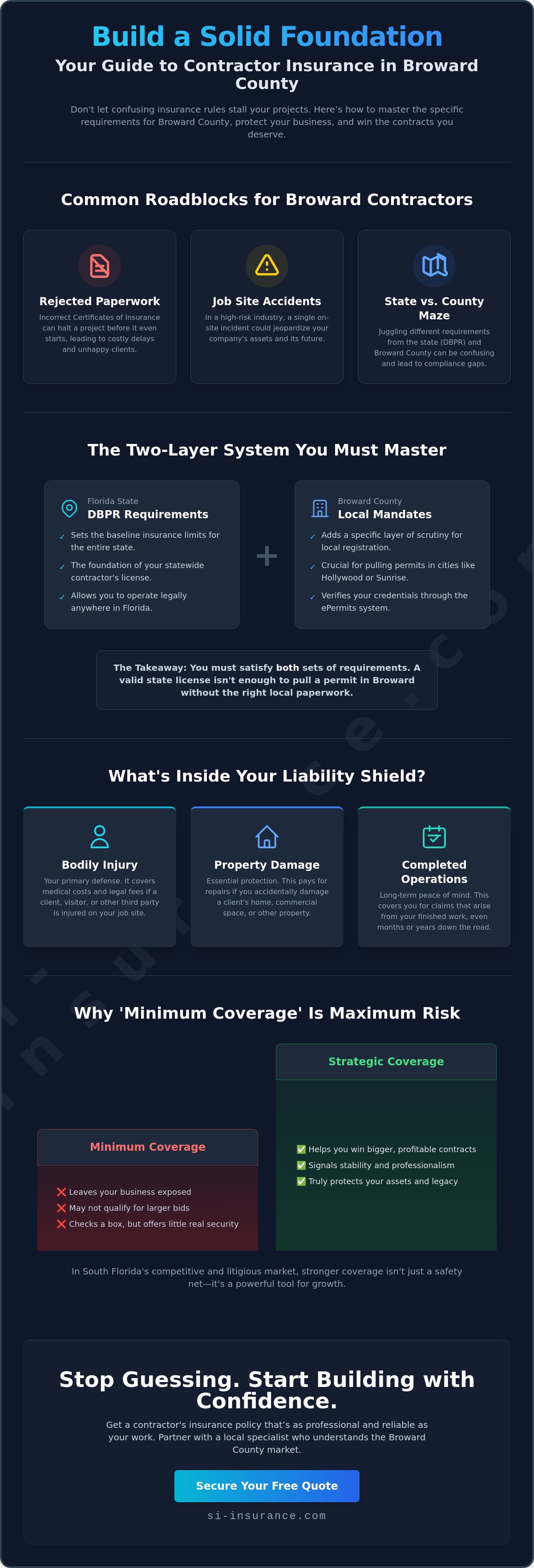
A comprehensive policy isn't a singular block of protection; it's a collection of specific coverages designed for different scenarios. Bodily injury coverage is your primary defense against third-party accidents on your job site, covering medical costs or legal fees if a visitor is hurt. Property damage addresses accidental harm to a client's home or commercial space, which is critical in high-value coastal neighborhoods. Finally, products-completed operations coverage is vital because it protects you long after you've packed up your tools, covering claims that arise from work you finished months or even years ago.
Why Local Expertise Matters for Broward Contractors
Florida's risk profile is unique, particularly in coastal construction zones where wind, salt air, and specific building codes create complex liabilities. Working with an agency that understands these regional nuances is essential for your long-term growth. Local specialists help you navigate the specific claims common to our area, ensuring your policy isn't just a generic template. When you partner with experts at SI Insurance, you're gaining a guardian who understands the Broward County landscape. This localized approach ensures your coverage evolves alongside your business, providing the intellectual confidence you need to bid on the county's most prestigious projects.
Florida State vs. Broward County: Understanding Local Insurance Mandates
Operating a construction firm in South Florida requires balancing two distinct sets of rules. On one side, the Florida Department of Business and Professional Regulation (DBPR) sets the baseline for the entire state. On the other, the Broward County Central Examining Board adds its own layer of scrutiny for local registration. This dual-registration system ensures that contractors meet rigorous standards for permitting and public safety. Managing general liability insurance for contractors Broward County mandates means you're constantly validating your credentials with both Tallahassee and Fort Lauderdale. It's a complex dance, but getting it right is the only way to keep your crews on the job site.
The intersection of these mandates often creates confusion during the permitting phase. While your state license allows you to work across Florida, you still need a local municipal business tax receipt and county-level insurance verification to pull permits in cities like Fort Lauderdale or Hollywood. If these two entities aren't in sync, your project can stall before the first shovel hits the ground. Aligning your coverage with both state and local expectations isn't just about following the law; it's about removing the bureaucratic friction that slows down your growth.
Broward County Central Examining Board Requirements
If you're a county-registered contractor, your local standing depends on meeting specific Broward County insurance requirements. For specialty trades like plumbing, electrical, and HVAC, the board generally mandates at least $300,000 per occurrence in general liability coverage. However, for significant projects or developer agreements, these limits often jump to a commercial standard of $1,000,000 per occurrence and $2,000,000 in the aggregate. The county recently updated its online verification system on April 29, 2026, making it even more critical for your Certificate of Insurance (COI) to be perfectly aligned with their digital records. You must also ensure that Broward County is explicitly named as a certificate holder, a small administrative detail that frequently causes permit denials.
State-Level Compliance for Florida General Contractors
State-certified contractors face a different set of hurdles through the DBPR. To maintain an active license, general and building contractors must carry a minimum of $300,000 in public liability and $50,000 in property damage insurance. Specialty contractors have a lower floor of $100,000 and $25,000. If your policy lapses for even a single day, the state can move your license to an inactive status. This effectively halts your legal ability to work anywhere in Florida. You can verify your current status through the state's online portal, but the real strategy lies in ensuring your renewals are processed and filed well before the expiration date. If you're looking to simplify this process and ensure you never miss a deadline, it might be time to consult with a specialist who understands the intricacies of general liability insurance for contractors Broward County requires.
Strategic Coverage: Beyond the Minimum General Liability Requirements
Compliance is a starting point, not the finish line. While Florida's state contractor insurance law establishes the legal baseline for your operation, these figures often fall short when faced with the actual costs of South Florida litigation. Securing the bare minimum coverage might satisfy the clerk at the permit desk, but it rarely satisfies the reality of a modern legal challenge. Investing in robust general liability insurance for contractors Broward County firms need is less about checking a box and more about securing your company's legacy against catastrophic financial loss.
Your policy limits also dictate the ceiling of your growth. High-value residential projects and major commercial contracts in Fort Lauderdale or Weston frequently require a $1,000,000 per occurrence limit as a prerequisite for bidding. If your coverage is capped at the state minimum, you're effectively locking yourself out of the most profitable opportunities in the region. Think of higher limits as a strategic asset that validates your firm's capacity to handle complex, high-stakes work. To truly protect your interests, you should consider how your primary policy interacts with a Business Owners Policy (BOP) or a personal umbrella insurance layer, especially when working on luxury waterfront estates.
Inland Marine: Protecting Your Tools and Equipment
It's a common misconception that general liability covers everything related to your business. In reality, GL is designed for third-party claims; it doesn't protect your own physical assets. If your specialized tools are stolen from a Sunrise job site or damaged while in transit to a Pompano Beach project, a standard liability policy won't provide a cent for replacement. This is where Inland Marine coverage, often called a "tools and equipment floater," becomes essential. It ensures your mobile assets are protected wherever they go, preventing a single theft from halting your entire production schedule.
Professional Liability and Pollution Coverage
As more Broward contractors move toward design-build models, the line between "doing the work" and "providing the plan" begins to blur. Standard general liability insurance for contractors Broward County professionals carry typically excludes errors in professional judgment or design flaws. Adding professional liability ensures you're covered if a client alleges that your advice led to a financial loss. Similarly, pollution coverage is no longer just for industrial firms. In Florida's sensitive environmental landscape, an accidental spill or the discovery of mold during a renovation can lead to massive cleanup costs. Specialized endorsements can close these gaps, providing a holistic shield that simple, one-size-fits-all policies simply can't offer.
The Permitting Process: How Your Insurance Impacts Broward County Projects
Pulling a permit in cities like Fort Lauderdale or Hollywood isn't just about your architectural plans; it's about the digital handshake between your insurance carrier and the Broward County ePermits system. If your general liability insurance for contractors Broward County documentation contains even a minor clerical error, the system will flag it, and your project will sit in a queue while your crew waits. A proactive strategy involves ensuring your Certificate of Insurance (COI) is uploaded and verified before you ever submit the permit application. This foresight prevents the common bottlenecks that plague less experienced firms and ensures your mobilization dates remain firm.
The speed at which you can start a project often depends on the precision of your administrative filings. Building departments are increasingly automated, meaning they don't have the latitude to "overlook" a missing endorsement or an expired policy date. When your insurance is properly structured, it acts as a lubricant for the entire regulatory process, allowing you to move from bidding to breaking ground with minimal friction. This efficiency is a hallmark of the most successful contracting firms in South Florida.
Mastering the Certificate of Insurance (COI)
Building departments in Broward County look for very specific legal phrasing on your COI. They generally require you to list the municipality or the county itself as a "Certificate Holder" and often demand "Additional Insured" status on a primary and non-contributory basis. This isn't just bureaucratic red tape; it's a critical risk transfer mechanism that protects the project owner and the city from your operational liabilities. Streamlining this digital submission process requires a broker who understands how to format these documents for immediate acceptance by local reviewers, preventing the "rejected" status that can delay a project for weeks.
Managing Sub-Contractor Risk
Your primary policy is only as strong as the weakest link in your chain of sub-contractors. If a sub-contractor is uninsured or underinsured, you face the danger of "vicarious liability," where their mistakes become your financial and legal burden. Best practices for local firms include maintaining a rigorous verification process for every team member in the field. You should collect and verify COIs before any work begins, ensuring their limits match your own contractual obligations and that their policies are currently active. For a broader perspective on protecting your enterprise, you can explore our Business Insurance in Broward County: A Strategic Guide.
Managing these moving parts requires a sophisticated partner who can act as a bridge between your operations and the county's regulatory demands. By securing a policy that's pre-vetted for local standards, you ensure that your business remains agile and ready for the next high-value project. If you're ready to optimize your paperwork for faster approvals, consult with our commercial risk specialists to review your current filings and sub-contractor protocols.
Securing Your Legacy: Partnering with a Local Broward Insurance Specialist
While digital platforms promise a quote in minutes, they often lack the technical depth required to handle the intricate realities of a South Florida job site. Choosing general liability insurance for contractors Broward County firms rely on shouldn't be a transactional click; it should be a deliberate act of engineering a business defense. When you're managing a complex project in Sunrise or Pompano Beach, you need more than a generic PDF. You need a partner who understands that a claim in our coastal environment carries different weight than one in a landlocked state. Automated systems don't account for the nuances of local litigation or the specific phrasing required by Broward's Central Examining Board, leaving your firm vulnerable to administrative rejections or uncovered losses.
Transitioning from simply buying a policy to constructing a strategic defense requires a shift in perspective. It's about recognizing that your insurance is a living component of your firm's infrastructure. A local presence ensures that when a crisis occurs, you aren't navigating a call center hierarchy. Instead, you're engaging with a seasoned consultant who understands the local courts, the regional weather risks, and the high expectations of South Florida's elite clientele. This localized expertise provides a superior claims experience that is both steady and reassuring, allowing you to focus on your craftsmanship while we manage the complexities of risk mitigation.
The SI Insurance Advantage: Expertise and Empathy
SI Insurance approaches risk management through a lens of meticulous analysis and professional empathy. We don't just facilitate transactions; we align your insurance structure with your firm's specific organizational goals. Our methodology involves a deep dive into your operational history and future aspirations to ensure your coverage is never a bottleneck for growth. By providing direct access to seasoned consultants who live and work in the Broward County market, we offer a level of intellectual confidence that an algorithm simply can't replicate. It's a human-centric approach to specialized risk management that treats your business as the unique entity it is, rather than a data point in a national pool.
Next Steps: Evaluating Your Current Risk Profile
The first step toward absolute security is a comprehensive evaluation of your current risk profile. Many contractors discover that their existing policies have silent gaps that only become visible during a catastrophic event or a rigorous permit audit. A local partner acts as a protective guardian for your business, identifying these vulnerabilities before they manifest as financial liabilities. If you're ready to move beyond the surface-level compliance of the past and secure a precisely engineered plan, our team is prepared to assist. You can Consult with SI Insurance for your Broward County Contractor needs to begin a thorough review of your current protections and ensure your legacy remains untarnished.
Building a Resilient Future for Your Contracting Firm
Managing a contracting business in South Florida requires balancing high-level craftsmanship with complex regulatory demands. You've seen how the distinction between state minimums and the specific requirements of the Broward County Central Examining Board can make or break your permitting timeline. By viewing your coverage as a strategic asset rather than a bureaucratic hurdle, you position your firm to win more prestigious contracts and operate with absolute intellectual confidence.
Our approach combines meticulous risk analysis for South Florida trades with deep local expertise in the Broward County permitting landscape. We move beyond automated checklists to provide a sophisticated, human-centric advisory service that treats your legacy as its own. Securing the right general liability insurance for contractors Broward County mandates is the first step in engineering a defense that grows alongside your organization.
We look forward to helping you build a more secure and prosperous future for your business.
Frequently Asked Questions
Is general liability insurance required for contractors in Broward County?
Yes, general liability insurance is a mandatory prerequisite for obtaining local registration and pulling permits through the Broward County Central Examining Board. You must provide proof of active coverage that meets or exceeds both state and county minimums to maintain your standing as a licensed professional. Without this verification, the building department will not authorize construction activities on any project within the county's jurisdiction.
How much general liability insurance does a contractor need in Florida?
At the state level, general and building contractors are required to maintain $300,000 in liability and $50,000 in property damage coverage. Specialty contractors must carry at least $100,000 in liability and $25,000 in property damage. It's important to recognize that these are the absolute minimums; many Broward County projects and commercial agreements will demand significantly higher limits to mitigate the actual costs of South Florida litigation.
Does general liability insurance cover my tools and equipment?
No, standard general liability insurance is specifically designed to address third-party claims of bodily injury or property damage, not your own physical assets. To protect your specialized tools from theft or damage at a job site, you'll need to secure an Inland Marine policy or a tools and equipment floater. This additional layer ensures your business can recover quickly if your essential gear is lost or stolen during a project.
What is a Certificate of Insurance (COI), and why do I need one for Broward County permits?
A COI is a formal document that summarizes your current insurance policy details and serves as verified proof of coverage for regulators and clients. The Broward County ePermits system requires this document to be on file and up to date before any permit is issued. It ensures that your firm has the financial backing to handle potential accidents, protecting both the municipality and the property owner from liability.
Can I get general liability insurance if I work as an independent sub-contractor?
Yes, independent sub-contractors can and should maintain their own general liability policies to protect their personal business interests. Most reputable general contractors in Broward County will require you to provide your own COI before you're allowed on a job site. Carrying your own coverage not only shields you from lawsuits but also makes you a much more attractive partner for high-value projects where risk management is a priority.
What happens if my contractor insurance expires while I have an open permit?
If your policy expires, the Broward County ePermits system will flag your registration, which can lead to a stop-work order or a failed inspection. Maintaining continuous general liability insurance for contractors Broward County authorities monitor is essential for avoiding project delays. A lapse in coverage can also trigger an inactive status for your license, requiring a complex and often expensive process to reinstate your professional credentials.
How long does it take to get a Certificate of Insurance for a project in Sunrise or Pompano Beach?
While a responsive agent can often generate a COI within a few hours, the process can take longer if the project owner requires specific "Additional Insured" language or endorsements. We recommend requesting your certificates at least two business days before your permit submission deadline. This allows enough time for a meticulous review to ensure the document meets all local municipal standards without causing a bottleneck in your project timeline.
Are there specific insurance requirements for electrical or plumbing contractors in Broward?
Yes, electrical, plumbing, and HVAC contractors must maintain at least $300,000 per occurrence in general liability insurance for contractors Broward County licensing boards oversee. For larger commercial developments or significant developer agreements, these requirements often escalate to a $1,000,000 per occurrence limit. Ensuring your policy specifically addresses the risks associated with your trade is vital for maintaining compliance and securing the most profitable contracts in the region.
Comments