


Guide to Tower Hill Insurance Alternatives in Florida
The lowest premium isn’t always the strongest choice. Comparing Tower Hill Insurance alternatives in Florida means weighing financial strength, guaranty protection, rate changes, and renewal terms alongside cost. Looking beyond the quote helps you judge whether a policy suits your home and priorities.
It’s understandable to focus on price when premiums change or renewal feels uncertain. But the quote alone doesn’t show an insurer’s financial position or the details of its coverage. Those factors matter when deciding whether to stay or switch.
This guide explains how to assess Florida home insurance options, including insurer strength, rate increases, and non-renewal concerns. Use the framework to compare policies and identify which details deserve your attention.
Table of Contents
Financial strength ratings and guaranty association protection
In 2022, Tower Hill began consolidating its Florida personal-lines business into Tower Hill Insurance Exchange. Compare the exact insurer named on a policy, rather than assuming every Tower Hill entity has the same financial profile.
Financial strength ratings
A financial strength rating evaluates an insurer’s capacity to meet its obligations; it does not promise a particular outcome for an individual claim. Assess Tower Hill’s rating for the specific underwriting entity named on the policy, including Tower Hill Insurance Exchange where applicable. Ratings apply to an insurer, not automatically to every company that shares a brand. Compare each alternative using the same rating agency and review date.
Review complaint information separately. Complaint records can point to customer-service patterns, while a strength rating addresses financial capacity. Neither tells you whether dwelling coverage, hurricane limits, jewelry coverage, or discounts fit your needs. Assess the insurer and policy together.
Financial stability and regulatory compliance
Florida regulatory compliance and financial stability answer different questions. A company’s authorization and compliance record concern its ability to operate in Florida; a financial strength rating concerns its capacity to meet obligations. For Tower Hill or another carrier, identify the legal insurer on the policy documents, then compare its rating and regulatory record using consistent criteria.
Guaranty association protection is distinct from an insurer rating. It is subject to eligibility rules and limits, so it shouldn’t replace an assessment of the company behind the policy. Treat the named insurer, policy type, and applicable protection terms as separate parts of your comparison.
Match the insurer named on the policy to its rating, complaint record, and applicable guaranty protection. Then compare coverage limits and policy terms. One rating alone cannot provide a complete measure of protection.
Comparing Tower Hill with other Florida insurers
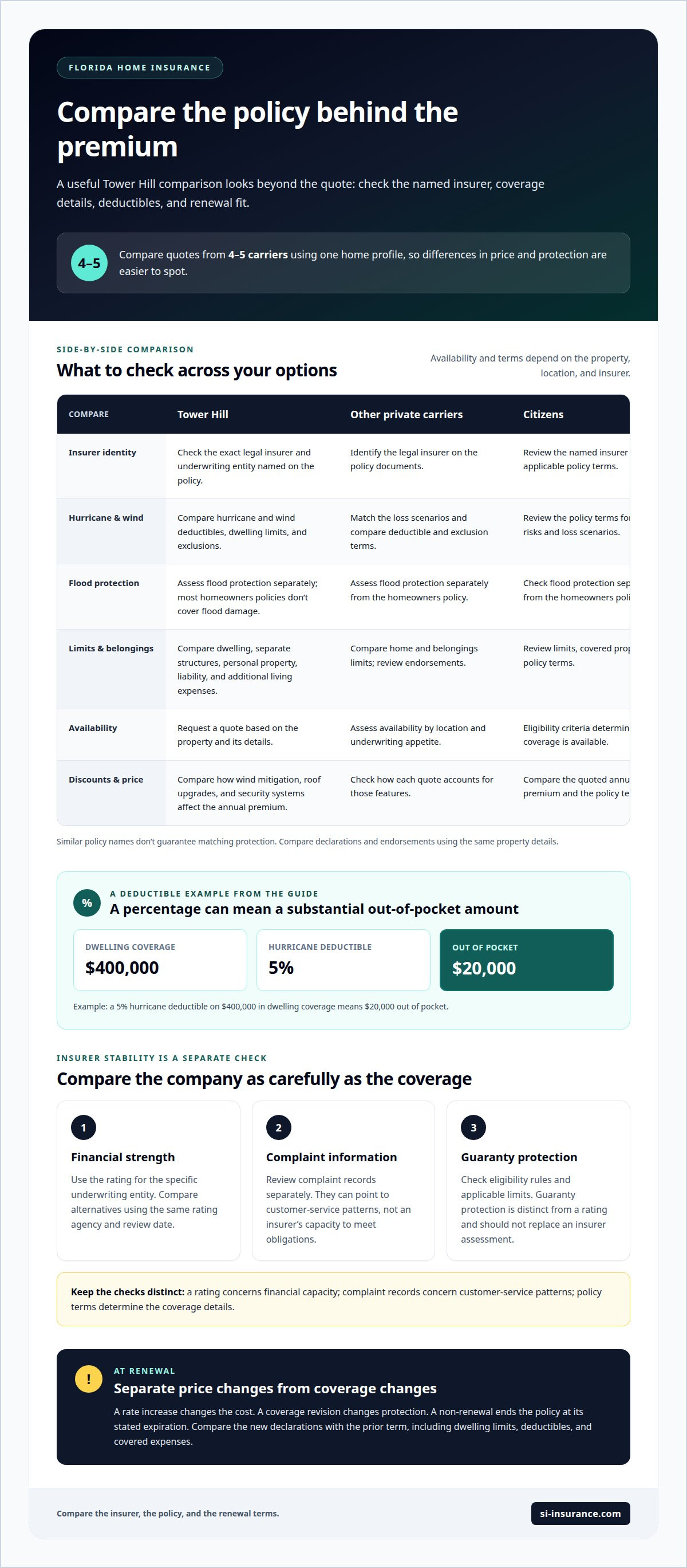
A useful comparison of Tower Hill Insurance alternatives in Florida starts with quotes based on the same home details and coverage needs. A premium alone does not show whether policies provide equivalent protection.
Hurricane, wind, and flood coverage
Compare hurricane and wind deductibles, dwelling limits, and exclusions. For example, a 5% hurricane deductible on $400,000 in dwelling coverage means $20,000 out of pocket. Most homeowners policies don’t cover flood damage, so assess flood protection separately. Similar policy names don’t ensure matching terms.
Deductibles, exclusions, and coverage limits
Deductibles describe the homeowner’s share of covered losses, limits cap payment, and exclusions identify risks the policy does not cover. Compare dwelling coverage, separate structures, personal property, liability, and additional living expenses. Read endorsements alongside the base policy because they can change protection for specific items or risks.
To compare deductibles, exclusions, and limits, review declarations and endorsements side by side using identical property details. This makes differences in hurricane deductibles, excluded damage, and personal property limits easier to spot.
Eligibility and inspection requirements vary by insurer. Details such as roof condition and prior improvements may affect underwriting or inspection decisions, so provide accurate information when requesting a quote.
Which insurers are accepting customers in your area? Availability depends on location and underwriting appetite. Request quotes based on your property rather than relying on a statewide list.
If private coverage is unavailable, apply through Citizens and provide the required property information. Eligibility criteria determine whether coverage is available.
Discounts for wind mitigation, roof upgrades, and security systems vary by insurer. Compare how each quote accounts for these features in the annual premium.
Compare quotes from 4-5 carriers using one home profile, then prioritize the terms that best address your risks.
Customer concerns about rate increases and non-renewals
A Florida home insurance renewal can bring a higher premium, changed terms, or a non-renewal notice. These outcomes are different: a rate increase changes the cost, a coverage revision changes protection, and non-renewal ends the policy at its stated expiration. Compare the new declarations with the prior term to see how the change affects your household.
For homeowners, the dwelling limit should reflect the cost of rebuilding, not simply the home’s purchase price. Renovations, added structures, and updated materials can affect that estimate. Review these details at each annual renewal, along with the dwelling limit, deductibles, and covered expenses. A lower premium may matter less if the policy no longer fits the home.
If an insurer plans not to renew, use the notice to organize your next steps. Record the policy end date, gather the current declarations, and prepare accurate details about the roof, systems, and recent improvements. This gives another insurer a consistent picture of the property. Don’t let comparing quotes delay arranging replacement coverage.
Compare the current and prior renewal documents, including coverage limits and deductibles.
Document repairs or upgrades that may affect the home’s condition or rebuild estimate.
List major household expenses that could follow covered damage, including temporary housing.
Review whether equipment breakdown protection appears in the policy and what terms apply.
An independent review of policy documents can help distinguish a premium change from a reduction in protection. For example, a Florida home might keep the same dwelling limit while losing an endorsement or gaining a different deductible. Identify each difference before comparing alternatives, so the next quote reflects equivalent coverage rather than a thinner policy.
At renewal, homeowners can also ask how the insurer’s updated assessment affects the annual premium and policy terms. Keep the response with the declarations and claim records. This creates a clear comparison file if a future rate increase or non-renewal requires a timely search for replacement home insurance.
Which Florida insurers offer the best coverage for hurricanes, wind, and flood damage?
No single insurer is best for every Florida property. Compare the written hurricane, wind, and flood terms with your home’s location, construction, and exposure. Start with the declarations and endorsements. Identify covered risks, risks with separate deductibles, and risks that need separate protection.
For hurricane and wind damage, compare how each policy defines covered damage and applies its deductible. A hurricane deductible can mean substantial out-of-pocket costs, so assess it alongside dwelling coverage limits. Review exclusions and how the policy treats detached structures, too. A policy that appears broad may still exclude a specific loss.
Flood requires a separate comparison. Most homeowners insurance policies do not cover flood damage, so don’t assume wind protection includes rising water. NFIP flood coverage has a 30-day waiting period. Account for that timing when planning coverage, rather than waiting until a storm threatens the property.
Use the same property details for each insurer quote, including roof information, dwelling value, and separate structures. Then compare how each option handles wind damage, hurricane deductibles, and flood losses. This makes differences visible without relying on a company name or premium alone.
For example, a homeowner near a flood-prone area should assess flood protection separately from hurricane and wind coverage. If wind exposure is the main concern, examine the deductible and exclusions first. In either case, compare limits with the home and belongings, then identify coverage gaps before choosing.
Review flood coverage options as part of your Florida property protection comparison.
Homeowners insurance policies typically include four coverages: Coverage A for the dwelling, Coverage B for other structures, Coverage C for personal property, and Coverage D for loss of use. Coverage A generally protects the insured home’s physical structure and certain attached components; Coverage B generally applies to separate structures. Coverage C protects belongings that aren’t permanently attached or built in, while Coverage D may help pay temporary living expenses when covered damage makes the home uninhabitable.
SI Insurance: Auto Insurance
SI Insurance offers Home Insurance and Auto Insurance for Florida households reviewing their broader coverage needs. If your home policy is changing at renewal, comparing its dwelling limits, deductibles, and exclusions can clarify what protection you need. Auto Insurance addresses a separate risk, but reviewing both policies together can help keep your decisions organized.
SI Insurance also offers Motorcycle Insurance and Boat Insurance. Evaluate each policy for its own risks and coverage requirements rather than treating it as an extension of homeowners protection. A focused review can help you identify the insurance questions to address before making a change.
To discuss your insurance needs, contact SI Insurance or visit the website.
Make Your Next Coverage Decision With Confidence
Choosing a home insurer is one part of a broader household risk review. Comparing Tower Hill Insurance alternatives in Florida is also a useful opportunity to consider how your other coverage fits together, especially when your home, vehicles, motorcycle, or boat each carry distinct risks.
Si Insurance Agency offers Auto Insurance, Motorcycle Insurance, and Boat Insurance, providing options to discuss beyond your home policy. Bring your priorities into one conversation: which protection matters most, where your current arrangements feel incomplete, and which decisions need attention first. To discuss your coverage needs, contact Si Insurance Agency and request a quote.
Contact SI Insurance to discuss your coverage options and take the next step toward a more coordinated insurance review.
Frequently Asked Questions
Which homeowners insurance companies offer coverage in Florida as alternatives to Tower Hill?
Florida’s home insurance market includes Universal Insurance Holding Group, Florida Peninsula Holdings Group, and HCI Group Inc. Their reported market shares are 9.61%, 7.59%, and 4.97%, respectively. These are group names, so compare the specific insurer named on each policy and whether it offers coverage for your property’s location. Review the policy terms alongside the company’s financial rating and coverage limits before deciding.
Which Florida home insurance companies are currently accepting new customers in my area?
Availability depends on your location and each insurer’s underwriting appetite, so request property-specific quotes. If private coverage is unavailable, apply through Citizens and meet its eligibility criteria.
How do Florida homeowners insurance rates compare among Tower Hill alternatives?
Rates vary by carrier and property.
What are the financial strength ratings and claims satisfaction of Tower Hill alternatives in Florida?
Compare the current rating for each named underwriting entity using the same rating agency and review date. Review complaint information separately, since it reflects customer-service patterns rather than financial strength.
Comments