


Hurricane Preparedness for Homeowners in Florida: A Strategic Guide for 2026
- siinsuranceflorida
- May 8
- 12 min read
Did you know that while Florida's insurance market shows signs of stabilization in 2026, the average homeowner still manages annual premiums reaching $4,500? It's a significant financial commitment that demands more than just basic shutters; it requires a sophisticated approach to hurricane preparedness for homeowners Florida that integrates physical resilience with airtight financial planning. You've likely felt the weight of complex policy language or worried that your current coverage might fail you during a catastrophic event. We believe you deserve the intellectual confidence that comes from a meticulously engineered risk management strategy.
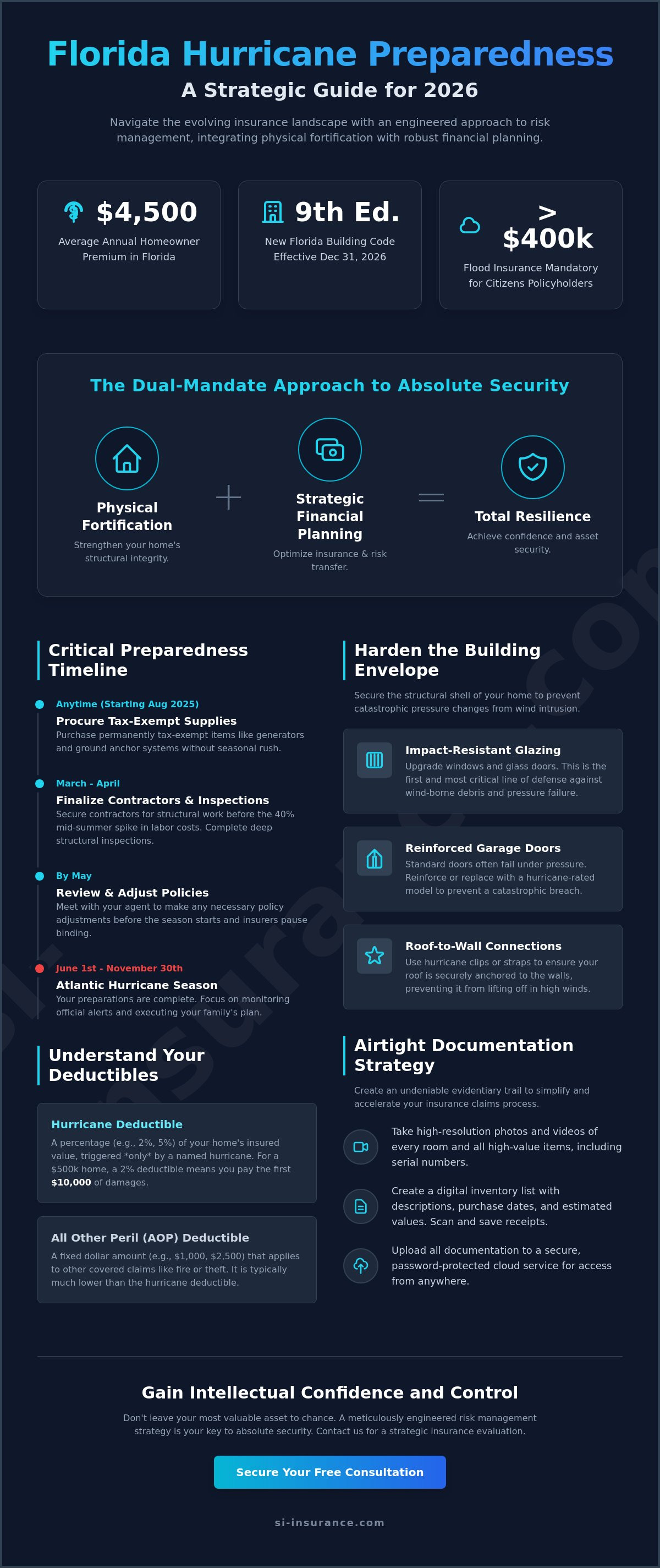
In this guide, we provide a strategic framework for safeguarding your residence through advanced fortification and bespoke risk transfer. We'll explore the implications of the 9th Edition Florida Building Code, which takes effect on December 31, 2026, and the mandatory flood insurance requirements for Citizens policyholders with dwellings valued at $400,000 or more that began on January 1, 2026. By following this expert analysis, you'll gain the tools to achieve absolute security and ensure your claims process remains seamless and successful.
Key Takeaways
Strengthen your home's exterior by focusing on the building envelope, specifically utilizing impact-resistant glazing and reinforced garage doors to manage extreme wind pressure.
Identify the nuanced differences between hurricane deductibles and standard All Other Peril (AOP) clauses to protect your long-term financial stability.
Establish a high-resolution digital documentation strategy for your assets, creating an airtight evidentiary trail that simplifies the insurance claim process.
Master a dual-mandate approach to hurricane preparedness for homeowners Florida by integrating physical asset hardening with strategic financial risk management.
Table of Contents
Understanding the 2026 Florida Hurricane Landscape
The Florida Division of Emergency Management (FDEM) defines the Atlantic hurricane season as a rigorous six-month window from June 1st to November 30th. In 2026, the landscape of risk has shifted, as storm intensity now plays a more significant role in determining property values than simple frequency. With average homeowners insurance premiums in Florida now ranging between $3,240 and $4,500, the financial stakes of a reactive mindset are simply too high. We encourage a shift toward a proactive posture where hurricane preparedness for homeowners Florida is treated as a core component of long-term asset management.
To better understand the steps involved in securing your residence against these evolving threats, watch this helpful video:
A holistic risk management framework is the only way to ensure absolute security for your family and your equity. This approach requires you to view your home not just as a shelter, but as a complex financial asset that requires Tropical cyclone preparedness and a strategic insurance evaluation. By combining physical fortification with intelligent risk transfer, you move beyond the seasonal anxiety and into a position of intellectual confidence and control.
The Critical Preparedness Timeline
Strategic planning must begin months before the June 1st inception date. This early window is the only time you'll have to perform deep structural inspections and secure policy adjustments without the pressure of an active storm threat. Since certain disaster preparedness items like portable generators and ground anchor systems became permanently tax-exempt on August 1, 2025, you can procure these assets at any time without waiting for a temporary holiday. Finalizing your contractor list by March or April ensures you aren't caught in the 40% spike in labor costs that often occurs mid-summer.
Local Risk Assessment and Evacuation Zones
Precision in risk assessment is what separates elite preparedness from basic guesswork. It's vital to differentiate between flood zones and evacuation zones, especially for residents in South Florida where these boundaries often overlap. Evacuation zones are determined by the FDEM based on potential storm surge impact, while flood zones are used for insurance rating purposes. Coastal assets naturally face higher surge risks, but inland homes are increasingly vulnerable to high-velocity wind damage as storm systems maintain their strength further across the peninsula. Utilizing official FDEM mapping tools helps you identify if your specific residential asset requires a specialized response plan.
Physical Fortification: Hardening the Residential Asset
Protecting your residence starts with securing the building envelope. This is the structural shell that keeps internal pressure stable during a storm. If a window or garage door fails, the sudden influx of air can create an internal pressure spike that can literally lift a roof off its walls. High-net-worth homeowners should prioritize impact-resistant glazing and reinforced garage doors as the first line of defense. With the 9th Edition of the Florida Building Code taking effect on December 31, 2026, new construction will face even stricter wind load calculations under the ASCE 7-22 standards. Even for existing homes, upgrading these entry points is a critical move for anyone serious about hurricane preparedness for homeowners Florida.
For a complete list of essential supplies and state-level safety protocols, the official Florida Hurricane Preparedness guide provides a solid baseline for emergency planning. Beyond the windows, you must evaluate roof-to-wall connections. Structural integrity depends on how well the roof is tied to the foundation. Using hurricane clips or wraps ensures the load is transferred through the walls rather than allowing the roof to act like a sail. Secondary vulnerabilities like unattached gazebos or sophisticated landscaping can also become projectiles if not properly addressed.
The Wind Mitigation Inspection
A wind mitigation inspection is a strategic tool for risk transfer rather than a mere formality. Professional inspectors look for features like secondary water barriers and specific nail patterns in the roof deck that prevent catastrophic failure. As of July 1, 2026, a new law prevents insurers from refusing to renew a policy based solely on roof age if an inspection shows five years of useful life remaining. These technical details directly influence underwriting decisions. They often result in significant premium credits that offset the cost of the upgrades themselves.
Exterior Maintenance and Property Clearing
Don't overlook the "soft" vulnerabilities on your property. Landscaping requires a methodical approach; high-value trees should be professionally pruned by an arborist to reduce wind resistance and prevent limb failure. Luxury outdoor amenities and heavy furnishings must be secured or moved to a reinforced storage area. Since drainage systems are prone to failure during heavy rainfall, clearing them is a non-negotiable task to mitigate localized flooding. If you're unsure how these physical improvements impact your overall coverage, a strategic policy review can reveal exactly where your risks are still exposed.
Strategic Financial Preparedness and Risk Transfer
While physical hardening protects the structure, financial preparedness protects your equity. Your homeowners policy serves as the primary instrument for transferring catastrophic risk from your personal balance sheet to the insurer. It's a complex contract that requires a high degree of precision to ensure your coverage aligns with your actual exposure. At SI Insurance, we act as a strategic guardian, analyzing the nuances of your policy to eliminate gaps that often lead to post-storm insolvency. We believe that intellectual confidence in your coverage is just as vital as the shutters on your windows.
One of the most misunderstood aspects of hurricane preparedness for homeowners Florida involves the deductible structure. Unlike standard All Other Peril (AOP) deductibles, which are usually flat dollar amounts, hurricane deductibles are typically calculated as a percentage of the home's total replacement value. If your residence is insured for $1,000,000, a 5% deductible means you're responsible for the first $50,000 of damage. This has a direct impact on your liquidity needs immediately following a storm. You also need to confirm your policy is written on a Replacement Cost Value (RCV) basis rather than Actual Cash Value (ACV). RCV ensures you can rebuild at today's prices, whereas ACV factors in depreciation, which can leave you with a significant financial deficit when sourcing materials in a stressed market.
The Necessity of Flood Insurance Integration
A common and costly assumption is that windstorm coverage includes damage from rising water. It doesn't. Standard Florida homeowners policies strictly exclude flood damage, regardless of whether the water came from a storm surge or a heavy downpour. As of January 1, 2026, Citizens Property Insurance Corporation has mandated that policyholders with a dwelling replacement cost of $400,000 or more must maintain flood insurance. We often recommend a strategic alignment of private flood solutions, as they typically offer higher limits and bespoke terms that the National Flood Insurance Program (NFIP) cannot provide for high-value residential assets.
Optimizing Deductibles and Coverage Limits
Choosing the right deductible is a delicate balance between managing annual premiums and ensuring you have the cash on hand to initiate repairs. You also need to evaluate "Law and Ordinance" coverage. This specific endorsement pays for the increased cost of construction required to bring an older home up to current building standards, such as the 2026 9th Edition Florida Building Code. Without this, you might be forced to pay out of pocket for mandatory upgrades during the rebuilding process. For a deeper analysis of these specific protections, you can review our Home Insurance in Florida guide.
The Documentation Strategy for Seamless Claims
A successful claim doesn't start after the storm; it begins with the evidentiary trail you build months in advance. For hurricane preparedness for homeowners Florida, this documentation acts as the bridge between your physical loss and your financial recovery. We recommend a high-resolution approach that leaves no room for ambiguity during the adjusting process. By capturing every detail of your residence in its pristine state, you provide the clear "before" picture that makes the "after" undeniable. This level of precision is exactly what's required in the 2026 insurance market, where carriers are increasingly utilizing data-driven underwriting and sophisticated loss-assessment tools.
Capturing this evidence requires a methodical walk-through of your entire property. Don't just settle for a few photos of the living room; you need to record 4K video that captures the condition of floors, ceilings, and internal systems. This meticulous record serves to accelerate the strategic risk transfer process by providing adjusters with indisputable proof of your home's pre-storm integrity. It transforms a potentially long, drawn-out negotiation into a clear, evidence-based transaction.
Creating a High-Value Digital Inventory
Documenting luxury interiors requires a specialized focus on detail. You should record high-resolution imagery of custom cabinetry, high-end appliances, and any specialized collections. For those with significant investments in fine pieces, our guide on Jewelry Insurance in Florida offers specific advice on valuation and protection. Make sure to digitize all original purchase receipts, professional appraisals, and serial numbers for all electronics. Storing these assets in a structured digital vault ensures that even if the physical items are lost, the proof of their value remains accessible and secure.
Critical Document Redundancy
Physical documents are inherently vulnerable to the very elements you're trying to guard against. You must establish a redundant, cloud-based backup system for your most critical financial and legal instruments. This includes your current homeowners policy, recent property tax assessments, and legal titles. Ensure that your policy numbers and agency contact details are accessible offline through a secure mobile application or an encrypted drive. Being prepared for immediate communication with SI Insurance after a storm is vital for initiating the claims process before local resources become overwhelmed. If you'd like to ensure your current documentation meets elite standards, you can schedule a strategic consultation with our team today.
The SI Insurance Agency Approach to Resilience
At SI Insurance, we view hurricane preparedness for homeowners Florida as an ongoing discipline rather than a seasonal task. We recognize that your residence is likely one of your most significant investments, requiring a level of protection that standard retail policies simply can't provide. Our firm operates as a strategic guardian, utilizing a sophisticated analysis of current market data to ensure your assets are shielded from both physical and financial volatility. With insurance premiums in 2026 showing signs of stabilization between $3,240 and $4,500, now is the ideal time to refine your risk management posture and lock in favorable terms. We don't just sell policies; we engineer long-term security.
Our commitment to excellence is reflected in the way we handle the complexities of the Florida market. We understand that the recent tort reforms and the decrease in Citizens Property Insurance Corporation policies to approximately 336,000 by early 2026 are indicators of a shifting landscape. This evolution creates new opportunities for sophisticated risk transfer that were unavailable just a few years ago. By partnering with us, you gain access to elite expertise that transforms these market trends into a personal advantage for your estate.
Bespoke Risk Management Solutions
Our methodology involves more than just issuing a policy; it's about engineering a bespoke risk transfer that matches your specific lifestyle and asset portfolio. We work exclusively with elite insurance carriers to provide coverage that evolves alongside your property's value. This strategic alignment is particularly crucial for clients with diverse holdings, such as those who also require Business Insurance in Broward County. By consolidating your risk management under one authoritative roof, we eliminate the overlaps and gaps that often occur with fragmented coverage. We take the time to understand the architectural nuances of your home, ensuring that every reinforced garage door and impact-resistant window is reflected in your underwriting profile.
Your Strategic Partner in Florida
We provide a white-glove service that prioritizes clarity and foresight in an often chaotic insurance environment. As the December 31, 2026, deadline for the 9th Edition Florida Building Code approaches, our team is already helping clients assess how these stricter standards will influence their future premiums and property valuations. We aren't just here for the storm; we're here for the long-term preservation of your wealth. Our institutional permanence means you have a calm, calculated partner ready to respond when the stakes are highest. This steady, methodical approach ensures that your claims potential is maximized before a single cloud appears on the horizon.
Absolute security is a choice made through rigorous analysis and proactive planning. We invite you to secure your financial future by scheduling a professional consultation with our elite team. Let us provide the intellectual confidence you need to face the Atlantic hurricane season with poise. Contact SI Insurance today for a comprehensive 2026 hurricane readiness review and experience the power of a truly strategic partnership.
Securing Your Residential Legacy Against the Elements
We've explored how 2026 marks a significant turning point for residents, from the upcoming December 31st implementation of the 9th Edition Building Code to the stabilization of the private insurance market. True resilience isn't found in a single upgrade or a basic policy; it's the result of a strategic fusion between physical hardening and sophisticated financial risk transfer. By prioritizing your home’s structural envelope and establishing a rigorous digital documentation trail, you're doing more than protecting a building. You're safeguarding your family's long-term financial health and peace of mind.
Achieving this level of hurricane preparedness for homeowners Florida requires a partner who understands the high stakes of our local landscape. Our professional risk mitigation experts possess the specialized Florida market knowledge needed to ensure your coverage stays in strategic alignment with elite carriers. We're here to provide the intellectual confidence you need to face the Atlantic hurricane season with total composure. Take the next step toward absolute security and Request a Strategic Insurance Review from SI Insurance Agency today. You've built an incredible life in the Sunshine State, and we're honored to help you protect it.
Frequently Asked Questions
When does the 2026 Florida hurricane season officially commence?
The 2026 Atlantic hurricane season officially commences on June 1st and concludes on November 30th. These parameters are established by the Florida Division of Emergency Management (FDEM) to align with historical tropical cyclone activity. While the peak usually occurs between August and October, we recommend finalizing your risk mitigation strategy by mid-May to avoid the seasonal rush for supplies and contractor availability.
How much water and non-perishable food should a Florida household store?
You should store at least seven days of non-perishable food and water for each member of your household. The standard requirement is one gallon of water per person per day for drinking and sanitation. It's a fundamental part of hurricane preparedness for homeowners Florida to ensure these supplies are rotated annually to maintain freshness and safety. Don't forget to account for pets and any specific dietary requirements for family members.
What is the difference between a standard deductible and a hurricane deductible?
A standard deductible is usually a fixed dollar amount applied to everyday claims, while a hurricane deductible is calculated as a percentage of your home's total insured value. This percentage typically ranges from 2% to 10% of your Coverage A limit. For example, if your residence is insured for $500,000, a 2% hurricane deductible requires you to pay $10,000 out of pocket before your insurance coverage begins to indemnify your loss.
Do I need a separate flood insurance policy if I live inland?
You absolutely need a separate flood insurance policy regardless of your inland location. Standard homeowners insurance excludes damage from rising water, and FEMA reports that over 20% of flood claims originate from areas outside of high-risk flood zones. Inland homes face significant exposure from localized heavy rainfall and overwhelmed drainage systems. Securing a private flood solution ensures a more comprehensive risk transfer for your property.
What should I do if my home is located in an evacuation zone?
If your residence is in an evacuation zone, you must follow the official orders issued by your local emergency management office. You can identify your specific zone through the FDEM mapping tools, which categorize areas from Zone A through Zone L based on storm surge vulnerability. Having a predetermined destination and an established communication plan is vital for ensuring your family’s safety while maintaining the security of your physical assets.
How often should a wind mitigation inspection be performed on my property?
A wind mitigation inspection should generally be performed every five years to remain valid for most insurance carrier requirements. If you've completed significant structural upgrades, such as a full roof replacement or the installation of impact-resistant windows, you should order a new inspection immediately. These reports are essential for securing the maximum premium credits allowed under Florida law and demonstrating your home’s resilience to underwriters.
Can I change my insurance coverage once a storm is in the forecast?
You cannot typically adjust your insurance coverage once a tropical storm or hurricane watch has been issued for your area. Insurance companies implement "binding moratoriums" as soon as a storm enters a specific geographic box or a warning is officially posted. This prevents homeowners from seeking coverage only when a loss is imminent. It's why we emphasize a proactive approach to hurricane preparedness for homeowners Florida well before the season begins.
What are the most common mistakes Florida homeowners make during hurricane prep?
The most frequent errors involve underestimating the financial impact of the hurricane deductible and failing to maintain a digital inventory of personal property. Many homeowners also mistakenly believe that their standard policy covers flood damage. Neglecting to review "Law and Ordinance" coverage is another strategic oversight that can lead to significant out-of-pocket expenses when rebuilding an older structure to meet the 2026 building codes.
Comments