


Non-Owner Car Insurance in Florida: A Strategic Guide for 2026
- siinsuranceflorida
- 11 minutes ago
- 12 min read
Forfeiting your vehicle registration doesn't mean you should relinquish your standing with elite carriers, especially since even a 30-day lapse in coverage can increase your future premiums by as much as 35 percent. It's a harsh reality in a state where the Florida Department of Highway Safety and Motor Vehicles tracks compliance with surgical precision. Most drivers recognize that the state's No-Fault statutes and Personal Injury Protection mandates are complex, often leading to unnecessary anxiety regarding license suspensions or high-risk designations. We understand that life transitions shouldn't jeopardize your financial reputation.
SI Insurance provides the clarity you need to maintain your status as a preferred risk. By securing non-owner car insurance Florida, you'll satisfy mandatory state filings like the SR-22 while ensuring you aren't penalized for a lack of continuous coverage when you eventually purchase a new vehicle. This guide details how to leverage these policies for bespoke risk mitigation while renting or borrowing cars throughout 2026. We'll examine the strategic alignment of your insurance history with current Florida law to protect your financial future and guarantee absolute legal compliance.
Key Takeaways
Understand how maintaining a continuous insurance history acts as a strategic safeguard against being reclassified into high-risk premium tiers.
Gain clarity on how Florida’s no-fault regulations and Personal Injury Protection (PIP) apply when you are operating a vehicle you do not personally own.
Discover how non-owner car insurance Florida serves as a sophisticated alternative to the high daily costs associated with rental agency waivers and car-sharing platforms.
Explore the specific economic variables and liability considerations essential for structuring a robust policy within Florida’s projected 2026 financial landscape.
Learn how the bespoke oversight and strategic expertise of Si Insurance Agency can help you navigate complex regulatory requirements with absolute confidence.
Table of Contents Understanding Non-Owner Car Insurance within the Florida Regulatory Landscape The Mechanics of Coverage: How Florida’s No-Fault Laws Apply to Non-Owners Strategic Scenarios: Who Benefits Most from a Non-Owner Policy in Florida? Navigating the Acquisition Process: Key Considerations for Florida Drivers Securing Your Driving Privilege with Si Insurance Agency’s Strategic Oversight
Understanding Non-Owner Car Insurance within the Florida Regulatory Landscape
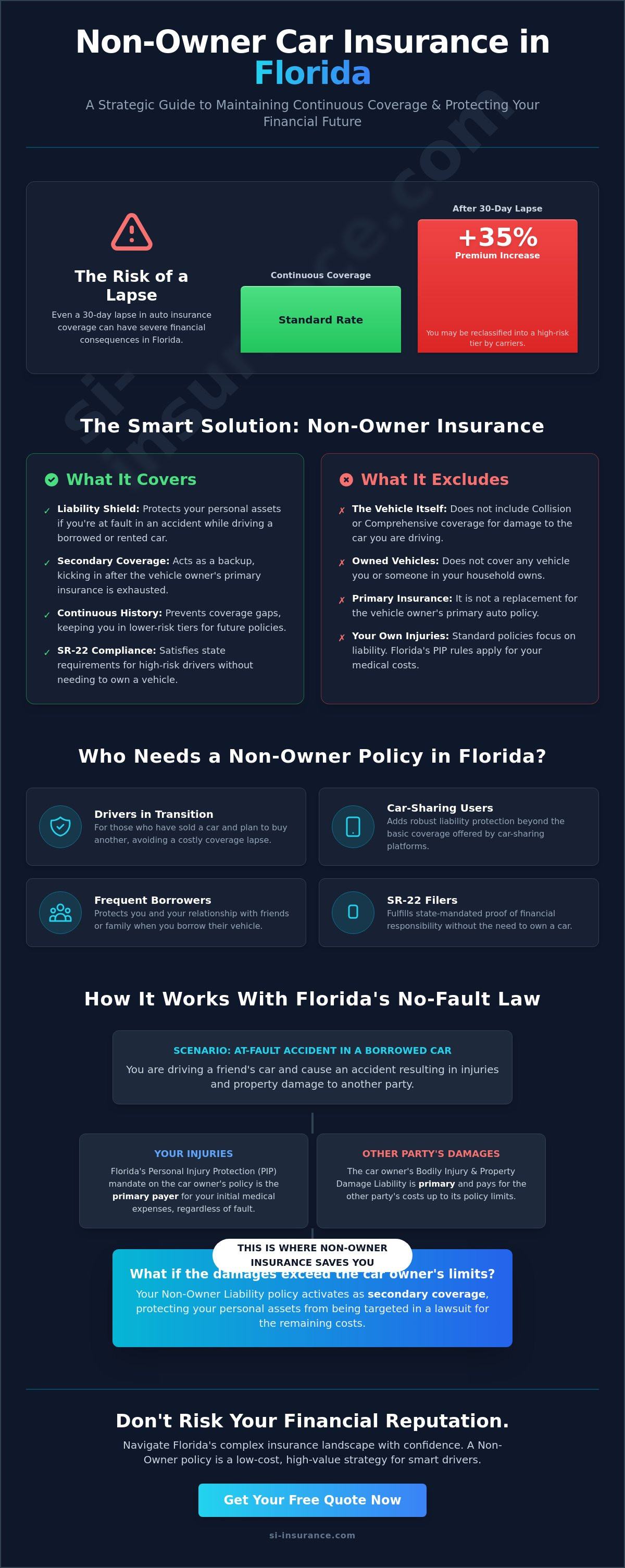
Non-owner insurance serves as a liability shield for drivers using vehicles they do not hold a title for. This specific financial instrument is designed for individuals who require legal protection while operating borrowed or rented vehicles without the burden of maintaining a full personal auto policy. At SI Insurance, we recognize that this coverage functions as a secondary layer of defense, activating only after the primary insurance on the vehicle is exhausted. It's a sophisticated method of risk transfer that ensures a driver’s personal assets remain protected regardless of the vehicle’s primary coverage limits. Maintaining a status of continuous coverage is a strategic necessity in the current insurance environment. Data from 2024 indicates that drivers who allow their insurance to lapse for more than 30 days are often classified into high-risk tiers, leading to a projected 15% to 22% increase in future premiums. By keeping a non-owner car insurance Florida policy active, you're effectively signaling underwriting excellence to future carriers. This approach demonstrates a commitment to consistent risk mitigation, which is essential for long-term financial stability and intellectual confidence in your coverage portfolio. To better understand this concept, watch this helpful video:
The Core Components of a Non-Owner Policy
The architecture of a non-owner policy is built upon two primary pillars: Bodily Injury Liability and Property Damage Liability. These components are designed to cover the costs associated with injuries to others or damage to third-party property when you're at fault in an accident. Because you don't hold the title to the vehicle, comprehensive and collision coverages are excluded from these contracts. These policies operate as excess coverage, meaning they provide an additional financial buffer once the vehicle owner's primary limits are reached. This structure is particularly relevant when considering Florida’s No-Fault Laws, which dictate how initial claims are processed through Personal Injury Protection.
Why Florida Drivers Require a Local Perspective
In metropolitan areas like Sunrise and Pompano Beach, the reliance on car-sharing services and high-frequency rentals is significantly higher than the national average. This environment demands a more nuanced approach to personal liability. An agent at SI Insurance acts as a strategic guardian, ensuring that your bespoke risk transfer strategy aligns with the specific density and legal complexities of the Florida market. This professional oversight helps you navigate the intricacies of the state's unique regulatory requirements while maintaining a composed and secure financial posture. Securing non-owner car insurance Florida residents can rely on ensures that your mobility doesn't come at the cost of your financial security.
The Mechanics of Coverage: How Florida’s No-Fault Laws Apply to Non-Owners
Florida's 1971 Motor Vehicle No-Fault Law creates a unique environment for those who drive but don't own a vehicle. While the state mandates that drivers carry Personal Injury Protection (PIP) to cover their own medical expenses, the application of this rule becomes complex when you don't have a title in your name. Choosing non-owner car insurance Florida requires a precise understanding of how these statutes interact with borrowed vehicles and rental agreements. It's a calculation that moves beyond simple compliance, focusing instead on the preservation of your financial standing.
A common misconception persists that "No-Fault" status eliminates the risk of being sued. This is a dangerous oversight in a state with high litigation rates. If you cause an accident resulting in permanent injury or costs exceeding the $10,000 PIP threshold, you're personally liable for the excess. Responsibility for Property Damage Liability (PDL) is also maintained by the operator. If you're behind the wheel of a borrowed car and cause a multi-car collision, the owner's policy typically pays first, but your non-owner policy acts as a vital secondary layer of defense. This strategic alignment of policy limits with your personal net worth ensures that a single lapse in judgment doesn't jeopardize your long term assets.
PIP and the Non-Owner Driver
In most scenarios, a standard non-owner policy doesn't include PIP because Florida law traditionally ties this coverage to a specific vehicle. However, if you reside in a household where a relative owns a vehicle, you're often covered under their PIP policy by default. For those without any household vehicle access, medical coverage gaps emerge quickly. Understanding Non-Owner Car Insurance is essential for identifying these specific exposures when securing non-owner car insurance Florida. If you're injured as a passenger or pedestrian, the lack of a personal PIP policy means you may have to rely on the other driver's coverage or your own health insurance, which often carries much higher deductibles.
Uninsured Motorist Protection: A Strategic Addition
According to 2021 data from the Insurance Research Council, roughly 20.4% of Florida drivers operate without any insurance. This high percentage makes Uninsured Motorist (UM) coverage a non-negotiable component of a sophisticated risk management plan. UM doesn't just protect you while driving a borrowed car; it follows you as a pedestrian or a cyclist. If a hit and run driver strikes you on a sidewalk in Miami, your UM policy provides the bespoke risk transfer needed to cover medical costs and lost wages. At SI Insurance, we view these additions as fundamental to maintaining a secure financial position. You can explore how we refine these strategic risk management solutions to fit your specific profile.
Strategic Scenarios: Who Benefits Most from a Non-Owner Policy in Florida?
Identifying the precise utility of a non-owner policy requires an understanding of how Florida's insurance market penalizes gaps in coverage. For high-frequency travelers who rely on rental agencies at Miami International or car-sharing platforms like Turo in South Florida, this coverage serves as a primary layer of liability protection. It effectively eliminates the need for expensive daily collision damage waivers, which often cost upwards of $30 per day as of 2024. By maintaining a non-owner car insurance Florida policy, you ensure that your personal liability limits remain intact regardless of which vehicle you operate.
Drivers in transition also find this a vital tool for long-term risk management. If you sell your vehicle in January 2026 but don't plan to replace it until June, a five-month lapse can trigger a rate increase of 20% or more when you finally re-enter the market. Insurance carriers view a history of continuous coverage as a primary indicator of driver reliability. Maintaining this policy keeps you in the "standard" or "preferred" rating tier, saving thousands over the long term. It's a calculated move that signals stability to future underwriters.
SR-22 and FR-44 Filings in Florida
Florida law mandates specific certificates of financial responsibility for drivers with certain traffic convictions. An SR-22 is typically required for several years following a license suspension or major moving violation. The FR-44 is more stringent, reserved for DUI convictions. Under Florida Statute 324.023, an FR-44 filing requires significantly higher liability limits of $100,000 per person, $300,000 per occurrence, and $50,000 for property damage. A non-owner car insurance Florida policy is often the most cost-effective way to satisfy these state requirements without the overhead of insuring a specific vehicle you don't own.
The 'Gap' Strategy for Future Savings
A 30-day lapse in Florida insurance can lead to significantly higher premiums later. This isn't just about avoiding a fine from the DMV; it's about maintaining underwriting excellence. We position the non-owner policy as a low-cost placeholder. It preserves your standing with elite carriers who demand an uninterrupted insurance history. This strategic alignment ensures that when you do purchase a luxury vehicle, your premiums reflect your status as a responsible, low-risk driver rather than someone re-entering the system after a period of uninsured status. It's a bespoke risk transfer method for those who value foresight.
Navigating the Acquisition Process: Key Considerations for Florida Drivers
Securing non-owner car insurance Florida isn't just a matter of checking a box for the DMV; it's a deliberate move to protect your future assets. Several variables dictate your premium, including your credit history, age, and previous insurance gaps. In Florida, the litigation environment remains a heavy influencer on pricing. With the state historically accounting for nearly 8% of all national auto insurance claims despite having only 6% of the population, carriers are meticulous about risk assessment. For 2026, we anticipate that inflationary pressures on medical services and vehicle repairs will keep premiums on a steady upward trajectory, making a clean driving record more valuable than ever.
When you select your liability limits, don't settle for the state minimums of $10,000. In the economic climate of 2026, a single multi-car accident on I-95 could result in medical bills far exceeding those basic thresholds. We recommend a strategic floor of $100,000 per person and $300,000 per accident for bodily injury. This level of coverage ensures that a momentary lapse in judgment doesn't lead to a devastating personal judgment against your savings or future wages.
Eligibility Requirements and Exclusions
The primary hurdle for many drivers is the "regular use" exclusion. If you live with a spouse or a roommate who owns a vehicle, you typically can't use a non-owner policy to cover your use of their car. Carriers assume you'll have frequent access to that vehicle; therefore, they require you to be listed as a secondary driver on the owner's primary policy instead. Similarly, if your employer provides a company car for your daily commute or personal errands, you're ineligible for this specific product. To qualify, you must possess a valid Florida driver's license or be in the process of a formal reinstatement, often requiring an SR-22 or FR-44 filing.
Comparing Quotes: What to Look For
Price is a factor, but it shouldn't be the only one. You'll want to investigate a carrier's claims-paying reputation and financial stability rating through agencies like A.M. Best. A policy is only as good as the company's ability to defend you in court. Working with an independent agency allows for a higher degree of underwriting excellence, as they can scan the market for bespoke risk transfer options that a single captive agent might miss. This process provides a broader perspective on Florida auto insurance and how non-owner coverage fits into your total risk profile. To begin your journey toward a secure driving profile, you can request a bespoke insurance consultation with our team today.
Securing Your Driving Privilege with Si Insurance Agency’s Strategic Oversight
Choosing a policy shouldn't feel like a transaction; it's a critical component of your broader financial defense. At Si Insurance Agency, we operate as elite consultants for drivers who recognize that standard coverage often falls short of protecting significant assets. Our team approaches non-owner car insurance Florida with a meticulous eye for detail, ensuring that every policy we draft serves as a robust barrier against unforeseen liabilities. This white-glove service isn't just about meeting state minimums. It's about crafting a strategic risk transfer that aligns perfectly with your individual financial goals and long-term stability.
We understand that the Florida insurance market in 2026 requires more than just reactive adjustments. It demands foresight. Our process involves a deep dive into your specific risk profile to identify potential gaps that others might overlook. By treating insurance as a sophisticated financial instrument, we provide our clients with a sense of absolute security. You can drive with the intellectual confidence that comes from knowing your protection has been engineered by professionals who prioritize precision over volume. We act as your strategic guardian, managing the complexities of the legal and financial landscape so you don't have to.
The Si Insurance Agency Advantage in Broward County
While our expertise extends to every city across the State of Florida, our deep roots in Broward County allow us to provide localized insights that national platforms simply can't match. We've spent years cultivating relationships with a network of over 15 top-tier, A-rated carriers. This allows us to match our clients with bespoke risk solutions that are specifically tailored to the unique driving environment of South Florida. Our commitment isn't just to the initial policy placement; we focus on long-term protection strategies that evolve as your life and assets grow. We offer a level of stability and professional insurance management that transforms a mandatory requirement into a strategic advantage.
Initiate Your Strategic Risk Assessment
The path to sophisticated protection begins with a single, deliberate conversation. We invite you to step away from the high-energy noise of retail marketing and experience the calm, calculated approach of professional risk management. Our consultants are ready to conduct a thorough evaluation of your needs and present a clear, logical strategy for your coverage. Don't leave your financial future to chance or automated algorithms that don't understand your unique situation. Connect with Si Insurance Agency today for a personalized non-owner insurance strategy.
Access to a curated network of 15+ elite insurance carriers.
Meticulous policy drafting focused on comprehensive risk mitigation.
Local expertise serving Broward County and all Florida municipalities.
Professional consultations designed for high-value asset protection.
Mastering Your Strategic Position on Florida Roadways
Navigating the intricacies of Florida's no-fault statutes requires a proactive stance toward long-term risk mitigation. As we approach 2026, maintaining a continuous insurance record isn't just about basic legal compliance; it's a calculated move to preserve your future insurability and financial stability. Since our founding in 2022, SI Insurance Agency has focused on providing the specialized oversight necessary for these high-stakes regulatory scenarios. Whether you're managing the rigorous requirements of an SR-22 or FR-44 filing or simply need a liability shield while using vehicles you don't own, the right policy serves as a critical financial anchor. We've seen how bespoke risk management strategies protect South Florida residents from the unpredictable nature of modern transit. Securing non-owner car insurance Florida drivers can rely on ensures that your driving privileges remain intact without the burden of vehicle ownership. Our team delivers the intellectual confidence you need to navigate these technical requirements with absolute precision. You don't have to manage these complex financial landscapes alone. We're here to help you maintain your momentum.
Frequently Asked Questions
Is non-owner car insurance required by law in Florida?
Florida law doesn't mandate non-owner insurance for the general public, but the Florida Department of Highway Safety and Motor Vehicles requires it for specific individuals. If you've had your license suspended or need to file an SR-22 or FR-44 under Florida Statute 324.021, you'll need this coverage to regain your driving privileges. It's a strategic tool for maintaining a continuous insurance history, which prevents high-risk premium spikes in the future.
How much does a non-owner car insurance policy typically cost in Florida?
While we don't set fixed rates, 2024 market data from industry analysts suggests that non-owner car insurance Florida policies often cost 40% to 50% less than standard owner policies. This price reflects the limited risk exposure since you aren't operating a specific vehicle daily. Your final premium depends on your underwriting profile and whether the state requires a high-limit FR-44 filing for compliance.
Can I use a non-owner policy to get my license back after a DUI?
You can certainly use a non-owner policy as a strategic path to license reinstatement after a DUI. Florida requires an FR-44 filing, which demands increased liability limits of $100,000 for bodily injury per person and $300,000 per accident. If you don't own a vehicle, a non-owner policy satisfies these rigorous state mandates. It provides a sophisticated solution for risk mitigation while you work toward full legal standing.
Does non-owner insurance cover me if I am driving a rental car in Florida?
Most non-owner policies provide secondary liability protection when you're behind the wheel of a rental car. This means the policy covers damages only after the rental company's basic insurance limits are fully exhausted. It's important to realize these policies don't include collision coverage for the rental vehicle itself. You'd still be responsible for physical damage to the car unless you buy additional protection at the counter.
What happens if I have an accident while driving a friend's car and I have a non-owner policy?
If you're involved in an accident, your friend's insurance acts as the primary coverage for the vehicle. Your non-owner policy serves as a secondary layer of protection, kicking in only if the claims exceed your friend's policy limits. This bespoke risk transfer ensures that you have an extra buffer of financial security. It protects your personal assets from being targeted if the primary insurance isn't enough to cover the total loss.
Can I get non-owner insurance if there is a car in my household?
Insurance carriers typically won't issue a non-owner policy if a functional vehicle is registered to your household address. Underwriting standards assume you'll have regular access to any car kept at your residence, which creates a different risk profile. In these cases, the most effective strategic alignment is to be added as a named driver on the existing household policy. This ensures you're properly covered for the specific risks associated with that vehicle.
Comments