


The Florida Home Underinsurance Crisis: A Strategic Guide to Protecting Your Equity in 2026
Updated: Sep 19
Have you noticed the recent headlines about Florida’s home insurance market finally starting to stabilize in 2026? It's a huge relief to see rates decreasing in 51 of our counties, but this shift can sometimes hide a quiet risk sitting right in your own policy declarations. While lower premiums are certainly a win, many families are unknowingly leaving their biggest asset vulnerable by having an **underinsured Florida home**. Homeowners in the state should be particularly careful, as the cost to actually rebuild has changed dramatically over the last few years.
We want to help you find that perfect balance where you're paying a fair price without sacrificing the security of your home's equity. In this guide, we’ll walk through how to identify the dangerous gap between your current coverage and today's actual construction costs. We’ll break down the crucial difference between what your house is worth on the market versus what it costs to build from scratch, and we’ll give you a simple, step-by-step plan to audit your policy yourself. It’s about giving you the clarity and confidence to know that if the worst happens, you’re fully prepared to rebuild and move forward without a mountain of unexpected debt.
Table of Contents
Understanding the Reality of Being Underinsured in Florida
It's easy to feel a sense of relief when you see the Florida insurance market showing signs of stabilization in 2026. With rate decreases reported in 51 counties and several new carriers entering the space, the frantic energy of previous years has cooled. However, this stability can create a false sense of security. Many homeowners are currently operating with policies that haven't been audited in years, leaving them with a "stale" limit that doesn't reflect the current economic reality. To truly protect your equity, you must start by Understanding the Reality of Being Underinsured. In the context of property, this refers to a dangerous gap between your policy’s "Coverage A" limit and what it would actually cost to hire a contractor to rebuild your home today.
Realizing your coverage is insufficient after a catastrophic loss is an emotional and financial weight that no family should have to carry. When the baseline for "adequate" protection shifts, your policy must shift with it. If you find your home underinsured florida costs could quickly exceed your personal savings, leaving your equity entirely exposed during a claim.
The Definition of the Coverage Gap
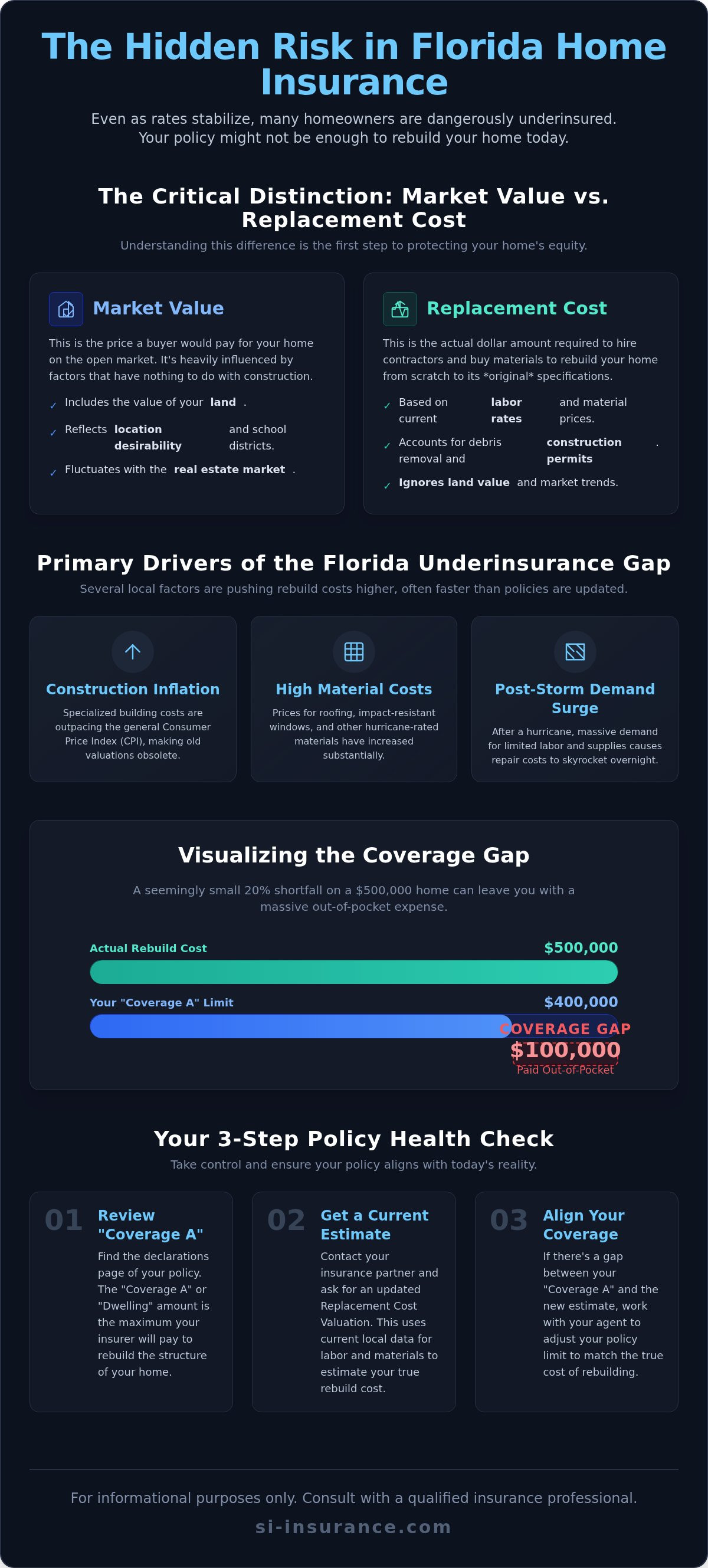
The technical distinction between your home's insured value and its actual rebuilding cost is where most equity is lost. Your policy might be based on what you paid for the home or an outdated appraisal, but neither of those numbers accounts for the 2026 prices of lumber, concrete, and skilled labor. A seemingly minor 20% gap in coverage can easily translate into a $100,000 out-of-pocket expense when you go to pull permits and sign contracts. Underinsurance is a failure to align policy limits with real-world labor and material rates.
Why Florida Homeowners Face Unique Risks
Florida’s geography makes the underinsurance crisis particularly acute. Unlike other regions where a house fire might be an isolated incident, our risks are often widespread. When a major hurricane makes landfall, the sudden, massive demand for repairs creates what experts call a "demand surge." Labor prices for roofers and specialists can skyrocket as they're courted by thousands of homeowners at once. This volatility is why high-quality home insurance florida is more than a line item; it's a strategic shield for your primary asset. In a market where the baseline for protection has shifted significantly over the last three years, failing to update your limits is essentially self-insuring for the most expensive portion of a rebuild.
Primary Drivers of the Florida Underinsurance Gap
While general economic indicators might suggest a cooling period in some sectors, the specific cost of replicating a residential structure in South Florida has followed a much steeper trajectory. If you haven't adjusted your coverage since 2022, you're likely holding what we call a "zombie policy." This is a contract that remains active on paper but is practically hollow when it comes to covering a modern total loss. The primary engine behind this gap is the compounding effect of construction-specific inflation, which often outpaces the general Consumer Price Index (CPI) by a significant margin. When you combine these rising costs with the persistent labor shortages in Broward County, the result is a systemic vulnerability for the average homeowner.
Many individuals mistakenly believe that a standard appraisal conducted for a mortgage or a sale reflects their insurance needs. In reality, these appraisals focus heavily on market value, which includes the land and the desirability of the location. Insurance valuations must focus exclusively on the cost of labor and materials required to replicate the structure itself. Relying on outdated market data is the fastest way to find your home underinsured florida residents often discover this discrepancy only when a contractor’s estimate arrives, revealing a six-figure shortfall that the policy cannot bridge.
Construction Inflation and Material Costs
Roofing materials and impact-resistant windows, both essential for our region's high-velocity hurricane zones (HVHZ), have seen substantial price increases over the last three years. A policy written in early 2022 simply doesn't reflect the 2026 market rates for these specialized components. Additionally, the labor market in Pompano Beach and Sunrise remains exceptionally tight. Skilled tradespeople are in high demand, which drives up the cost of every repair hour and extends reconstruction timelines, further inflating the final bill. This divergence between general inflation and construction costs means your "inflation guard" endorsement may not be keeping pace with the regional reality.
Ordinance or Law: The Hidden Cost of Compliance
Perhaps the most overlooked driver of the underinsurance crisis is the cost of meeting modern building codes. Ordinance or Law coverage is designed to pay for the required upgrades when a damaged home must be rebuilt to current standards. In Florida, these requirements are non-negotiable. Rebuilding a home to meet contemporary HVHZ standards can add 20% to 30% to the total cost compared to the original structure. Without this specific endorsement, you could find yourself legally required to install expensive upgrades that your insurance company isn't obligated to fund. This forces homeowners to liquidate personal assets to bridge a gap they didn't know existed. If you're concerned about your current limits, it's wise to consult with a local independent agent who understands these specific regional pressures and can help you verify your actual risk exposure.
Replacement Cost vs. Market Value: The Critical Distinction
One of the most persistent myths in the Florida insurance market is that your home’s market value is a reliable guide for your insurance coverage. While it’s tempting to look at a recent appraisal or a soaring real estate estimate as the "correct" number, doing so is a strategic error that leaves your equity exposed. Market value is a reflection of what a buyer is willing to pay for your home, your neighborhood, and the dirt your house sits on. While luxury real estate specialists like DeFeo Luxury Properties can provide precise insights into what buyers on the Gulf Coast are currently paying for premium properties, insurance only cares about the cost of labor and materials required to rebuild that structure from the ground up at 2026 prices. If you confuse these two, you're likely to end up with a home underinsured florida families often find themselves in this trap when they assume a high market value automatically equals high protection.
Relying on a bank appraisal for insurance purposes is particularly dangerous. Lenders are primarily concerned with the loan-to-value ratio and protecting their investment in the event of a default. They aren't calculating the specific cost of a roofing crew in Pompano Beach or the current price of impact-resistant glass. To ensure you can actually move back into a finished home after a disaster, your policy must be anchored to Replacement Cost Value (RCV) rather than a real estate valuation.
Your lot retains its value even if a hurricane levels every wall on the property. Because the land doesn't burn or blow away, including its value in your insurance calculations leads to a distorted perspective on your actual risk. To get a clear picture, you must separate your "improvement value" from the total property value. By focusing your insurance dollars strictly on the structure rather than the dirt, you ensure that your policy limits are aligned with the physical reality of reconstruction. This distinction is vital to avoid paying for coverage you don't need while missing the protection you actually do.
The Pitfalls of Actual Cash Value (ACV)
Choosing an Actual Cash Value policy might lower your monthly premium, but it introduces a massive financial vulnerability in a total loss scenario. ACV calculates your payout based on the replacement cost minus depreciation. If your kitchen cabinets are fifteen years old or your roof is nearing the end of its lifespan, an ACV policy will only pay you for their "used" value. In contrast, a Replacement Cost Value (RCV) policy offers a "new for old" promise. It provides the funds necessary to rebuild with modern materials at today's prices, regardless of how much the original components have aged. For primary Florida residences, RCV is essentially non-negotiable for maintaining financial continuity.
How to Perform a Comprehensive Insurance Audit
Transitioning from understanding the risks to securing your equity requires a methodical evaluation of your current policy. You shouldn't wait for a tropical system to enter the Gulf before you decide to look at your coverage limits. Ensuring you aren't a home underinsured florida statistic requires a proactive approach that moves beyond simply paying your premium. A thorough audit allows you to identify where your current protection ends and where your personal financial liability begins. This process starts with your documentation and ends with a professional verification of your home's actualized reconstruction value.
Beyond the primary limits, you must look for specific endorsements that act as safety valves during a claim. An "Inflation Guard" helps your coverage limits keep pace with rising costs between renewals, while "Water Back-up" coverage protects you from internal drainage failures that aren't typically covered by standard flood or home policies. Additionally, documenting every upgrade, from a new roof to a kitchen remodel, is essential. These improvements increase your home's replacement value, and if they aren't reflected in your "Coverage A" limit, you're essentially self-insuring those high-value assets.
Reviewing Your Declarations Page
Your declarations page is the summary of your financial defense. Locate "Coverage A" (Dwelling) and compare this number to current local build rates. In 2026, building costs in Broward County have reached levels that make older policies obsolete. You should also check for an "Extended Replacement Cost" endorsement, which provides a buffer, often 25% or 50% above your limit, to account for the "demand surge" pricing discussed earlier. Finally, verify your hurricane deductible. It's usually a percentage of your total coverage rather than a flat dollar amount. If your deductible is 2% of a $500,000 policy, you need $10,000 in liquid savings ready to go before your insurance pays a dime.
Consulting with a Local Professional
While DIY audits are helpful, a local insurance agency in Sunrise, FL provides the neighborhood-specific data necessary for absolute precision. They understand the specific labor rates in Pompano Beach and the unique structural requirements of homes built in different decades. During an annual review, ask your agent if your policy includes "Ordinance or Law" and what the current local cost per square foot is for your specific home's finish level. This audit is the only way to confirm you aren't currently a home underinsured florida policyholder. A meticulous 15-minute audit can prevent a lifetime of debt. If you haven't reviewed your limits in the last twelve months, schedule a comprehensive policy review with a strategic partner who can verify your actual risk exposure.
Strategic Risk Management with SI Insurance
At SI Insurance, we understand that your home is much more than just a physical structure; it's where your life happens and where your family feels safe. We don't believe in one-size-fits-all coverage because we know every family's needs are unique. Our team acts as your personal guide, helping you navigate the complexities of the market with a focus on your long-term security. We're here to make sure you never have to deal with the stress of a home underinsured florida homeowners can sometimes face when policies aren't kept current. We see ourselves as your partners, working together to keep your equity exactly where it belongs.
Our approach to finding the right coverage starts with a deep understanding of our local community. Because we're based right here in Sunrise and Pompano Beach, we see the real-world changes in construction costs and labor every day. We use this local insight to build a protection plan that's actually grounded in reality. Since we're an independent agency, we aren't tied to any single carrier. We have the freedom to compare options from over 20 different Florida insurance companies, which means we can find the specific policy that fits your home and your budget perfectly.
Personalized Solutions for Your Unique Needs
We take a thoughtful, human approach to every policy we create. We'll sit down with you to listen to your concerns and look at every detail of your property. This level of care is especially important for high-value items that might need extra attention, like your jewelry insurance florida needs. We're committed to making sure every part of your lifestyle is protected with a plan that makes sense. You can trust that our advice is based on what's best for you, delivered with the warmth and honesty you'd expect from a neighbor.
Get in Touch with SI Insurance
Protecting your home shouldn't feel like a chore or a source of anxiety. We invite you to stop by our offices in Sunrise or Pompano Beach for a relaxed, face-to-face conversation about your coverage. Our consultative process is straightforward and easy to understand, designed to give you clarity and confidence. You can also visit us online at learn more to start your strategic assessment today. We're ready to show you how a local partner can make all the difference in keeping your home and your equity safe for years to come.
Securing Your Financial Future in a Stabilizing Market
The stabilization of the Florida market in 2026 offers a rare window of opportunity to recalibrate your defense strategy before the next cycle of volatility begins. You now understand that your home's replacement cost is a moving target, shaped by regional labor shortages and the rigorous demands of modern building codes. Relying on stale policy limits or real estate appraisals is no longer a viable method for protecting your primary asset. To ensure you aren't living with a home underinsured florida families often overlook, you must align your coverage with the physical reality of today's construction environment.
As an independent agency with access to more than 20 Florida carriers, we specialize in the sophisticated risk management required for high-value properties in Broward County. We've the local expertise to translate complex jargon into an airtight plan for your security. You shouldn't navigate this financial landscape alone when a calculated partner is ready to help. Take the first step toward absolute peace of mind and Request a Strategic Home Insurance Audit from SI Insurance. It's time to transform your insurance from a passive expense into a proactive shield for your equity. We're here to ensure your home remains the sanctuary it was meant to be.
Frequently Asked Questions
How do I know if I am underinsured on my Florida home?
You can determine your status by comparing the "Coverage A" limit on your declarations page to the current localized reconstruction costs in Broward County. In 2026, many homeowners discover they're a home underinsured florida case because their policy hasn't kept pace with labor hikes. A professional audit looks at your home’s square footage against the specific material rates in Sunrise or Pompano Beach to identify any dangerous shortfalls in your protection.
What is the difference between market value and replacement cost in insurance?
Market value represents what a buyer will pay for your property, including the land and the neighborhood's desirability. In contrast, replacement cost focuses strictly on the price of labor and materials needed to rebuild your structure from scratch. Because land doesn't burn or blow away, your insurance shouldn't cover it. Relying on market value often leads to incorrect coverage limits that don't reflect the physical reality of a total loss.
Does my home insurance automatically increase with inflation?
While many policies include an "inflation guard" endorsement, it doesn't always reflect the specific construction inflation seen in South Florida. These automated increases are often based on broad national indices rather than the volatile labor markets in Pompano Beach. You shouldn't assume your policy is self-correcting. A manual review is the only way to confirm your limits align with the actualized costs of 2026 building materials and specialized trades.
What happens if my Florida home is destroyed and I am underinsured?
If your coverage is insufficient, you'll be responsible for paying the difference between your policy limit and the contractor's final bill out of pocket. This financial gap can lead to long term debt or the inability to finish your home’s reconstruction. Being a home underinsured florida resident means your equity is essentially acting as a secondary deductible. Without adequate limits, a catastrophic storm can quickly transform a manageable claim into total financial insolvency.
Is it better to insure my home for the bank loan amount or the rebuild cost?
You should always insure your home for the full replacement cost rather than the bank loan amount. Lenders only require enough coverage to protect their financial interest in the mortgage, which might be significantly lower than the cost to rebuild. If you only cover the loan, you could lose your entire down payment and any accumulated equity if the structure is leveled. Your policy should protect your family's future, not just the bank's investment.
Can I get a separate policy for hurricane damage in Florida?
Hurricane damage is typically included in your standard Florida homeowners insurance policy, though it's subject to a specific "hurricane deductible" rather than your standard "all other perils" deductible. This deductible is usually calculated as a percentage of your total dwelling coverage. While you can't buy a standalone hurricane policy for a house, you can secure separate flood insurance, which is essential since standard home policies don't cover rising water or storm surges.
How often should I review my home insurance policy limits?
We recommend a comprehensive policy review at least once every twelve months or immediately following any significant home improvements. Adding a new roof, remodeling a kitchen, or installing impact windows increases your home's value and its replacement cost. If these upgrades aren't reported to your agent, your current limits won't reflect the new reality of your property. Annual audits ensure your risk management strategy remains as sophisticated as your investment.
What is Ordinance or Law coverage and why do I need it in Florida?
Ordinance or Law coverage pays for the additional costs required to bring a damaged home up to current building codes during reconstruction. Florida’s building standards are among the strictest in the nation and frequently change to improve storm resilience. Without this coverage, you'd be forced to pay for required upgrades, like new electrical systems or reinforced roofing, with your personal savings. It's a non-negotiable component for any modern Florida insurance portfolio.
Comments