


American Integrity Insurance Alternatives for Florida Homeowners
A lower premium isn’t necessarily a better alternative to American Integrity if the policy changes what your home is protected against. For Florida homeowners, the challenge is finding insurers that will consider a specific property, then comparing quotes whose exclusions, deductibles, and limits may differ in important ways. That’s why American Integrity Insurance alternatives for Florida homeowners are best assessed by property fit and policy terms, not brand name alone.
If you’re unsure which companies may consider your home, or whether a cheaper quote offers comparable protection, that uncertainty is understandable. Availability and underwriting decisions can vary by location and property, so an insurer that works for one homeowner may not be an option for another.
This article outlines insurer and market options to investigate, then explains how to compare coverage limits, exclusions, deductibles, and other policy terms consistently. It also covers why roof condition, location, and other property details can matter when seeking quotes. As an independent Florida agency, SI Insurance can discuss available options with homeowners and review policy details without assuming that any one insurer is the right fit.
Table of Contents
Why Florida homeowners look for American Integrity Insurance alternatives
How to evaluate American Integrity alternatives beyond the premium
Which Florida insurance options might be worth investigating?
How to switch homeowners insurance without leaving a coverage gap
Compare Florida homeowners options with help from SI Insurance Agency
Why Florida homeowners look for American Integrity Insurance alternatives
A change at renewal, a nonrenewal notice, or a shift in your property needs can prompt a search for another insurer. A new roof, a change in how the home is occupied, or a desire to revisit coverage limits may also make it sensible to review your options. Whatever starts the search, an insurer’s name alone can’t tell you whether it will consider your property, whether its quote represents good value, or whether its policy offers protection comparable to your current one.
In Florida, details such as wind exposure, hurricane deductibles, roof condition, and flood risk can shape the questions to ask. Homeowners policies and flood coverage aren’t interchangeable, so check each policy’s wording rather than assuming one covers what the other does. For a foundational overview of homeowners insurance, review how standard policies are generally structured, then verify the terms of any quote you receive.
For broader context on Florida-specific considerations, see this Florida home insurance guidance.
For another perspective on Florida insurers, you can also watch this video:
Changing insurers isn’t the same as making a like-for-like coverage comparison. A lower premium or a familiar company name doesn’t establish that a new policy protects your home in the same way. Keep that distinction in mind when researching American Integrity Insurance alternatives for Florida homeowners.
What to establish before comparing insurers
Start with the property address, occupancy, construction details, and current policy dates. Gather your declarations page, renewal or nonrenewal notice, and relevant property information, including roof details and updates. These records help ensure quote requests use the same facts. Underwriting decisions are individual, so a single feature, such as roof age or location, can’t predict whether a particular insurer will accept the property.
Florida property risks that can shape eligibility
Coastal exposure, roof characteristics, and the home’s overall condition may affect an insurer’s willingness to consider a property. Their impact depends on the insurer’s current guidelines and the specific risk. Ask how wind or hurricane deductibles apply, and review exclusions and coverage limits in writing. If flood risk is a concern, confirm whether flood coverage is included, excluded, or needs to be considered separately. Don’t infer the answer from a homeowners quote alone.
How to evaluate American Integrity alternatives beyond the premium
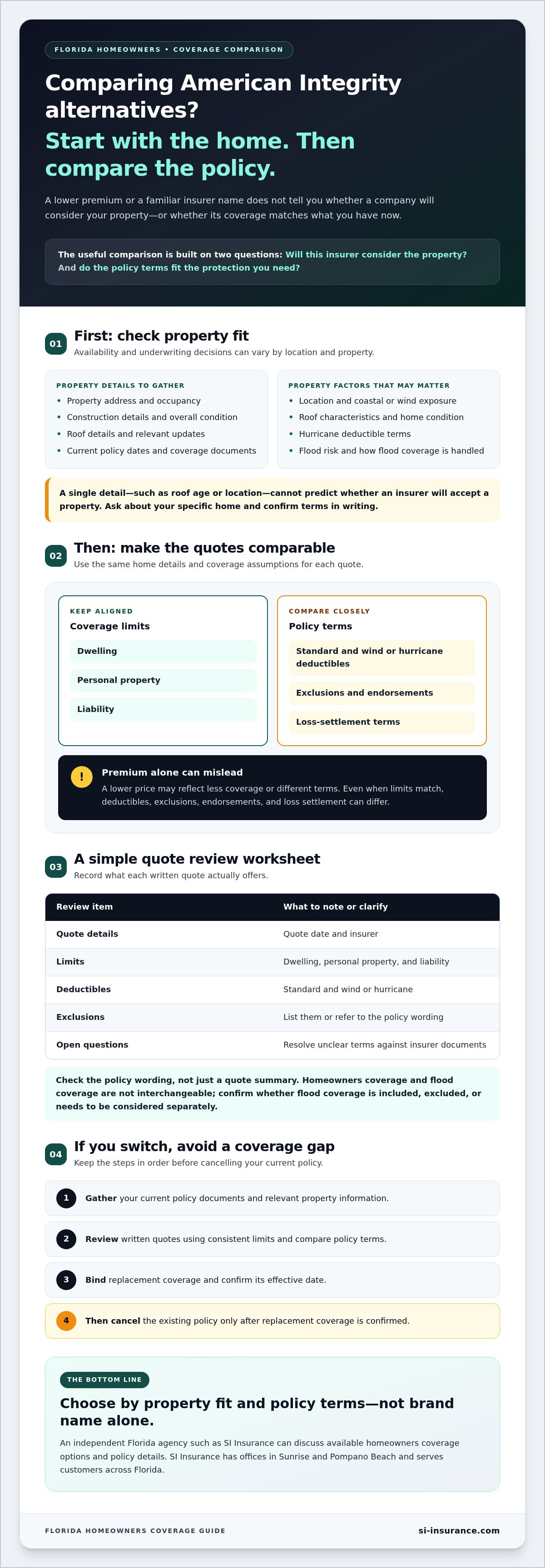
A useful comparison starts with written quotes based on the same home and coverage assumptions. Keep the dwelling limit, personal property basis, and liability limits consistent. Otherwise, a lower premium may simply reflect less coverage. Even when limits match, review the policy wording because deductibles, exclusions, endorsements, and loss-settlement terms can differ.
The lowest premium isn’t a like-for-like comparison unless the coverage terms align. Use a worksheet to record what each quote actually offers, then confirm the details against the insurer’s documents rather than relying on a summary alone.
Which policy details deserve a line-by-line review?
Compare limits for the dwelling, other structures, personal property, and additional living expenses. Check how personal property is valued, and read the deductible wording carefully, including whether a separate wind or hurricane deductible applies and how it is calculated. Then review exclusions, roof provisions, endorsements, and loss-settlement terms in the policy documents. If a term is unclear, ask for an explanation in writing before deciding.
Why underwriting fit matters as much as price
Property age, roof details, location, and overall condition may influence an insurer’s decision, but no single detail guarantees acceptance or rejection. A quote is useful only if the company is currently considering the property and the proposed terms meet your needs. Citizens Property Insurance Corporation, Tower Hill, Universal Property & Casualty, and Frontline can be research starting points, not confirmed options. Verify current availability and eligibility for your address. The Florida Office of Insurance Regulation is a source for Florida market information.
When researching American Integrity Insurance alternatives for Florida homeowners, the goal isn’t simply to collect more prices. It’s to identify quotes that fit the property and compare their terms on equal footing. An independent agency can discuss available options and review policy details. You can learn more about SI Insurance as one place to start that conversation.
Which Florida insurance options might be worth investigating?
There isn’t a single shortlist that fits every Florida home. A company that considers one property may not consider another, and an insurer’s name alone doesn’t confirm that a policy is available for your address or meets your coverage needs. Treat American Integrity Insurance alternatives for Florida homeowners as research leads. Assess each option against the home’s location, condition, and required protections, then confirm current availability and eligibility.
Private-market insurers are one place to begin. You can also research Citizens Property Insurance Corporation, but verify its current eligibility criteria and rules for your circumstances rather than assuming you qualify. Availability can change, so confirm whether an insurer currently offers homeowners coverage for your specific property before relying on it as an option.
How to research named insurer alternatives responsibly
Use the Florida's official insurance rate comparison tool as an initial reference, not a substitute for a property-specific quote. Sample rate information may help you frame questions, but it doesn’t establish that a company will insure your home or that its policy terms match another quote. Check current company and market information, then request the proposed policy documents and confirm the insurer legally issuing each quote. Read the documents for the actual limits, deductibles, exclusions, and conditions.
Keep property details consistent across inquiries: address, occupancy, roof information, construction, and the coverage you’re seeking. This makes it easier to tell whether a difference comes from the insurer’s appetite for the risk or from different assumptions in the quote.
When a different type of coverage may need consideration
Homeowners insurance and flood insurance are distinct policy types. Don’t assume a homeowners policy covers flood damage, or that a separate flood policy covers every water-related loss. Ask the insurer or a qualified agent to clarify how the specific policy defines covered causes of loss and exclusions. Depending on the property and protection needed, investigate whether coverage through the National Flood Insurance Program is relevant, and compare its terms with any other flood option available to you.
Windstorm coverage and residual-market options also deserve direct confirmation. Ask whether wind damage is covered, whether a separate deductible applies, and what conditions or exclusions affect the protection. For broader background before reviewing quotes, consult Florida home insurance coverage guidance. The goal isn’t simply a longer list of insurers, but a verified set of options that may fit your property and can be assessed through their written terms.
How to switch homeowners insurance without leaving a coverage gap
Changing policies takes more than choosing a quote. The replacement policy needs to be accepted, its terms reviewed, and its effective date confirmed before you take steps to end existing coverage. Cancellation procedures, any refund, and transition requirements depend on your current policy, so verify them with the insurer rather than assuming the change happens automatically.
A practical quote-to-bind checklist
Keep the process orderly by moving from your current documents to confirmed replacement coverage:
Gather your records. Set aside the declarations page, renewal notice, property details, and coverage limits you want to compare.
Request comparable quotes. Provide consistent information about the home and ask for written terms, including limits, deductibles, exclusions, and settlement provisions.
Resolve differences. Ask the insurer or agent to explain variations, especially those involving roof, wind, hurricane, or flood-related coverage. Confirm details in the proposed policy documents.
Confirm acceptance and dates. Ask whether the quote is final or still subject to inspection, documentation, or underwriting review. Obtain confirmation that the replacement policy has been accepted and verify its effective date.
Coordinate the transition. Confirm the new policy’s start date before cancelling existing coverage. Then verify the cancellation date and any refund or other transition terms with your current insurer.
If you have a mortgage, ask your lender what insurance documents it requires and how to submit them. Don’t assume that a quote or application satisfies those requirements. Confirm what documentation is needed and when.
Questions to ask before replacing a policy
Before making the change, clarify what could affect the proposed coverage. Is it subject to inspection or further review? How does the policy address the roof, wind and hurricane damage, and flood-related losses? If the property isn’t accepted after inspection or review, ask what options remain and how that could affect the transition. Get answers in writing where possible, and avoid cancelling the existing policy until you’ve confirmed the replacement coverage and dates.
This careful sequence matters whether you’re renewing or considering American Integrity Insurance alternatives for Florida homeowners. A new quote is a starting point, not proof that coverage has been bound. If you’d like help discussing homeowners coverage options and reviewing policy details, contact SI Insurance Agency.
Compare Florida homeowners options with help from SI Insurance Agency
Once you know what matters in a policy, an independent agency can help make the comparison more manageable. SI Insurance is an independent Florida agency that offers homeowners insurance and can discuss available coverage options. Its offices are in Sunrise and Pompano Beach, and it serves customers across Florida. That local context may be useful, but it doesn’t mean a particular insurer or policy will be available for every property.
A productive conversation starts with your home and priorities, not a company name. If you’re researching American Integrity Insurance alternatives for Florida homeowners, share what you hope to improve or preserve in your coverage. This gives the discussion a clearer focus and helps identify which policy differences deserve a closer review.
What to bring to a coverage conversation
Have the property address, current declarations page, renewal documents, and relevant property details available. If you know the renewal date, include it so you can discuss timing. It also helps to identify what matters most to you, such as a deductible you’re comfortable with, roof provisions, liability limits, or questions about flood risk. You don’t need to arrive with every answer. A clear list of concerns is a useful start.
As you discuss options, ask for material differences to be explained in writing. For example, if one proposal changes a deductible or excludes something addressed by your current policy, request clarification about how that difference affects the protection offered. Written explanations and policy documents make it easier to review the details carefully after the conversation.
A decision framework for choosing an alternative
Use this sequence to keep the decision grounded in your home’s needs:
Confirm property fit. First establish whether the insurer will consider the home at its location, subject to current eligibility and underwriting review.
Compare policy terms. Review limits, deductibles, exclusions, endorsements, and proposed effective dates instead of relying on the premium or a brief summary.
Check the final documents. Before deciding, confirm that the issued policy documents reflect the coverage and terms you intended to select.
The right choice is the option that fits the property and your priorities, with terms you understand. No insurer’s name alone can establish eligibility or equivalent protection, and availability can change. SI Insurance offers a place to discuss homeowners coverage options without assuming that any particular carrier is appointed or accessible for your situation.
If you’re ready to talk through your property details and coverage priorities, discuss Florida homeowners coverage with SI Insurance.
Make your next coverage decision with confidence
The right alternative to American Integrity is the one that fits your property and offers terms you understand, not simply the one with the lowest quoted premium. When assessing American Integrity Insurance alternatives for Florida homeowners, focus on whether an insurer will consider your home, how the written policy handles the risks that matter to you, and whether the final documents reflect the protection you expect.
A careful comparison can help you move from uncertainty to a more informed decision. Keep your priorities clear, ask about differences you can’t resolve from the quote alone, and confirm the replacement policy’s effective date before ending existing coverage.
SI Insurance Agency is an independent agency operated by SI Insurance LLC, with offices in Sunrise and Pompano Beach, serving customers across Florida. Homeowners insurance is among its offerings, and the agency can discuss coverage options without promising a particular insurer, eligibility, or savings. If you’d like to talk through your needs, discuss your Florida homeowners coverage options. Start with a thoughtful review of the coverage that suits your home.
Frequently Asked Questions
Is American Integrity the only homeowners insurance option in Florida?
No, but the alternatives available to you depend on your property, location, insurer underwriting criteria, and current market conditions. A company appearing in a search doesn’t mean it will quote your address or offer terms that suit your needs. Request current, property-specific quotes, confirm eligibility directly, and compare the written policy terms before deciding whether another option is appropriate.
What are alternatives to American Integrity Insurance for Florida homeowners?
Depending on your property and location, you might investigate private-market insurers or Citizens Property Insurance Corporation. Tower Hill, Universal Property & Casualty, and Frontline are examples to research, not confirmed options for your home. Availability, products, and eligibility can change. Confirm current offerings for your address, then compare actual limits, deductibles, exclusions, and endorsements. The names alone can’t establish suitability or equivalent protection.
Can I switch homeowners insurance before my renewal date?
A policy change may be possible before renewal, but the steps and any financial consequences depend on your existing policy, the replacement insurer, and your mortgage arrangements. Before cancelling, confirm in writing that the new policy has been accepted and verify its effective date. Ask your current insurer about notice and cancellation terms, and check with your lender about any required insurance documents.
How do I compare American Integrity alternatives fairly?
Request quotes using consistent property details and coverage assumptions, then compare the documents rather than premiums alone. Review dwelling and personal property limits, liability protection, deductibles, exclusions, endorsements, roof provisions, and loss-settlement terms. If a quote changes an important limit or deductible, note the difference before weighing its price. Ask the insurer or agent to explain material differences in writing so you can assess what each proposal actually provides.
Does homeowners insurance in Florida cover flood damage?
Don’t assume a homeowners policy covers flood damage. The answer depends on the policy wording, and flood protection may need separate consideration. Review the documents and ask how flood-related losses are treated. You can also ask whether a National Flood Insurance Program policy may be relevant to your property. Confirm current eligibility and terms before relying on any policy, since coverage depends on the specific contract.
Should I cancel my current policy as soon as I receive a new quote?
No. A quote may still be subject to underwriting review, inspection, or additional documentation, and it doesn’t necessarily confirm that coverage is bound. First verify acceptance, review the final policy documents, and confirm the effective date. Then contact your current insurer about cancellation steps and applicable policy terms. If you have a mortgage, confirm your lender’s documentation requirements before completing the change.
Can an independent insurance agency help me compare Florida homeowners policies?
An independent agency may help you discuss available coverage options and understand differences among quotes, but access depends on the agency’s insurer relationships and your property’s eligibility. Ask which options can be considered for your address and whether a quote remains subject to underwriting. SI Insurance Agency is an independent Florida agency serving customers across the state, with offices in Sunrise and Pompano Beach. Confirm directly what it can access for your property.
Comments