


Insurance Mistakes to Avoid When Buying Your First Home in Tampa
Could you secure homeowners insurance before closing and still leave your first Tampa home exposed to a serious coverage gap? One of the insurance mistakes to avoid when buying your first home in Tampa is assuming a standard policy covers every storm-related risk. Flood damage, in particular, needs separate attention. The home’s location, roof condition, and construction can also affect the coverage questions worth asking.
It’s understandable if insurance feels like one more complicated task alongside inspections, financing, and closing paperwork. Leaving coverage decisions until the final days can add pressure, especially if questions about the property or timing are still unresolved.
This guide explains how to assess homeowners and flood insurance options, identify Tampa-area risks that deserve a closer look, and plan around closing deadlines. You’ll see why the property’s flood information, roof condition, and wind-mitigation documentation matter, and how to make key decisions before time is tight. SI Insurance Agency offers home and flood insurance to help Florida buyers consider coverage as part of a deliberate first-home plan.
Table of Contents
First-Time Homebuyer Insurance Mistakes in Tampa Begin Before You Compare Quotes
Understand Tampa Home Insurance Coverage Before You Assume You Are Protected
Tampa Property Risks Can Change How You Compare Home Insurance
Avoid Closing Delays With a Tampa Home Insurance Review Checklist
Build a More Confident First-Home Insurance Plan With SI Insurance
First-Time Homebuyer Insurance Mistakes in Tampa Begin Before You Compare Quotes
A first home brings several moving pieces at once: inspection findings to review, property details to gather, insurance decisions to make, and a closing date to prepare for. It’s easy to treat insurance as a task to finish after the rest of the purchase is underway. Instead, include it in your property review so there’s time to clarify questions about the home and policy before deadlines feel urgent.
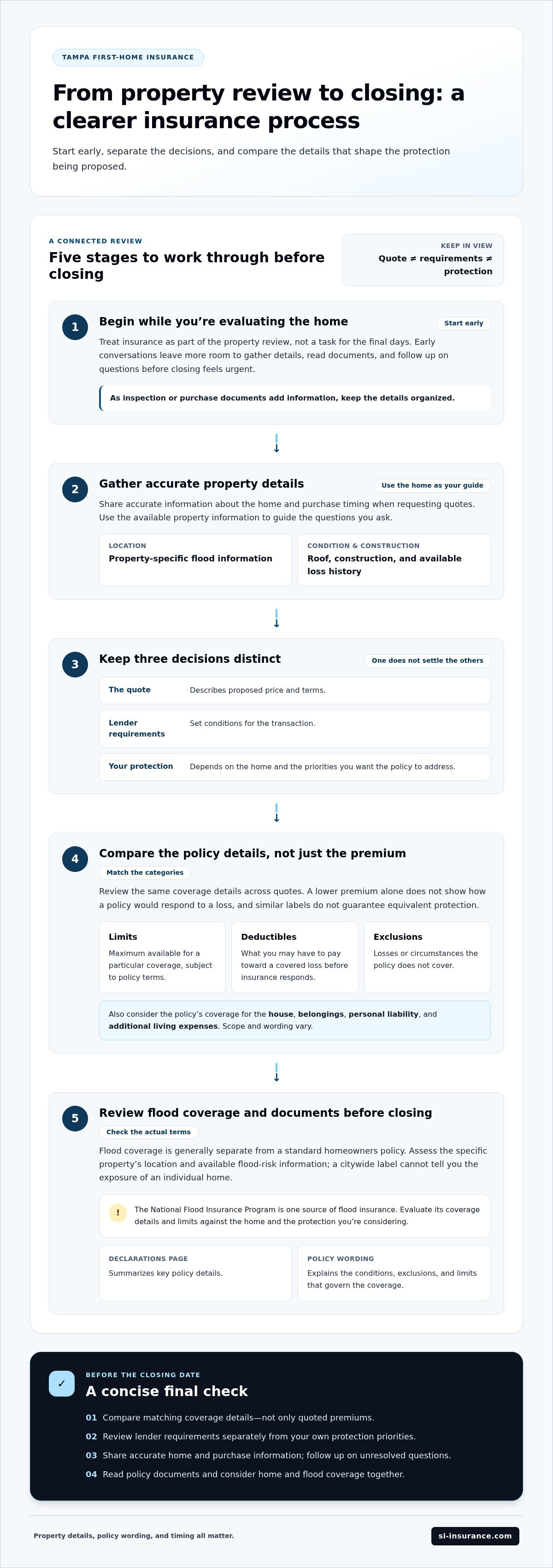
Keep three things distinct: a quote describes proposed price and terms, the lender’s requirements set conditions for the transaction, and suitable protection depends on the home and your priorities. Meeting one need doesn’t automatically meet the others. For context on how home policies are structured, consult this Home Insurance Overview.
For a broader look at homebuying pitfalls, this video offers additional perspective:
Use this short checklist to keep the process on track:
Compare the same coverage details, not just the quoted premium.
Review the lender’s stated requirements separately from your own protection priorities.
Gather property information while you’re evaluating the home.
Leave time to read documents and follow up on questions before closing.
Mistaking a low premium for the right policy
A lower quote can be appealing when you’re balancing a down payment, inspection costs, and other purchase expenses. But a premium alone doesn’t show how a policy would respond to a loss. Coverage limits, deductibles, and exclusions all affect what protection is proposed and what costs could remain yours. Compare these details side by side before weighing price.
For example, two quotes with different limits or deductibles aren’t an equivalent comparison. Check whether the figures and terms match the protection you want to evaluate. Don’t assume a higher premium means broader protection, either. The goal is to understand the terms behind each price. That’s central to avoiding insurance mistakes to avoid when buying your first home in Tampa.
Waiting until the final days before closing
Starting late can leave little time to collect missing property details, read documents carefully, or resolve questions. That doesn’t guarantee a delay, but it can make follow-up more stressful, especially if an inspection or purchase document has added new information about the home.
Begin insurance discussions while you’re evaluating the property, rather than treating them as a last-minute administrative task. As details become available, keep them organized and share accurate information about the home and purchase timing when requesting quotes. This gives you more room to compare options and address open questions before closing is close.
Understand Tampa Home Insurance Coverage Before You Assume You Are Protected
A homeowners policy doesn’t promise that every type of damage, expense, or liability will be covered. It’s a contract, and its protections, limits, conditions, and exclusions are set out in the policy terms. For a first-time buyer, understanding those details is more useful than relying on a policy label or brief quote summary, especially when several types of coverage appear together.
Policies may address four broad areas, though the scope and wording vary. Dwelling coverage relates to the house itself; personal property coverage concerns belongings; personal liability coverage may apply to certain claims that someone else was injured or their property was damaged; and additional living expenses may help with specified costs if a covered loss makes the home uninhabitable. The policy explains what qualifies, how much may be available, and what conditions apply.
The declarations page summarizes key policy details, while the policy wording explains the conditions, exclusions, and limits that govern them.
Read limits, deductibles, and exclusions together
A limit is the maximum amount available for a particular coverage, subject to the policy’s terms. A deductible is the amount you may have to pay toward a covered loss before insurance responds. An exclusion describes a loss or circumstance the policy doesn’t cover. Consider each in turn: whether the limits fit your needs, whether you could manage the deductible, and whether an exclusion leaves a gap you should understand.
Compare the same categories and details across quotes, but don’t assume insurers use identical wording or organize coverage in exactly the same way. If proposals show different limits or deductibles, note those differences before comparing prices. A side-by-side review of the declarations and relevant policy language can show what you’re weighing, rather than leaving you to assume similar labels mean equivalent protection.
Do not assume homeowners insurance covers flood damage
Flood coverage is generally separate from a standard homeowners policy. Review the actual policy terms instead of assuming all water-related damage is treated the same way. In the Tampa Bay area, flooding is a reason to assess the specific property’s location and available flood-risk information. A citywide label can’t tell you the exposure of an individual home.
The National Flood Insurance Program is one source of flood insurance, but evaluate its coverage details and limits against the home and the protection you’re considering. Don’t rely on a program name or general description to determine what a particular policy covers. Clarifying how homeowners and flood insurance fit together is one of the insurance mistakes to avoid when buying your first home in Tampa.
SI Insurance Agency offers home and flood insurance options for buyers in Florida.
Tampa Property Risks Can Change How You Compare Home Insurance
Two homes in Tampa can raise different insurance questions, even if they’re close together. Location, construction, roof condition, documented improvements, and available information about prior losses may all be relevant to an underwriting review. No single detail necessarily determines the outcome. A quote is more useful when it reflects the specific property instead of assumptions based on its city or county.
Use inspection findings and property records to build a focused set of questions. This framework connects what you learn about the home with the documents you’re reviewing:
Assess flood and storm exposure at the property level
A Tampa address alone can’t establish an individual home’s flood exposure. Use property-specific information, including current flood maps and relevant Hillsborough County resources, as a starting point, then compare it with the policy documents for the home. Maps, records, and insurer practices can change, so verify that the information you rely on is current. Take the same property-specific approach to storm exposure instead of making blanket assumptions about Tampa Bay homes.
Connect inspection findings to insurance questions
An inspection report helps you understand the home’s observed condition. An insurance evaluation considers information relevant to the proposed coverage and underwriting. They serve different purposes. If the report identifies roof wear, repairs, or updates, keep those details available when discussing the property. Clear documentation can help prevent mismatches between what’s known about the home and what appears in a quote.
Don’t assume a particular inspection type or roof-age threshold applies universally in Florida. Requirements and evaluation practices can vary, so follow the guidance that applies to the property and insurer. A repair or improvement also won’t necessarily change coverage or price in a predictable way. Disclose relevant details accurately and understand how they appear in the documents you receive.
These property checks make insurance mistakes to avoid when buying your first home in Tampa easier to spot before you compare options. If a quote appears to rely on outdated or incomplete information, revisit the underlying records. Keep the property documents together so you can resolve discrepancies during the review.
Avoid Closing Delays With a Tampa Home Insurance Review Checklist
Insurance preparation is easier to manage when it follows a clear sequence instead of becoming a last-minute closing task. Provide accurate property information, review the options and documents, and keep the purchase timeline visible. Lender instructions and insurer decisions are separate: read the lender’s requirements directly, and don’t assume that preparing a quote guarantees a particular underwriting decision or closing outcome.
Use these steps to organize your review:
Gather property details. Record the home’s address, expected purchase and closing timing, available inspection findings, and known updates. Keep supporting records together.
Identify open questions. Note property details that are incomplete or unclear. Don’t fill gaps with guesses; identify what information is still needed.
Request quotes using consistent details. Share the same accurate information and purchase timing with each quote request. If details change or become available, update them so requests don’t reflect different versions of the home.
Compare the proposed terms. Review the same coverage categories and compare limits, deductibles, and exclusions, not only the quoted premium.
Review flood coverage separately. If you’re considering flood insurance, review its proposed terms alongside the homeowners policy to understand how each document addresses coverage.
Check documents against the transaction. Read the policy documents and lender instructions directly. Resolve discrepancies or unanswered questions before the closing date where possible.
Prepare property details before requesting quotes
Accurate information makes a comparison more useful. Assemble the address, purchase timeline, inspection findings, and records of known repairs or updates before requesting quotes. If the inspection identifies a concern or a record is unavailable, don’t invent an answer or assume the detail is unimportant. Note what’s unknown and provide accurate information as it becomes available. This keeps quote requests aligned and makes differences in proposed terms easier to identify.
Review the policy documents before the closing date
A quote is a starting point, not a substitute for reviewing the documents that describe proposed coverage. Compare limits, deductibles, and exclusions, as well as any separate flood coverage you’re considering. Review lender instructions separately: they address the transaction, while policy documents set out insurance terms. For more context on state-specific considerations, consult this home insurance in Florida guide.
Starting before the closing rush gives you more room to organize records, compare documents, and follow up on questions. This sequence can help reduce avoidable insurance mistakes to avoid when buying your first home in Tampa while keeping buyer preparation distinct from lender and insurer decisions. SI Insurance Agency offers home and flood insurance options for Florida buyers planning a purchase.
Build a More Confident First-Home Insurance Plan With SI Insurance
A sound first-home insurance plan follows a deliberate sequence: assess the specific property, understand the coverage being considered, compare policy terms, and keep the purchase timeline in view. Each step provides context for your decisions, rather than leaving you to choose based on a quote alone or postpone document questions until closing is near. The aim isn’t to predict every outcome. It’s to understand what you’re reviewing and where important questions remain.
Keep the roles clear. You provide accurate information about the home and purchase; the lender communicates its transaction requirements, and insurers evaluate the information submitted. A quote or review can’t guarantee a particular policy result or closing outcome, but careful preparation can help you make an informed choice.
Use an insurance review to clarify your options
SI Insurance Agency offers home and flood insurance to help buyers consider their options and understand the policy details involved. An insurance review can connect the property’s known characteristics to the coverage being considered, highlight terms that differ between proposals, and identify questions that still need answers. Your decision should reflect the actual documents and the protection you want to evaluate.
For Tampa buyers, ground that review in the individual home, not assumptions about every property in the area. As you work through insurance mistakes to avoid when buying your first home in Tampa, keep property information and policy documents together. It’s easier to revisit a detail, compare the same information across options, and distinguish stated terms from questions that remain open.
Take the next step before the closing rush
Before discussing options, gather the property address, available inspection information, records of known updates, and expected purchase timeline. If a detail is unknown, say so rather than guessing. Sharing a clear picture of the property and timing gives the review a useful starting point and keeps the conversation focused on your purchase.
SI Insurance offers home, homeowners, and flood insurance to customers across Florida. An insurance review can be part of first-home planning, with attention to the property, the terms under consideration, and the transaction timeline. This helps you approach the decision without assuming every home has the same needs or that a particular outcome is assured.
If you’re preparing to buy in Tampa, connect with SI Insurance about Florida home and flood insurance options as part of your purchase planning.
Make Your Next Homebuying Decision With Confidence
Buying your first home is a major step, and insurance decisions deserve time alongside the rest of the purchase. The insurance mistakes to avoid when buying your first home in Tampa are less likely to catch you off guard when you review your choices before the closing rush. Add an insurance check-in to your homebuying calendar so you can address questions as they arise instead of carrying them into the final stretch.
You don’t need every answer before beginning a conversation. A clear sense of what you know, what you still need to understand, and when your purchase is expected to close can make the discussion more productive. SI Insurance Agency offers home insurance options for Florida buyers.
Discuss your Florida home insurance options and take your next step with a clearer plan. Thoughtful preparation can help you approach this milestone with greater confidence.
Frequently Asked Questions
Is homeowners insurance required by law to buy a home in Florida?
Florida law generally doesn’t require a buyer to purchase homeowners insurance simply to own a home, but a mortgage lender may make coverage a condition of the loan. Review your loan documents and lender instructions to understand what applies to your purchase. One insurance mistake to avoid when buying your first home in Tampa is assuming that meeting a lender’s requirement automatically means the policy fits your needs.
Does homeowners insurance cover flooding in Tampa?
Generally, a standard homeowners policy doesn’t cover damage caused by flooding, so buyers may need to consider a separate flood policy. The relevant risk and any lender conditions depend on the specific property and loan, not just its Tampa address. Review available flood information for the property, then compare it with the policy documents and lender instructions. Don’t assume coverage for other types of water damage includes flooding.
Can I get homeowners insurance before my Tampa home inspection is complete?
You can begin gathering quotes and discussing coverage before the inspection is complete. Whether a policy can be finalized or take effect may depend on the property information available and the insurer’s review. If an inspection later identifies a repair, update, or other detail that changes what you know about the home, provide accurate updated information. Keep the planned purchase and coverage effective dates clear as you coordinate next steps.
What is a four-point inspection, and will my insurer ask for one?
A four-point inspection typically documents four major home systems: the roof, electrical, plumbing, and heating or cooling equipment. An insurer may request one as part of its property review, but it isn’t automatically required for every Florida home. A general home inspection and a four-point report may serve different purposes, so don’t assume one replaces the other. Follow the documentation request that applies to the property being reviewed.
Does my mortgage escrow account pay my homeowners insurance premium?
If your mortgage includes an escrow account, the servicer may collect part of your housing payment for insurance and other escrowed expenses, then pay the premium from that account. Escrow arrangements vary, so check your closing documents and statements rather than assuming the premium is handled automatically. If insurance isn’t included in escrow, understand the payment schedule and arrange payment directly according to the policy documents.
What happens if I change my mind about my home insurance policy after closing?
You may be able to change policies after closing, but coordinate the dates carefully. Before ending existing coverage, understand the policy’s cancellation terms and make sure any replacement coverage is in effect when needed. Your mortgage servicer may also need updated insurance information. Whether a premium refund applies depends on the policy terms and timing, so review the documents and resolve payment or cancellation questions before making a change.
Will a home inspection guarantee that an insurer will cover my Tampa property?
No. A home inspection can provide information about the property’s condition, but it doesn’t guarantee that an insurer will offer coverage or specific terms. Insurers make their own assessments using information relevant to their review and may request additional details. For example, an inspection report may describe a roof condition, while the insurer considers that information alongside other property records. Treat the report as useful documentation, not an approval.
Comments