


Bilingual Insurance Agent Near Me: Local Guidance in Florida
What makes an insurance conversation clear: speaking in your preferred language, or leaving with a confident understanding of what a policy does and doesn’t cover? If you’re looking for a bilingual insurance agent near me in Florida, both matter. Insurance terms can be difficult to follow in a second language, and an online directory can’t show how clearly an agent will explain them.
It’s reasonable to want personal guidance without feeling rushed toward a purchase. A useful discussion gives you room to ask questions, hear unfamiliar terms explained plainly, and consider how coverage fits your needs. That matters whether you’re reviewing auto insurance, protecting a home or business, or comparing policy details.
This guide explains how to assess language-accessible guidance, prepare practical coverage questions, and approach a conversation with a Florida agency. You’ll learn what to clarify, from limits and deductibles to exclusions, so you can better understand the trade-offs. SI Insurance serves Broward County and beyond from offices in Sunrise and Pompano Beach, offering a local resource for personal and business insurance discussions.
Table of Contents
What a Bilingual Insurance Agent Near You Can Help Clarify
Searching for a bilingual insurance agent near me is often about more than finding someone who can hold a conversation in another language. Insurance terms have specific meanings. A clear discussion should help you understand the choices being considered, identify questions that remain, and know where to find the final details in the policy documents.
Language-accessible insurance guidance explains coverage concepts across languages with enough precision for you to understand your choices and ask informed questions. Conversational fluency can make an exchange more comfortable, but explaining policy language accurately takes more: technical terms need to be described without changing their meaning or implying protection the contract doesn’t provide.
An agent can explain options and how they relate to your stated needs. For a general overview of the role, see What is an insurance agent? Clear explanations support a more informed discussion, but they can’t guarantee a claim outcome or replace the terms of a specific policy. The written contract and selected coverage determine the details.
What should a clear insurance conversation include?
A useful conversation starts in straightforward language and introduces technical terms when they help explain a choice. If a term is unfamiliar, ask what it means in the context of the policy rather than relying on a word-for-word translation. The explanation should distinguish what is known from what depends on the contract, selected coverage, or other policy details.
Pause and ask follow-up questions when you need to. You might say, “Could you explain that another way?” or “Can I summarize what I understand, so you can clarify anything I’ve missed?” Restating a point can reveal confusion before you make a decision. It also gives the agent a chance to clarify the differences between coverage options without pressuring you to choose immediately.
Why local context matters for Florida insurance
Local context can make examples more relevant, but it doesn’t replace reviewing your individual needs. A Florida resident discussing auto insurance may have different questions from someone reviewing home, condo, or renters coverage. Even within the same area, property, vehicle, household, and policy circumstances vary, so no single example represents every customer.
SI Insurance is an independent Florida agency with offices in Sunrise and Pompano Beach, serving Broward County and beyond. Florida residents can use the agency as a local point of reference for personal and business coverage discussions. Whether you’re considering auto coverage in Sunrise or reviewing renters insurance in Pompano Beach, the goal is the same: understand the options being discussed and refer to the specific policy for its conditions, limits, and exclusions. Clear language makes the process easier to follow, while careful attention to the contract keeps the discussion grounded in the actual coverage.
Florida Insurance Terms a Bilingual Agent Should Explain Clearly
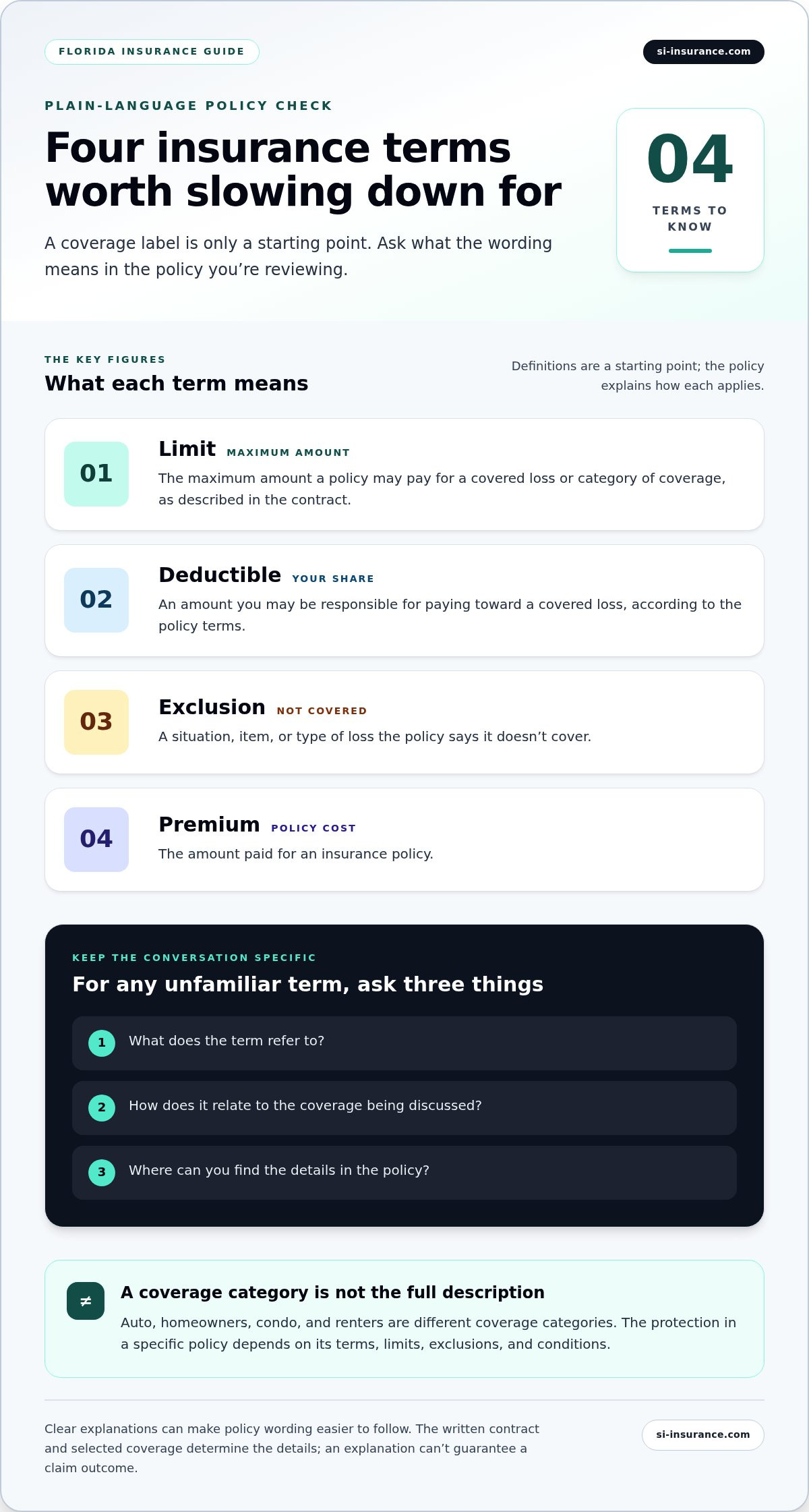
A policy label is a starting point, not a complete description of protection. A coverage category identifies the general kind of insurance being discussed; specific protection depends on the terms, limits, exclusions, and conditions in the individual policy. That distinction matters when comparing options, especially if technical wording is unfamiliar or doesn’t translate neatly into everyday language.
If you’re meeting with a bilingual insurance agent near me, ask for each unfamiliar term to be explained in context: what it refers to, how it relates to the coverage being discussed, and where the corresponding details appear in the policy. An agent’s explanation can make the wording easier to follow, but the policy remains the source for its terms. Florida’s Department of Financial Services provides official information about agents through its Florida Insurance Agent Licensing resource.
How to discuss auto and property coverage in plain language
Auto, homeowners, condo, and renters insurance address different needs, but the category name alone doesn’t explain what a particular policy includes. When reviewing a coverage component, ask: “What is this intended to address?” Then ask which limits, exclusions, or conditions apply to that specific option. For additional context on auto policy questions, SI Insurance offers Florida auto insurance guidance.
Keep the conversation specific to your circumstances. Someone discussing a vehicle may want to understand a term in an auto proposal, while a condo owner or renter may be reviewing different policy language. These examples can help frame questions, but they aren’t a substitute for checking your own policy wording. Don’t assume that a familiar coverage name means two policies provide identical protection.
How to make technical terms easier to follow
Ask for plain-language definitions, then connect each term to the policy being reviewed. These common words have distinct meanings:
Limit: The maximum amount a policy may pay for a covered loss or category of coverage, as described in the contract.
Deductible: An amount you may be responsible for paying toward a covered loss, according to the policy terms.
Exclusion: A situation, item, or type of loss the policy says it doesn’t cover.
Premium: The amount paid for an insurance policy.
Before a meeting, write down questions in your preferred language, especially terms you’ve seen in a quote, renewal notice, or existing policy. Ask for an explanation, then refer to the corresponding policy wording so you can distinguish the verbal description from the written terms. If an answer is still unclear, pause and ask for another explanation. This gives you a better basis for comparing coverage without assuming that a broad category guarantees a particular outcome.
How to Compare Bilingual Insurance Agent Support Without Guesswork
A conversation in two languages can feel more comfortable, but fluency alone doesn’t guarantee that policy details will be explained precisely. Compare support in three areas: whether explanations are clear, whether the agent’s style helps you follow the discussion, and how questions are handled afterward. This gives you a more useful basis for assessing a bilingual insurance agent near me than a directory label alone.
Independent agency or direct purchase: what changes?
An independent agency acts as an intermediary, helping connect a customer’s coverage needs with options from insurance providers. The options depend on the agency’s relationships and the specific circumstances. “Independent” doesn’t mean access to every carrier or policy. Direct online research lets you explore information on your own. Neither route is universally better; the difference is whether you prefer a guided discussion, self-directed research, or a combination.
What signals a useful bilingual insurance discussion?
Notice whether the conversation stays connected to your actual question. A helpful explanation relates a term to the coverage choice at hand rather than relying on a fluent exchange alone. It should leave room to pause, request clarification, and compare options carefully. Communication quality is separate from price, eligibility, or the outcome of a future claim. Clear discussion can support understanding, but it can’t guarantee any of them.
After an initial discussion, consider these points:
Clarity: Could you describe the main point in your own words afterward?
Explanation style: Were technical phrases put into context without losing their specific meaning?
Follow-up: Do you understand how remaining questions can be addressed and what information to refer to?
These are separate measures, not a scorecard that predicts policy quality. A directory may identify an agency near you, but it can’t show how an individual discussion will unfold. A conversation lets you assess the explanation directly, while online research gives you time to review general information independently. Use each for what it can establish, and rely on the policy wording for the terms of the coverage being considered.
How to Prepare for a Local Insurance Conversation in Florida
A little preparation can make an insurance discussion easier to follow, especially if you want to work through coverage questions in your preferred language. You don’t need a perfect script or a prescribed set of documents. Bring relevant policy information if you have it, and use these four steps to give the conversation a clear focus.
Identify your needs. Note what you want to discuss, such as a vehicle, home, condo, rental, or business, and what questions or concerns prompted the conversation.
Gather existing policy details. If you already have coverage, relevant policy documents or notices can help ground the discussion. Bring what’s useful to your questions; one particular document isn’t a fixed requirement.
List your questions. Write them in your preferred language, including unfamiliar terms and differences you want explained between proposed options.
Review the explanations. Before wrapping up, summarize what you understand and identify anything that still needs clarification.
Questions to organize before discussing coverage
Start with what you want the policy to address: which risks, property, or other needs are relevant to you? Note any terms that have been difficult to understand and ask for a clear explanation in your preferred language. If options are presented, ask how they differ in coverage, limits, and exclusions. These questions keep the discussion connected to your priorities rather than broad category names.
Consider cost and coverage as separate parts of the decision. A quoted premium is useful information, but it doesn’t explain by itself what protection the policy provides or which limitations apply. Ask about coverage details alongside the price so one doesn’t overshadow the other.
How to review an explanation before making a decision
At the end of a discussion, try describing the main points in your own words. This isn’t a test. It gives the agent a chance to correct a misunderstanding and helps you identify what you still need to review. Separate details tied to a policy or proposal from estimates and examples used only to illustrate a point. If the distinction isn’t clear, ask which information is specific to the option being discussed.
Take the time you need to consider the explanation and policy details. A clear conversation can support an informed comparison, but it shouldn’t pressure you to decide before your questions are answered. As you prepare, explore insurance options from SI Insurance.
Local Florida Insurance Guidance and Next Steps with SI Insurance
For readers searching for a bilingual insurance agent near me, location is one part of finding useful guidance. It also matters that you understand the coverage being discussed and can ask questions in terms that make sense to you. SI Insurance is an independent Florida agency with offices in Sunrise and Pompano Beach, serving Broward County and beyond. The agency provides a local point of contact for personal and commercial insurance needs.
The right questions depend on what you want to protect and the details of your situation. Identify the policy type you want to discuss, then note what you want clarified about its coverage. This keeps the conversation focused without assuming one policy or outcome will fit everyone.
Coverage conversations for Broward County residents
Florida residents can explore personal coverage categories such as auto, home, condo, and renters insurance. A driver might want to discuss auto coverage options, while a condo owner or renter may have different questions about a policy they’re considering. Business owners can also discuss business insurance and commercial auto coverage in relation to their operations. These are starting points, not descriptions of specific policy terms.
The Sunrise and Pompano Beach offices connect the agency to Broward County and surrounding communities, while SI Insurance serves customers across Florida. Local familiarity can make it easier to begin a coverage discussion, but personal circumstances and policy details still matter. For deeper auto coverage education, use the Florida auto insurance guide as a separate resource alongside questions about specific options you’re reviewing.
Choose a useful next step
Before reaching out, write down the policy type you want to discuss and the questions you want answered. If you’re reviewing existing coverage, keep relevant policy information nearby. For auto insurance, note which terms or proposed options you want explained; for business coverage, identify the property or activity you want the conversation to address. Preparation can be simple and tailored to your needs.
As you compare options, consider coverage details as well as the premium. Price alone doesn’t show the full scope of a policy, and no general description can replace its written terms. Take time to understand the distinctions that matter to you, and ask for clarification wherever needed.
To explore personal and commercial coverage categories and decide what you’d like to discuss, view SI Insurance options. This is a straightforward way to prepare for a more informed conversation without committing to a policy.
Make Your Next Coverage Conversation More Purposeful
Choosing a bilingual insurance agent near me is only one part of making an insurance discussion useful. Bring your priorities into focus: what you want to protect, which policy details you need clarified, and what would help you feel ready to compare options. Take the time you need to understand the information before deciding what to do. A conversation should leave you better equipped to consider your choices, not pressured to make an immediate commitment.
SI Insurance is operated by SI Insurance LLC and provides a local resource for discussing personal and commercial coverage. If you’re ready to consider your next step, explore the available options at your own pace.
Explore insurance options with SI Insurance and take the time you need to make an informed decision.
Frequently Asked Questions
What does a bilingual insurance agent do?
A bilingual insurance agent helps clients discuss insurance in two languages, including questions about coverage options and policy details. The role involves more than translating words: insurance terminology needs to retain its intended meaning when explained. If you’re looking for a bilingual insurance agent near me, consider whether you can follow the discussion, ask questions comfortably, and distinguish general explanations from the actual terms in a quote or policy.
Can a bilingual insurance agent explain my policy in my preferred language?
A clear explanation should make unfamiliar terms easier to understand while preserving their meaning. Ask the agent to explain a confusing phrase in context, then compare the explanation with the corresponding wording in your policy documents. Spoken guidance doesn’t replace the written policy. If the meaning still feels uncertain, pause and ask for clarification before making a decision.
Does an independent insurance agent represent one insurance company?
An independent agent acts as an intermediary and can help connect clients with insurance options from providers, rather than representing only one insurance company. The range of options depends on the agency’s carrier relationships and the circumstances of the coverage request, so independence doesn’t mean every carrier or policy is available. SI Insurance Agency is operated by SI Insurance LLC and serves individuals and businesses in Florida.
What should I bring to a conversation with an insurance agent?
Bring information related to the question you want to discuss, such as an existing policy, renewal notice, or quote you’re reviewing, if you have those materials. You can also note relevant changes, such as acquiring a vehicle or moving, and write down terms you’d like clarified. There isn’t one required document set for every discussion; useful information depends on your situation.
Can I discuss auto, home, and renters insurance with one local agency?
Yes. SI Insurance Agency offers auto, home, and renters insurance, along with condo, business, and commercial auto insurance. Discussing several coverage categories with one agency can help you organize questions across different needs, though each policy has its own terms and details. For example, prepare separate questions about a vehicle and a rental home rather than assuming one policy addresses both.
How do I compare insurance options if policy terms are difficult to understand?
Compare each option using the same questions: what coverage it describes, what limits apply, and what exclusions or conditions appear in the written terms. Note the answers beside the relevant quote or policy section, and mark anything that remains unclear. This makes differences easier to revisit without relying on memory alone. Consider the premium separately from the coverage details so price doesn’t become the only basis for comparison.
Comments