


Florida Home Insurance Claim Mistakes: A Strategic Guide to Avoiding Costly Errors in 2026
Updated: Aug 21
Did you know that waiting just one day past the new 12-month filing window could permanently forfeit your right to a recovery, regardless of the damage severity? We understand the immense pressure of standing in a damaged living room, trying to decipher complex 2026 policy language while fearing that a single misstep could lead to a denial. It's a high-stakes environment where the emotional weight of property loss is often compounded by the clinical nature of carrier communications. Avoiding common florida home insurance claim mistakes requires more than just promptness; it demands a calculated, documented strategy that aligns with the latest legislative shifts.
This guide provides a professional roadmap to managing these complexities, ensuring you meet every obligation while securing the full value of your claim. You'll gain a clear understanding of your policy obligations and the confidence to communicate effectively with adjusters. We'll examine the critical errors in documentation, the new mandatory dispute resolution process through the Division of Administrative Hearings, and the specific 2026 timelines that now dictate the success of your recovery.
Table of Contents
The High Stakes of Property Claims in the 2026 Florida Insurance Market
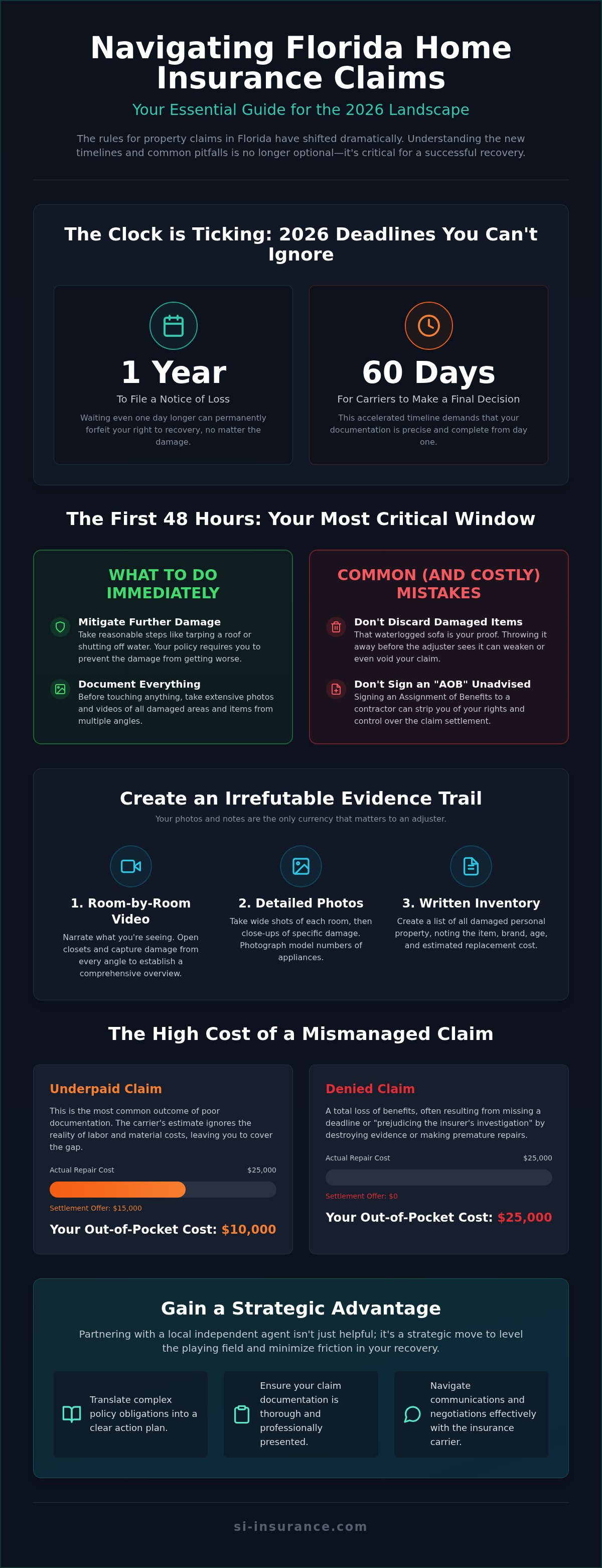
The Florida property market in 2026 reflects a complex equilibrium between necessary reform and rigorous enforcement. While we've seen signs of stabilization and even some rate reductions, the margin for error during the claims process has effectively vanished. Carriers now operate under a 60-day window to make final determinations, a shift that forces a faster, more technical evaluation of every loss. For homeowners in Sunrise or Pompano Beach, this environment demands a level of precision that feels at odds with the chaos of a sudden disaster. It's easy to let stress drive reactive decisions, but you must remember that from the carrier's perspective, documentation is the only objective currency. If a detail isn't captured in a photograph or a written log, it effectively doesn't exist in the eyes of an adjuster. A foundational step in this process is understanding property insurance and the specific perils your policy covers before the pressure of a claim sets in.
Why 2026 is a Turning Point for Florida Homeowners
Recent legislative updates have fundamentally altered the timeline for recovery. Most notably, the window to file a "Notice of Loss" has been compressed to just one year. This change aims to reduce litigation, but it also places a heavy burden on you to act immediately. In Broward County, where premiums often exceed $6,000, many residents have opted for higher deductibles to manage costs. This shift makes small-scale florida home insurance claim mistakes particularly costly, as an underpaid claim might not even clear your deductible, leaving you to fund repairs entirely out of pocket. At SI Insurance, we advocate for a proactive policy review before hurricane season begins to ensure your coverage limits align with current construction costs.
The Cost of a Mismanaged Claim
The first 48 hours after a loss are often the most critical. If you inadvertently discard damaged materials or fail to document the initial state of a room, you risk "prejudicing the insurer's investigation." This legal concept allows carriers to deny coverage if your actions prevent them from accurately assessing the cause of loss. There is a significant difference between a denied claim and one that is simply underpaid. A denial is a total loss of benefit, but underpayment is a more subtle failure where the carrier's estimate ignores the reality of Florida's labor market. Both outcomes usually stem from the same root: a lack of objective evidence, which is why avoiding common florida home insurance claim mistakes in the early stages is so vital for a full recovery.
Immediate Post-Loss Errors: Documentation and Mitigation Pitfalls
In the wake of a localized flood or a pipe burst, the instinct to restore order is overwhelming. Most homeowners feel a visceral need to scrub away the damage, yet this emotional response often leads to the most detrimental florida home insurance claim mistakes. Discarding a waterlogged sofa or a failed water heater before an adjuster arrives can inadvertently strip your claim of its objective proof. While you have a legal obligation to prevent further damage, you must do so without erasing the evidence that justifies your recovery. For a structured approach to these initial steps, referencing the University of Florida's Claim Filing Guide provides a reliable framework for residents who need to navigate this high-pressure phase.
The Duty to Mitigate: A Balancing Act
Creating an Irrefutable Evidence Trail
Documentation should be treated with the same rigor as a forensic investigation. Instead of just taking static photos, use a room-by-room video strategy. Start from the doorway to provide context, then zoom in on specific points of entry or failure. It's also vital to save the "failed part," such as a cracked supply line or a faulty valve; this physical evidence is often the only way to prove the cause of loss was a covered peril rather than wear and tear. Ensure your digital files retain their metadata and timestamps to verify exactly when the damage was recorded. Maintaining a meticulous log of every conversation, vendor visit, and expense is the only way to ensure your claim remains on track. If you're feeling overwhelmed by these requirements, consulting with a strategic risk advisor can help you organize your claim file before minor errors become permanent denials.
Communication Missteps: The Risk of Statements and Initial Settlements
Communicating with an insurance carrier requires a level of tactical awareness that most homeowners aren't naturally prepared for. While it's human to want to be helpful and transparent, the reality is that the claims process is a formal financial transaction. One of the most pervasive florida home insurance claim mistakes involves the way information is shared during the initial outreach. Your carrier is looking for objective data to either validate or exclude coverage, and your verbal input serves as a primary source for their legal determination. Every statement is evaluated against the specific language of your policy, meaning a casual description can have unintended consequences.
Navigating the Recorded Statement
Speculation is perhaps the greatest risk during a recorded statement. If an adjuster asks about the origin of a leak and you suggest it "might have been going on for a while," you could inadvertently trigger a "wear and tear" or "long-term seepage" exclusion. It is vital to remember that "I don't know the exact timeline yet" is a valid and often necessary response. You are not a forensic engineer; therefore, you should wait for professional reports before committing to a narrative that could jeopardize your recovery. Always review your "Duties After Loss" section before the call so you understand exactly what information you are contractually obligated to provide.
Evaluating the Initial Settlement Offer
When the initial settlement offer arrives, it often feels like a relief after weeks of uncertainty. However, these first checks are frequently based on "Actual Cash Value," which accounts for depreciation. If your policy provides for "Replacement Cost Value," you must understand the specific methodology for recovering that withheld depreciation once repairs are verified. Accepting a check is usually acceptable, but signing a "Full and Final Release" is a significant error if repairs are not yet complete. Hidden damage, such as microbial growth or structural compromises behind drywall, often only becomes apparent once the restoration work begins.
Under the current 2026 regulations, insurers are required to decide on a claim within 60 days of receiving it. This accelerated timeline can sometimes lead to rushed estimates that overlook the specific labor rates in the South Florida market. Keeping your claim open for supplemental findings is a strategic necessity. If you find yourself at an impasse with an offer that feels insufficient, the new mandatory dispute resolution process through the Division of Administrative Hearings offers a structured path forward. This system is designed to be faster than traditional litigation, but it still requires a foundation of professional-grade evidence to succeed.
Navigating Deadlines and 2026 Regulatory Requirements
Missing a statutory deadline is perhaps the most avoidable yet devastating of all florida home insurance claim mistakes. As of 2026, the window for homeowners to file an initial property insurance claim has been reduced to exactly one year from the date of loss. This shift from the previous two year period was implemented to expedite the recovery process, but it leaves little room for hesitation. If you discover hurricane damage months after the event, the burden of proving that the delay was reasonable falls entirely on you. This compressed timeline applies not just to the initial filing, but also to supplemental claims, which must be submitted within specific windows to be considered valid under current Florida law.
The 'Prompt Notice' Standard in Broward County
In Broward County, where coastal exposure and high density often lead to a surge in claims following a storm, courts have become increasingly rigid regarding the "prompt notice" requirement. A Notice of Loss is a formal contractual trigger that initiates the insurer's duty to investigate and adjust your claim. In 2026, "prompt" is generally interpreted as notifying your carrier as soon as the damage is discovered or should have been discovered through reasonable inspection. Failing to report roof damage immediately after a storm can lead to a denial if the carrier argues that your delay allowed interior mold or structural rot to worsen, thereby increasing the cost of the claim unnecessarily.
The Proof of Loss: Accuracy Over Speed
While the Notice of Loss starts the clock, the Sworn Proof of Loss is the document that carries the most legal weight. This is your formal statement of the amount you are claiming, supported by detailed inventories and repair estimates. Common errors here include failing to account for depreciation correctly or submitting a contents list that lacks specific brand details and age. In 2026, your Proof of Loss must align perfectly with the documented evidence you've gathered. If there's a discrepancy between your sworn statement and the digital metadata of your photos, it can create a "credibility gap" that adjusters may use to contest the entire claim. To ensure your filing strategy aligns with these rigid 2026 statutes, it is prudent to consult with a local Broward County agent who can audit your documentation before it reaches the carrier.
If a dispute arises regarding the valuation in your Proof of Loss, the 2026 legislative landscape has introduced a mandatory resolution process. Under HB 459, effective July 1, 2026, disputes are now routed through the Division of Administrative Hearings (DOAH). This system replaces voluntary mediation with a structured, administrative alternative to litigation. While this process is intended to be faster and less expensive, its success depends on the quality of your initial filing. A meticulous Proof of Loss serves as your primary evidence in these hearings, making it the most critical document in your entire recovery strategy.
Strategic Recovery: How a Local Florida Agent Minimizes Claim Friction
While the technical and legal requirements of a claim can feel insurmountable, the presence of a professional advocate changes the entire dynamic of the recovery. Many homeowners view the claims process as an inherently adversarial battle between themselves and a massive corporation. However, shifting to a "managed recovery" mindset allows you to approach the situation with the same strategic rigor that a business applies to risk management. SI Insurance acts as your primary strategist, ensuring that the common florida home insurance claim mistakes discussed earlier, such as documentation gaps or missed deadlines, are addressed before they can compromise your financial outcome. Having a calm, calculated partner allows you to focus on your family's immediate needs while your recovery is handled with professional precision.
In Sunrise and Pompano Beach, local expertise is particularly valuable when it comes to the logistics of repair. We understand the specific challenges of the Broward County market, from the scarcity of qualified contractors following a major storm to the nuances of municipal building codes. By leveraging these local relationships, you can secure reputable vendors who respect the boundaries of your policy. This helps you avoid the predatory practices that often lead to underpayment or protracted litigation, positioning you as a prepared and proactive policyholder rather than a reactive one.
The Value of an Independent Advocate
At SI Insurance, our methodology begins long before a loss occurs. We focus on "policy engineering," which involves meticulously structuring your coverage to align with the unique risks of the Florida landscape. When a crisis hits, we serve as a professional intermediary, helping you interpret complex policy language and providing objective guidance on every communication with the carrier. This buffer is essential for avoiding the reactive errors that often occur when homeowners feel pressured by an adjuster's timeline. To understand how we build these protective structures from the start, you can learn more about our approach to Home Insurance in Florida and our commitment to long-term security.
Next Steps: Securing Your Property's Future
A successful claim payout shouldn't be the end of your risk management strategy. Once the repairs are complete, it's vital to conduct a post-claim policy audit. Your property's value and its risk profile have likely changed, and your coverage should reflect those updates. In the 2026 market, bundling your home coverage with flood or auto policies can also provide a layer of stability and potential rate relief that isn't available through single-line carriers. This proactive stance ensures that you aren't just recovering from the last event, but are better prepared for the next one. If you're ready to transition from a reactive posture to a position of absolute security, contact SI Insurance for a professional policy review today and let us help you navigate the complexities of the Florida insurance landscape with confidence.
Mastering Your Property Recovery Strategy
The evolution of Florida's insurance landscape in 2026 means that precision is no longer optional. While the legislative shifts we've discussed, from compressed timelines to the new administrative dispute resolution process, can feel daunting, they also provide a clearer framework for those who are prepared. Avoiding common florida home insurance claim mistakes is ultimately about maintaining a meticulous evidence trail and understanding your contractual obligations before a loss occurs. It's about shifting from a position of vulnerability to one of strategic control.
By partnering with a local advocate who understands the specific risks inherent to Broward County, you gain the intellectual confidence to handle any property loss with composure. We focus on providing the stability and foresight needed to protect your most valuable assets in a shifting financial environment. This professional partnership ensures you aren't just filing a claim; you are executing a calculated recovery plan that prioritizes your long-term security and financial health. As part of a holistic approach to safeguarding your future, you can learn more about coordinating your health coverage with your broader financial goals. You don't have to navigate these high-stakes complexities alone.
Secure your Florida home with a strategic policy review from SI Insurance. Taking these proactive steps today ensures that when you're faced with a sudden loss, you can move forward with absolute security and peace of mind.
Frequently Asked Questions
What happens if I accidentally threw away damaged property before the adjuster arrived?
Discarding evidence can lead to a claim denial because it prejudices the insurer's ability to investigate the cause and extent of the loss. If you must remove items for safety or health reasons, you should take detailed, high-resolution photographs and video from multiple angles first. Keep any serial number tags or model plates to verify the item's specifications and value for the adjuster's eventual report.
Can I perform my own emergency repairs to stop a leak in Florida?
You have a contractual duty to take reasonable steps to prevent further damage, which often includes stopping an active leak. Performing temporary repairs like shutting off water valves or placing tarps is encouraged, provided you document the area before and after your work. It's vital to avoid permanent repairs or structural changes until the field adjuster has conducted their official inspection and verified the initial cause of loss.
How long do I have to file a hurricane claim under 2026 Florida law?
Under the current 2026 statutes, you have exactly one year from the date of the storm to file your initial property insurance claim. This reduction from the previous two year window means promptness is essential for your recovery. Missing this deadline is one of the most frequent florida home insurance claim mistakes that results in a total loss of benefits, as carriers aren't legally required to consider late notices.
Should I accept the first check my insurance company sends me?
You can generally accept the initial payment, but you should never sign a "Full and Final Release" unless you're certain all repairs are complete and accounted for. These first checks are often based on Actual Cash Value, which includes depreciation. You must keep the claim open for supplemental requests, especially since hidden issues like mold or structural rot often appear only after the restoration work has begun.
What is the difference between a public adjuster and my insurance agent?
A public adjuster is a private professional you hire to negotiate your claim in exchange for a percentage of your final settlement. Your independent insurance agent provides strategic guidance and acts as a professional intermediary throughout the process without taking a portion of your recovery. An agent's role is to ensure your policy is engineered correctly from the start so that claim friction is minimized when a loss occurs.
Is it a mistake to give a recorded statement to my insurance company?
While your policy requires you to cooperate with the investigation, giving a recorded statement is a high-stakes interaction where every word is evaluated for coverage exclusions. It's often better to provide a written statement or wait until you've fully organized your evidence. Avoid speculative language regarding the timeline or cause of damage, as casual guesses can inadvertently trigger exclusions for wear and tear or long term seepage.
What does 'Additional Living Expenses' (ALE) cover if my home is uninhabitable?
ALE covers the increase in your daily living costs, such as hotel stays, restaurant meals, and temporary rental fees, while your primary residence is being repaired. It's designed to pay for the difference between your normal household expenses and the higher costs caused by the displacement. You must keep every receipt and maintain a meticulous log of these expenditures to ensure you're fully reimbursed according to your policy limits.
How do I dispute my insurance company's estimate for repairs?
You should first provide the carrier with independent contractor quotes that reflect the current labor and material rates in the South Florida market. If the insurer refuses to adjust their estimate, you can trigger the appraisal process or utilize the new 2026 mandatory dispute resolution through the Division of Administrative Hearings. This administrative path is designed to be a faster and less expensive alternative to traditional litigation for resolving valuation disputes.
Comments