


Heritage Insurance vs Citizens Property Coverage in Florida: 2026 Comparison Guide
The cheapest property insurance policy in Florida might actually become the most expensive gamble you take with your home. When evaluating Heritage Insurance vs Citizens property coverage Florida homeowners often fixate entirely on bottom-line costs, assuming state-backed coverage is inherently safer or that a private takeout offer is an automatic trap.
If you've recently pulled a Citizens depopulation letter from your mailbox with a strict 30-day deadline, that hesitation is completely natural. It's stressful to balance fears of water damage sub-limits and roof depreciation against the risk of unexpected assessment surcharges after a brutal storm season.
The right decision hinges on policy language rather than premium figures alone. We'll break down the critical coverage limits, hurricane deductibles, and mandatory flood requirements separating an HO-3 policy from Heritage and Citizens. You'll learn how Florida's 20% depopulation rule works, what to look for in the fine print, and how to protect your home with lasting confidence.
Table of Contents
Florida Property Insurance Overview: Private Carriers vs State-Backed Coverage
Every homeowner in the Sunshine State eventually faces a fundamental choice between standard private protection and state-administered risk pools. Grasping the real differences between Heritage Insurance vs Citizens property coverage Florida homeowners encounter starts with structural regulation. While both entities insure residential structures, they operate under entirely different legal charters, financial backstops, and operational mandates.
Florida law established Citizens Property Insurance Corporation as the residual property insurance market; it serves as a safety net when admitted private carriers cannot extend terms. In contrast, Heritage Property & Casualty functions as a private, state-regulated stock insurance company. Admitted private carriers assume individual exposure backed by corporate capital reserves and commercial reinsurance contracts, whereas Citizens pools collective risk directly under legislative supervision.
To better understand how claims professionals view market options and carrier stability across the state, watch this helpful overview:
Recent legislative reforms targeting litigation abuse and runaway legal fees have begun stabilizing the marketplace. More private capacity is returning, prompting thousands of residents to compare private contracts against residual policies. Working alongside an independent broker like SI Insurance allows you to evaluate multiple admitted options objectively rather than remaining locked into a single market segment.
The Role of Citizens as the Insurer of Last Resort
Citizens exists strictly for properties that cannot secure coverage in the standard commercial market. Florida statutes require applicants to verify that private coverage is unavailable or that available private quotes exceed Citizens' renewal offers by a specific statutory threshold. State policy deliberately drives depopulation, transferring insureds into private portfolios to protect taxpayers from multi-billion-dollar storm exposures.
Heritage Property & Casualty in the Florida Market
Heritage actively underwrites Florida risks by securing financial stability ratings from agencies such as Demotech. These ratings evaluate carrier solvency, unassigned surplus levels, and catastrophe reinsurance treaties. As an admitted insurer, Heritage files its standardized policy forms, underwriting rules, and rating schedules directly with the Florida Office of Insurance Regulation. This framework gives consumers clear contractual terms backed by the Florida Insurance Guaranty Association if insolvency ever occurs.
Comparing Policy Coverage: Heritage Insurance vs Citizens HO-3 Contracts
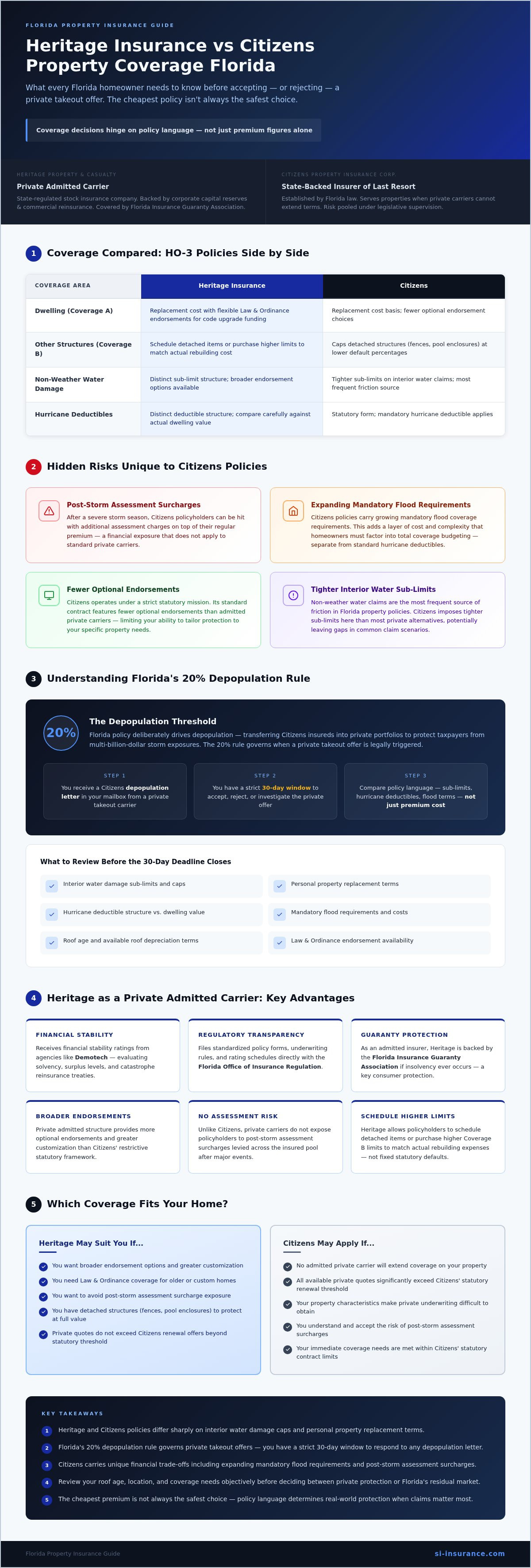
A policy's declaration page rarely tells the whole story. While both carriers issue standard HO-3 forms, reading the fine print reveals stark differences between Heritage Insurance vs Citizens property coverage Florida residents rely on for catastrophic and daily losses. Citizens operates under a strict statutory mission as the state's insurer of last resort, which means its standard contract features tighter sub-limits and fewer optional endorsements than an admitted private carrier like Heritage.
Dwelling and Other Structures Coverage Terms
Both carriers calculate Coverage A (Dwelling) based on estimated replacement costs, but the settlement mechanics diverge quickly. Heritage typically offers more flexibility for Law and Ordinance endorsements, which fund modern building code upgrades during repairs. Citizens caps detached structures like fences or pool enclosures at lower default percentages, while Heritage allows policyholders to schedule detached items or purchase higher Coverage B limits to match actual rebuilding expenses.
Water Damage Sub-Limits and Managed Repair Programs
Non-weather water claims represent the most frequent source of friction in Florida property policies. The two carriers handle these claims with fundamentally different contractual restrictions:
Citizens Managed Repair Program: Citizens caps non-weather water mitigation at $3,000 unless you utilize their approved contractor network. Permanent repairs are capped at $10,000 unless you participate in their managed repair program, which strips away your ability to choose an independent restoration crew.
Heritage Water Loss Endorsements: Heritage policies generally provide full Coverage A limits for sudden and accidental discharge, provided you maintain required leak detection systems or adhere to designated contractor protocols. Full-limit endorsements are often available for an adjusted premium.
Because restrictive endorsements can leave you paying tens of thousands out of pocket after a plumbing failure, having an independent agent review your policy endorsements through Si Insurance Agency ensures you spot these critical coverage caps before a pipe bursts.
Personal Liability and Loss of Use Limits
Coverage C (Personal Property) on a standard Citizens form often defaults to actual cash value, depreciating your possessions based on age unless you buy a replacement cost endorsement. Heritage regularly packages replacement cost terms directly into its baseline quotes. Similarly, Citizens limits personal liability to $100,000 with rare exceptions for $300,000, creating severe coverage gaps for high-net-worth households. Heritage permits liability limits up to $500,000, making it far easier to align your underlying home policy with personal umbrella insurance requirements.
Storm Hazards, Mandatory Flood Rules, and Hidden Assessment Risks
Tropical storms test an insurer's financial mechanics long before the first claim check is cut. Beyond everyday plumbing leaks, analyzing Heritage Insurance vs Citizens property coverage Florida homeowners must maintain requires evaluating statutory flood mandates and storm deficit recovery mechanisms. What seems affordable on paper can trigger substantial downstream expenses when a catastrophic season exhausts carrier cash reserves.
Citizens Phased Flood Insurance Requirements
Under Florida Statute 627.351(6), Citizens is phasing in a mandatory flood insurance requirement for all personal residential policies with wind coverage. As of January 1, 2026, homes with a dwelling limit (Coverage A) of $400,000 or greater must carry separate flood protection regardless of their FEMA flood zone. On January 1, 2027, this mandate expands to every Citizens residential policyholder with wind coverage. Private insurers like Heritage do not impose an across-the-board flood requirement unless your property sits in a federally designated Special Flood Hazard Area with an active mortgage.
The Reality of Post-Storm Assessment Surcharges
Citizens maintains a unique funding model that exposes its policyholders to direct financial liability after major hurricanes. If catastrophic claim volume depletes Citizens' reserves and reinsurance, state law authorizes specific recovery tiers:
Citizens Policyholder Surcharge: Citizens can levy a direct surcharge of up to 15% on its own policyholders to cover an operating deficit.
Emergency Assessments: If that initial surcharge proves insufficient, the state can assess nearly all Florida property and casualty policyholders, including auto insurance policies, across subsequent years.
Admitted private insurers manage insolvency risks through private reinsurance layers and mandatory participation in the Florida Insurance Guaranty Association. Heritage policyholders are not subjected to sudden 15% state-mandated operating surcharges if the company experiences severe storm losses.
Wind Mitigation Credits and Hurricane Deductibles
Both carriers apply calendar-year hurricane deductibles, which typically range between 2% and 5% of Coverage A. This deductible applies once per calendar year, regardless of how many named storms strike your home. However, verified wind mitigation features significantly reduce your base premium on both forms. Licensed inspections documenting hip roof geometry, hurricane clips, and complete opening protection unlock substantial discounts. Working with an independent advisor like Si Insurance Agency helps ensure all qualifying mitigation discounts are properly credited across competing quotes.
How to Handle a Citizens Depopulation or Takeout Letter
Opening your mailbox to find a depopulation packet can feel unsettling. Receiving an assumption offer from Heritage does not mean you did something wrong or lost your coverage overnight. Instead, it indicates that an admitted private carrier reviewed your home's underwriting profile and selected your policy for removal from the state-backed pool. Knowing how to weigh Heritage Insurance vs Citizens property coverage Florida rules dictate gives you back control over your dwelling protection.
The Florida 20 Percent Takeout Rule Explained
Florida law enforces a strict financial benchmark known as the 20 percent rule. Under this statute, if an admitted private carrier offers a comparable policy with an estimated renewal premium that is not more than 20 percent higher than your Citizens renewal rate, you become legally ineligible to stay with Citizens. The state considers this offer an available private-market solution, revoking your access to the residual market. If the private offer exceeds that 20 percent margin, you retain the legal right to decline the assumption and remain with Citizens.
Action Plan: Evaluating Your Takeout Packet
You have a strict 30-day window to evaluate and respond to a takeout packet. Ignoring the correspondence results in an automatic transfer to the private insurer upon your renewal date. Take these practical steps as soon as the envelope arrives:
Calculate the Premium Spread: Compare the private carrier's estimated renewal quote directly against your projected Citizens renewal premium to determine whether the proposal falls within the mandatory 20 percent threshold.
Examine Water and Roof Endorsements: Scrutinize the fine print for restrictive roof depreciation schedules or emergency water mitigation sub-limits. A private carrier might cost slightly more while removing Citizens' restrictive managed repair caps.
Verify Separate Flood Requirements: Check how moving away from Citizens affects your mandatory flood obligations. If your dwelling exceeds $400,000, staying with Citizens requires immediate flood coverage regardless of your zone, whereas a private policy might eliminate that added expense.
Register Your Formal Decision: If your offer is outside the 20 percent window and you prefer to stay, submit your opt-out election online through the Citizens portal before your 30-day clock expires.
Navigating takeout notices under tight deadlines can be challenging. If you received an assumption packet, contact Si Insurance Agency to conduct an independent review of your carrier options before your decision window closes.
Choosing the Right Protection: Navigating the Florida Insurance Market
Selecting the right policy is rarely about declaring one carrier universally superior to the other. When contrasting Heritage Insurance vs Citizens property coverage Florida homeowners need to evaluate their roof condition, household liability exposures, and geographical wind risk against specific contract exclusions. Finding the proper balance protects both your dwelling and your long-term personal finances.
When Heritage Insurance Is Often the Preferable Choice
Private admitted coverage through Heritage provides clear contractual advantages under specific circumstances:
Broad Water and Property Protection: Ideal for homeowners who prefer full Coverage A water limits without being locked into a mandatory network of state-assigned contractors.
Higher Personal Liability Limits: Best suited for families requiring liability protection up to $500,000 to satisfy personal umbrella insurance thresholds.
Properties Outside High-Risk Flood Zones: Advantageous for owners seeking to avoid Citizens' phased-in mandatory flood insurance purchase rules when their mortgage does not otherwise require it.
When Citizens Serves as the Practical Necessity
Despite restrictive endorsements, Citizens remains an essential safety net for several property scenarios across Florida:
Aging Roof Structures: Properties with roofs approaching or exceeding 15 years that struggle to pass stringent private underwriting guidelines.
Adverse Prior Loss History: Homes with multiple weather or non-weather claims within the past three to five years that private carriers decline to bind.
Significant Cost Disparities: Situations where available private admitted quotes exceed Citizens' renewal offers by well over the statutory 20 percent threshold.
The Advantage of Independent Agency Consultation
Working with an independent broker eliminates guesswork. Rather than pushing a single carrier's agenda, an independent agency evaluates multiple Florida-admitted carriers alongside Citizens. This comprehensive approach allows you to seamlessly bundle homeowners insurance with auto insurance, flood insurance, and umbrella policies to eliminate costly coverage gaps.
To dive deeper into statewide trends, deductible mechanics, and mitigation credits, explore our comprehensive Florida home insurance guide. When you're ready to review a takeout packet or compare competing policies line by line, contact Si Insurance Agency for an objective Florida coverage review. Their local teams in Sunrise and Pompano Beach bring specialized South Florida insight to protect your family's biggest investment.
Securing Smarter Property Protection for Your Florida Home
Deciding between private admitted security and residual market placement shouldn't come down to guesswork. When weighing Heritage Insurance vs Citizens property coverage Florida homeowners must look past initial premium comparisons to evaluate restrictive water damage endorsements, expanding mandatory flood rules, and post-storm assessment risks. A lower annual cost offers little relief if an everyday plumbing leak or tropical system leaves you facing thousands in out-of-pocket restoration shortfalls.
Whether you need to decipher an urgent takeout packet or simply desire comprehensive personal lines protection, partnering with an independent advocate changes the dynamic. An independent agency analyzes policy language across multiple admitted carriers to confirm your dwelling limits, roof terms, and liability schedules align with your actual exposure. With physical offices in Sunrise and Pompano Beach, local agents understand South Florida's unique coastal risks and regulatory environment.
Take charge of your dwelling's financial defense before the next storm cycle begins. Request a Florida Property Coverage Review from Si Insurance Agency to ensure your home, personal assets, and long-term peace of mind remain fully protected.
Frequently Asked Questions
What is the primary difference between Heritage Insurance and Citizens in Florida?
The main distinction lies in their corporate structure and operational purpose. Heritage is an admitted private carrier backed by private reinsurance capital and standard industry solvency ratings. Citizens operates as Florida's state-created insurer of last resort, designed strictly for properties unable to secure private coverage. In comparing Heritage Insurance vs Citizens property coverage Florida homeowners discover that Heritage offers broader endorsement flexibility, whereas Citizens utilizes more standardized, statutory terms.
What happens if I receive a Citizens depopulation letter naming Heritage Insurance?
Receiving this notice means Heritage identified your property as meeting their private underwriting criteria and submitted an assumption offer to remove you from the state pool. The letter outlines your projected renewal terms, including coverage limits and deductibles. You have 30 days to review the proposal and make a formal decision before your policy either transfers automatically or remains with Citizens under statutory eligibility rules.
Can I refuse a takeout offer from Heritage and stay with Citizens?
You can refuse the offer only if the private renewal premium exceeds your Citizens renewal quote by more than 20 percent. Under Florida law, an offer within that 20 percent threshold disqualifies you from continuing with Citizens, making the transfer mandatory. If the offer exceeds that percentage, you can submit an opt-out election through the Citizens policyholder portal within the designated 30-day window.
Does Citizens require me to buy separate flood insurance even if I am not in a flood zone?
Yes, statutory rules require separate flood insurance for Citizens policyholders carrying wind coverage. Properties with dwelling coverage of $400,000 or higher must carry flood coverage regardless of their designated flood zone. This mandate expands to cover all residential policyholders with wind coverage by January 1, 2027. In contrast, private carriers typically only require flood coverage if you hold a federally backed mortgage in an official high-risk flood zone.
How do water damage coverage limits differ between Heritage and Citizens?
Citizens restricts non-weather water claims with a $3,000 cap on emergency mitigation and a $10,000 limit on permanent repairs unless you join their mandatory contractor network. When evaluating Heritage Insurance vs Citizens property coverage Florida families find that Heritage typically provides full dwelling limits for covered water losses, provided you comply with basic maintenance terms and optional water endorsements that eliminate restrictive repair network mandates.
What are Citizens assessment fees, and could they impact my annual costs?
Citizens assessments are statutory surcharges imposed when major catastrophic storm seasons exhaust the insurer's reserves and reinsurance layers. Citizens can assess its own policyholders up to 15 percent directly on top of their annual premium. If that deficit persists, emergency surcharges can be levied across most Florida property and casualty policies, potentially inflating your annual insurance costs for years following a destructive hurricane season.
Why should I work with an independent insurance agency instead of buying directly?
Direct insurers or captive agents only sell their own specific products, leaving you with limited choices. Independent brokers like Si Insurance Agency partner with multiple Florida-admitted carriers as well as Citizens. With physical offices in Sunrise and Pompano Beach, their advisors objectively evaluate complex takeout packets, review restrictive policy endorsements, and coordinate your homeowners coverage with flood, auto, and umbrella policies across all Florida communities.
Comments