


How to Challenge a Denied Roof Insurance Claim in Jacksonville
A denied roof claim raises two separate questions: whether the insurer’s decision can be reviewed and what home insurance may be available in the future. If you’re researching how to get home insurance after a roof claim denial in Jacksonville, start by keeping those questions separate. The denial letter may cite policy terms or damage causes that aren’t immediately clear, while repair decisions may need attention.
It’s understandable to feel caught between protecting your home and figuring out what the insurer’s decision means. A denial doesn’t, by itself, tell you whether the evidence was incomplete, the damage was attributed to wear and tear, or a policy exclusion was applied. Understanding the stated reason helps you identify which records may be relevant and what questions to ask.
This guide explains how to review the denial and cited policy language, organize photos, inspection findings, repair estimates, and other relevant records, and consider options for seeking further review. It also covers how to compare future home insurance options in Jacksonville and across Florida with a clearer picture of your roof and coverage needs. A review request may clarify the decision, but it can’t guarantee a different outcome.
Table of Contents
Roof claim denied in Jacksonville? First identify what the insurer actually decided
Receiving a denial can be unsettling, especially when the roof needs attention and the letter relies on policy language you may not recognize. A denial is a decision to understand, not proof that every question about the damage or coverage has been settled. First identify exactly what the insurer declined and the reason it gave.
That distinction matters in Jacksonville and throughout Florida. The useful next step depends on whether the insurer rejected the entire claim, approved only part of it, or disagreed with the proposed repair work. These outcomes aren’t interchangeable. An estimate difference alone doesn’t necessarily mean all coverage was denied.
For a general explanation of the term acting in bad faith, see this overview. A denial by itself, however, doesn’t establish that an insurer acted improperly.
This video offers general roofing guidance. Its subject is hiring a contractor, rather than interpreting a claim decision.
What does a roof insurance claim denial mean?
A denial means the insurer has declined some or all of the coverage requested for the reported roof damage. A full denial rejects the requested coverage; a partial denial accepts some portion but declines another. A scope dispute is different: the insurer may accept that covered damage exists while disagreeing about the repairs or amount needed. Read the notice to identify the damage, the decision, and the policy provisions the insurer cites.
At a glance: A full denial declines the requested coverage; a partial denial declines only part of it; a scope dispute concerns the extent or cost of repairs. A partial payment or estimate disagreement isn’t automatically a full denial.
What to locate in the denial letter and policy
Look for the insurer’s explanation, any exclusions cited, and referenced inspection findings. Compare those details with the policy documents in effect on the reported date of loss, not a different policy version. If the letter’s wording is unclear, note the exact passage and request clarification through the insurer’s stated claim communication process.
Before deciding how to get home insurance after a roof claim denial in Jacksonville, understand what the insurer decided about the past loss. This can help you separate a claim dispute from questions about future coverage. The denial notice and a repair estimate are parts of the record, not substitutes for considering the policy language and claim details together.
How to review the denial: connect policy wording with roof-damage evidence
Once you know what the insurer decided, build a clear record of what was reported, inspected, and observed. An organized claim file makes it easier to compare the denial’s explanation with the available evidence. Avoid assuming that either the insurer’s assessment or your first impression tells the whole story.
Which documents and photos can help clarify a roof claim?
Gather the policy in effect on the reported loss date, the denial notice, claim correspondence, inspection materials, and dated photographs. Add repair records, receipts, and other reports related to the roof or resulting interior conditions. Keep copies together. Arrange photos by date and location so damage in separate areas, or changes over time, don’t get confused.
Policy and decision: Keep the relevant policy documents with the denial notice and any claim estimate.
Communications: Save letters, emails, and notes of calls, including their dates.
Condition records: Label roof and interior photos with when and where they were taken; include inspection reports and repair records.
A simple timeline can bring the file into focus. Note when you discovered the damage, when you reported it, when inspections took place, and when key communications arrived. Separate direct observations, such as a ceiling stain or a visibly displaced shingle, from conclusions about the cause. If you’re unsure what caused a condition, record that uncertainty rather than presenting a guess as fact.
How to read policy language without jumping to conclusions
Mark the coverage section, exclusions, conditions, and definitions cited in the denial. Compare the insurer’s description of the damage and its reasoning with your records, item by item. Policy wording varies, so general guidance isn’t a rule that automatically applies to your claim. United Policyholders explains common policy limitations for roofs, which may help you locate relevant terms in your own documents.
Claim decisions depend on the policy terms in effect for the reported loss and the documented facts of the individual claim. If a provision or inspection finding is unclear, note the exact wording and ask the insurer to explain how it relates to the damage described in the file.
For broader context on coverage considerations in Florida, read this Florida home insurance guide. Organizing your claim records can also help you make a more informed decision about how to get home insurance after a roof claim denial in Jacksonville. SI Insurance helps customers across Florida compare home insurance options for future coverage.
Compare your options after a Jacksonville roof claim denial
There isn’t one response that fits every denial. Your next step depends on what the insurer decided, whether you have information it may not have considered, and what the policy and claim record show. You can ask for clarification, submit additional information for review, explore a formal review route where appropriate, or accept the decision. Each option serves a different purpose, and none guarantees a particular outcome.
When might a clarification or reconsideration request make sense?
Consider writing to the insurer if the notice leaves a specific question unanswered, describes the damage differently from your records, or doesn’t address a document you submitted. Keep the request focused: identify the decision, cite the wording or finding you’re asking about, and explain which record may help clarify it. Follow the insurer’s stated process for sending information and retain a copy of everything.
An inspection report, dated photographs, repair records, or a clear estimate may help explain the issue under review. But an additional inspection or document doesn’t guarantee the insurer will change its decision. Its relevance depends on the policy, the evidence, and how the information relates to the stated reason for the decision.
When should you consider a formal review route?
If a direct request doesn’t resolve the question, formal options may be worth examining. Their availability and suitability depend on the policy, the facts, and current Florida procedures. The Florida Department of Financial Services describes Florida’s free mediation program. Review the department’s current information to understand its process and whether it may fit your circumstances.
Before pursuing a review, keep the decision records together: the denial notice, cited policy provisions, relevant correspondence, inspection materials, and the specific questions still in dispute. A formal process can provide another avenue to address a disagreement, but it doesn’t ensure coverage or a changed claim outcome. Legal interpretation and any public-adjuster process depend on individual circumstances, so general guidance isn’t a universal recommendation.
Accepting the insurer’s decision is another possible choice, particularly after reviewing the explanation and available records. Keep the claim file organized so you can understand the decision later and distinguish it from a future coverage application. If you’re also considering how to get home insurance after a roof claim denial in Jacksonville, treat that as a separate question from whether to seek further review of the claim. SI Insurance helps customers across Florida compare home insurance options for future coverage.
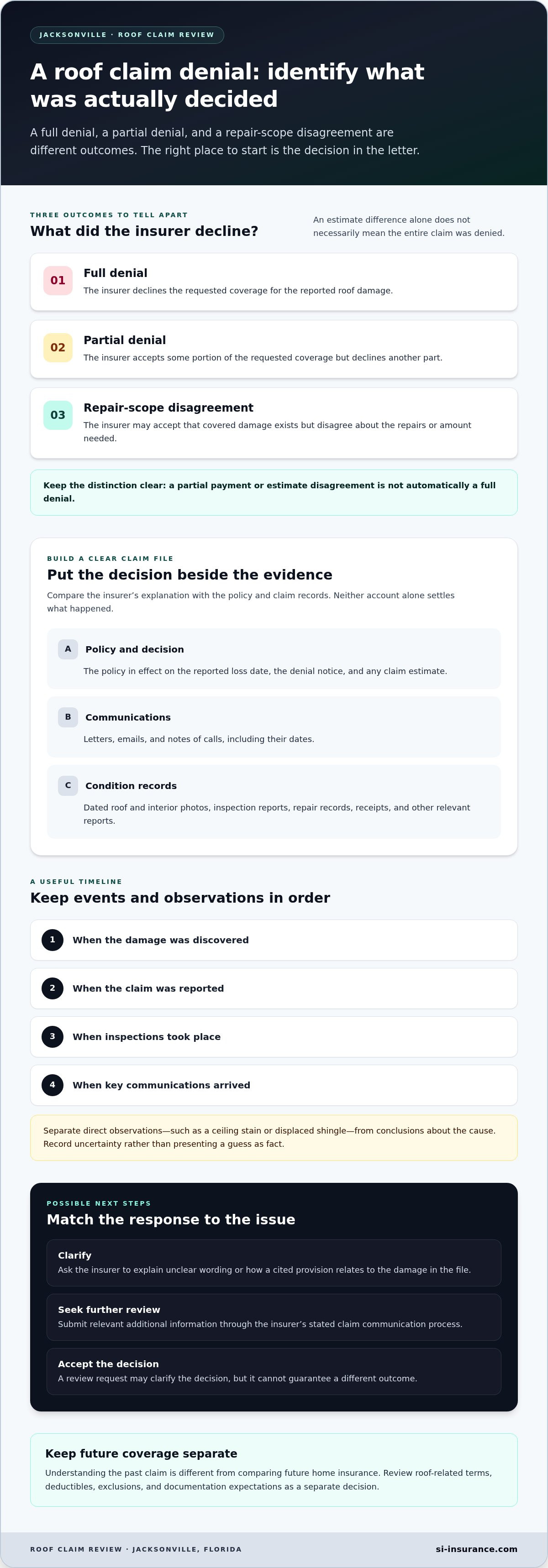
A practical step-by-step plan for responding to a roof claim denial
A measured response starts with a clear record, not a long argument. Keep each question tied to the insurer’s explanation and the documents that may clarify it. This sequence can help you prepare a focused response and preserve a useful file for later decisions.
Preserve the claim file. Save the policy, denial notice, estimates, inspection materials, photographs, receipts, and all claim communications. Keep copies of anything you send or receive.
Review the explanation. Identify the specific damage and policy wording involved. Note what the insurer says it found and what remains unclear.
Organize relevant evidence. Arrange documents and dated photos by topic or event. Create a timeline of discovery, reporting, inspections, communications, and repair decisions.
Submit focused questions. Use the insurer’s stated submission process. Refer to specific passages in the notice and identify the records that support each question.
How to prepare a clear written response
Keep the tone factual and concise. Identify the decision you’re asking about, quote the relevant sentence from the notice, and explain what you’d like clarified. List each supporting item by name and date, then describe what it shows without overstating what it proves. Ask direct questions, such as how a cited policy provision applies to a particular area of damage. Keep the complete submission and any response.
Before sending anything, check that the documents are legible and the dates and locations are clear. Don’t present an uncertain cause of damage as established fact. Distinguish what you observed from what a report or another person concluded.
How to track repairs, inspections, and claim communications
Use one timeline for calls, emails, inspections, photographs, and repair decisions. Record the date, who communicated, what was discussed, and any next steps mentioned. If insurer correspondence or the policy includes a time-sensitive instruction, flag it and verify its meaning against those documents rather than relying on memory.
Roof conditions may need prompt attention, but document repair or mitigation decisions. Keep related estimates, receipts, photographs taken before and after work, and notes about why the work was done. Review the policy and the insurer’s written instructions for applicable documentation or process requirements. Don’t assume one procedure applies to every policy.
In short, preserve the file, examine the stated reason, connect evidence to specific questions, and keep a dated record of communications and repair decisions. A review may not change the outcome. For broader context as you consider how to get home insurance after a roof claim denial in Jacksonville, read this Florida home insurance coverage guidance. To compare future coverage options, explore Florida home insurance options.
After the dispute: plan your next home insurance decision in Jacksonville
The result of a roof claim and the terms of future coverage are two separate matters. A claim review looks at a past loss under the policy that applied at the time. A renewal or new application is about coverage going forward. Don’t assume a new policy will cover existing damage or an earlier loss.
What to review before renewing or changing home insurance
Use what you learned from the claim to guide your next policy review. Compare roof coverage wording, exclusions, deductibles, and policy conditions side by side. Look closely at how each policy describes roof damage and repairs. Similar terms can mean different things across policies, so read the wording rather than relying on assumptions.
Check that the roof and property details on a renewal or application are accurate. Keep inspection findings, repair records, and other relevant documents handy. If a policy term isn’t clear, note it and ask for an explanation before deciding. A careful comparison can clarify the coverage being offered, though it can’t predict how a future claim will be handled.
How an insurance agency can help with future coverage comparisons
Comparing home insurance involves more than looking at the premium. Coverage terms, exclusions, deductibles, and conditions all matter. SI Insurance helps customers across Florida compare home insurance options, with offices in Sunrise and Pompano Beach.
If you’re considering how to get home insurance after a roof claim denial in Jacksonville, keep the claim review separate from your search for future coverage. Use your claim records to understand what’s documented about the roof and any repairs, then read the terms of the policy you’re considering. A past denial doesn’t automatically determine whether you can get future coverage, and a new policy shouldn’t be expected to cover damage that already exists.
Gather the roof information you have and identify the policy terms you want to understand. Then compare available coverage options with those details in mind. Explore Florida home insurance options as you consider what may fit your needs.
Make your next coverage decision with clarity
A roof claim denial deserves a careful review, but it doesn’t answer every question about your policy or future coverage. First identify whether the insurer declined the full claim, part of it, or a particular repair scope. Then compare the stated reason with the policy wording and the records you’ve gathered, and choose a next step based on what remains unclear.
Keep future coverage decisions separate from the dispute. Reviewing roof-related terms, exclusions, deductibles, and property details can help you compare options with a clearer understanding of your needs. If you’re considering how to get home insurance after a roof claim denial in Jacksonville, remember that a new policy’s terms are distinct from the outcome of a past claim.
SI Insurance offers home insurance and homeowners insurance to customers across Florida, with offices in Sunrise and Pompano Beach. Explore Florida home insurance options as you consider your next step. Organizing your claim record and comparing coverage terms can help you move forward with a clearer picture of your options.
Frequently Asked Questions
Can I dispute a denied roof insurance claim in Jacksonville?
Yes, you can ask the insurer to explain its decision or review additional information, but the available options depend on the policy and claim facts. Start by identifying whether the insurer denied the whole claim, part of it, or only certain repairs. Then connect your questions to the stated reason and relevant records. A request for review may clarify the decision, but it doesn’t guarantee a different outcome.
What should I do first after my roof claim is denied?
Read the denial notice carefully and save it with your policy and claim correspondence. Identify the specific damage, policy wording, and inspection findings the insurer cites. Note any questions or factual differences you want clarified. Keep the original documents and organize photos, reports, and repair records by date. This gives you a clear basis for deciding whether to ask for an explanation, submit more information, or accept the decision.
What evidence can help me challenge a denied roof claim?
Relevant records may include the policy in effect on the reported loss date, the denial letter, claim correspondence, inspection materials, dated roof and interior photos, repair records, receipts, and estimates. A timeline of when you noticed damage, reported it, and had inspections can help put the file in order. Separate what you observed from conclusions about the cause, and don’t assume any single document will determine the outcome.
How long do I have to dispute a denied roof claim in Florida?
There isn’t one deadline that applies to every kind of dispute. For a Florida property insurance claim, the deadline to file a lawsuit against the insurer is generally two years from the date of loss, not the date of denial. That is not necessarily the deadline for asking the insurer to review information or pursuing another process. Check your policy and current requirements promptly, since timing can depend on the action involved.
Should I get another roof inspection after an insurance denial?
A further inspection may be worth considering if the denial refers to findings you question, leaves damage unexplained, or appears inconsistent with your records. Before arranging one, identify what issue the inspection should address and review any relevant instructions in your policy or claim correspondence. Keep the resulting report and photographs with your claim file. An added inspection can provide information, but it doesn’t guarantee the insurer will change its decision.
Does a denied roof claim mean my home insurance will not cover future roof damage?
No, a denial on one claim does not automatically determine coverage for a future loss. Future coverage depends on the policy in effect then, its terms, and the facts of the later damage. If you’re considering how to get home insurance after a roof claim denial in Jacksonville, review roof-related coverage wording, exclusions, deductibles, and any property details used for an application or renewal. Don’t assume a new policy will cover existing damage or a past loss.
Can an insurance agency overturn my denied roof claim?
An insurance agency can help customers compare home insurance options, but a past claim decision and future coverage selection are separate matters. Si Insurance Agency offers home insurance and homeowners insurance to customers across Florida, with offices in Sunrise and Pompano Beach. Comparing future policy terms can help you understand available coverage without determining the outcome of an earlier claim.
Comments