


St. Petersburg Cast Iron Pipe Home Insurance Guide 2026
Could a home with cast iron pipes still qualify for suitable coverage? It may be possible, but the pipe material alone doesn’t settle the question. For home insurance for homes with cast iron pipes in St. Petersburg, insurers may also want to understand the plumbing’s age, condition, and repair history, while the policy wording determines how certain types of damage are treated. It’s understandable to worry about a coverage gap or an unexpected repair bill, especially when inspection requirements and exclusions can sound like the same thing.
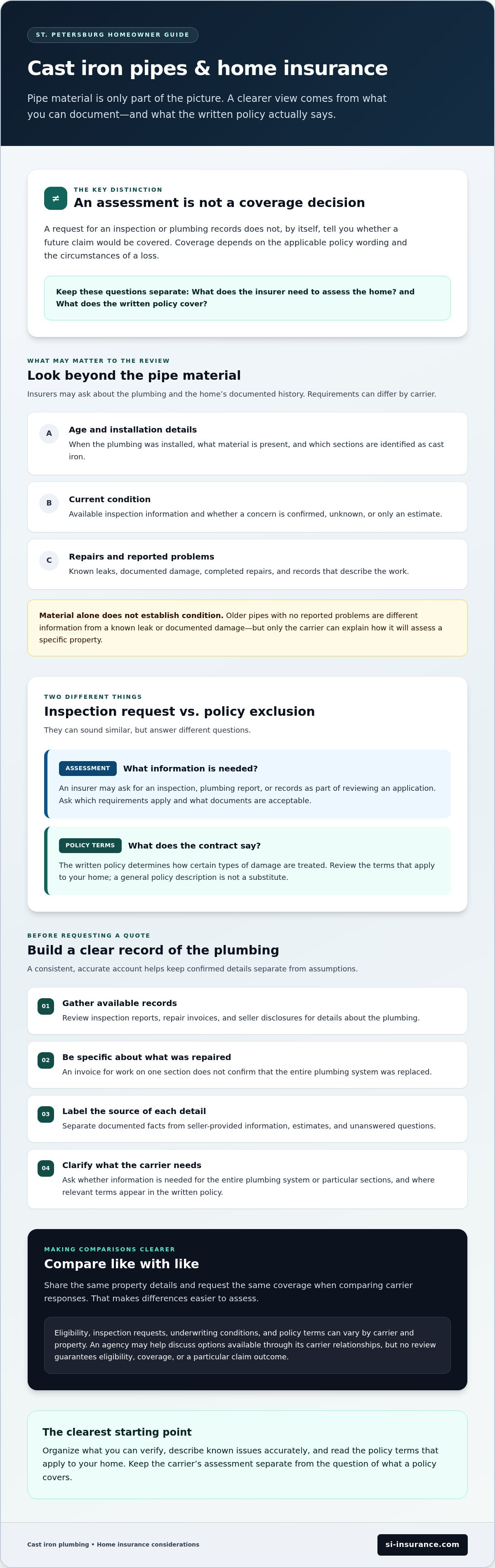
The key is to separate what an insurer needs to assess the home from what the policy may cover. A request for an inspection or plumbing records doesn’t automatically tell you whether a claim would be covered. Likewise, a general description of a policy isn’t a substitute for reviewing the terms that apply to your home.
This guide explains what insurers may ask about cast iron plumbing, how to distinguish an inspection request from a policy exclusion, and what information to gather before requesting a quote. You’ll also find practical ways to document the plumbing’s condition and discuss next steps with an insurance agency. These steps apply to St. Petersburg homeowners and can help Florida residents in other cities prepare to compare coverage options with clearer expectations and fewer assumptions.
Table of Contents
Home insurance for homes with cast iron pipes in St. Petersburg: what homeowners should know
How insurers may assess a St. Petersburg home with cast iron pipes
Compare home insurance terms for cast iron pipes, not just the quote
Prepare your St. Petersburg home before requesting a cast iron pipe insurance quote
Home insurance for homes with cast iron pipes in St. Petersburg: what homeowners should know
Cast iron plumbing can raise questions during a home insurance application, but pipe material alone doesn’t determine every insurer’s decision. For home insurance for homes with cast iron pipes in St. Petersburg, the home’s documented condition and the carrier’s review process may also matter. A house with older pipes and no reported problems presents different information from one with a known leak or documented damage. Only the carrier can explain how it will assess a particular property.
Cast iron pipes are made from iron and carbon and have been used in plumbing systems over time. Knowing the material is useful, but it doesn’t establish the pipes’ current condition, which sections are present, or whether repairs have been completed. Review available inspection records, invoices, or seller disclosures for those details rather than inferring condition from the pipe material alone. For background on the material and its development, see this overview of the history of cast iron pipe.
This video discusses a cast-iron-pipe insurance claim. Treat it as an individual example, not a guide to the terms of your policy or the outcome of a claim involving your home. Claim decisions depend on the applicable policy language and the circumstances of the loss.
Why cast iron plumbing can prompt questions during an insurance application
A carrier may ask when the plumbing was installed, what material is present, whether repairs have been made, and whether an inspection or plumbing report is available. These questions are not proof that a leak exists or that damage has occurred. A concern about age or condition is different from a confirmed leak, and an inspection request is not itself a coverage decision. Ask which requirements apply to your application, what documents are acceptable, and whether the carrier needs information about the entire plumbing system or particular sections.
What St. Petersburg homeowners should establish first
Start with what you can verify. Review available plumbing or repair records to see which sections are identified as cast iron, and note which document or person supports each detail. If information comes from a seller, label it as seller-provided. If you’re estimating, say so rather than presenting the estimate as confirmed. For example, distinguish an invoice documenting work on one section from a statement that the entire system was replaced. This helps keep quote discussions for homes in St. Petersburg and Pinellas County accurate.
Eligibility, inspection requests, underwriting conditions, and policy terms can differ by carrier and property. Before relying on an assumption, ask the insurer or agency to clarify what information is needed and where any relevant terms appear in the written policy. These considerations are useful for homeowners throughout Florida, but a carrier’s review of one property doesn’t establish how it will assess another. This guide can help you prepare and compare responses, but it can’t promise eligibility, coverage, or a particular claim outcome.
How insurers may assess a St. Petersburg home with cast iron pipes
Once you know what can be verified about the plumbing, organize the information before approaching insurers. A clear record helps distinguish the home’s documented condition from estimates or unanswered questions, and gives you a consistent basis for discussing home insurance for homes with cast iron pipes in St. Petersburg. The review process may differ by carrier, so treat an inspection request or report requirement as something to confirm, not a universal rule.
Underwriting requirements vary by insurer and by the individual home. One carrier may ask for records or an inspection, while another may request different information. Ask what applies to your property, how the information should be provided, and whether any follow-up is needed. If a carrier’s request is unclear, write down the specific question and ask for an explanation before arranging work or submitting incomplete records.
Which plumbing records and inspection details to gather
Start with documents already available, such as home inspection reports, plumbing-system details, repair invoices, and records of previous work. Note the dates and scope of repairs, and keep supporting documents together. An invoice may identify the work completed without describing every pipe in the home, so avoid treating a record as broader evidence than it is. If a report uses terms you don’t understand or leaves the pipe material or condition unclear, ask a qualified plumbing professional to explain the findings rather than guessing.
Depending on the property and the carrier’s request, an inspection or plumbing report may help clarify the information under review. Confirm what type of documentation is needed before arranging anything. Ask whether the carrier has specific questions the report should address, and don’t assume one report will satisfy every carrier. For broader background on disputes involving insurance claims for cast iron pipes, ConsumerNotice.org provides additional context, though an outside account cannot determine how your own policy or application will be assessed.
How to disclose known leaks, repairs, or pipe replacement
Answer application questions accurately and separate past issues from current ones. For example, identify a leak as repaired only if you have reason to believe the work was completed, and describe any unresolved concern as unresolved. If records are incomplete, say what you know and what remains uncertain. Don’t omit a known issue, and don’t treat a repair invoice as automatic proof that a carrier will accept the risk or that a future claim will be covered.
Before submitting information, ask the agent which documents the carrier wants to see and whether it needs clarification about the work performed. An insurance agency can help you discuss available options with carriers, but each carrier makes its own assessment. If you’d like to explore home insurance options, having your plumbing records and repair history ready can make that conversation more focused with SI Insurance Agency.
Compare home insurance terms for cast iron pipes, not just the quote
A lower quote may look attractive, but it doesn’t show the whole insurance arrangement. To compare home insurance for homes with cast iron pipes in St. Petersburg, give each carrier the same property details and request the same coverage, then review the written responses alongside the proposed policy documents. If the information provided differs from one quote request to another, differences in the responses may reflect those details rather than a difference in how the same risk is treated.
A quote alone does not establish the final terms of an issued policy. Keep these items distinct:
Quote: An initial price indication based on the details provided. Confirm what information the quote assumes and whether the carrier still needs to review documents.
Underwriting condition: A request or requirement from the carrier, such as additional documentation or specified work, that may affect its decision. Ask what must be completed or provided and how the carrier will confirm that requirement.
Plumbing exclusion or limitation: Policy wording that may restrict coverage for certain plumbing-related circumstances. Check the exact wording and ask what situations it applies to.
Confirmed policy language: The terms in the policy issued for the property, which should be reviewed rather than inferred from a conversation or quote.
Questions to ask about eligibility, conditions, and exclusions
Ask whether the carrier needs an inspection, plumbing report, repairs, pipe replacement, or other documentation before it can complete its review. Confirm whether any plumbing-related exclusion or limitation appears in the proposed terms, and ask how applicable water-damage wording addresses the situations you’re concerned about. If an answer could affect your decision, request clarification in writing and keep it with the quote and policy documents.
An inspection request isn’t itself an exclusion, and a repair request shouldn’t be treated as proof of what a future claim would cover. Read the actual wording and ask the carrier or agent to explain anything that remains unclear before binding coverage. If a condition is stated verbally, ask where it will appear in the written documents and whether there are any remaining requirements.
How to compare offers without assuming identical protection
Use a consistent comparison across carrier responses. Check the documents for:
Coverage limits and deductibles
Plumbing exclusions or other relevant limitations
Written underwriting conditions and any outstanding requests
Policy language addressing water damage
Don’t compare premium alone or assume that similar labels mean equal protection. If one response includes a condition or limitation that another doesn’t mention, ask whether the difference is intentional, unresolved, or reflected in the proposed policy. Also treat flood coverage as a separate question: ask whether it is included or needs to be considered separately, then verify the applicable written terms. Record each carrier’s answer alongside the document it refers to, so you can see what has been confirmed and what still needs clarification before making a decision.
Prepare your St. Petersburg home before requesting a cast iron pipe insurance quote
A little preparation can make quote discussions clearer and help you compare carrier responses on a consistent basis. Before requesting home insurance for homes with cast iron pipes in St. Petersburg, gather the property details and plumbing records you have, and clearly identify what remains uncertain. Accurate information is more useful than a confident guess. Use the same set of details when asking different carriers about a home, whether it is in St. Petersburg or another Florida city.
For broader context on Florida home insurance and policy considerations, see this Florida home insurance guide.
A document checklist for homeowners and prospective buyers
Collect the records available to you before beginning quote requests. A simple folder, digital or physical, can keep details accessible and reduce the chance of giving inconsistent answers. You don’t need to fill gaps by guessing; make a note of what you don’t know and ask the carrier whether it needs more information.
Property basics: The home’s address and available details about its age, structure, and systems.
Plumbing information: Records identifying pipe material and location, if known, along with inspection reports or professional findings.
Work history: Plumbing repair or replacement invoices, receipts, and notes describing the date and scope of work.
Purchase documents: Seller disclosures and inspection materials available for a home you’re considering buying.
Keep confirmed information separate from estimates or statements you can’t verify. For example, if a seller says some pipes were replaced but you haven’t seen supporting records, identify that as seller-provided information rather than treating it as established fact. Ask what documentation is available before relying on assumptions about a property’s condition. When records describe work on only part of the system, note that limitation so it isn’t mistaken for confirmation about the whole home.
A focused question list for an agent or carrier
Use your records to ask direct questions, and disclose known issues even if some details are still being checked. You might ask:
What evidence or records are needed to evaluate the home’s cast iron plumbing?
Is an inspection or plumbing report being requested, and what should it address?
Does a proposed condition affect eligibility, timing, or policy terms?
How should I describe a known leak, completed repair, or unresolved concern?
If you don’t know which pipe sections are cast iron, say so and ask what could clarify the point. Uncertainty about one detail doesn’t require withholding facts you do know. Keep the answers and any follow-up requests with your records, then use the same property information for each quote request so the responses are easier to compare.
With your documents and questions organized, you can have a more focused conversation about your options. To discuss a Florida home insurance inquiry, contact SI Insurance and share the property and plumbing details you can verify.
Finding Cast Iron Pipe Home Insurance in St. Petersburg
Finding a suitable policy is a process of confirming details, not relying on assumptions about what a carrier may accept. For home insurance for homes with cast iron pipes in St. Petersburg, move through the review in a clear order: organize available records, describe the property and plumbing accurately, compare carrier responses in writing, and confirm the final policy terms before relying on them.
An independent agency may help homeowners discuss options available through its carrier relationships, but placement and terms aren’t guaranteed. SI Insurance Agency offers home insurance and serves customers across Florida, including homeowners seeking coverage in St. Petersburg and other Florida cities. Ask the agency directly whether it can help with your property.
What to share when requesting guidance from SI Insurance
Prepare the property address, known plumbing details, relevant reports, repair or replacement history, and the date you’d like coverage to begin. If a detail is uncertain, label it as unknown or unverified rather than presenting it as established. This gives the agency a more accurate starting point and helps avoid misunderstandings as questions are discussed with carriers.
Ask whether the agency can assist with the St. Petersburg property and what information would be useful for an initial conversation. If you have a report or invoice, describe what it documents rather than drawing conclusions beyond its findings. Clear distinctions between confirmed records, estimates, and seller-provided statements can help keep the review grounded in what’s actually known. You can also ask whether the agency needs additional records before discussing available options.
How to make a confident decision before coverage begins
Before relying on a coverage assumption, review the final policy documents and any written conditions. If the wording leaves questions about plumbing limitations or water damage, raise them directly with the agent or carrier and request clarification. Don’t treat a preliminary quote or verbal explanation as a substitute for the issued policy language.
For broader context on Florida home insurance considerations, consult a Florida home insurance resource. The useful sequence remains straightforward: organize your records, describe the property accurately, compare written responses, and confirm the final terms. To discuss home insurance options, contact SI Insurance and ask whether it can assist with your St. Petersburg inquiry.
Make your next insurance conversation more informed
Cast iron plumbing doesn’t tell the whole insurance story. For home insurance for homes with cast iron pipes in St. Petersburg, the details you can document, the carrier’s requirements, and the final written policy terms all matter. Keep plumbing records and repair history together, describe confirmed facts accurately, and compare written responses using consistent property information.
Before relying on an assumption about eligibility or water-damage protection, review the issued policy and ask about any wording or conditions you don’t understand. A careful review can help you make decisions with a clearer picture of what has been offered, without treating a quote or inspection request as a guarantee of coverage.
SI Insurance offers home insurance and serves customers across Florida. Ask whether the agency can assist with your St. Petersburg property and what information would help clarify your options. Discuss your St. Petersburg home insurance options with your property and plumbing details ready. A thoughtful, well-documented inquiry is a practical next step toward choosing with greater confidence.
Frequently Asked Questions
Can I get home insurance for a St. Petersburg home with cast iron pipes?
Possibly, but eligibility depends on the property and insurer. For home insurance for homes with cast iron pipes in St. Petersburg, a carrier may consider the plumbing’s documented condition, repair history, available inspection information, and its own underwriting requirements. Share known details accurately and ask what records are needed. Confirm eligibility, any conditions, and the final coverage terms directly with the insurer or agency before relying on an estimate.
Do cast iron pipes automatically make a home uninsurable?
No, don’t assume that pipe material alone determines an insurer’s decision. Carriers may assess a home’s plumbing condition and other property details differently, and their requirements can vary. Ask whether an inspection, repairs, or additional records are needed for the specific property. Another homeowner’s experience or a general statement about cast iron pipes can’t confirm how a particular insurer will assess your home.
Will homeowners insurance cover damage caused by cast iron pipes?
Coverage depends on the policy wording, the circumstances of the damage, and any applicable exclusions or conditions. Don’t assume every leak, pipe failure, or resulting repair is covered. Review the proposed policy and ask the agent or carrier how its water-damage provisions apply to the situation you’re concerned about. If a loss occurs or may have occurred, follow the insurer’s instructions and provide accurate information.
Do I need a plumbing inspection to insure a home with cast iron pipes?
Not necessarily. An inspection may be requested, but the requirement depends on the insurer and property. Before arranging one, ask what type of report is acceptable, which areas it should address, and whether existing records may be sufficient. If the pipe condition is unclear, a qualified plumbing professional may help document findings. An inspection report can provide information, but it doesn’t guarantee an insurance decision.
Should I replace cast iron pipes before applying for home insurance?
Don’t assume replacement is required or that completing it guarantees approval. First, ask the prospective insurer whether it has a specific condition for the property and what evidence it will consider. If an inspection identifies a concern, discuss the findings and potential work with a qualified plumbing professional. Compare the carrier’s written requirements and proposed policy terms before deciding whether to proceed with repairs or replacement.
What documents should I gather for a home insurance quote with cast iron pipes?
Gather any available inspection reports, plumbing invoices, repair records, seller disclosures, and documents showing which sections of the home’s plumbing are cast iron. Note known leaks and completed work, and distinguish documented facts from estimates or statements you haven’t verified. Ask the agent what else the carrier needs. A complete, consistent account can help clarify follow-up questions, but it doesn’t guarantee eligibility or coverage.
Is flood damage covered by home insurance in St. Petersburg?
Don’t assume a standard home policy covers flood damage. Coverage depends on the policy and any separate coverage in place, so review the actual documents and ask the insurer or agent directly. Treat flood protection as a distinct question while comparing options for a St. Petersburg home. Confirm the applicable terms and limits rather than relying on a general description of homeowners insurance.
Comments