


Switching Home Insurance With an Open Claim in Florida: What to Know
An open homeowners claim doesn’t automatically mean you must stay with the same insurer. But switching home insurance with an open claim in Florida calls for two separate decisions: keeping the existing loss with the insurer handling it and arranging suitable coverage for the future.
It’s understandable to worry that a policy change could interrupt claim handling, create a gap between policies, or complicate coverage decisions while repairs or settlement remain unresolved. The insurer covering the home when the damage occurred generally continues handling that claim. A new policy applies to covered losses after its effective date, not damage that already happened. That distinction matters, but you still need to coordinate the change carefully.
This guide explains how the loss date, policy terms, and new effective date fit together, why a prospective insurer may review unrepaired damage and claim history, and which records to organize before changing coverage. You’ll also learn how to compare future protection while the claim remains pending, so your decision reflects the home’s current condition and documented needs.
Table of Contents
Can You Switch Home Insurance in Florida With an Open Claim?
An unresolved homeowners claim can make a coverage decision feel complicated, especially if you’re waiting on an inspection, a coverage decision, or repairs. Separate the questions: what remains to be resolved with the existing loss, and what protection do you need for future losses? Whether switching home insurance with an open claim in Florida is practical depends on your circumstances, the claim’s status, the policy terms, and the terms available for future coverage.
A policy change concerns future coverage. The policy in effect on the date of loss is generally central to reviewing that event, but the precise terms and applicable requirements matter. Changing future coverage doesn’t, by itself, rewrite the terms governing an earlier loss. General information about home insurance policies can provide context, but your policy documents and claim correspondence are the relevant records for your situation.
For a general overview of considerations involved in changing coverage, watch this video:
What does an open homeowners claim mean?
“Open” means the claim hasn’t reached a final resolution in the insurer’s records. It doesn’t explain what remains outstanding. The loss may still be under review, the insurer may be actively adjusting it, a coverage or damage decision may be disputed, or a decision may have been made while repairs continue. These are different situations, and none alone tells you what the insurer will do next. Review the latest claim status and written correspondence to see what has been completed, what remains pending, and whether the insurer has requested a response or document.
Does changing policies automatically move the existing claim?
A new insurer’s policy shouldn’t be treated as taking over an earlier claim. The policy in effect on the date of loss is central to reviewing that event, while the new policy’s terms apply to its own period of coverage. Policy wording and applicable requirements matter, so don’t assume the claim’s status or when it will close. Ask the current insurer for written clarification of the claim’s status, expected next steps, and where to send outstanding materials.
Keep the existing claim record distinct from the new-policy decision. Gather the current declarations page, relevant policy wording, claim reference, and key correspondence. Then work through the change in sequence:
Understand what remains unresolved in the existing claim.
Compare the protection and terms available for future coverage.
Coordinate the policy dates and retain written confirmations.
Review prospective coverage using the home’s current condition and claim information.
This approach won’t determine the outcome of the existing claim, but it can keep the two decisions clear: the earlier loss is reviewed under its applicable policy, while future protection is assessed on its own terms.
How the Loss Date, Policy Terms, and New Effective Date Fit Together
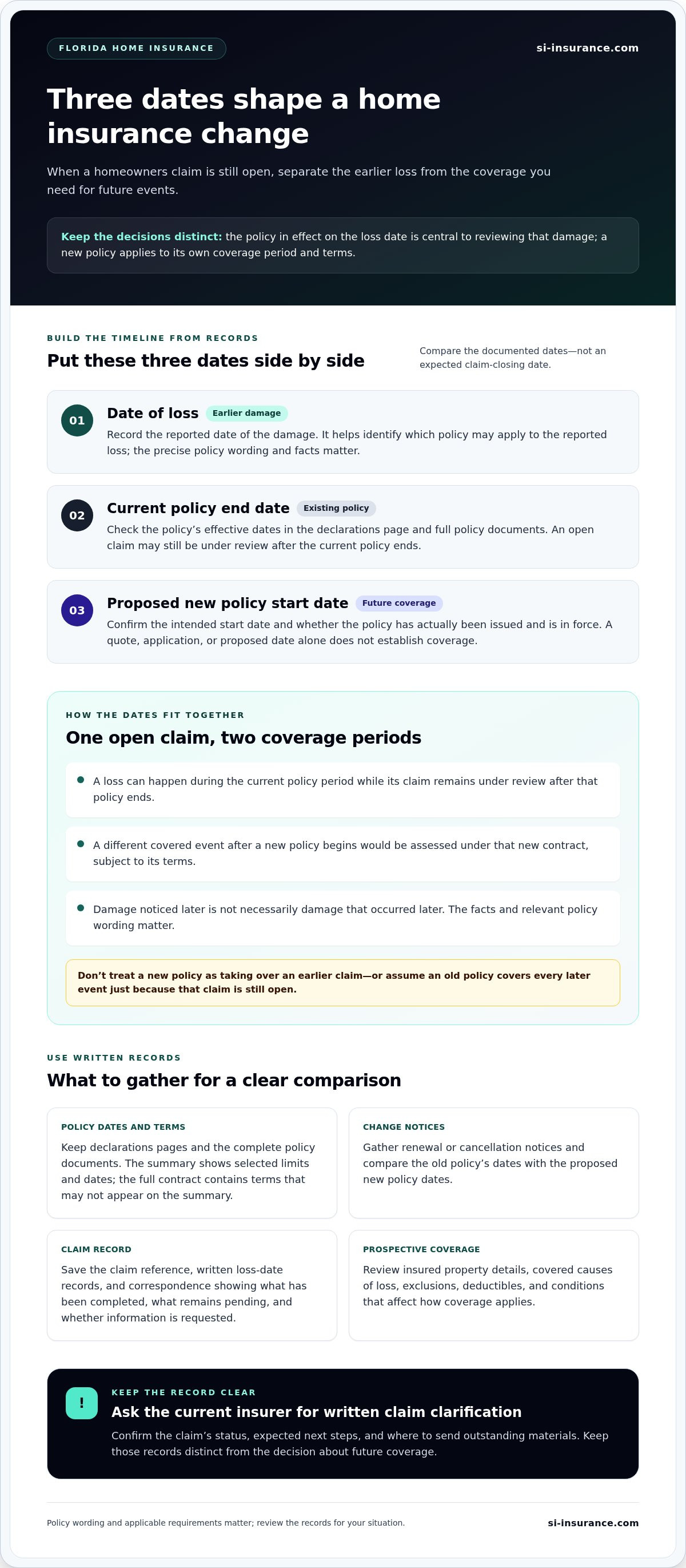
To map the transition, put three dates side by side: when the damage occurred, when the current policy ends, and when the proposed new policy is intended to start. The loss date helps identify which policy may apply to the reported damage. The other dates show when one contract ends and the next is intended to begin. An unresolved claim doesn’t replace these dates or establish coverage on its own.
For example, a loss may occur during the current policy period, while the claim remains under review after that policy ends. Those are separate events. A different covered event after a new policy begins would be assessed under the new contract, subject to its terms. Don’t assume damage first noticed later necessarily occurred later; the facts and relevant policy wording matter.
Which documents help establish the coverage timeline?
Build the timeline from records, not memory or an expected claim-closing date. Gather declarations pages and full policy documents, renewal or cancellation notices, and claim correspondence. Use written insurer records to note the reported loss date and claim reference. Then compare the old policy’s effective dates with the proposed new policy dates. A quote or application alone isn’t proof that coverage has begun.
Claim correspondence can show whether the insurer is still reviewing the loss, has communicated a decision, or is waiting for information. Declarations pages summarize policy dates and selected limits, while the complete contract contains terms that may not appear on the summary page. Keep both. An informal conversation or the assumption that a claim is “almost closed” isn’t a substitute for written records.
What can a new policy cover after the transition?
Prospective coverage depends on the new contract, its effective date, and its terms. Review the insured property details, covered causes of loss, exclusions, deductibles, and conditions that affect how coverage applies. An application, quote, or proposed start date alone doesn’t establish that a policy has been issued or is in force. An open claim also doesn’t guarantee that a prospective insurer will accept an application.
Keep the earlier loss distinct from a genuinely new event after the proposed start date. The new contract shouldn’t be treated as a way to reassign prior damage, and the old policy shouldn’t be assumed to cover every later event simply because the earlier claim remains open. For broader context on reviewing protection for a Florida home, consult Home Insurance in Florida: A Strategic Guide to Protecting Your Sunshine State Investment in 2026, then review the actual policy wording rather than relying on a general description.
For a measured review of prospective home coverage, review Florida home insurance options alongside your policy and claim records. A clear timeline helps identify what needs clarification before you align the transition dates.
What to Compare Before Replacing Florida Home Insurance During a Claim
Comparing policies during an unresolved claim takes more than placing two premium amounts side by side. Consider whether the proposed policy protects the home and household on terms that fit your needs, given the property’s current condition and claim history. A lower premium alone doesn’t establish equivalent protection.
Use the declarations pages and policy forms to compare details directly. The table below is a starting point; exact terms vary by contract.
Which coverage details deserve a side-by-side review?
Compare dwelling and personal-property limits, liability terms, and loss-of-use coverage where applicable. Read the exclusions and conditions instead of relying only on a summary. In Florida, pay close attention to wind, hurricane, and water-related terms, whose application depends on the actual policy language. Review any separate wind or hurricane deductible or provision shown in the forms. Also note whether the home’s repair status or documented damage affects the proposed terms.
Record the differences, even when the comparison seems straightforward. Similar-looking limits may apply to different categories of property, while an exclusion or deductible can change how a future loss is handled. Check that the insured address and property details are accurately represented in the prospective documents.
How can an open claim affect a new application?
A prospective insurer may ask about prior or open claims and the home’s present condition as part of its underwriting review. Read each application question carefully and answer completely and accurately. Don’t assume the claim guarantees acceptance or rejection, or predict how it will affect the proposed terms. The prospective insurer evaluates the application; the current insurer handles the reported loss under the applicable policy and claim record.
Keep those conversations distinct. Questions about inspections, claim decisions, or outstanding documents belong with the current insurer. Questions about how the property’s condition, repair status, or claim history are considered belong to the prospective coverage review. This distinction is central to switching home insurance with an open claim in Florida: compare future protection without treating a new policy as a substitute for the existing claim.
Steps to Coordinate a Home Insurance Change While Your Claim Is Open
A clear record makes a complicated transition easier to manage. Organize the existing claim and prospective coverage review as related but separate workstreams. These steps can help you identify what needs attention and avoid relying on memory or informal estimates while switching home insurance with an open claim in Florida.
1. Organize your records. Create a concise timeline showing the date of loss, when it was reported, inspections, decisions, payments, and outstanding issues. Keep the current policy and declarations page, claim correspondence, repair records, and relevant photographs together. A digital folder with clear file names makes documents easier to find.
2. Clarify the claim status. Review the current insurer’s latest written communication and note what remains unresolved. List unanswered questions, such as whether more records are outstanding or what the next step is. Send claim-related messages to the insurer handling the reported loss and save its responses with the claim file. For general context on organizing claim records and communications, consult Florida Insurance Claim Guide: A Step-by-Step Process.
3. Review prospective policy terms. Use the current documents and information about the home’s condition to assess proposed coverage, limits, exclusions, deductibles, and conditions relevant to documented damage or unfinished repairs. SI Insurance Agency can help review prospective home coverage and policy details. That review concerns future protection, not the handling or outcome of another insurer’s claim.
4. Align the dates carefully. Compare the current policy’s stated end date with the proposed new policy’s start date. Review the current contract’s cancellation or expiration language rather than assuming how or when it ends. Before treating the new policy as active, obtain written confirmation of its effective date and binding status. A quote or estimated start date alone may not establish that coverage is in force.
5. Retain confirmations. Keep written notices about the current policy’s end date and confirmation of the new policy’s start date with the relevant documents. Save application materials, declarations pages, policy forms, and messages about the proposed coverage together. If dates or terms change, keep the updated confirmation so your records reflect the final arrangement.
Keeping claim communications and new-policy documents in one organized file can prevent confusion about which correspondence relates to the earlier loss and which documents describe future coverage. The goal isn’t to transfer or resolve the existing claim through a policy change. It’s to make the next coverage decision using reliable records and clearly confirmed dates.
For a focused review of prospective Florida home coverage, review home insurance options with your policy and claim information organized.
Review Your Next Home Insurance Decision With SI Insurance
Once your records are organized, focus on the home’s future protection. A review can help you assess whether proposed coverage reflects the property’s current condition and your priorities. It isn’t a way to transfer, reopen, or erase an existing claim. Keep decisions about future coverage distinct from questions about the unresolved loss.
What information helps make a useful coverage review?
Bring the current declarations page and policy documents, accurate property details, and relevant claim correspondence. If repairs are underway, information about their progress can provide useful context. You don’t need every claim question resolved before reviewing future coverage, but it helps to identify what remains open and separate those issues from questions about a proposed policy.
Before a review, consider organizing:
Policy records: declarations page, policy forms, and notices showing the policy period.
Property details: information about the home and documented damage or repair status.
Claim correspondence: the latest status update and any outstanding requests or decisions.
Decision priorities: your intended timing and questions about limits, exclusions, deductibles, or covered property.
Direct claim questions to the insurer handling the loss, and keep coverage questions for the prospective policy review. This makes clear which policy and decision each response concerns.
How SI Insurance fits into the next step
SI Insurance can help you review prospective home insurance options and policy details using the information you’ve gathered. That review can bring your coverage questions into focus, but claim decisions and settlement remain with the insurer handling the existing loss. Keeping those responsibilities distinct lets you consider future protection without treating a new policy as a replacement for the claim process.
For homeowners considering switching home insurance with an open claim in Florida, a measured next step is to assess future coverage against the home’s current needs and the policy terms being considered. Use your records to identify the questions that matter most, then review the proposed protection carefully before deciding. This keeps the focus on a clear, informed path forward.
Discuss your Florida home insurance options with SI Insurance.
Make Your Next Coverage Decision With Confidence
An open claim can make it tempting to postpone every insurance decision until the file is closed. Instead, consider what you want your next policy to reflect: the home’s current condition, completed repairs, and the protection that matters to your household going forward. This gives a coverage review a practical purpose beyond simply replacing one policy with another.
When switching home insurance with an open claim in Florida, ground the decision in records and policy documents rather than assumptions about how the claim will end. Identify details that may change as repairs progress, and revisit them before treating a proposed policy as final. Careful preparation can make the next discussion clearer without tying future coverage to an outcome you can’t yet predict.
SI Insurance Agency can help you review prospective home coverage in Florida. Discuss your Florida home insurance options and take a considered next step toward protection that fits your home’s needs.
Frequently Asked Questions
Can I switch homeowners insurance in Florida while a claim is open?
A policy change may be possible, but eligibility and consequences depend on the circumstances and policies involved. Switching home insurance with an open claim in Florida doesn’t, by itself, decide what happens to the reported loss. If the insurer is still reviewing damage, ask in writing what stage the claim has reached and whether it needs more information from you before you make a coverage decision.
Will my old insurer still handle a claim after I change home insurance?
A policy change doesn’t itself transfer the existing claim to a new insurer. For claim updates, decisions, or questions about an outstanding request, contact the insurer handling the reported loss and follow its written instructions. Include the claim number in your correspondence and save responses with your records. A new insurer can answer questions about its proposed policy, but that doesn’t determine what will happen with the earlier claim.
Can a new home insurer deny coverage because I have an open claim?
There’s no reliable way to predict an application outcome from the open claim alone. A prospective insurer’s underwriting decision may depend on its requirements, the property’s condition, the information provided, and the terms it offers. Answer application questions accurately, including questions about claims or damage, and review the written offer and policy documents carefully. Don’t assume an application or quote means coverage has been approved or is active.
Should I wait until my Florida home insurance claim is closed before switching?
There isn’t one answer that fits every homeowner. Consider the claim’s current status alongside your future coverage needs and the dates stated in both policies. A pending repair estimate may raise different practical questions from a claim awaiting a final payment decision. Review the contracts and obtain written confirmation of proposed dates before making a change, rather than treating claim closure as the only factor.
Can I change home insurance if my house is still being repaired after a claim?
You may explore future coverage, but unfinished repairs or visible damage could matter during a prospective insurer’s review of the property. Keep records of completed work and what remains, such as invoices, repair updates, or dated photographs. Provide requested information accurately and read proposed terms closely. Repair progress alone doesn’t establish whether an insurer will accept the application or what coverage it may offer.
What happens if my old policy ends before the new home policy starts?
Different end and start dates can leave uncertainty about the intended coverage period, so don’t rely on an estimate or application alone. Review the current policy’s stated end date and obtain written confirmation of the proposed policy’s effective date and binding status. If the documents don’t align, address the discrepancy before treating the transition as complete. The applicable policy wording determines the details, so avoid assuming specific legal consequences.
Who should I contact about an open Florida homeowners claim after switching insurers?
Direct questions about the reported loss, claim status, or outstanding claim documents to the insurer handling that claim. Direct questions about proposed limits, exclusions, deductibles, or effective dates to the prospective insurer or agency involved in the new coverage review. Keeping the topics separate helps prevent a coverage discussion from being mistaken for a claim update. Save written answers with the records they relate to.
Comments