


Was Your Home Insurance Claim Denial in Orlando Unfair? How to Assess It
Could a claim denial stem from a misunderstanding of your policy, the damage, or the evidence submitted? A denial letter can sound final, but it may not answer every question about how the loss was assessed. Before switching home insurance after a claim denial in Orlando, compare the stated reason with your policy and the records related to the damage. A new policy may provide future coverage, but it won’t resolve an existing claim.
It’s understandable to consider a change when your confidence in your coverage has been shaken. A careful review helps separate what the insurer concluded from what the letter establishes, and highlights the documents, policy terms, or questions that may matter next. The steps below can help you assess the denial, organize relevant evidence, and consider what to do without confusing the current claim with future protection. If you compare home insurance options, keep continuity in view and don’t cancel current coverage before replacement coverage is effective.
Table of Contents
Was Your Orlando Home Insurance Claim Denial Unfair? Start With the Letter
A denial can disrupt repair plans and shake your confidence in your coverage. The letter alone, however, doesn’t settle whether the decision was correct. To assess it, compare the insurer’s stated reason with the policy wording and the evidence in the claim file. The outcome depends on the specific policy, the reported cause of loss, the documented damage, and the records considered during the claim.
Read the letter closely rather than assuming either that the insurer’s conclusion is conclusive or that it must be wrong. The decision states the insurer’s position based on its review; it is not, by itself, a final legal determination. That distinction matters if you’re considering next steps or switching home insurance after a claim denial in Orlando.
For a broader explanation of how a claim may be effectively rejected without an outright denial, see the term de facto denial. The concept may help you recognize why a claim’s practical outcome deserves attention. The policy wording and individual circumstances still need to be considered.
This general overview may also help explain questions that can arise after a homeowner’s claim is denied:
What the denial letter can tell you
Use the letter as a guide to the insurer’s reasoning. Find the stated reason for denial, any cited policy provisions, the property or part of the home involved, and the decision date. Separate what the letter clearly states from what you’re inferring. For example, a cited exclusion explains the insurer’s stated basis for its decision. Whether that exclusion applies depends on the policy wording and claim evidence.
Look for referenced attachments, inspection findings, estimates, or policy provisions that weren’t included. Note anything unclear or missing so you can ask focused follow-up questions. Keep the original letter and enclosures together, then compare them with your policy and other claim records.
What a denial letter cannot establish by itself
A denial doesn’t automatically prove that the damage is excluded. At the same time, disagreeing with the insurer doesn’t establish that it made an error or guarantee payment. A sound assessment needs the context behind the decision: the applicable policy language, reported cause, documented damage, and claim history. Review those materials together before deciding whether the denial was unfair.
How to Test an Orlando Home Insurance Denial Against Your Policy
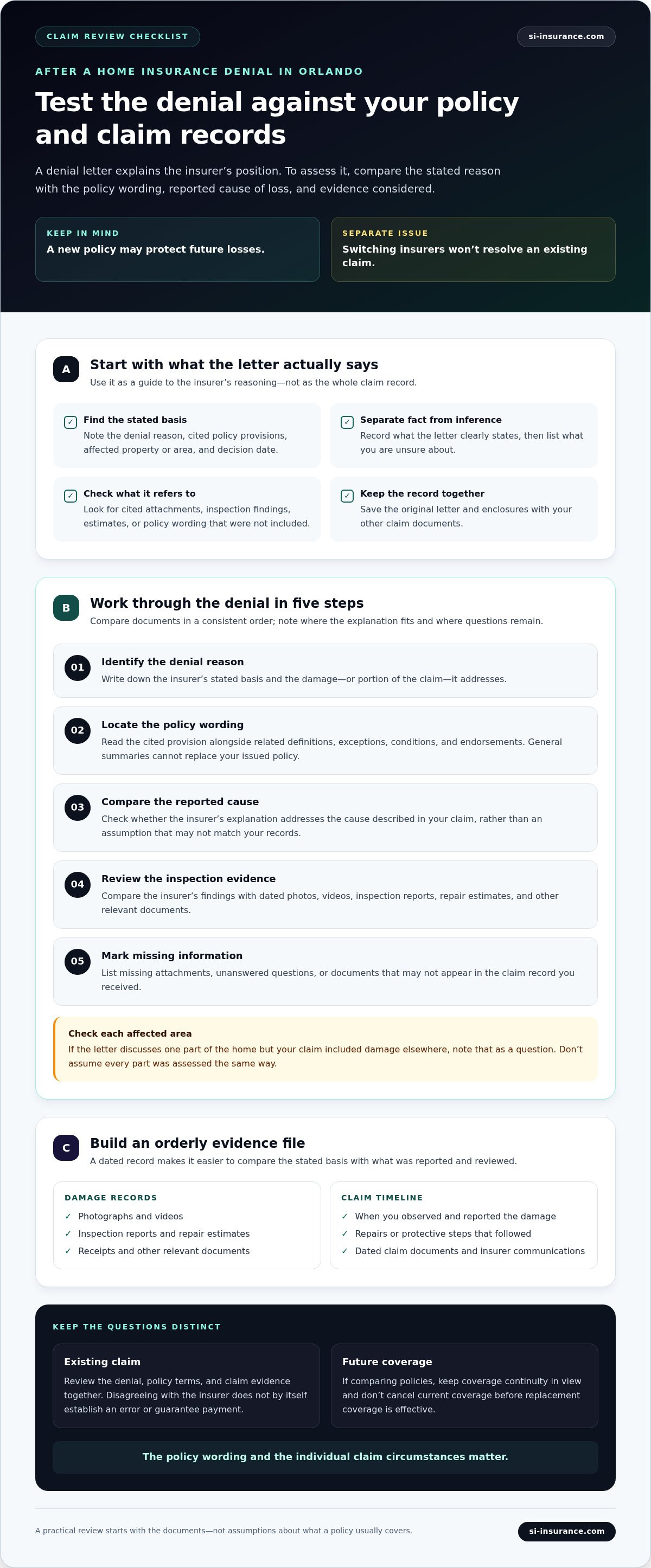
A useful review is a comparison, not a guess about what a policy “usually” covers. Exclusions, limitations, conditions, and covered causes depend on the wording of the policy issued for your home, including relevant definitions and endorsements. Work through the denial and claim records in a consistent order. Note where the insurer’s explanation aligns with the documents and where questions remain.
Identify the denial reason. Write down the insurer’s stated basis and the damage or portion of the claim it addresses.
Locate the policy wording. Find the cited provision, then read it alongside related definitions, exceptions, conditions, and endorsements. A general online summary cannot replace the policy issued to you.
Compare the reported cause. Check whether the explanation addresses the cause of damage described in your claim, rather than an assumption that may not match your records.
Review inspection evidence. Compare the insurer’s findings with dated photographs, videos, inspection reports, repair estimates, and other relevant documents.
Identify missing information. Note referenced attachments you don’t have, unanswered questions, or documents that may not appear in the claim record you received.
Check whether the explanation addresses each affected area. If the letter discusses one part of the home but your claim included damage elsewhere, note that as a question. Don’t assume that every part of the claim was assessed in the same way.
Match the insurer’s reason to the policy language
Read the cited provision in context. Definitions elsewhere in the policy, exceptions to an exclusion, or an endorsement may affect how the wording applies. Compare the relevant language with the reported cause of loss and each area of damage described in the claim. If the explanation is unclear, identify the specific sentence or provision you want clarified. A broad description of coverage is not a substitute for your policy.
Build a clear record of the damage and claim
Organize photographs, videos, estimates, receipts, inspection reports, submitted claim documents, and insurer communications by date. Record what you observed, when you reported it, and what repairs or protective steps followed. A dated, orderly record makes it easier to compare the denial’s stated basis with the reported cause, visible damage, and information considered during the claim review.
For general consumer guidance on dispute-resolution approaches, see United Policyholders’ Resolving Claim Disputes. Verify legal interpretations, appeal routes, and deadlines against current Florida-specific authoritative information before relying on them. Future coverage is a separate matter. If you’re considering switching home insurance after a claim denial in Orlando, SI Insurance’s home insurance options can be part of your comparison, but they won’t determine the outcome of the existing claim.
Appeal, Seek a Review, or Switch Home Insurance? Compare the Choices
After reviewing the denial, separate steps that address the existing claim from decisions about future coverage. Asking for clarification, reviewing your policy, exploring a formal dispute process, and shopping for another policy serve different purposes. Buying a different policy does not, by itself, change how your current insurer handles an existing claim.
When a factual or document review may be the next step
If the explanation leaves a specific point unclear, ask questions tied directly to the denial letter. You might ask which policy provision applies to a particular area of damage, what inspection evidence informed the decision, or which document the insurer still needs. Keep each question factual, specific, and dated, and save the response with your claim records. Clarification or additional documents may inform a review, but they don’t guarantee the decision will change.
When to research formal dispute or legal options
Mediation, appraisal, or legal consultation may be relevant in some circumstances, but no single path fits every denial. Whether an option applies may depend on the policy terms, the nature of the disagreement, and current Florida requirements. Verify eligibility, timing, and procedures through current authoritative guidance before acting. A general description doesn’t confirm that a particular process is available to you.
Keep that inquiry separate from your future coverage decision. An independent agency can help compare home insurance options through its carrier relationships, while the existing claim remains a separate matter. For broader context on evaluating coverage in Florida, read this Florida home insurance guide. If you’re considering switching home insurance after a claim denial in Orlando, make sure any replacement coverage is effective before ending your current policy.
What Orlando Homeowners Can Do After a Claim Denial
A practical response starts with an organized record, not a rushed decision about a new policy. Whether you own a home in Orlando or elsewhere in Florida, location alone doesn’t determine whether a denial was correct. The issued policy, reported cause, and claim evidence matter. Keep the existing claim review separate from plans for future coverage, and verify applicable options or deadlines through current, authoritative Florida-specific information.
1. Preserve the denial letter. Keep the original and every attachment, and note when you received them. If the letter refers to a policy provision, inspection, estimate, or other document you don’t have, record that for follow-up.
2. Gather policy and claim records. Collect the policy and endorsements, claim forms, submitted documents, photographs, videos, repair records, estimates, inspection materials, and insurer communications. Keep dated copies and organize them so the sequence of events is clear. Don’t alter or discard relevant evidence.
3. List specific questions. Tie each question to the letter’s stated reason. Note unclear wording, evidence you believe may not have been addressed, or referenced material that is missing.
4. Verify applicable options. Before relying on an appeal, dispute, or legal process, check whether it applies to your policy and circumstances, along with current requirements and time limits. Don’t assume a deadline based on a general online summary.
Prepare a concise request for explanation or reconsideration
If you write to the insurer, identify the claim, decision date, and stated reason for denial. Ask focused questions, such as which policy provisions and evidence informed the decision or what specific documentation is still needed. Keep the tone factual rather than alleging misconduct before you’ve reviewed the record. Save a copy of your request and note when and how you submitted it. Additional information may prompt further review, but it doesn’t guarantee a different outcome.
Protect future coverage while the claim remains unresolved
Track renewal and cancellation dates separately from the existing claim’s timeline. When comparing replacement policies, read the proposed terms carefully and don’t cancel current coverage until replacement coverage is effective. Provide accurate information about prior losses and claims when applying. Switching home insurance after a claim denial in Orlando may address future protection, but it doesn’t resolve or change the existing claim.
For a future coverage comparison, SI Insurance can help you review home insurance options through its carrier relationships. Compare home insurance options as a separate step from pursuing questions about the current claim.
Choosing Future Home Insurance After a Denial in Orlando
Shopping for future coverage and resolving an existing claim are separate decisions. A new policy doesn’t change how a prior claim is handled, and you shouldn’t assume it will cover damage or events that occurred before its effective date. If you’re considering switching home insurance after a claim denial in Orlando, compare the proposed coverage carefully rather than treating a change of insurer as a remedy for the denial.
Compare coverage details rather than focusing only on the premium
Look beyond the quoted price. Compare the policy wording for covered property and perils, exclusions, limits, deductibles, conditions, and endorsements. Consider how each proposal relates to your home’s characteristics and your priorities. For example, check whether the proposed limits and covered property align with the areas of the home you want insured, and review exclusions that could affect your understanding of the coverage.
Insurer requirements can also shape the options available for a particular home. Read the application and proposed policy together, and provide accurate information about the property and prior claims. An independent agency can help compare home insurance options through different carrier relationships, while keeping that future coverage review distinct from questions about the existing claim.
Make a deliberate transition without a coverage gap
Before ending your current policy, confirm the proposed policy’s effective date and understand when the existing coverage ends. A gap can leave the home without the intended protection, so don’t cancel current coverage until replacement coverage is effective and you’ve reviewed its terms. Keep the claim timeline and policy transition dates in separate records because they answer different questions.
SI Insurance is an independent Florida agency with access to multiple carriers, supporting a considered comparison of future home insurance options. For additional Florida coverage context, read the Florida home insurance guide before reviewing proposals. A careful comparison can help you understand how each policy is structured without assuming a new policy changes an earlier claim.
When you’re ready to assess future protection, review Florida home insurance options with your home’s needs, policy terms, and effective dates in view.
Make Your Next Coverage Decision With Confidence
A denial letter is a starting point for review, not proof by itself that the decision was right or wrong. Compare the insurer’s reasoning with your policy wording and claim records, and keep questions about the existing claim separate from decisions about future protection. If you’re considering switching home insurance after a claim denial in Orlando, compare the proposed policy’s terms and make sure replacement coverage is effective before ending your current policy.
SI Insurance is an independent Florida agency offering home insurance through relationships with multiple carriers. With offices in Sunrise and Pompano Beach, the agency can help you compare options for future coverage without confusing that choice with the handling of an existing claim. To review your next steps, explore Florida home insurance options.
A careful review can help you move forward with greater clarity and protect the coverage your home needs.
Frequently Asked Questions
Was my home insurance claim denial in Orlando unfair?
You can’t determine fairness from the denial letter alone. Compare the insurer’s stated reason with the policy wording, reported cause of damage, inspection findings, and documents in the claim file. For an Orlando home, location doesn’t replace this contract- and evidence-specific review. A disagreement may justify asking focused questions, but it doesn’t by itself prove an error or guarantee payment.
Can I switch home insurance after a claim denial?
Yes, you can shop for future coverage after a denial, but switching doesn’t resolve the existing claim. Compare proposed policies’ covered property and perils, exclusions, deductibles, limits, and requirements. Provide accurate information about prior claims and property details, and don’t cancel your current policy until replacement coverage is effective. An independent Florida agency such as SI Insurance Agency can help compare future options through its carrier relationships.
What should I do first after my home insurance claim is denied?
Preserve the denial letter and attachments, then gather your policy, claim documents, photographs, inspection materials, repair records, and dated communications. Identify the stated reason and note any cited wording or evidence you don’t have. Write down specific questions tied to the letter. Check any relevant policy or legal time limits using current, authoritative Florida guidance rather than relying on a general online summary.
How do I challenge a denied home insurance claim in Florida?
Start by comparing the denial’s reasoning with the applicable policy terms and claim evidence. You can ask the insurer to clarify its explanation or identify information it says is missing, keeping copies of your questions and responses. Formal options, which may include mediation, appraisal, or legal consultation, depend on policy terms and claim circumstances. Verify current Florida procedures and eligibility before choosing a path.
Does switching insurers affect an existing home insurance claim?
No. Purchasing a different policy doesn’t itself change how an existing claim is handled. The claim review concerns the policy and evidence applicable to the reported loss, while a replacement policy is intended for future coverage under its own terms. Keep claim communications with the insurer handling that claim, and manage your policy transition separately to avoid a gap in future protection.
Can an insurer deny a home insurance claim because of missing documents?
Missing documents may affect a claim review, but whether they support a denial depends on the policy, the information requested, and the circumstances. Read the denial letter to see what records the insurer says were absent and how that relates to its stated reason. Keep copies of documents already submitted, note when they were sent, and ask specific questions about any missing or unclear items.
How long do I have to appeal a denied home insurance claim in Florida?
There isn’t one universal internal appeal deadline to assume for every Florida property claim. The applicable timing may depend on the policy, the type of claim action, and the process being considered. Review your policy and denial correspondence promptly, then verify any deadlines with current authoritative Florida guidance or a qualified legal professional. Don’t rely on a generic online timeline for your specific claim.
Will a new home insurance policy cover damage from my denied claim?
Don’t assume a new policy will cover damage that occurred before its effective date. A replacement policy is generally intended to provide coverage for future losses according to its terms, not to change the handling of a past claim. Review the proposed policy’s effective date, covered property, exclusions, and limits before switching, and keep the existing claim process separate from your future coverage decision.
Comments